Skiing Adventures Chile South America

Patagonia Volcanoes Ski Expedition

Patagonia Volcanoes Ski Expedition · Northern Patagonia, Chile · 8 Days · Four Volcano Objectives · Maximum Six Skiers and Splitboarders

8 Days Group: Maximum 6 · 3:1 client-to-guide ratio $5,500 per person

The Ski Expedition

Patagonia Volcanoes Ski Expedition · Northern Patagonia, Chile · 8 Days · Four Volcano Objectives · Maximum Six Skiers and Splitboarders

Four volcano objectives in Chile’s Araucanía and Lake District. Eight days of real vertical, real spring conditions and a point-to-point road trip south, from Temuco to Puerto Montt.

3,125mVolcán Llaima, the high point · 10,255 ft
8Days, Temuco to Puerto Montt
4Volcano objectives
6Skiers and splitboarders, maximum
3:1Client-to-guide ratio
Sep–OctSpring corn, right before your home season

Most North American skiers and riders hang up their boots in April. Some cannot. They are watching forecasts in August and counting the weeks until opening day. This trip is built for them. Late September and early October in northern Patagonia put you on four volcanoes with genuine vertical and spring corn snow, right before your home season opens. Skiers and splitboarders both.

The Program

Northern Patagonia does not look like what most people expect. The volcanoes are bigger than the photos suggest. The towns are modern and well equipped. And the driving is part of the experience: you move south through a landscape that changes every day.

Temuco, Malalcahuello, Pucón, Puerto Varas. Real towns with good food, good beds and gear shops when you need them.

What makes this trip work is the terrain. Four volcanoes, each with its own character. Big elevation, open faces and corn snow that earns its reputation. No lift lines, no crowds and no two days that look alike. You earn every descent.

This is not a lodge-based program where you ski the same zone all week. We move south objective by objective, reading the weather and picking our days. When conditions are right, we go. When the snow is better somewhere else, we adjust. That is how we have always run it: from knowing the terrain, not from a fixed schedule.
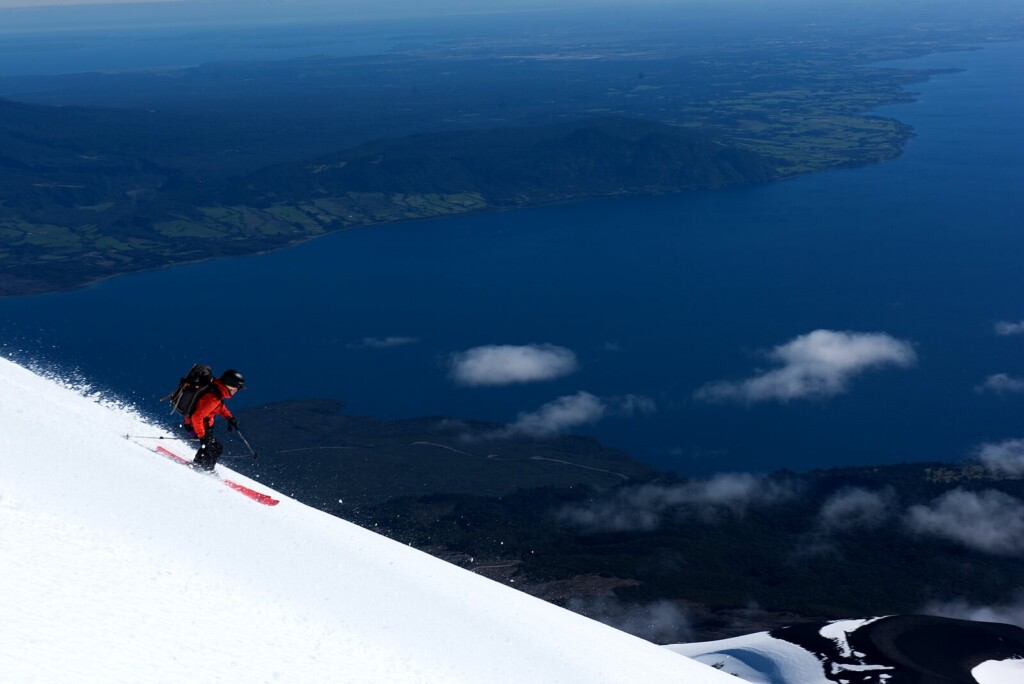
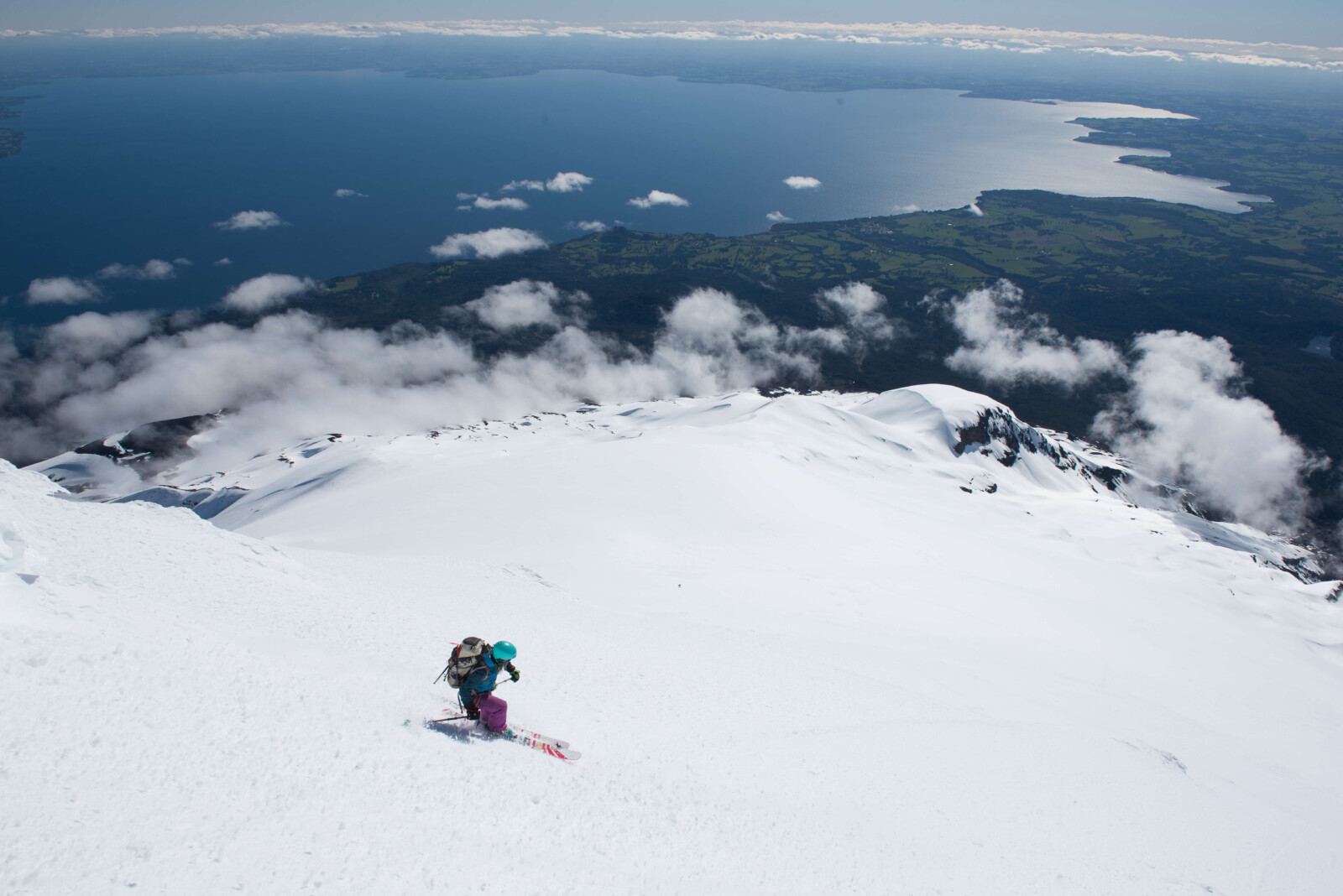
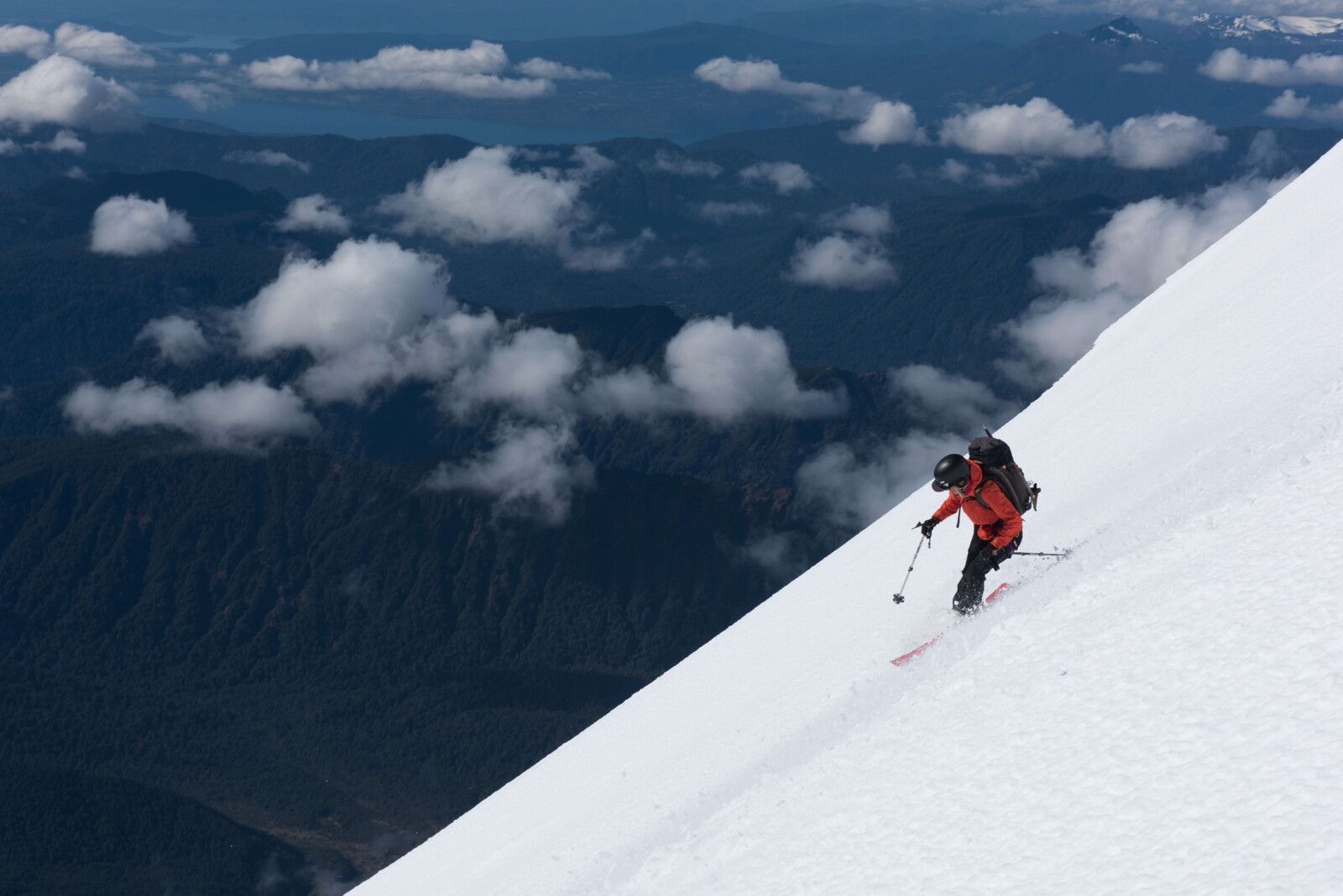
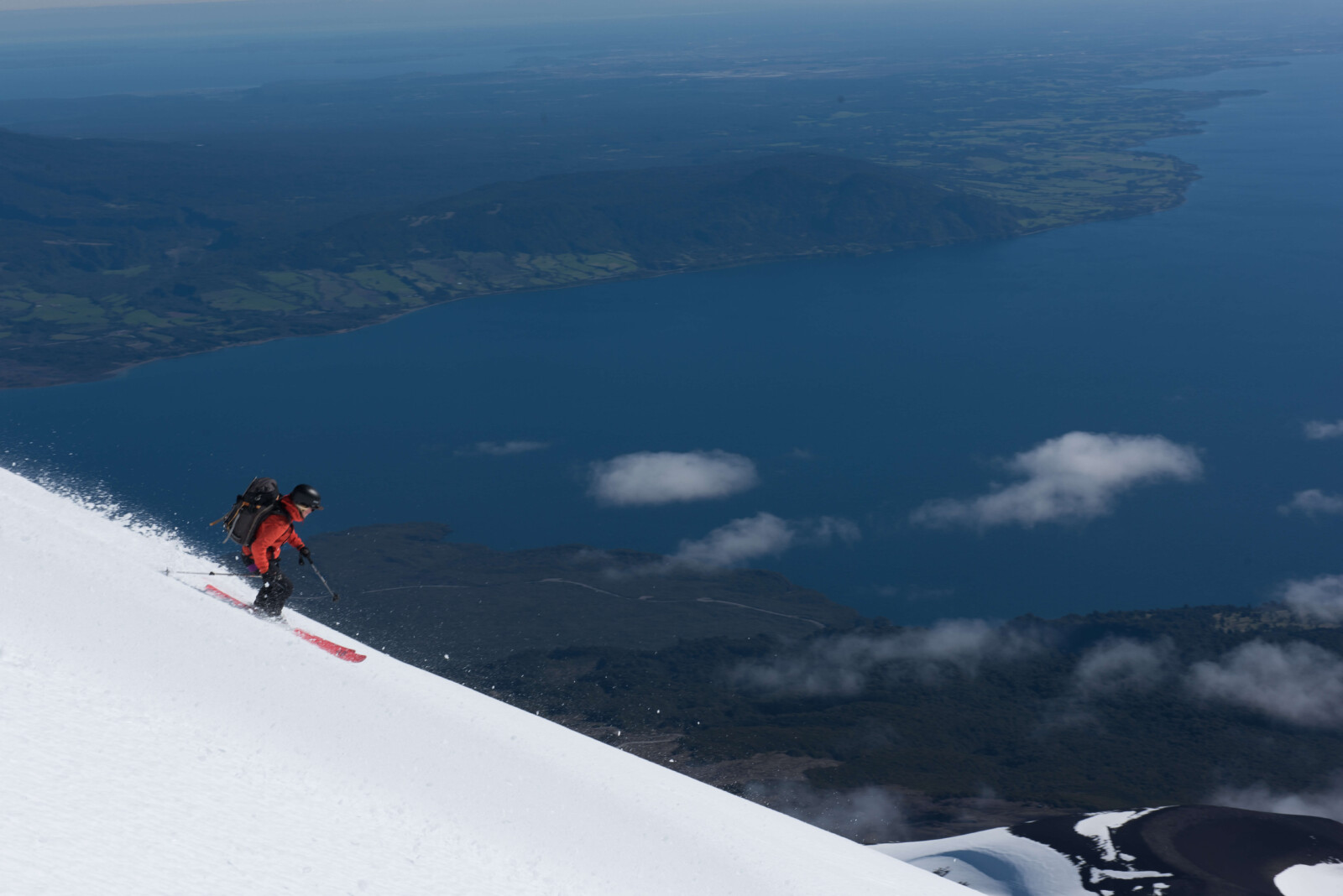
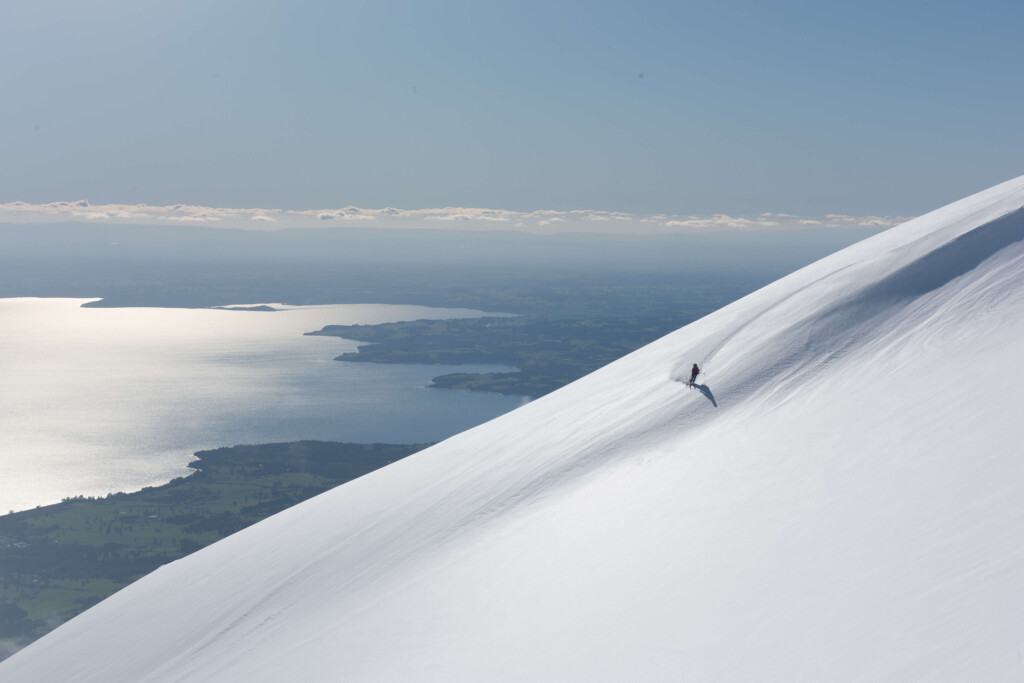
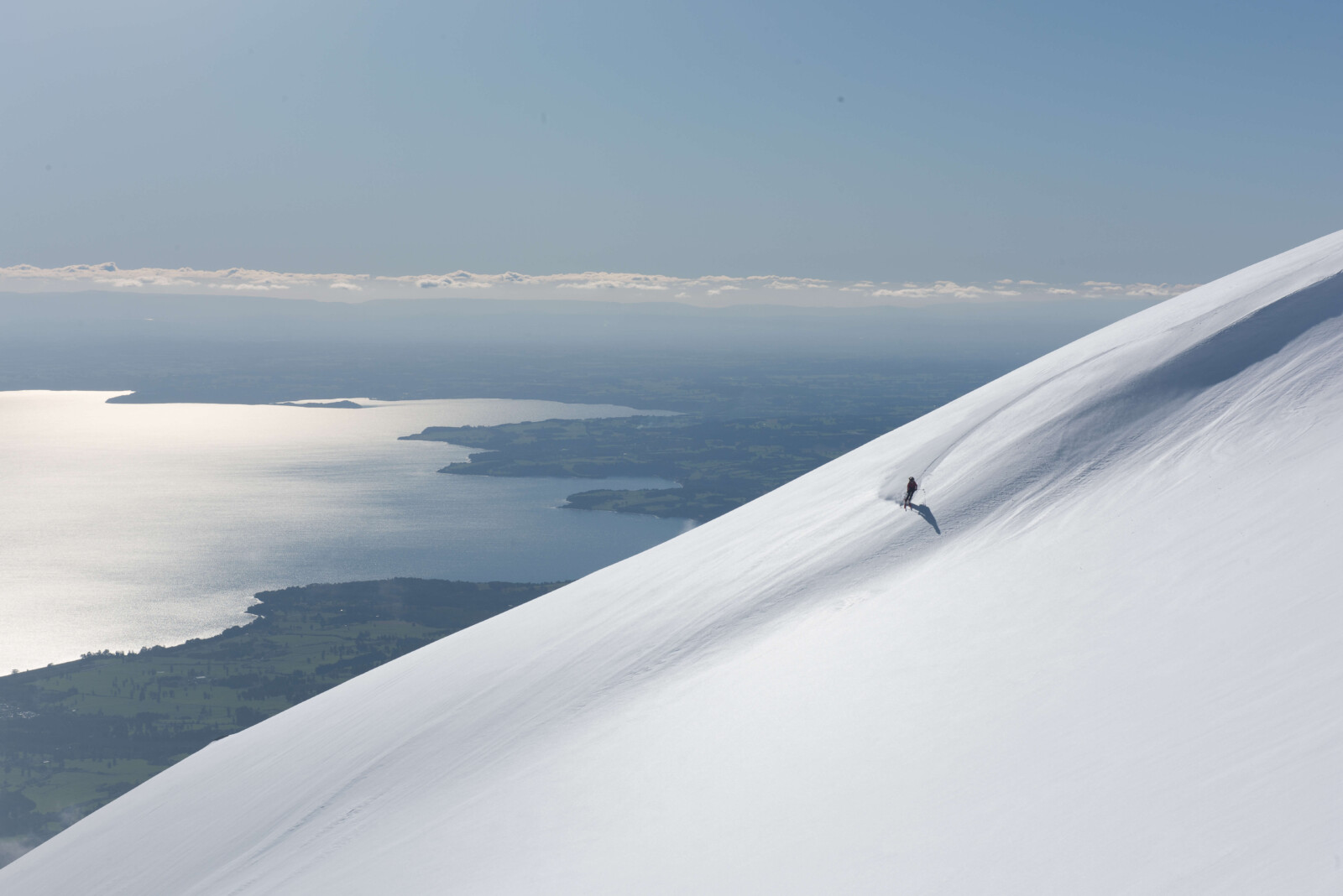
Skier descending a volcano above a lake in northern Patagonia, Chile

Four Volcano Objectives

Volcán Lonquimay: 9,400 ft / 2,865 m. The opening objective. When Corralco Ski Resort is operating, lift access lets us gain elevation efficiently before we transition to touring across Lonquimay’s broad upper slopes. Smooth corn and wide volcanic terrain set the tone for the week.

Volcán Llaima: 10,255 ft / 3,125 m. The giant of the region, rising above the old lava fields, araucaria forests and glacier-fed lakes of Conguillío National Park. Llaima is usually the biggest performance day of the trip, with more than 5,000 vertical feet of descent available from the summit cone when conditions allow.

Volcán Villarrica: 9,341 ft / 2,847 m. The icon above Pucón, and the objective most affected by conditions outside anyone’s control. Villarrica is an active volcano. When the volcanic alert level, CONAF and park access, and mountain conditions all permit, it offers an ascent toward the upper cone and a long descent across broad volcanic snowfields. Your guides and the current restrictions set the high point. Sometimes that is the summit; sometimes it is not.

Volcán Osorno: 8,701 ft / 2,652 m. The closing objective. Osorno’s symmetrical, glacier-draped cone rises above Lago Llanquihue and is a landmark of the Lake District. Long, sustained descents over glaciated terrain, with views across the southern Andes. Your guides manage the rope work; no glacier experience is required.

What “Four Volcano Objectives” Means

The itinerary is built around four primary volcano objectives. It is not a promise of four summits. Snow, wind, volcanic alert levels, park access and lift operations decide what is possible on any given day, and your guides make that call. We would rather tell you that now than at the trailhead.

We never promise crater access, visible lava, lift operation or perfect weather. What we commit to is putting you on the best terrain available in the conditions we are given.

Why a Small Team: 3:1

Maximum six skiers and splitboarders on the team, at a 3:1 client-to-guide ratio. A full team of six runs two guides.

That is not a marketing line. On volcanic terrain with variable snow, moving weather and technical summit approaches, a small team is a faster team. We make decisions quickly, adjust on the fly and reach lines that a larger group cannot access safely. You will never disappear into the group.

  • Your guides know how you ski or ride: your fitness, your technique, where you are strong and where you need support.
  • They know it before the hard days arrive, not after.
  • Go/no-go and turnaround decisions are made with full knowledge of each person on the team.

Built on Snow, Not Borrowed From Climbing

High-altitude climbing experience does not make someone a ski guide. Ski mountaineering is its own discipline: snowpack assessment, avalanche terrain management and the judgment to know when a slope that looks perfect is not.

Benegas Brothers Expeditions guides on skis year-round. Winters in the Wasatch backcountry in Utah, spring in the Andes. That is where our ski-specific judgment is built and kept current.

The credentials behind this program are ski credentials:

  • AMGA Ski Mountaineering Guide certification: the ski-specific standard, separate from and additional to alpine and rock guide certification.
  • AIARE Level III avalanche certification: the professional tier of avalanche education.
  • Ski patrol experience in the Wasatch, including years working avalanche terrain at Snowbird.
  • IFMGA certification: the international standard for professional mountain guides.

Willie Benegas holds all of the above, and BBE’s ski programs are built and run to that standard.

Every departure is led by an IFMGA-certified lead guide. Every guide on this program holds IFMGA, AMGA or the equivalent Chilean national certification.

Eleven Seasons on These Volcanoes

On specific terrain, what matters most is repetition. We have run this program for eleven seasons. We know where the snow sets up, which aspects hold corn and which turn to trap, when Corralco and the Osorno ski area are worth using, and how Villarrica behaves when the alert level moves.

That knowledge is not in a guidebook. It comes from being there, season after season, with a small team.

Safety and Communications

Safety on a real mountain is a system, not a slogan. Every departure of this expedition runs with:

  • An IFMGA-certified lead guide
  • Satellite and radio communications within the team throughout the trip
  • A comprehensive group medical kit on every mountain day
  • Avalanche safety equipment, a beacon check every morning before anyone moves, and a daily conditions assessment
  • Daily checks on every team member’s pace, hydration, appetite and recovery

Mobile service and hotel Wi-Fi are generally reliable in the main towns. Connectivity on mountain days can be limited or unavailable.

Turning around is sometimes the right call. When it is, your guide makes it early and clearly. It is a professional decision, not a failure.

What Is Included

  • Lodging: seven nights in hotels and mountain lodges, double occupancy, no dormitories. Two nights in Malalcahuello, three in Pucón, two in Puerto Varas.
  • Meals: all meals from dinner on Day 1 through breakfast on Day 8, including trail food on mountain days. Only alcohol and personal drinks are on you.
  • Ground transport: all scheduled transfers from Temuco Airport (ZCO) through Puerto Montt Airport (PMC).
  • Access: standard access fees required by the itinerary, plus lift access at Corralco and the Osorno ski area when the lifts are operating and your guides use them.
  • Guiding: professional guiding to the standard above, at 3:1.

Airfare, insurance, personal gear, alcoholic drinks, optional activities and tips are not included. What to Budget For breaks down the full picture.

Who This Expedition Suits

Intermediate-to-advanced skiers and splitboarders with real backcountry experience. You should be comfortable linking controlled turns in variable snow, including short sections to approximately 45 degrees, and around fifteen days of backcountry touring, not resort mileage, is the experience level we look for. It’s a guideline, not a hard minimum: tell us honestly where you are and we’ll talk it through.

Current avalanche training is required: AIARE 1, AST 1 or the recognized national equivalent, with genuine competence on your own beacon, shovel and probe. It is the one certification we ask for.

You do not need a mountaineering background. Ice axe and crampon technique is taught and coached on the trip. You do need the fitness for 4,000 to 5,000 vertical feet on back-to-back days.

For the full requirements and an honest look at how hard this is, read Is This for Me?

Private and Founder-Led Trips

If your team wants its own dates and pacing, the same program runs as a private expedition for up to six skiers and splitboarders, on dates you request. We confirm feasibility for the season and conditions.

On this ski program, founder-led private trips are led by Willie Benegas on request, confirmed in writing in the trip terms. See Private & Custom Expeditions.

We don’t simply guide expeditions. We help people build a lifetime in the mountains.

Ready for the Volcanoes?

Tell us where you have toured, what your avalanche training is, how you train and what you want this week to be. If this is the right trip, we will say so. If something else should come first, we will say that too. See dates & prices → · climbing@benegasbrothers.com · benegasbrothers.com
Ask a guide

Day by Day

Patagonia Volcanoes Ski Expedition · 8 Days · Temuco to Puerto Montt

Eight days, four volcano objectives and three towns, moving south through northern Patagonia from Temuco to Puerto Montt. Four mountain days, one deliberate recovery day and two travel days. The schedule is a plan; the mountain is the reality.

Duration: 8 days / 7 nights, Temuco (ZCO) to Puerto Montt (PMC)

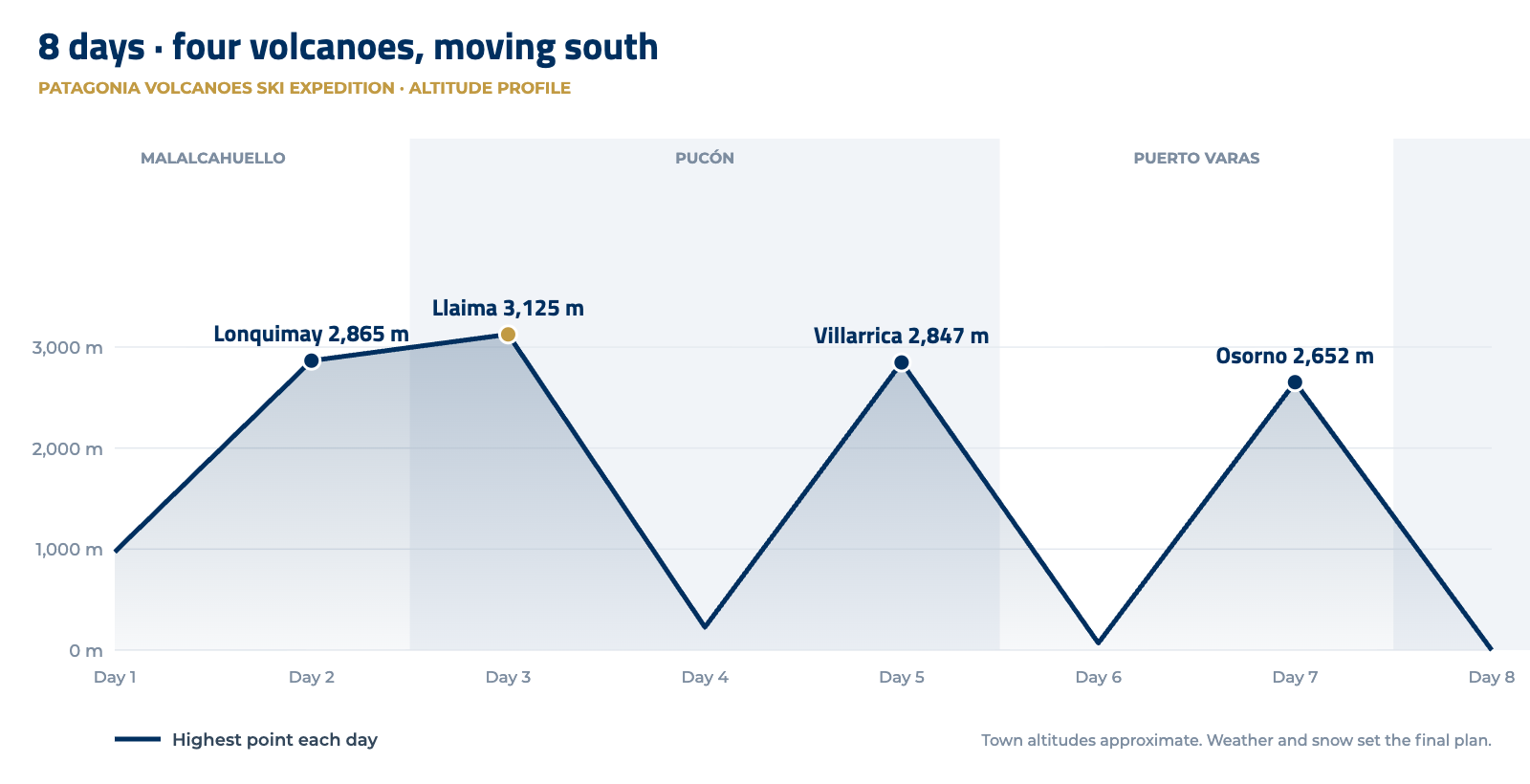
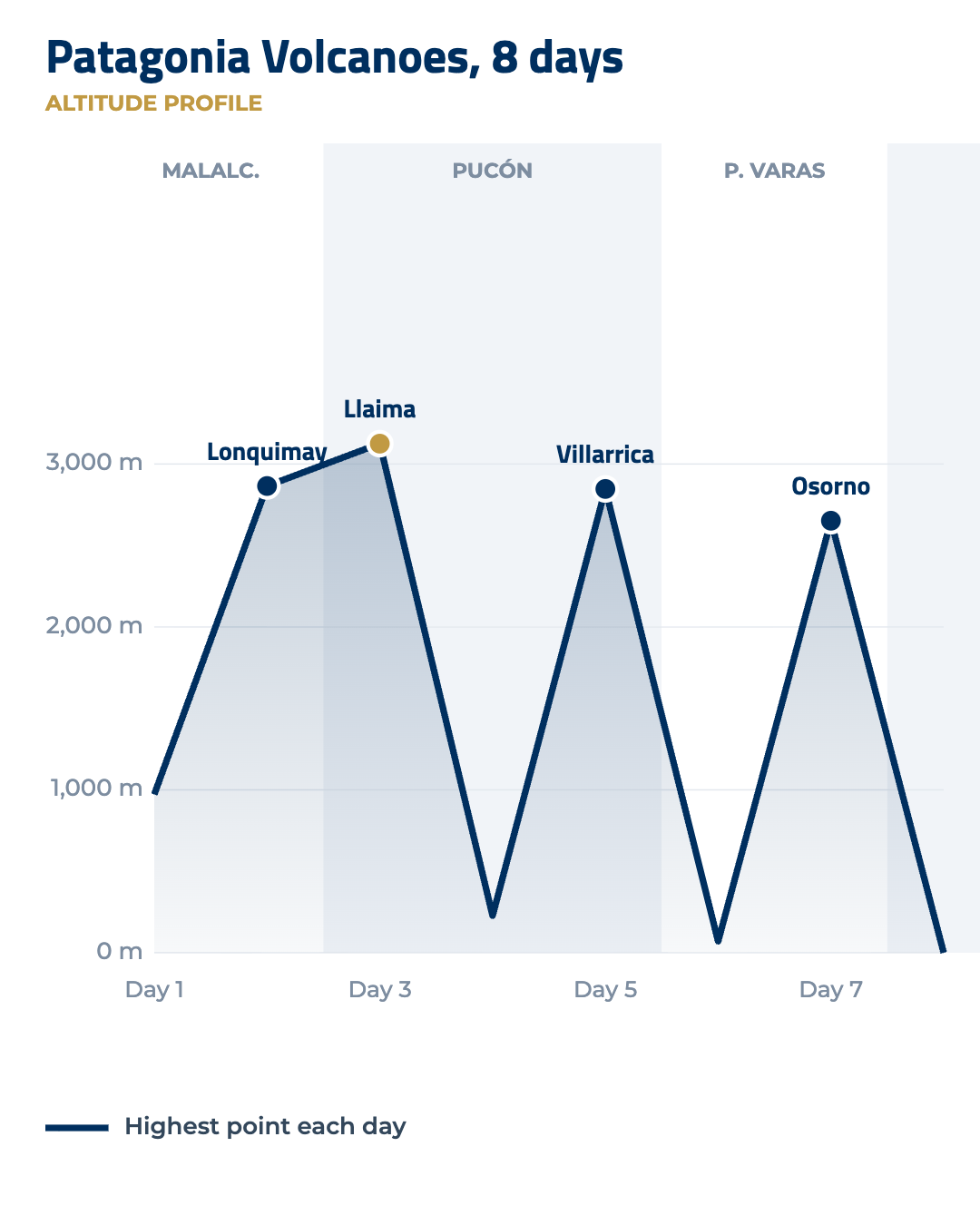
Objectives: Lonquimay 9,400 ft / 2,865 m · Llaima 10,255 ft / 3,125 m · Villarrica 9,341 ft / 2,847 m · Osorno 8,701 ft / 2,652 m

Nights: 2 in Malalcahuello, 3 in Pucón, 2 in Puerto Varas, all in hotels and lodges

Meals: all included, dinner on Day 1 through breakfast on Day 8

Good to know

This is a planning framework, not a promise of four summits.

Weather, wind, snowpack, volcanic activity, park access, lift operations and how the team is moving all shape what happens on any given day. Your guides make those calls in the field, using current information, and they will change the plan when changing it is the right decision.

What follows is how a strong week typically unfolds. Read it to understand the rhythm and the physical demand. Do not read it as a schedule we are locked into. Drive distances and vertical figures are approximate.

Altitude profile of the 8-day Patagonia Volcanoes Ski Expedition: Lonquimay 2,865 m, Llaima 3,125 m, Villarrica 2,847 m and Osorno 2,652 m, with nights in Malalcahuello, Pucón and Puerto VarasAltitude profile of the 8-day Patagonia Volcanoes Ski Expedition: Lonquimay 2,865 m, Llaima 3,125 m, Villarrica 2,847 m and Osorno 2,652 m, with nights in Malalcahuello, Pucón and Puerto Varas
Elevations of the four volcano objectives; town altitudes are approximate.

The 8 Days at a Glance

Each row shows where you sleep that night. ▲ marks the volcano you ski that day. Tap a day to open it.

In each day below, altitude reads start → high point → where you sleep. Distances and hiking times are estimates.

Climb high, sleep low

Some days climb well above where you sleep. The gap between the day’s high point and the night’s camp is how your body adapts.

Times are estimates

Hiking times change with the team and the conditions. A slow, steady pace is the plan, not a problem.

The plan can flex

Weather, how the team is acclimatizing and your guides’ judgment can change the daily plan. That flexibility is part of the plan.

The trip moves. You sleep in three different towns. This is a road trip built around objectives, not a lodge program, so bags get packed and repacked. That is the trade for skiing four distinct volcanoes instead of one zone all week.

The recovery day is not filler. Day 4 exists because Days 2, 3, 5 and 7 are hard. Skipping recovery is how people ski badly on the back half of a trip.

All meals are included, from dinner on Day 1 through breakfast on Day 8, including trail food on mountain days. Only alcohol and personal drinks are on you.

This itinerary works for skiers and splitboarders alike.

Drive: Temuco to Malalcahuello, approximately 56 miles / 90 km, about 1.5 hours

Arrive at Temuco Airport (ZCO), where our team meets you for the transfer to Malalcahuello: a quiet mountain village beneath the volcanoes of the Araucanía region, and the launch point for the expedition.

After check-in, we run a full gear review. This is not a formality. Every item gets looked at: skis or splitboard, skins, boots, bindings, beacon, shovel, probe, layers, and the axe and crampons you will carry on summit days. We check that your beacon works, that your skins still stick, and that nothing critical got left at home or lost in transit. If something needs replacing, Malalcahuello and Pucón have options, and it is far better to find out now.

We then cover current mountain and snow conditions, walk through the plan for the coming days, and finish with a trip briefing over dinner. Your guides will explain how decisions get made on this trip and what they need from you.

We coordinate your Day 1 flight into Temuco so the whole team arrives together for the group transfer; send us your proposed flights before you book. Most clients route through Santiago (SCL) and take a morning domestic flight south. See Flights & Getting to Temuco.

Sleep: Malalcahuello

Vertical: approximately 4,000–5,000 ft / 1,220–1,520 m

The opening objective, and a deliberate one. Lonquimay’s wide, forgiving volcanic terrain lets your guides watch how each person moves before the bigger days arrive. It is also where axe and crampon technique gets taught and drilled if anyone on the team is new to it.

When Corralco Ski Resort is operating and access is appropriate, we use the lifts to gain elevation efficiently, then transition to skins for the climb onto Lonquimay’s upper slopes. When the lifts are not running, your guides choose the best available approach for the conditions.

The northeast face offers sustained volcanic terrain: wide, open and consistent, with short sections reaching approximately 45 degrees. On a clear day you can pick out several volcanoes from the upper mountain, and the araucaria forests below are unlike anything in North American ski terrain.

Typical day: early breakfast, on snow in the morning, back to the village by late afternoon.

An optional evening soak at local mineral hot springs, at your own cost, is good preparation for Day 3.

Sleep: Malalcahuello

Vertical: approximately 5,000+ ft / 1,520+ m · Drive after skiing: Llaima to Pucón, approximately 75 miles / 120 km, about 2 hours

The biggest day of the week, and an early departure to match.

Llaima rises above Conguillío National Park: old lava fields, glacier-fed lakes and araucaria forest. It is the highest and most demanding objective on the itinerary, and when conditions and access line up it delivers the strongest ski mountaineering of the trip.

Expect a long approach, a sustained climb, and more than 5,000 vertical feet of descent available from the summit cone. This is the day your training pays for itself. Arrive fit and it is an excellent day. Arrive undertrained and it is a very long one.

After skiing, we load up and transfer south to Pucón.

Sleep: Pucón

Vertical: none scheduled

A built-in recovery day, placed deliberately after the hardest objective and before the most conditions-dependent one.

Pucón sits on the shore of Lago Villarrica, with Villarrica’s cone rising directly above town. It is a real town with good coffee, good food and gear shops if something needs replacing before the second half of the trip.

Options for the day: rest at the hotel, walk the lakefront, visit one of the hot springs in the forests around Pucón, such as Termas Geométricas, or arrange an optional activity at your own cost. Your guides will use part of the day to review conditions and the forecast for Villarrica and to brief the team on the plan.

Meals are included today as on every other day. Pucón has good restaurants, though, and if you would rather find your own lunch or dinner, do it. No one will mind.

The rhythm of this expedition is intentional. Push hard, recover properly, push again. Four consecutive hard days would produce worse skiing and worse decisions than three hard days with a break in the middle.

Sleep: Pucón

Vertical: approximately 5,380 ft / 1,640 m, when access permits

A signature objective, and the one most subject to forces outside anyone’s control.

Villarrica is an active volcano. Access to the upper cone depends on the current volcanic alert level, on CONAF and park authority regulations, and on mountain conditions on the day. When all three permit, we climb the north side toward the upper cone and ski broad volcanic snowfields back toward the valley: a long, open descent with the lake below you the whole way.

When they do not, your guides set a different high point or a different objective. That decision is not negotiable, and it is not a failure of the trip. Villarrica has been restricted or closed in multiple recent seasons. Come with that understood.

Early start regardless. Firm morning snow means axe and crampons on the upper sections, and it means the descent is timed to the corn cycle rather than to our preferences.

Sleep: Pucón

Drive: Pucón to Puerto Varas, approximately 211 miles / 340 km, about 4 hours with stops

The longest drive of the trip, and a good day.

We move south through the heart of Chile’s Lake District toward Puerto Varas: farmland, dense native forest and the shores of glacier-fed lakes, with Calbuco and Osorno growing on the horizon. Puerto Varas is a German-settled town on Lago Llanquihue, with Osorno’s cone framed across the water.

In practice this is a second rest day. Legs recover in the vehicle, and the team arrives fresh for the final objective.

Sleep: Puerto Varas

Vertical: approximately 3,500+ ft / 1,070+ m · Drive to the mountain: Puerto Varas to the Osorno ski area, approximately 37 miles / 60 km, about 1 hour

The closing objective.

Osorno’s symmetrical glaciated cone rises directly above Lago Llanquihue, with Lago Todos los Santos on the far side. When the ski area is operating, lift access can shorten the lower approach before we transition to touring. When it is not, we adapt the objective and the ascent plan.

The skiing is a sustained descent over glaciated terrain, with views across the southern Andes. Glacier travel protocols apply: your guides manage rope work and crevasse hazard and brief the team before we move onto the ice. No prior glacier experience is required.

Shorter than Llaima, but the terrain and the setting make it many people’s favorite day of the trip.

Sleep: Puerto Varas

Drive: Puerto Varas to Puerto Montt airport, approximately 12 miles / 20 km, about 25 minutes

Breakfast, then the transfer to El Tepual International Airport (PMC) in Puerto Montt for departure flights.

Book an afternoon flight out of Puerto Montt, leaving enough time to connect in Santiago to your international flight home. Send us your proposed flights before you book; your guides confirm timings with you during the trip.

The Route, End to End

Roughly 430 miles / 690 km of driving south through the Chilean Andes, from Temuco to Puerto Montt. Three towns, two national parks and four volcano objectives.

Four mountain days. One recovery day. Roughly 18,000 vertical feet / 5,500 m of skiing across the week when all four objectives come together.

What a Mountain Day Looks Like

Mountain days follow a consistent shape. Early breakfast, drive or lift to the trailhead, beacon check before anyone moves, then skin up at a managed pace with your guides setting the track. Transitions are drilled and efficient, because a slow team loses the snow window. Ski or ride down when the aspect and the timing are right, not when the group is impatient.

Spring corn skiing is a timing sport. Too early and you are on boilerplate. Too late and it is mush, with wet-slide hazard. A large part of what your guides are doing all week is putting you on the right aspect at the right hour.

For the full picture of a day, including start times, meals, weather and how the go/no-go call gets made, see Life on the Expedition. For how hard each day feels, read Is This for Me? For hotels and lodges, see Where You’ll Stay.

Weather and Flexibility

The order of the objectives can change. When the forecast, the snow or access favors a different sequence, your guides will rework the plan. Changing the order is part of the plan, not a departure from it.

Snow, wind and volcanic activity can close an objective on the day. When that happens, your guides find the best available alternative. Eleven seasons on these volcanoes means we usually know where it is.

No one can promise a summit. Our responsibility is to give the team the strongest responsible opportunity on the best terrain available.

Questions About the Itinerary?

Questions About the Itinerary?

Tell us how you tour, how you train and which days look hardest to you. A guide will walk you through it. See dates & prices → · climbing@benegasbrothers.com · benegasbrothers.com
Ask a guide

Is This for Me?

Patagonia Volcanoes Ski Expedition · An Honest Answer, Not a Sales Pitch

This is an intermediate-to-advanced ski mountaineering expedition. Here that means backcountry touring, summit ascents and long descents on four volcanoes in northern Patagonia, in a remote and changeable mountain environment, on back-to-back hard days.

This expedition works for skiers and splitboarders.

This page is written to help you make an honest call about whether you are ready. We would rather you decide now than find out on Day 3 that the trip is beyond you. If you are not there yet, the last sections tell you what to do about it.

The Patagonia Volcanoes at a Glance

Ski and ride abilityintermediate to advanced. Controlled turns in variable snow, with short sections to approximately 45 degrees
Touring experiencearound fifteen days of backcountry touring, as a guideline rather than a hard minimum
Required certificationcurrent avalanche training (AIARE 1, AST 1 or a recognized national equivalent). The only one
Mountaineering skillsnot required. Axe and crampon technique is taught on the trip
Summit days4,000 to 5,000 vertical feet of climbing, on back-to-back days
Elevationsapproximately 8,700 to 10,255 ft / 2,650 to 3,125 m
Coldest conditions14°F to 32°F / −10°C to 0°C on summit days, colder in the wind
Training time3–5 months, structured
FamiliesWelcome
Team sizemaximum six skiers and splitboarders, 3:1 client-to-guide ratio

The Short Version

You are ready for this trip if you can ski or ride slopes up to around 45 degrees in variable snow with control, you have around fifteen days of real backcountry touring behind you, you hold current avalanche training, and you are fit enough to climb 4,000 to 5,000 vertical feet and then descend well, day after day.

Notice what is not on that list: a mountaineering background. We teach that part.

Skiing and Riding Ability

This is not a groomed run. The volcanoes ask for real skiing and riding: variable snow, steep terrain, and conditions that change through the day as the sun works on the slope.

Most of the terrain is moderate and open. Some sections steepen to around 45 degrees, usually short pitches rather than sustained faces. You need to be able to link controlled turns there without hesitation, in whatever snow the mountain gives you.

Morning starts mean firm, icy volcanic snow before the sun hits. Afternoons can mean heavy, wet, grabby snow. Anyone confident only in soft snow will have a hard week.

Sidecountry and slackcountry laps do not prepare you for this. Neither does expert-level resort skiing or riding, however good you are inbounds. The difference is consequence: a fall in the wrong place on a volcanic slope does not stop where a fall on a groomer stops.

Touring Experience

Around fifteen days of backcountry touring is the experience level we look for, including recent time in variable snow and on steep terrain. It’s a guideline, not a hard minimum: tell us honestly where you are and we’ll talk it through.

That means real touring. Skinning uphill with a pack. Efficient transitions. Skiing or riding terrain with consequence. If you have toured in the Cascades, the Rockies, the Wasatch, Alaska, the Alps or similar, you are likely in the right place.

You should also be comfortable with:

  • Skinning a set track at a steady pace for several hours
  • Transitioning quickly without holding the team up
  • Managing your own layering, hydration and fuel across a long day
  • Taking direction from a guide in terrain where the direction matters
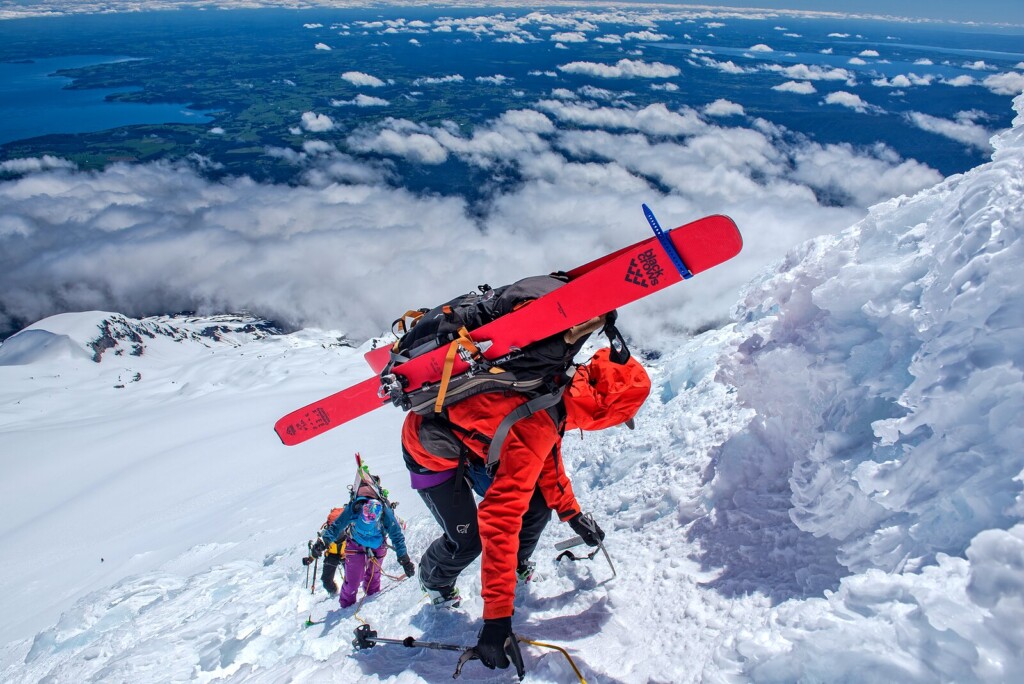
Ski mountaineers bootpacking a volcano in northern Patagonia, Chile

The One Hard Prerequisite: Avalanche Training

Avalanche training is the skill we cannot teach you here. AIARE 1, AST 1 or the recognized equivalent in your country, plus real competence with your own beacon, shovel and probe. You bring all three.

You will be moving through avalanche terrain in a range you do not know, in a snowpack that behaves differently from the one at home. Your guides make the terrain and timing calls, but every member of a team is part of that team’s safety system.

Be able to run a companion rescue under pressure, with cold hands, without thinking about which button does what. We run a beacon check every morning before anyone moves.

If your certification is several seasons old and you have not practiced since, take a refresher before you come. If you are unsure whether your training qualifies, ask us. We will tell you straight.

Snow Climbing Skills: We Teach These

You do not need a mountaineering background to join this expedition.

Ice axe and crampon technique is taught and coached on the trip: self-arrest, moving confidently on firm snow, walking a bootpack. Your guides cover it before it matters, and these volcanoes give us good terrain to learn on.

What we ask instead: tell us at booking if you have never worn crampons, so your guides can plan the early days around it. Prior experience means you will get more out of the harder days, but it is not a barrier to joining.

On Osorno’s glacier, your guides manage rope work and crevasse hazard. You follow their system. No glacier experience is required.

Fitness: Can You Do These?

Excellent physical condition is a requirement, not a suggestion.

Expect summit days of 4,000 to 5,000 vertical feet of climbing, on back-to-back hard days, with long hours moving in cold, demanding terrain. Llaima and Villarrica can run past 5,000 feet when conditions allow. Across the week, that adds up to roughly 18,000 vertical feet when all four objectives come together.

Use these as an honest self-check, not a pass/fail test:

  • Climb 4,000 to 5,000 vertical feet in a day with a pack, then ski or ride down well. The descent is the part that matters.
  • Do it again the next day. Days 2 and 3 are back to back, and Day 3 is the biggest of the week.
  • Hold a steady skinning pace for several hours without needing the team to wait.

Fitness is not just about finishing. A fit team gives the guides more options: more terrain in play, more flexibility to move when the snow window opens. A tired one narrows the whole team’s day.

Altitude

The volcanoes run from approximately 8,700 to 10,255 feet. That is moderate by mountaineering standards, but high enough to affect performance if you arrive from sea level unprepared.

Summit days mean sustained hard output at elevation. Most healthy, fit people adapt well across the progressive structure of the itinerary. No pre-acclimatization program is required.

Team Size and Guide Decisions

Maximum six skiers and splitboarders, at a 3:1 client-to-guide ratio. A full team of six runs two guides.

Small teams move faster, make decisions faster and reach terrain a larger group cannot access safely. It also means your guides know how you ski or ride, where you are strong and where you need support, before the hard days arrive.

Your guides make the calls that shape the week: which objective, which aspect, what time, and when to turn around. When a turnaround is the right call, it is made early and clearly. It is a professional decision, not a failure, and this expedition only works if you are willing to accept it.

What You Are Signing Up For, and What You Are Not

Four volcano objectives is a plan, not a guarantee. Volcanic alert levels, park access, lift operations, weather and snowpack all decide what is possible on any given day, and your guides make that call.

Villarrica in particular has been restricted or closed to the upper cone in multiple recent seasons. It may be fully available on your departure. It may not.

If four summits is the only outcome that would make the trip worthwhile to you, this is not the right program. No one can honestly guarantee it. What we commit to is putting you on the best terrain available in the conditions we are given.

Is This the Right Trip for You?

This trip is a good fit if:

  • You can say yes to the touring, avalanche and ability requirements above.
  • You will commit to three to five months of structured training.
  • You are comfortable with early starts, firm morning snow and long days.
  • You are happy on a road trip that moves through three towns.
  • You are coachable, and you will accept a guide’s objective, timing and turnaround calls.

This trip is probably not for you if:

  • You are new to backcountry touring, or your touring days are mostly mellow low-angle laps
  • You do not hold avalanche training, or yours is old and unpracticed
  • You are not currently training and cannot start three months out
  • You want a lodge-based trip with one base; this one moves through three towns
  • You need a guaranteed summit to feel the trip was worth it

None of that is a permanent verdict. Most of it is a timing problem.

Two more things to be clear about before you book:

  • Health. No medical certificate is required. If you have a heart, lung or other medical condition, talk to your physician about hard exercise at altitude before you commit.
  • Age. The minimum age is set by Chile’s and Argentina’s regulations and by insurance: skiers and splitboarders under 18 climb with a parent or guardian, and each skier or splitboarder’s insurance must cover their age. Families are welcome: younger skiers and splitboarders can join a scheduled team with a parent or guardian, or come on a private family expedition built around your family, and if a special permit is needed, we’ll help you apply.

How to Prepare

Train seriously for at least three to five months before departure. Structured work, not just general activity:

  • Uphill cardio with a loaded pack, several sessions a week
  • Leg and core strength
  • Back-to-back endurance days, so your second hard day is as good as your first
  • Time on skis or your splitboard, if your season allows it
  • A beacon practice session before you fly

Responsible Stewardship

We approach Chile’s volcanic landscapes with respect for the mountains, the environment and the Mapuche communities who have lived with this land for centuries. Villarrica, Rukapillán in Mapudungun (the house of the great spirit), and the surrounding peaks are sacred ground. We do not treat that as a footnote.

We leave every zone cleaner than we found it. We manage expedition waste carefully, operate within national park regulations and hold our teams to a high standard of conduct in the field.

Not Ready Yet? Here Is the Path

Contact us anyway. We will review your background honestly and tell you either that you are ready or exactly what is missing. For most people who are close but not there, the gap is one of three things:

  • Touring days. Build toward fifteen. Our Wasatch backcountry program is a direct way to add real touring days with BBE guides.
  • Avalanche training. Take an AIARE 1 or the equivalent where you live. It is a two-to-three-day course, and it makes you a better partner everywhere, not just here.
  • Fitness. Three to five months of structured training closes this gap more reliably than anything else on the list.

If the fit is wrong for other reasons, there are good alternatives:

Still Deciding?

With a maximum of six skiers and splitboarders per departure, we have time for a real conversation before you book. Tell us where you have toured, what your avalanche training is and how you train. We will give you an honest assessment. If something else should come first, we will tell you that too. See dates & prices → · climbing@benegasbrothers.com · benegasbrothers.com
Ask a guide

Before You Go

Patagonia Volcanoes Ski Expedition · Before You Go

Preparing for the Patagonia Volcanoes Ski Expedition: Start Here

The skiers and splitboarders who land in Temuco relaxed aren’t always the strongest on the skin track. They’re the ones who sorted their avalanche course, their rescue cover and their flights months ago, and who fitted their crampons to their boots at home. This page puts your preparation in order: what to do, when, and where to find the details.

A question answered in June is worth more than the same question asked in the parking lot at Malalcahuello. If anything here is unclear, ask a guide.

Three Things to Know Now

Current avalanche training is required.Required

AIARE 1, AST 1 or a recognized national equivalent is the one certification we ask for, and we don’t waive it. Ice axe and crampon technique is taught on the trip. If you don’t hold a certificate yet, book a course this season; courses fill. Is This for Me? sets out the rest, including the touring experience we look for (around fifteen days of backcountry touring, as a guideline) and the fitness for 4,000–5,000 vertical feet on back-to-back days.

Rescue and evacuation coverage is required.Required

It must cover backcountry skiing, splitboarding and ski mountaineering at this trip’s elevations, helicopter rescue and international medical transport, and it must be in place before you leave home. We recommend Global Rescue or Ripcord.

You fly into one airport and out of another.Two airports

The expedition starts in Temuco (ZCO) on Day 1 and finishes in Puerto Montt (PMC) on Day 8, with a road trip south between them. Don’t book a round trip into Temuco.

Your Seven Preparation Guides

Your Preparation Timeline

When you book

  • Through the registration link we email you, complete the reservation form and pay your deposit by the invoice we send; then complete the Registration Form (profile, emergency contacts, medical history, ski or ride background and avalanche training), passport copy, Terms & Conditions and Release
  • Check your passport: valid at least six months beyond your return date
  • No avalanche certificate yet? Sign up for a course this season
  • Tell us about dietary needs and medical conditions, whether you’ve used crampons before, and whether you’d like a single room
  • Read the gear list now, and give boots, skins, bindings and crampons time to be tested together

Any time before departure

  • Arrange your rescue and evacuation coverage and email us the certificate. It must be in place before you leave home
  • Travel insurance is strongly recommended. If you want cancellation cover, check your insurer’s purchase window: some benefits are only available soon after your first payment

3–5 months before

  • Train: sustained uphill efforts with a pack, three to four times a week, building toward roughly 3,300 ft / 1,000 m of climbing followed by a strong descent
  • Take your avalanche course if you haven’t already
  • Audit your gear honestly. Boots that hurt after four hours at home will end your trip on Day 3. If you need new boots, buy them now and put days on them

120 days before departure

  • Your balance is due. (If you book within 120 days, full payment is due at booking.)

Once you’ve paid in full

  • Send us your proposed flights, then book them: Santiago (SCL) to Temuco (ZCO) at the start, Puerto Montt (PMC) to Santiago at the end. Email your final itinerary to climbing@benegasbrothers.com. We coordinate the Day 1 arrival so the whole team lands in Temuco together; on Day 8, book an afternoon flight out of Puerto Montt with enough time to connect in Santiago to your international flight home

6–8 weeks before

  • Work through the gear list. Replace worn skins, check your beacon’s batteries and firmware, and service your bindings
  • Ski or ride in your full kit, with the pack you’ll carry and the boots you’ll bring
  • Practise a full companion rescue: beacon search, probe, shovel

At least 3 weeks before

  • Tell us if you need to arrange an ice axe or crampons locally

The final 2 weeks

  • Save copies of your passport, rescue certificate, any travel insurance policy and flight details to your phone and the cloud, and carry a paper set
  • Tell your bank you’re traveling to Chile
  • Download the forecast apps your guides use: Windy, Mountain-Forecast and Meteoblue
  • Pack your ski or snowboard boots and your beacon in your carry-on
  • Buy the snacks you personally rely on, in modest quantity, and check them against Chile’s customs rules

Arrival day

Land in Temuco, where our team meets you for the transfer to Malalcahuello. Withdraw Chilean pesos in Temuco; Malalcahuello is small, so don’t count on an ATM there. Before dinner, your guides run a full gear and beacon check. Bring everything: this is the point where a problem can still be solved. Then dinner, a briefing for Day 2, and sleep. From then on, logistics are our job. Yours is skiing.

Still Deciding?

This section assumes you’re coming. If you’re still working out whether your touring days, avalanche training and fitness are where they need to be, start with Is This for Me? and Your Questions, or read The Ski Expedition for what the trip is and why we run it this way. If this trip isn’t the right fit yet, the Ecuador Mountaineering School builds mountaineering skills, and Mexico Volcanoes is worth a look. For your own dates or your own team, see Private & Custom Expeditions.

Questions While You Prepare?

Avalanche courses, ski width, crampon fit, insurance fine print, flight timing: ask early. Small questions are easiest to solve months out. See dates & prices → · climbing@benegasbrothers.com · benegasbrothers.com
Ask a guide

Your Expedition Checklist

The skiers and splitboarders who arrive in Temuco relaxed are the ones who handled the paperwork months ago, not weeks. None of it is complicated, but a few pieces take time, and one of them, your avalanche certificate, can’t be fixed once you’ve landed. This page lists everything BBE needs from you, what you need to arrange yourself, and when.

Your Paperwork at a Glance

Everything BBE needs from you, in the order you’ll do it. Tick items off as you go; your ticks are saved on this device. The details for each item are below.

Step 1At booking, in the registration formDone together with your deposit

Step 2Buy, then send to BBEEmail climbing@benegasbrothers.com

Step 3Arrange and carryNeeded on the trip

At Booking

How booking works. When you ask about the expedition, we reply by email with the trip details and a link to our online registration form. Everything in this section is done there.

Reservation form. Your full name, email, date of birth and address, plus any notes for our program staff about your reservation.

Deposit. The reservation form includes a link to pay your deposit. Your place is confirmed once BBE receives it. Amounts and deadlines are on Dates & Prices.

Complete at Booking

Registration Form. Your personal profile, emergency contacts, medical history, ski or ride background, touring days and avalanche training, and whether you’ve used crampons before. Medical information stays within the guiding team and is used to plan for your safety. Be thorough and honest about your health and your experience. It tells your guides what they need to know before the first skin track.

Passport. A copy of your passport photo page.

Terms & Conditions. BBE’s booking, payment and cancellation terms. Read them before you sign.

Release. A liability release acknowledging the inherent risks of backcountry skiing, splitboarding and ski mountaineering. Read it carefully. It means what it says.

When: complete these in the registration form at booking, with your deposit.

Send us later. As soon as you have them, email climbing@benegasbrothers.com your flight itinerary (we use it to plan your pickup in Temuco), your rescue and evacuation certificate, and your avalanche training certificate or course details. Rescue and evacuation cover is required on this expedition. You can buy it any time, but it must be in place before departure. Travel insurance is strongly recommended, not required. See Trip Insurance & Evacuation Coverage.

Balance payment. Due 120 days before departure. If you book within 120 days of departure, full payment is due at booking.

Avalanche Training: The One Certification

Current avalanche training is required: AIARE 1, AST 1 or a recognized equivalent in your country. It’s the only certification we ask for, and we don’t waive it. Send us your certificate or course details before the expedition.

If you don’t hold one yet, book a course this season and tell us early. There’s usually time. Ice axe and crampon technique is taught on the trip, so you don’t need a mountaineering background. The touring and fitness standard is on Is This for Me?

Park Access Fees: Who Does What

BBE handles them, and they’re included. There’s no separate climbing permit for you to arrange. Standard park and mountain access fees required by the itinerary are included in your expedition price, and we pay them in the field.

What isn’t guaranteed is access itself. Villarrica is an active volcano. CONAF and the park authorities can restrict or close the upper cone at short notice, depending on the volcanic alert level. That’s a conditions matter, not a paperwork one, and your guides plan around it.

Entry to Chile

US, Canadian, UK and EU passport holders don’t need a visa for a tourist stay of up to 90 days, far longer than this expedition. If you hold another passport, check your requirements with your foreign affairs office or the Chilean consulate before you book flights.

Keep any entry record or tourist card you’re given on arrival. Chile also enforces an agricultural customs declaration that catches a lot of skiers out with their snacks. Flights & Getting to Temuco has the full details.

Health Preparation

No medical certificate is required. Do fill in the medical section of your Registration Form fully and honestly.

See your physician. If you have any condition that cold, long days of sustained exertion or elevation could affect, discuss this expedition with your physician before you book.

Prescription medications. Bring everything you take, for the full trip plus a few extra days, in your carry-on, in the original labeled containers.

First aid. Bring a small personal kit for blisters and minor aches. The guide team carries a group medical kit.

Gear and Rentals

Read the gear list early. Boots, bindings, skins and crampons need to be tested together at home, and that takes time. Nothing should be used for the first time on a volcano.

Your avalanche kit is your own. Bring your own beacon, shovel and probe, and practise with them before you fly.

Local rental. Limited rental of ice axes and crampons may be available in the region, but stock is thin. If you need to arrange anything locally, tell us at least three weeks before departure. Bring your own skis or splitboard; the right spec is hard to find locally.

Travel

Passport. Valid at least six months beyond your return date. There’s no fix for an expired passport once flights are booked.

Flights. Book once your place is confirmed and you’ve paid in full, and send us your proposed itinerary before you buy. You fly Santiago to Temuco at the start and Puerto Montt to Santiago at the end: not a round trip. We coordinate your Day 1 flight into Temuco so the whole team arrives together for the group transfer to Malalcahuello. On Day 8, book an afternoon flight out of Puerto Montt, with enough time to connect in Santiago to your international flight home. Favor changeable fares.

The Final Two Weeks

  • Do a full pack-out using the gear list, packed the way it will travel
  • Check your crampons still fit your ski or snowboard boots, and your skins still stick
  • Put fresh batteries in your beacon and practise a search
  • Tell your bank you’re traveling to Chile
  • Buy the snacks you rely on, in modest quantity, and check them against Chile’s customs rules
  • Save copies of your passport, rescue certificate, any travel insurance policy and flight itinerary to your phone and a cloud account, and carry paper copies separate from the originals
  • Leave your emergency contact details and our pre-departure information with someone at home

Bring With You to Chile

  • Passport, valid six months beyond your return
  • Printed flight itinerary, with our contact and emergency numbers
  • Rescue and evacuation certificate and your provider’s 24-hour emergency number
  • Travel insurance policy number and emergency contact, if you have a policy
  • Avalanche training certificate or course details
  • Written list of emergency contacts and relevant medical information
  • Prescription medications in their original containers
  • A credit or debit card that works abroad, with your bank told you’re traveling

Arrival Day

Land in Temuco, where our team meets you for the transfer to Malalcahuello, approximately 56 miles / 1.5 hours. Withdraw Chilean pesos in Temuco. Before dinner, your guides go through every item: skis or splitboard, skins, boots, bindings, beacon, shovel, probe, layers, axe and crampons. It’s scheduled on the first evening deliberately, while a problem can still be solved. Then dinner and a briefing for Day 2. From then on, logistics are our job. Yours is skiing.

Questions?

Paperwork is the least interesting and most fixable part of expedition preparation. Ask early. Back to Before You Go → · climbing@benegasbrothers.com · benegasbrothers.com
Ask a guide

Trip Insurance & Evacuation Coverage

This expedition is backcountry skiing and ski mountaineering on four volcanoes, with roped glacier travel on Osorno and summits up to 10,255 ft / 3,125 m on Llaima. Some days put you a long way from a road. Plenty of policies exclude off-piste skiing, splitboarding or anything they call mountaineering, and the exclusion is usually in the fine print. This page explains the two kinds of cover, which one is required, and how to confirm yours before you pay.

Required by BBERescue and evacuation coverage

Required on every BBE international expedition. It pays to get you off the mountain and to proper medical care. The coverage it must include for this trip is listed below.

Strongly recommendedTrip insurance

Protects the money you’ve spent if illness, a family emergency or a travel disruption stops or cuts short your trip.

Rescue and Evacuation Coverage: Required

Every client on this expedition must carry rescue and medical evacuation coverage, with proof on file with BBE before departure. No exceptions. It pays for rescue, emergency transport and medical evacuation if you’re injured or ill in the mountains. Those costs are substantial, and without cover they’re yours, not BBE’s. Your standard health insurance almost certainly won’t cover international mountain rescue.

Your policy must cover all of the following:

  • Activity: backcountry skiing, splitboarding and ski mountaineering, off marked runs and in avalanche terrain, including glacier travel on Osorno. A policy that excludes “off-piste” or “mountaineering” doesn’t work here.
  • Altitude: the elevations on this program, up to at least 10,255 ft / 3,125 m, the summit of Llaima.
  • Helicopter rescue, stated explicitly in the policy.
  • Field rescue: evacuation from remote mountain terrain, not only cover that starts once you reach a hospital.
  • Destination: Chile, for your full travel dates.
  • Medical transport: to an appropriate medical facility, including international medical transport.
  • 24-hour emergency assistance.

Providers we recommend: Global Rescue or Ripcord. Many insurers only act once you’ve reached a hospital. Global Rescue works differently: if you’re injured or ill in the field and can’t get out under your own power, they mobilize rescue teams, helicopters and transport to your location. Coverage depends on the membership you buy, so confirm it meets every point above. Global Rescue and Ripcord both offer travel-insurance products alongside rescue cover; check what each plan includes. Standard Global Rescue membership covers field rescue up to 15,000 ft / 4,600 m, well above this expedition’s highest summit, so the High-Altitude Evacuation Package isn’t needed here. Whichever you choose, confirm the plan covers backcountry skiing and helicopter evacuation to at least 10,255 ft / 3,125 m.

You may use any provider whose policy meets every point above.

Travel Insurance: Strongly Recommended

Travel insurance is separate from rescue cover, and worth having. Look for trip cancellation and interruption, travel delay and missed connections, emergency medical expenses, and baggage loss or delay. Baggage cover matters on a trip where your skis or splitboard fly through Santiago.

Check explicitly that the policy covers backcountry skiing or splitboarding. Many standard travel policies mean resort skiing on marked runs.

BBE’s cancellation terms are based on how much notice you give, and refunds are not given for illness, injury, missed flights, weather, closed park or volcano access, or leaving the expedition early (see Dates & Prices). In many of those situations, travel insurance is the only way to recover your costs.

Rescue cover and travel insurance are often sold separately, and buying one doesn’t give you the other.

When to Buy

Rescue and evacuation coverage: any time before departure, as long as it’s in place before you leave home and we have your certificate. Memberships can take a day or two to issue, so don’t leave it to the airport.

Travel insurance: if you want cancellation cover or a pre-existing-condition waiver, check your insurer’s rule. Those benefits are often only available if you buy within a set window after your first trip payment.

What to Confirm With Your Insurer

Before you buy, give the provider this description:

Copy this for your insurer

“I will take part in a professionally guided backcountry ski and splitboard expedition on four volcanoes in northern Patagonia, Chile. The itinerary includes ski touring and ski mountaineering off marked runs in avalanche terrain, bootpacking with ice axe and crampons, roped glacier travel on Osorno, and summits up to 10,255 ft / 3,125 m.”

Then ask them to confirm in writing:

  • That backcountry skiing, splitboarding and ski mountaineering are covered, with no off-piste or mountaineering exclusion
  • The maximum altitude covered, and that it is at least 3,125 m
  • That helicopter rescue and field rescue are included
  • The coverage limits for evacuation and for medical treatment
  • How to reach their emergency assistance line from Chile, and whether you must call before an evacuation
  • Whether pre-existing conditions are covered, and what the purchase deadline is

If they won’t clearly confirm those points, choose another policy. If you’re unsure, send us what they told you.

What to Send BBE

Email your rescue and evacuation certificate to climbing@benegasbrothers.com as soon as you buy it. It should show the provider, policy or membership number, coverage dates and the 24-hour emergency number. If you buy travel insurance, send that policy number and emergency contact too. Your guide team carries these details in the field. Keep a copy on your phone and a paper copy in your pack.

BBE doesn’t sell insurance and can’t interpret or guarantee an individual policy.

What Evacuation Actually Involves

Rescue on a volcano isn’t like calling emergency services at home. The objectives are big, open and exposed to wind, and some approaches are long.

If a client becomes sick or injured, the guide team assesses the situation and decides on the safest practical response. That can include first aid and stabilization, stopping the day, an assisted descent on skis or on foot, contacting rescue services and your insurer’s assistance line, and arranging transport to medical care. Your guide team carries satellite and radio communications throughout.

Helicopter rescue is never guaranteed. Weather, wind, cloud, landing sites and aircraft availability all limit when a helicopter can fly. Often the first part of an evacuation happens on skis or on foot. Your policy must cover a helicopter for the times one can reach you. Don’t plan around it.

BBE doesn’t control rescue services, aircraft, hospitals or insurance decisions, and a policy doesn’t guarantee that a rescue can happen or that every cost will be paid. What good coverage does is take cost out of the decision and get you to proper care quickly.

Your financial responsibility. Rescue teams, transport providers and hospitals may ask for payment before they act, even when you’re insured. Travel with a credit card with real available credit, and save your policy number, emergency number and claim instructions offline. Any cost your insurance doesn’t pay remains yours.

If You Have to Leave Early

In the event of injury, illness, or a personal emergency, our guide team will assist you in arranging transport out as safety, weather, and logistics allow. Transfers to the nearest airport, Temuco or Puerto Montt depending on where you are on the route, aren’t included in the expedition price, and no refunds are issued for illness, injury, insufficient fitness, personal emergency or voluntary withdrawal. That’s exactly why trip-interruption cover matters. Read your policy before you travel, not after something happens.

Questions About Your Policy?

Send us what your insurer told you, and we’ll tell you if anything looks missing. We can’t approve a policy for you, but we can point out the gaps we see most often. Back to Before You Go → · climbing@benegasbrothers.com · benegasbrothers.com
Ask a guide

Flights & Getting to Temuco

This trip runs point to point. You start in Temuco and finish in Puerto Montt, after roughly 430 miles of driving south through the Chilean Andes, and you never come back to where you started. Booking a round trip into Temuco is the most common and most expensive mistake clients make on this expedition. Read this page before you open a booking site.

Before You Book

A departure is confirmed when we tell you so in writing. Please buy nonrefundable flights only after your departure is confirmed. Book your flights once your place is confirmed and you’ve paid in full. Send us your proposed itinerary before you buy, so we can coordinate the Day 1 arrival, when the whole team lands in Temuco together, and check your Day 8 timing. Favor refundable or changeable fares, and book with your full legal name exactly as it appears in your passport.

The Shape of the Travel

Two separate domestic legs, not a return:

  • Santiago (SCL) to Temuco (ZCO) at the start
  • Puerto Montt (PMC) to Santiago (SCL) at the end

Most airlines sell this as a multi-city or open-jaw booking. It usually costs no more than a return, and it saves you a long backtrack at the end of the week.

Flying to Santiago

Fly into Santiago (SCL), the international gateway for the whole country. Everything else connects through it.

We recommend arriving in Santiago at least one day before the expedition starts. Southern-hemisphere spring brings weather delays, and a missed connection on Day 1 costs you the first volcano. A night in Santiago is cheap insurance against that. Nights before the expedition are at your cost; ask us and we’ll suggest places to stay.

The Domestic Flights

Santiago to Temuco is roughly an hour and a half in the air. Several Chilean carriers fly both domestic routes, schedules change by season, and codeshares are common, so go by the operating carrier shown on your ticket.

Choose the schedule and baggage policy that best protect your connection and your equipment, not just the cheapest fare. A small fare saving is a poor trade for a board bag that arrives two days late.

Day 1: Arriving in Temuco

Our team meets you at Temuco Airport (ZCO) for the group transfer to Malalcahuello, approximately 56 miles / 1.5 hours. Most clients route through Santiago and take a morning domestic flight south. We coordinate your Day 1 flight into Temuco so the whole team arrives together; send us your proposed flights before you book.

Day 8: Flying Home From Puerto Montt

On Day 8 we transfer you from Puerto Varas to El Tepual International Airport (PMC) in Puerto Montt, approximately 12 miles / 25 minutes. Book an afternoon flight from Puerto Montt to Santiago, leaving enough time to connect to your international flight home. Send us your proposed flights before you book; your guides confirm timings with you during the week.

Connecting in Santiago

On arrival, you clear immigration and customs in Santiago, collect your checked luggage and re-check it for the domestic flight, unless your airline explicitly confirms otherwise.

Allow at least three hours between your international arrival and your domestic departure. Anything less and you’re relying on everything running perfectly.

Entering Chile

Your passport. Valid at least six months beyond your return date. Check any extra validity or blank-page rules for your nationality and routing before you book.

No visa for US, Canadian, UK and EU citizens. Chile grants visa-free entry for tourism for up to 90 days, far longer than this eight-day expedition. None of these nationalities pays a reciprocity fee; the fee US citizens once paid on arrival was abolished years ago. If you hold another passport, check your requirements with your foreign affairs office or the Chilean consulate before you book flights, not after.

Entry record. Keep any entry record or tourist card issued to you on arrival, and follow the departure instructions immigration gives you. You may be asked for proof of onward travel; a booked flight home is the simplest answer.

Chilean Customs: Read This Before You Pack

Chile takes agricultural biosecurity seriously and enforces it. You must declare animal, plant and agricultural products on arrival. Commonly controlled items:

  • Fresh fruit and vegetables of any kind
  • Meat products, including jerky and dried, cured or canned meat
  • Honey and bee products
  • Seeds, soil and untreated wood
  • Nuts, dried fruit, grains and other plant products, unless clearly admissible under current SAG rules

This catches skiers and splitboarders constantly, because energy bars, trail mix and dried meat are exactly what people pack for a ski trip.

Declare everything. Some processed items are admitted, but they still have to be declared. Declaring costs nothing; not declaring can mean a fine.

All meals are included on this expedition, including trail food on activity days, so you don’t need to import a week of mountain food. Bring a modest supply of the specific snacks you rely on, and check them against current SAG rules. Temuco, Pucón and Puerto Varas all have well-stocked supermarkets if you’d rather buy locally.

Ski and Splitboard Baggage

Skis or splitboard, the same rules apply:

  • Pack your boots in your carry-on. Ski or snowboard boots are the hardest item to replace on the road, and a delayed bag with your boots inside can end your trip before it starts.
  • Keep your beacon, goggles, gloves and one set of base layers in your carry-on too. If the big bag is late, you can still function for a day while it catches up.
  • Use a padded ski or splitboard bag, labeled inside and out with your name, phone and email.
  • Confirm oversized-baggage rules with every carrier when you book, and buy the allowance online. Airport counter charges are routinely higher.
  • Check both legs. International and domestic allowances often differ, and the domestic leg is usually the tighter one.
  • Put a tracking tag in each checked bag. Santiago is where bags go astray, and a tag turns a lost week into a delayed afternoon.

Pack into two large duffels, or one duffel plus a roller ski or splitboard bag, and lock everything with TSA-approved locks or zip ties. The full item-by-item list is a download on the Patagonia Volcanoes Gear List page.

Ground Transport: Included

From the pickup at Temuco Airport on Day 1, all scheduled ground transport is included: through all four volcano zones, ending with the drop-off at Puerto Montt Airport on Day 8. Full details come in your pre-departure information. Transfers outside the expedition dates are additional; ask us and we’ll help set them up.

Arriving Early or Staying On

Nights outside the expedition dates aren’t included.

  • Arriving early: Temuco or Malalcahuello are the practical options.
  • Staying on: Puerto Varas or Puerto Montt. Puerto Varas is much the better of the two to spend time in.
  • Santiago: a wide range of hotels for international arrival and departure nights.

Ask us and we’ll suggest specific places in any of them.

Money on Arrival

Chile’s currency is the peso (CLP). Withdraw pesos from a bank ATM in Temuco on arrival; Malalcahuello is small, so don’t count on an ATM there. Tell your bank you’re traveling. What to Budget For covers cards, cash and tips.

If Something Goes Wrong

Flight delayed, cancelled or connection missed. Contact us right away at climbing@benegasbrothers.com, before you rebook if you can, and we’ll work out the best way to get you to the team. Extra hotel nights, transfers and flight changes caused by travel disruption are your cost. This is where travel insurance earns its price.

Bag delayed. Report it to the airline before you leave the airport, then tell us. Bags usually catch up within a day or two, which is why your boots, beacon and base layers belong in your carry-on. Temuco and Pucón have outdoor shops for consumables.

Travel problems are solvable. Late information is what makes them expensive.

Questions Before You Book?

A quick email now saves rebooking fees later. Back to Before You Go → · climbing@benegasbrothers.com · benegasbrothers.com
Ask a guide

Where You'll Stay

Recovery happens where you sleep. On this expedition, every night is spent in a real bed in a real town: seven nights in hotels and lodges in Malalcahuello, Pucón and Puerto Varas, moving south with the route. There’s no camping on this program and there are no dormitories. After four hard days on volcanoes, that matters more than it sounds.

Night by Night

  • Night 1 (Day 1): Malalcahuello, after the transfer from Temuco and the gear check
  • Night 2 (Day 2): Malalcahuello, after Lonquimay
  • Night 3 (Day 3): Pucón, after Llaima and the drive south
  • Night 4 (Day 4): Pucón, recovery day
  • Night 5 (Day 5): Pucón, after Villarrica
  • Night 6 (Day 6): Puerto Varas, after the drive through the Lake District
  • Night 7 (Day 7): Puerto Varas, after Osorno
  • Day 8: transfer to Puerto Montt airport and your flight home

The Three Towns

Malalcahuello · two nights, Days 1 and 2. A quiet mountain village beneath Lonquimay in the Araucanía region, and the launch point for the expedition. Your first night is included; you don’t need to arrange anything for arrival day.

Pucón · three nights, Days 3 to 5. On the shore of Lago Villarrica, with the volcano rising directly above town. It covers Llaima, the recovery day and Villarrica. Pucón is a real town, with good food, coffee and gear shops if something needs replacing before the second half of the trip.

Puerto Varas · two nights, Days 6 and 7. A German-settled town on Lago Llanquihue, with Osorno’s cone framed across the water. It covers Osorno and the final evening.

What to Expect at Every Stop

We use hotels and mountain lodges in each town. We don’t use dormitory accommodation on this expedition. At every property you can expect:

  • A private room, shared with one teammate or your own if you’ve asked for a single
  • Hot showers
  • Wi-Fi at the property
  • Somewhere to dry skins, boots and layers overnight
  • Secure storage for skis, splitboards and boots
  • Breakfast on site

This is comfortable, functional lodging chosen for mountain access and good rest, not luxury resort accommodation. Gear drying, good food and a solid night’s sleep before an early start matter more here than a spa.

Rooms

Room sharing. Accommodation is based on double rooms. If you’re traveling alone, we pair you with a same-gender teammate.

Single rooms. Available on request; we’ll quote the cost when you ask. Ask early: these are small mountain towns with limited rooms in the spring season.

Which Properties

The hotels and lodges for your departure are named in your pre-departure information, with addresses and contact details. Availability in these towns shifts from season to season, so we confirm properties closer to departure. If knowing earlier matters to you, ask and we’ll tell you what’s currently planned.

Leave a copy of your pre-departure information with someone at home. It’s the simplest way for family to know where you are on any given night.

Meals

All meals are included, from dinner on Day 1 through breakfast on Day 8, including trail food on activity days. Only alcohol and personal drinks are on your own account.

Dietary requirements can usually be accommodated with advance notice, including vegetarian and vegan. Options are more limited in small mountain towns than in a city, so tell us when you book rather than on arrival.

Charging and Wi-Fi

In town. Wi-Fi at every property, and reliable mobile service in Malalcahuello, Pucón and Puerto Varas. Charge everything each night.

On mountain days. Connectivity can be limited or absent entirely. Your guide team carries satellite and radio communications throughout. Tell people at home to expect a gap during the day and a message in the evening.

Extra Nights Before or After

Nights outside the expedition dates aren’t included.

  • Arriving early: Temuco or Malalcahuello are the practical options.
  • Staying on: Puerto Varas or Puerto Montt. Puerto Varas is the better of the two to spend time in.
  • Santiago: a wide range of hotels for international arrival and departure nights.

Tell us your plans and we’ll suggest specific places in any of them.

Questions About Where You’ll Stay?

Back to Before You Go → · climbing@benegasbrothers.com · benegasbrothers.com
Ask a guide

Life on the Expedition

“Take care of the mountain, and the mountain will take care of you.” It is the Benegas Brothers’ motto, and the rule we climb by.

The descents are what you’ll remember. The expedition is eight days.

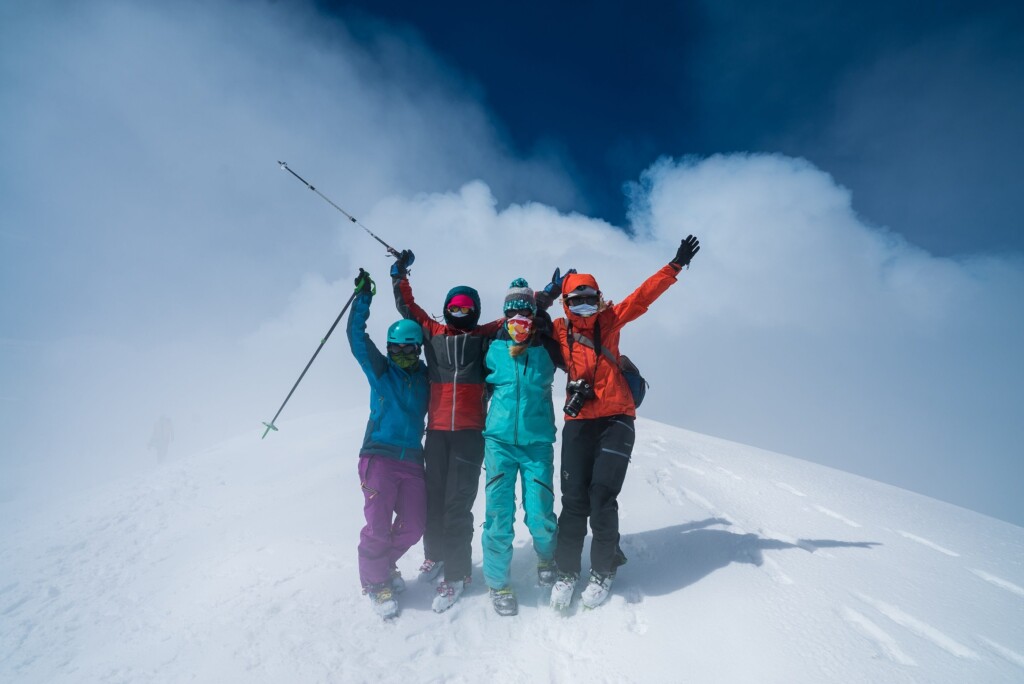
Ski team celebrating on a Chilean volcano

What separates skiers and splitboarders who thrive from those who merely get through isn’t fitness or ski ability alone. It’s how they handle the daily realities: early starts, packing and repacking as the route moves south, drying skins every night, and waiting patiently for the wind and the snow to come right.

Here’s what a week on the volcanoes of northern Patagonia actually looks like, and how to prepare for it.

The Road-Trip Rhythm

This is a road trip built around objectives, not a lodge program. You sleep in three towns, and the route moves progressively south through four volcano zones: Malalcahuello, Conguillío, Pucón and Puerto Varas. Across the week that’s roughly 430 miles of driving, from Temuco to Puerto Montt.

Bags get packed and repacked. That’s the trade for skiing four distinct volcanoes instead of one zone all week. Keep your kit organized and the moves are easy.

The longest drive is Day 6, Pucón to Puerto Varas, approximately 211 miles / 4 hours with stops. It’s a rest day in practice: legs recover in the vehicle, and the team arrives fresh for Osorno. Day by Day has the full sequence.

The Three Kinds of Days

Mountain days (Days 2, 3, 5 and 7). Lonquimay, Llaima, Villarrica and Osorno, the four primary volcano objectives. These are the hard days: sustained climbing on skins and bootpacks, then long descents. Llaima on Day 3 is the biggest day of the week, and the drive to Pucón follows it.

The recovery day (Day 4, Pucón). Positioned after the hardest objective and before the most conditions-dependent one. Push hard, recover properly, push again. Four hard days in a row would produce worse skiing and worse decisions.

Travel days (Days 1, 6 and 8). Arrival and the gear check on Day 1, the Lake District drive on Day 6, and the transfer to Puerto Montt airport on Day 8.

A Day in the Mountains

Mountain days start early, often before sunrise on the bigger objectives. We move when the snow and the weather are right, not when it’s convenient.

  • Early breakfast, usually between 5 and 7 a.m.
  • Drive, or lift when a ski area is operating, to the start of the climb
  • A beacon check before anyone moves
  • Skin up at a managed pace, with your guides setting the track
  • Efficient transitions, then the descent when the aspect and the timing are right
  • Drive back to town, dinner, and a briefing for the next day

Expect roughly 6 to 10 hours from vehicle to vehicle on a summit day, including the climb, transitions and the descent.

Skiers and splitboarders travel together on this trip. Transitions take slightly different shapes, and your guides build the day’s timing around the whole team, not its fastest member. With a maximum of six clients and a 3:1 ratio, a full team of six runs two guides, so pace can be managed and no one gets lost in the group.

Spring Snow Is a Timing Sport

Plan for melt-freeze spring conditions. Too early and you’re skiing boilerplate. Too late and it’s mush, with wet-slide hazard. A large part of what your guides do all week is putting you on the right aspect at the right hour.

We time ascents to climb in the cool of the morning and descend on softening corn. The best days give you corn from high on the volcano to the valley floor. Powder days happen, but they’re the exception rather than the plan.

Firm morning snow on the upper cones means axe and crampons, and on Osorno’s glacier your guides manage rope work and crevasse hazard.

How Your Guides Make the Call

Three things have to line up for a summit day: workable weather, manageable avalanche conditions and skiable snow. Your guides check all three every day and make the go/no-go call on current conditions, not on the printed schedule.

Other things sit outside anyone’s control. Villarrica is an active volcano, and access to the upper cone depends on the volcanic alert level and on CONAF and park authority rules. Lifts on Lonquimay and Osorno run only when the ski areas are operating. The itinerary has room to move when weather or access forces a change.

When a summit isn’t safe, or the snow isn’t worth it, we find the best available alternative. Eleven seasons on these four volcanoes means we usually know where it is.

A summit called off for conditions is not a refundable event. It means your guide made the right decision. Turning around is a professional call, not a failure, and it’s what you’re paying for.

Learning on the Trip

You don’t need a mountaineering background. Ice axe and crampon technique is taught and coached in the field: self-arrest, moving on firm snow, walking a bootpack. Your guides cover it early, often on Lonquimay, on terrain chosen for learning, before it matters on the steeper objectives. No glacier experience is needed for Osorno; you follow your guides’ system.

If you’ve never worn crampons, tell us when you book so the early days can be planned around it.

What you do need before you arrive is current avalanche training: AIARE 1, AST 1 or a recognized national equivalent. See Is This for Me?

Food and Water

All meals are included, from dinner on Day 1 through breakfast on Day 8, including trail food on activity days. Only alcohol and personal drinks are on your own account. Summit days are long efforts, and eating properly is the difference between a good fourth mountain day and a bad one.

Your own snacks. Bring a modest supply of the bars, gels or electrolyte powder you personally rely on, and check them against Chile’s customs rules before you pack.

Dietary needs. Usually accommodated with advance notice, including vegetarian and vegan. Tell us when you book.

Water. Carry two 1-liter wide-mouth bottles and a thermos for something hot on cold summit days. Skip hydration bladders: the hoses freeze on cold mornings.

Weather and Conditions

We run this expedition in the spring ski mountaineering window, late September to early October. Northern Patagonia has a heavy maritime snowpack driven by moist Pacific air, so by late September the snow is deep and consolidated on the upper volcanoes.

Temperature. Valley highs run roughly 41–59°F / 5–15°C. On summit days, expect 14–32°F / −10 to 0°C, with significant wind-chill on the upper cones.

Wind. Always a factor at elevation on these volcanoes. A clear, sunny day can still be brutally cold on an exposed ridge. Carry more insulation than you think you need.

Terrain. Mostly moderate, sustained volcano terrain, with short sections to approximately 45 degrees. You should be comfortable making controlled turns on a steep pitch with consequence below you.

Sun. Spring snow reflects UV hard, and the volcanoes are wide open with no shade. Sunburn is the most common avoidable problem on this trip.

Forecasting. Your guides use Windy for wind at multiple altitudes, Mountain-Forecast for summit-elevation forecasts, and Meteoblue as a cross-check. Download them before you fly if you want to follow along.

Rest Days and Hot Springs

If you need a rest day at any point, take it. Tell your guide the evening before if you can. Your recovery matters more than ticking every objective, and a rest day in town is never treated as a failure.

Day 4 in Pucón is the scheduled recovery day. Options include a soak at one of the hot springs in the forests around Pucón, such as Termas Geométricas, hiking, river trips, lift-accessed skiing or riding when the ski area is operating, or simply walking the lakefront. Meals are included as on every day, though if you’d rather find your own lunch or dinner in one of Pucón’s restaurants, do it.

Several hot springs sit along the route, and an evening soak after a hard summit day is good recovery. Hot springs and optional activities are at your own cost; What to Budget For has typical ranges.

Evenings

Evenings are for eating well, sorting gear and getting ready for the next day. Dry your skins and layers. Charge what needs charging. Check your pack before you sleep rather than in the dark at 5 a.m.

Then your guides run a short debrief on the day and a briefing on the next. It takes about ten minutes, and it’s the most useful ten minutes of your evening: it sets your wake-up time, your layers and what goes in your pack.

Staying in Touch

Mobile service and Wi-Fi are reliable in Malalcahuello, Pucón and Puerto Varas. On mountain days, connectivity can be limited or absent. Your guide team carries satellite and radio communications throughout, and we set up a WhatsApp group for each expedition. Tell people at home to expect a gap during the day and a message in the evening.

Laundry and Packing Light

Pucón and Puerto Varas both have laundry services, and the three nights in Pucón are the natural point to use one. Pack accordingly rather than bringing eight days of clothes. Laundry is at your own cost.

Questions About What the Days Actually Feel Like?

Back to Before You Go → · climbing@benegasbrothers.com · benegasbrothers.com
Ask a guide

Patagonia Volcanoes Gear List

This expedition puts you on four volcanoes in eight days: long skin tracks, firm early-morning bootpacks, a glacier on Osorno and long spring descents. You climb on your gear as much as you ski on it, and four mountain days expose every weak point. This page explains how to think about your kit and where people get it wrong. The full list, every item with our guides’ recommended models, is a download you can print and take shopping.

This expedition works for skiers and splitboarders. The list covers both, with splitboard-specific items marked.

What the Conditions Do

Spring in northern Patagonia means variable snow, strong sun and weather windows that open and close quickly. Your clothing has to handle a wide daily swing:

  • Valleys and towns: roughly 41–59°F / 5–15°C by day, with strong sun
  • Summit days: 14–32°F / −10 to 0°C ambient, with significant wind-chill on the upper cones

Several thin layers work better than one thick one. No cotton, anywhere.

The One Rule

Bring equipment you’ve already used.

An expedition in northern Patagonia isn’t the place to break in new boots, learn an unfamiliar binding, or discover that your crampons don’t fit the boots you brought. If you’re buying something new for this trip, buy it early enough to use it at home first.

Four Systems

1. Your touring setup. Skis or splitboard, bindings, skins, ski or splitboard crampons and poles. A 90–105 mm waist suits Chile’s spring snow: wide enough for corn and wind crust, light enough that you’re not fighting it uphill. Ski or splitboard crampons are required, and they must match your bindings.

Common failure: skins with tired glue. The melt-freeze cycle is hard on adhesive, and wet spring snow globs badly. Bring skin wax.

2. Avalanche safety. Beacon, shovel and probe, and the training to use them. These are your own: BBE doesn’t supply personal avalanche equipment. If your beacon is more than five years old, replace it, and practise with it before you fly. We run a beacon check every morning before anyone moves.

Common failure: a beacon its owner hasn’t touched since the course.

3. Technical equipment. Ice axe, boot crampons, helmet and harness. The summit cones involve firm early-morning snow and bootpacking, and there’s glacier travel on Osorno. You don’t need to arrive knowing how to use the axe and crampons, because that’s taught on the trip, but you do need to arrive with them, and they need to fit.

Common failure, and the one we see most: crampons that don’t fit the ski boots. Fit them together at home, before you travel. A metal toe bail works best with most AT boots.

4. Clothing. Layering that handles cold, windy summit ridges and warm valley afternoons on the same day.

Common failure: dressing for the valley forecast instead of the summit ridge.

Your Kit, System by System

A summary of the downloadable list. The PDF has every item with recommended models.

Touring setup. Touring skis with tech bindings, 90–105 mm underfoot, or a splitboard you ride confidently in variable snow; touring boots with a walk mode (splitboarders: the snowboard boots you already ride in); skins trimmed to your skis or board, tail clips preferred, plus skin wax; adjustable poles with powder baskets (splitboarders: three-section poles that collapse for ride mode); ski or splitboard crampons matched to your bindings.

Avalanche safety (your own). A modern three-antenna digital beacon; a shovel with a metal blade, extendable handle preferred; a 260–300 cm probe with a quick-deploy mechanism. An FRS radio is recommended, and an avalanche airbag is optional.

Technical. A 50–65 cm general mountaineering axe; aluminum boot crampons whose toe attachment works with your boots; a lightweight alpine harness with adjustable leg loops that fit over ski layers; a dual-rated climbing and ski helmet; two locking and two non-locking carabiners.

Packs and bags. A 30–40 L touring pack with ski or board carry; a 90–120 L expedition duffel; a roller ski or splitboard bag, which can replace your second duffel; a 10–20 L day pack for town and rest days; a tracking tag for each checked bag.

Head and eyes. Category 4 sunglasses with full side coverage; goggles with a low-light lens option; a sun cap (no white under the brim); a warm beanie that fits under your helmet; a buff; a balaclava.

Hands. Liner gloves, lightweight gloves for the skin track, insulated midweight gloves, heavyweight waterproof gloves for cold, stormy days, and a spare pair for every summit day.

Upper body. A sun hoody, a base-layer top, a midweight fleece, a breathable synthetic jacket, a packable down jacket, a softshell, a waterproof hard shell with a hood, and a heavy insulated parka for cold summit waits and weather delays.

Lower body. Three pairs of non-cotton underwear, base-layer bottoms, quick-dry hiking pants for travel and rest days, softshell touring pants, waterproof hard-shell pants with full side zips, and shorts.

Feet. Approach or hiking shoes, camp shoes, liner socks (optional), three pairs of hiking socks and five to seven pairs of ski socks.

Health and hygiene. SPF 50+ sunscreen in new tubes, two SPF lip balms, a personal first aid kit, foot care, hand sanitizer, saline nasal spray and your prescription medications in their original labeled containers.

Everything else. Two 1 L wide-mouth bottles (no hydration bladders: they freeze), a 1 L thermos, a headlamp plus a backup, hand and toe warmers, a repair kit (binding parts, screws, skin tip loops, duct tape, zip ties, wire), a multi-tool, a pocket scraper, ski straps, a power bank, a travel adapter (Chile uses Type C and L plugs), luggage locks, a reusable shopping bag, earplugs, swimwear for the hot springs, and a modest supply of your favorite snacks.

The Sun Is the Underrated Hazard

Spring snow reflects UV hard, and volcanic terrain is wide open, with no shade anywhere. Sunburn is the most common avoidable problem on this trip.

SPF 50+ in new tubes, because old sunscreen loses its rating. Two SPF lip balms. Category 4 sunglasses with full side coverage. Reapply at every transition.

How Your Gear Travels

Pack into two large duffels, or one duffel plus a roller ski or splitboard bag, and lock everything.

Keep your boots, your beacon and one set of base layers in your carry-on. Boots are the hardest item to replace on the road, and a delayed bag with your boots inside can end your expedition.

Put a tracking tag in each checked bag. Santiago connections are where bags go missing. Flights & Getting to Temuco has the full baggage guidance.

Test Everything Before You Go

Nothing should be used for the first time on a volcano. Test your systems together at home:

  • Boot crampons on your ski or snowboard boots
  • Ski or splitboard crampons on your bindings
  • Skins on your skis or board, with fresh glue if they need it
  • A full beacon search, with probe and shovel
  • A full day out in your kit, with the pack you’ll carry
  • Your helmet over a beanie

Problems found at home are easy to fix. Problems found at the trailhead cost you an objective.

What BBE Provides

  • Ropes, snow pickets and group protection
  • The group medical kit
  • All meals, including trail food on activity days

You don’t need technical climbing hardware beyond your own personal items. Your avalanche kit, touring setup and personal technical gear are yours to bring.

Renting and Replacing

Arrive with your own properly fitted equipment wherever you can. Limited rental of ice axes and crampons may be available in the region, but stock is thin and can’t be assumed. If you need to arrange anything locally, tell us at least three weeks before departure.

Temuco, Pucón and Puerto Varas all have outdoor shops for consumables and anything that didn’t survive the flight. Skis and splitboards in the right spec are hard to find locally, so bring your own.

The Gear Check

On Day 1 in Malalcahuello, your guides run a full gear review before anything else happens: bindings, skins, beacon function, crampon fit and layers. It’s deliberately scheduled on the first evening, while there’s still time to fix a problem. Finding a gap on Day 1 is inconvenient. Finding it at the trailhead on Day 2 is a lost objective. Send us questions about specific items at any point before the trip.

Questions About Gear?

Ski width, crampon fit, beacon age: gear questions are exactly what Ask a Guide is for. Back to Before You Go → · climbing@benegasbrothers.com · benegasbrothers.com
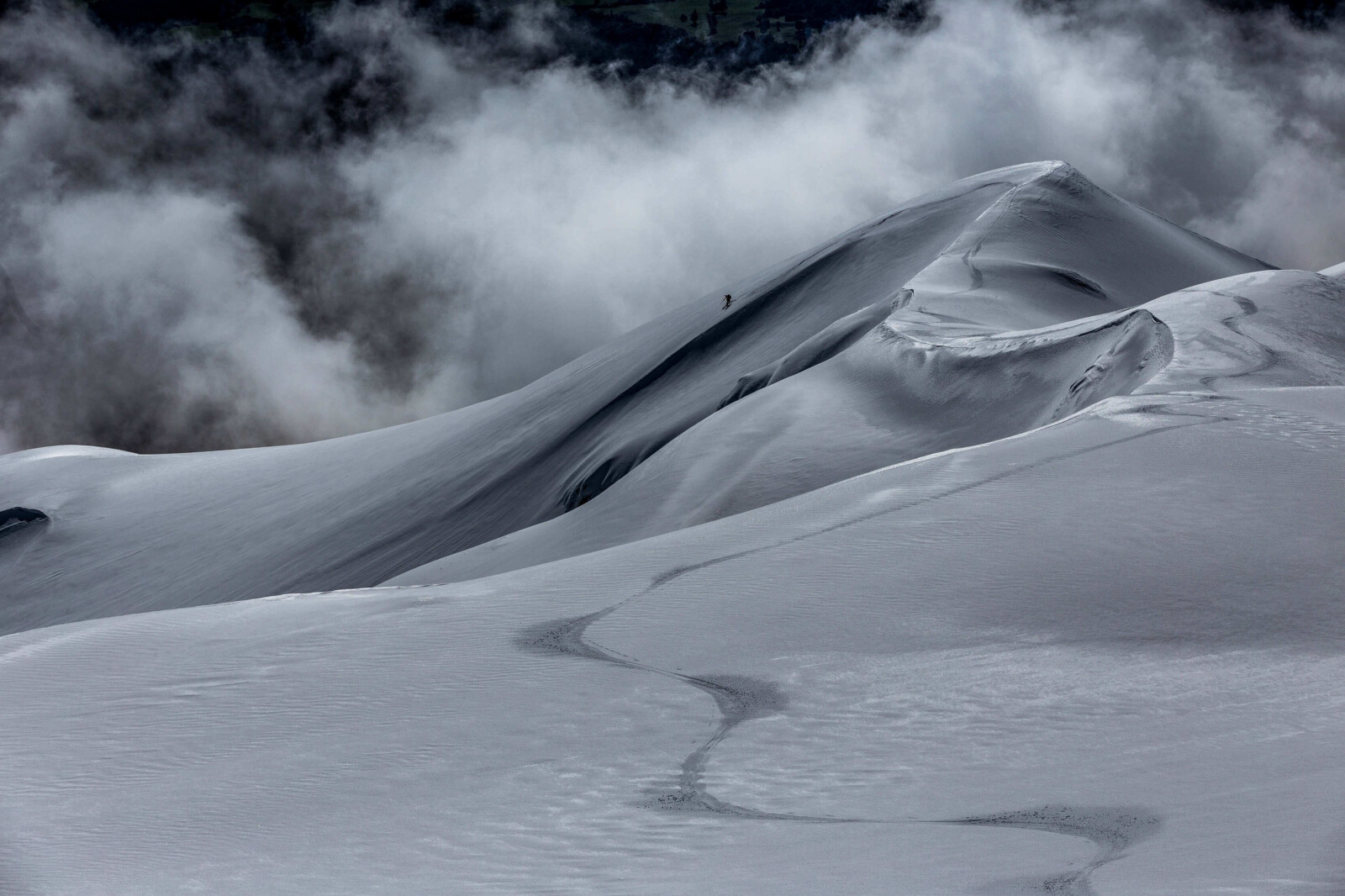
Ask a guide

What to Budget For

The expedition price is one number, and it’s on Dates & Prices with departures and booking terms. On this trip it covers more than you might expect: every night’s lodging, all ground transport and all meals, not just breakfasts. This page lays out every cost beyond the price: what you must pay, what we strongly recommend, what’s optional, and what to keep in reserve.

Tips7–10%

Of the trip cost, for your guide team and local staff.

Local spending$15–30 a day

Drinks and personal extras.

Rest-day activities$50–150

Optional. Hot springs about $20–50 a visit.

Your Budget at a Glance

RequiredCosts every climber pays
  • Rescue & evacuation coverageRequired by BBE · ski mountaineering and helicopter rescueVaries
  • FlightsTo Santiago, plus two domestic legs · you book theseVaries
  • Ski or splitboard baggageSet by each airline · buy the allowance when you bookVaries
  • Personal gearTouring setup and avalanche kit · depends on what you ownVaries
  • Guide team tipsVoluntary but expected in Chile · details below7–10% of trip cost
Strongly recommended
  • Travel insuranceCancellation, interruption, delays, baggage, travel medicalVaries
OptionalOnly if you add them
  • Single roomOn request · we quote when you askOn request
  • Extra nightsSantiago, Temuco, Puerto Varas or Puerto MonttVaries
  • Local gear rentalMainly ice axes and crampons · tell us 3 weeks aheadVaries
  • Private & custom tripsYour own dates, team or objectivesQuoted

Tips: How They Work

Tips are a direct way to recognize people who worked hard on your behalf.

Your guide team. The guideline for this expedition is 7–10% of the trip cost, reflecting the service you received. We use a percentage rather than a fixed amount so the guidance stays accurate whatever the season’s pricing.

Local staff and drivers. Included within that same guideline. A single group tip at the end of the expedition is the simplest approach, and your guides will explain how it’s shared.

How it works. Tips are cash only, handed to your lead guide at the end of the expedition. There’s no way to add a gratuity to your expedition invoice. Chilean pesos are easiest for local staff; US dollars work but are less convenient for them.

Restaurants. 10% is standard, and it’s often already added to the bill as propina. Check before adding more.

Cash and Cards

Currency. The Chilean peso (CLP). Visa and Mastercard are widely accepted at hotels, restaurants and larger shops in Temuco, Pucón and Puerto Varas. In mountain zones and small villages, cash is often the only option.

ATMs. Reliable in Temuco, Pucón and Puerto Varas. Malalcahuello is small, so don’t count on an ATM there: arrive with pesos in hand. Use machines attached to reputable banks.

Three things that save you money:

  • Make fewer, larger ATM withdrawals. Chilean ATMs charge foreign cardholders a fee on every transaction.
  • Always choose to be charged in pesos, not US dollars, when an ATM or card machine offers the conversion. Its rate is much worse than your bank’s.
  • Don’t exchange money at airports or hotels. Casas de cambio in central Santiago give better rates.

How much cash. Most clients are comfortable with a few hundred dollars’ worth of pesos for incidentals, plus their tips in cash. Withdraw in Temuco on arrival and top up in Pucón if you need to. Keep some US dollars as backup, in small denominations.

Tell your bank you’re traveling. A card frozen for suspected fraud on Day 2 is an avoidable problem, and you won’t always have the connectivity to sort it out quickly.

Contingency

Disruption costsReserve

If a flight is delayed or cancelled, or you need to leave the expedition early, extra hotel nights, transfers and flight changes are your cost. Transfers to Temuco or Puerto Montt airport after an early departure aren’t included, and unused expedition services aren’t refunded. Travel insurance is what usually covers these. Leaving-early and cancellation terms are on Dates & Prices.

Keep a reserveReserve

Travel with a credit card with real available credit, beyond your planned spending. Rescue teams, transport providers and hospitals may ask for payment up front, even when you’re insured.

More cost details for this trip

What the Expedition Price Covers

In short: professional guiding, with an IFMGA-certified lead guide on every departure; four available mountain days built around four primary volcano objectives; seven nights in hotels and lodges, double occupancy; all meals from dinner on Day 1 through breakfast on Day 8, including trail food on activity days; all scheduled ground transport from Temuco Airport to Puerto Montt Airport; standard park and mountain access fees required by the itinerary; and lift access at Corralco (Lonquimay) and the Osorno ski area when the lifts are operating and your guides use them. We can’t promise the lifts will run. The controlling list of inclusions and exclusions is on Dates & Prices.

Because meals and lodging are covered, your day-to-day spending on this trip is low.

Personal Spending

These are estimates, not fixed costs. Costs in northern Patagonia are moderate compared with much of South America, and lower than skiing in North America or the Alps.

Drinks and personal extras$15–30 per day

All meals are included, so this covers alcohol and personal drinks, and airport meals in transit.

Hot springs, optional$20–50 per visit
Optional rest-day activities$50–150
Souvenirs, laundry and incidentalsYour call

Budget Summary

Beyond the expedition price:

Required: rescue and evacuation coverage, flights and baggage, and any personal gear you need. Costs vary; no figures published.

Expected: tips of 7–10% of the trip cost for your guide team, covering local staff.

Strongly recommended: travel insurance.

Local spending, per day: about $15–30 for drinks and personal extras.

Local spending, optional: hot springs at about $20–50 a visit.

Local spending, rest day: optional activities at about $50–150.

We deliberately don’t publish an all-in total. Airfare from Denver and airfare from Frankfurt aren’t comparable, and a made-up average would be worse than no number at all.

Questions About Costs?

If you’d like a breakdown for your own situation, ask. We’d rather you plan it right than guess. See dates & prices → · climbing@benegasbrothers.com · benegasbrothers.com
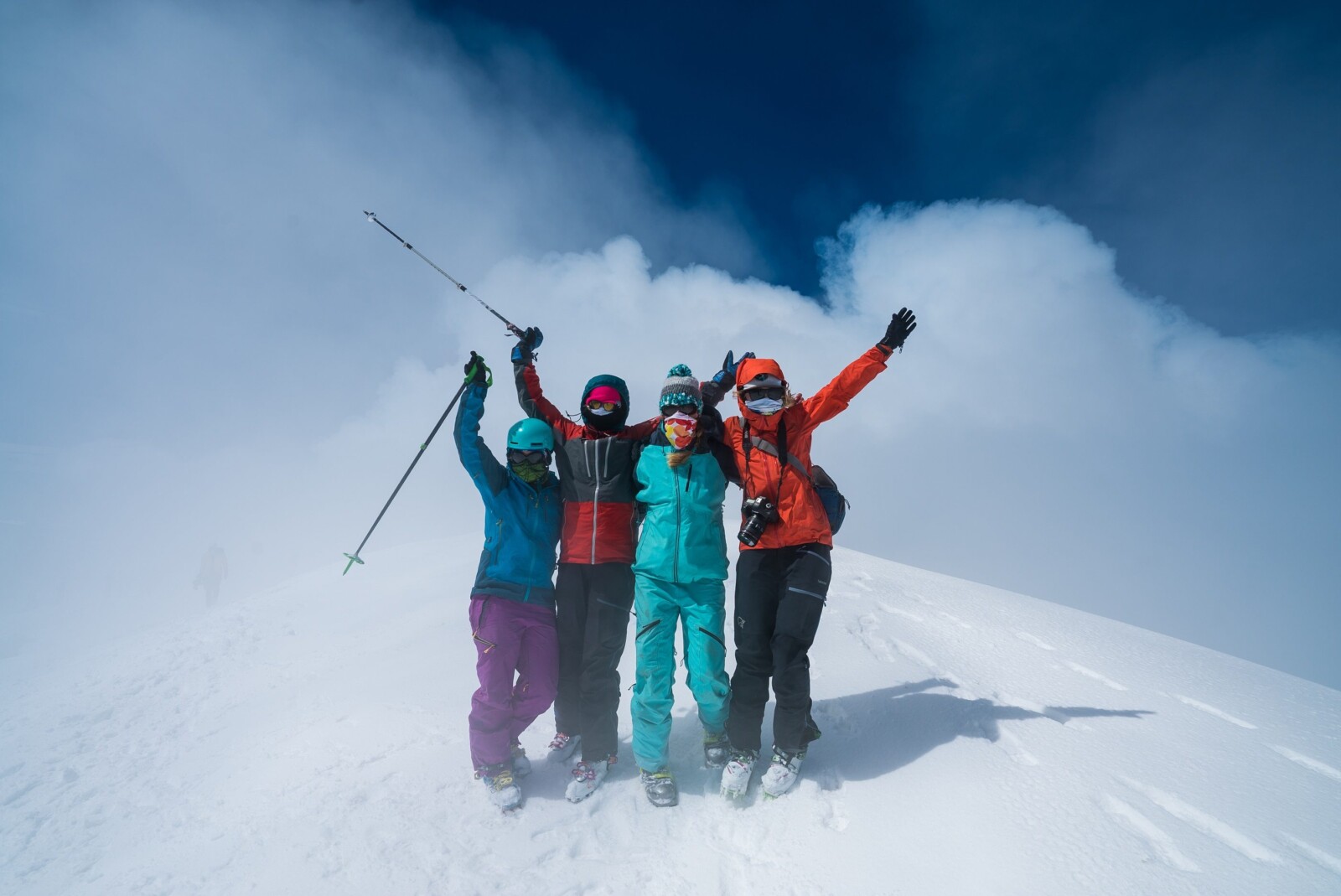
Ask a guide

Private & Custom Expeditions

Patagonia Volcanoes Ski Expedition · Your Dates, Your Team, Your Objectives

Our scheduled Patagonia Volcanoes Ski Expedition gives skiers and splitboarders a proven structure: four primary volcano objectives, a small team and experienced leadership. Not every team fits a fixed departure. If you want your own dates, your own pace or a different mix of objectives, we build the expedition around you, with the same guide standards, the same terrain knowledge and the same support as every BBE departure in northern Patagonia.

Private does not mean easier, and it does not mean more advanced. It means the expedition is designed around your team.

Who Private Expeditions Suit

  • Friends who already ski or ride together and want to travel only with each other
  • A family with the right skill level across the whole group
  • A club, a team, or a company doing something more serious than a retreat
  • A single skier or a pair who want a guide’s full attention
  • Teams that need dates outside the scheduled departures
  • Groups with a range of experience, where an itinerary built around the whole team works better than one built around an average Skiers and splitboarders both.

Team Size

No minimum for a private expedition. Maximum six.

A private expedition can be one skier with a guide or a team of up to six. We keep private trips small for the same reasons we cap the scheduled departures: a small team moves faster, decides faster and reaches terrain a larger group can’t access safely.

The same 3:1 client-to-guide ratio applies. A private team of six travels with two guides.

What You Can Customize

Dates. Our scheduled departures run in late September and early October, the spring ski mountaineering season in northern Patagonia. Private expeditions run on dates you request; we confirm feasibility for the season and conditions. Earlier in the season generally means a deeper, more consolidated snowpack. Later means a more reliable corn cycle but more melt-out on the lower approaches. Tell us what matters to you and we’ll tell you honestly how the volcanoes look for the dates you have in mind.

Objectives. The route can be shaped to your team’s experience and ambitions:

  • Go deeper on fewer peaks. Focus on one or two volcanoes rather than moving every day.
  • Extend the itinerary to include additional peaks in northern Patagonia.
  • Combine climbing and skiing for teams that want mixed alpine objectives.
  • Build around conditions and group fitness rather than a fixed schedule.

Pace and rest days. Private itineraries are built day by day, so adding a recovery day or a lift-accessed day is straightforward.

Skills focus. If your team wants to come home better than it arrived, we can build the program around steep skiing, glacier travel or decision-making in avalanche terrain.

A private trip doesn’t change what the mountains decide. Volcanic alert levels, park access, lift operations, weather and snowpack still set what is possible each day, and no one can promise a summit.

Requirements Don’t Change

A private expedition is flexible on dates and objectives. It is not flexible on preparation.

  • Avalanche training is still required for every member of the team: AIARE 1, AST 1 or a recognized national equivalent.
  • Fitness expectations are the same: days of 4,000 to 5,000 vertical feet, back to back. The touring guideline is the same too: around fifteen days of backcountry touring is the experience level we look for; tell us honestly where each person is and we’ll talk it through.
  • Ice axe and crampon technique is still taught on the trip. You don’t need a mountaineering background.

If someone in your group doesn’t yet have avalanche training, tell us early. There is usually time to fix it before the season.

Age. The minimum age is set by Chile’s and Argentina’s regulations and by insurance: skiers and splitboarders under 18 climb with a parent or guardian, and each skier or splitboarder’s insurance must cover their age. Families are welcome: younger skiers and splitboarders can join a scheduled team with a parent or guardian, or come on a private family expedition built around your family, and if a special permit is needed, we’ll help you apply.

See Is This for Me? for the full requirements.

Led by Willie Benegas

On this ski program, founder-led private trips are led by Willie Benegas on request, confirmed in writing in the trip terms.

Ski mountaineering is a distinct discipline, and we are specific about who leads it. Willie holds the AMGA Ski Mountaineering Guide certification and AIARE Level III avalanche certification alongside his IFMGA credential.

A founder’s participation applies only when it is confirmed in writing in your trip terms, never assumed. If it matters to your team, raise it in your first inquiry.

What’s Included

A private expedition carries the same support as our scheduled departures: professional guiding with an IFMGA-certified lead guide, hotel and lodge accommodation, all meals from the first dinner through the final breakfast, and ground transportation throughout the program. Your proposal sets out exactly what is included for your itinerary.

How a Proposal Comes Together

Every private expedition is quoted individually. The price depends on your team size, the number of days, your objectives and guide staffing.

Private expeditions need lead time for guide scheduling, lodging and transport in small mountain towns. The earlier you reach out, the more options we can offer.

How to Start

Email us and tell us:

  • Your preferred dates or date range
  • How many skiers and splitboarders are in your group
  • Each person’s background: ski or ride ability, touring days, avalanche training and any mountaineering
  • Any volcanoes or objectives you have in mind
  • Scheduling constraints or particular requirements, and whether you’d like Willie to lead

We’ll review your team against your objectives and come back with a proposed itinerary and price. If something else should come first, we’ll say that too. We answer every inquiry personally.

Ask a guide

See dates & prices → · climbing@benegasbrothers.com · benegasbrothers.com
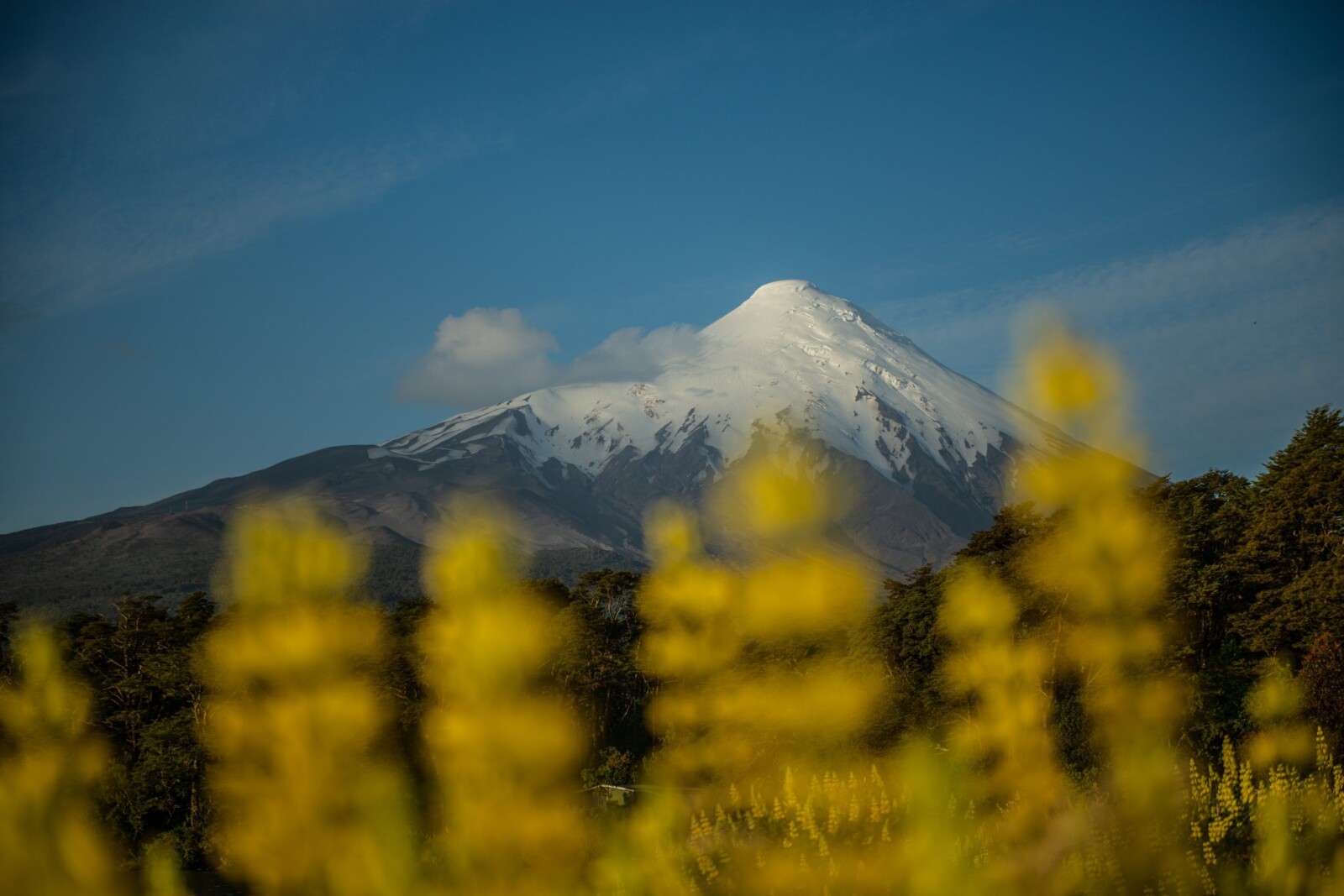
Ask a guide

Dates & Prices

Patagonia Volcanoes Ski Expedition · 8 Days · Northern Patagonia, Chile · Maximum Six Skiers and Splitboarders

Everything you need to book: departures, the price, what it covers and the terms. If you’re still deciding, start with Is This for Me? or talk to a guide first. We review every skier’s and splitboarder’s background with them before booking.

Departures

Expedition price$5,500

USD per person.

Deposit to book20%

Of the expedition price. Includes a $350 non-refundable booking fee.

Balance120 days

Due 120 days before departure. Inside 120 days, you pay in full at booking.

2027 departures.
2028 departure: $6,100 USD per person.

Departures

Sat Sep 25 – Sat Oct 2, 2027Scheduled departure
Sat Oct 2 – Sat Oct 9, 2027Scheduled departure
Sat Sep 30 – Sat Oct 7, 2028Scheduled departure

Each departure takes a maximum of six skiers and splitboarders, with a 3:1 client-to-guide ratio: a full team of six runs two guides. Every departure has an IFMGA-certified lead guide. A departure is confirmed when we tell you so in writing. Please buy nonrefundable flights only after your departure is confirmed. When it’s full, it closes.

Day 1 is arrival at Temuco Airport (ZCO), where our team meets you for the transfer to Malalcahuello. Day 8 is departure from Puerto Montt Airport (PMC). Dates run Saturday to Saturday. The full itinerary is on Day by Day.

When We Ski

We run this expedition in late September and early October, the spring ski mountaineering season in northern Patagonia. A heavy maritime snowpack is usually deep and consolidated by late September, and spring conditions follow through October. Plan for melt-freeze snow: we skin in the cool of the morning and ski sun-softened corn on the descent.

No week guarantees good weather. Snow, wind, volcanic activity, park access and lift operations vary every season. The itinerary is built around four primary volcano objectives, but no specific summit is guaranteed on any departure. Your guides set the daily plan from current conditions.

What’s Included — and What Isn’t

Included in the price

Before you go
  • Preparation guidance and training recommendations from our guide team
  • The Patagonia Volcanoes Gear List and an equipment review with your guides on Day 1
In Chile
  • Your meet at Temuco Airport (ZCO) on Day 1 and all scheduled ground transportation through the drop-off at Puerto Montt Airport (PMC) on Day 8
  • Seven nights in hotels and mountain lodges, double occupancy, no dormitories: two in Malalcahuello, three in Pucón and two in Puerto Varas
  • All meals, from dinner on Day 1 through breakfast on Day 8, including trail food on activity days
  • Standard park and mountain access fees required by the itinerary
  • Lift access at Corralco (Lonquimay) and the Osorno ski area when the lifts are operating and your guides use them. We can’t promise the lifts will run
On the mountain
  • Four available mountain days, built around four primary volcano objectives: Lonquimay, Llaima, Villarrica and Osorno
  • An IFMGA-certified lead guide on every departure, and a 3:1 client-to-guide ratio
  • Ice axe and crampon instruction in the field; on Osorno’s glacier, your guides manage the rope work
  • Group technical and safety equipment: ropes, snow pickets and group protection
  • A comprehensive group medical kit on every mountain day, and satellite and radio communications within the team
  • A beacon check every morning and daily conditions assessment

Not included

  • International and domestic flights, including Santiago to Temuco and Puerto Montt to Santiago
  • Ski, splitboard and excess baggage fees, paid to the airline
  • Rescue and medical evacuation insurance (required) and travel insurance (strongly recommended)
  • Personal equipment and clothing: skis or splitboard, skins, ski or splitboard crampons, beacon, shovel, probe, ice axe, boot crampons, helmet and harness, and any rentals
  • Tips for the guide team
  • Alcoholic beverages and personal drinks
  • Hot springs visits and optional rest-day activities
  • A single room (available on request; we’ll quote the cost when you ask)
  • Nights outside the expedition dates, and meals in transit
  • Costs of leaving the expedition early, including transfers to Temuco or Puerto Montt, and costs from delays or circumstances beyond the expedition’s control
  • Laundry, souvenirs and other personal expenses

What each of these typically costs is on What to Budget For.

What We Ask of You

Current avalanche training is required: AIARE 1, AST 1 or the recognized equivalent in your country. It is the only certification we ask for. Ice axe and crampon technique is taught on the trip.

Around fifteen days of backcountry touring is the experience level we look for. It’s a guideline, not a hard minimum: tell us honestly where you are and we’ll talk it through. You also need the fitness for 4,000 to 5,000 vertical feet on back-to-back days. The minimum age is set by Chile’s and Argentina’s regulations and by insurance: skiers and splitboarders under 18 climb with a parent or guardian, and each skier or splitboarder’s insurance must cover their age. Families are welcome: younger skiers and splitboarders can join a scheduled team with a parent or guardian, or come on a private family expedition built around your family, and if a special permit is needed, we’ll help you apply. Full detail is on Is This for Me?

Your Total Trip Cost

The expedition price is the biggest number, not the only one. Typical ranges per climber, in U.S. dollars:

Expedition price (2027)$5,500
Tips7–10% of the trip cost
Local spendingabout $15–30 a day
Rescue and evacuation coverage (required), flights, gearvaries

We deliberately don’t publish an all-in total: airfare from Denver and from Frankfurt aren’t comparable, and a made-up average would be worse than no number. The full breakdown is on What to Budget For.

Payment & Cancellation

Deposit: $1,100 (2027) or $1,220 (2028) (20% of the trip price), due at booking. $350 of it is a nonrefundable booking fee.

Balance: $4,400 (2027) or $4,880 (2028), due 120 days before the start date. Booking within 120 days? Full payment is due at booking.

How to pay: bank transfer/ACH (no fee), wire transfer (you pay the bank fees) or credit card (3% surcharge). All prices are in U.S. dollars.

If you cancel:

  • 121 days or more before the start date: full refund, less the $350 booking fee
  • 90 to 120 days: 50% refund, after the $350 booking fee
  • 89 days or fewer: no refund

Can’t make it? Send a qualified climber in your place at no BBE fee.

Insurance: medical and rescue/evacuation coverage required. Trip cancellation insurance strongly recommended.

Once the trip begins, payments are nonrefundable.

Read the full Payment & Cancellation Policy →

Insurance

Rescue and medical evacuation coverage is required on this expedition. Your policy must cover backcountry skiing, splitboarding and ski mountaineering at this trip’s elevations, helicopter rescue and international medical transport. Many policies exclude off-piste skiing, so confirm the cover in writing with your insurer.

You can arrange it any time before the trip’s departure date, but it must be in place by then. Your guide team will ask for your rescue cover details before the expedition begins.

Coverage pays for a rescue; it can’t guarantee one. Evacuation from the mountain always depends on weather and conditions.

Travel insurance is strongly recommended, but not required. Cancellation and interruption cover is, in many situations, the only way to recover costs from disruptions outside anyone’s control. Cancellation cover is worth most when you buy it soon after your deposit. See Trip Insurance & Evacuation Coverage.

Private Departures

A private expedition runs on dates you request, for your own team of up to six, with no minimum; we confirm feasibility for the season and conditions. It can follow this program or be shaped around your team’s objectives.

Led by Willie Benegas: on request, priced individually. A founder’s participation applies only when it is confirmed in writing in your trip terms.

Every private expedition is priced individually, based on team size, trip length, objectives and guide staffing. See Private & Custom Expeditions.

Guide Authority

BBE guides hold final authority on all safety and operational decisions, including turnaround times, route changes, weather holds and evacuation. A guide’s decision does not create a right to a refund.

Ready to Book?

Ask a guide → · climbing@benegasbrothers.com · benegasbrothers.com
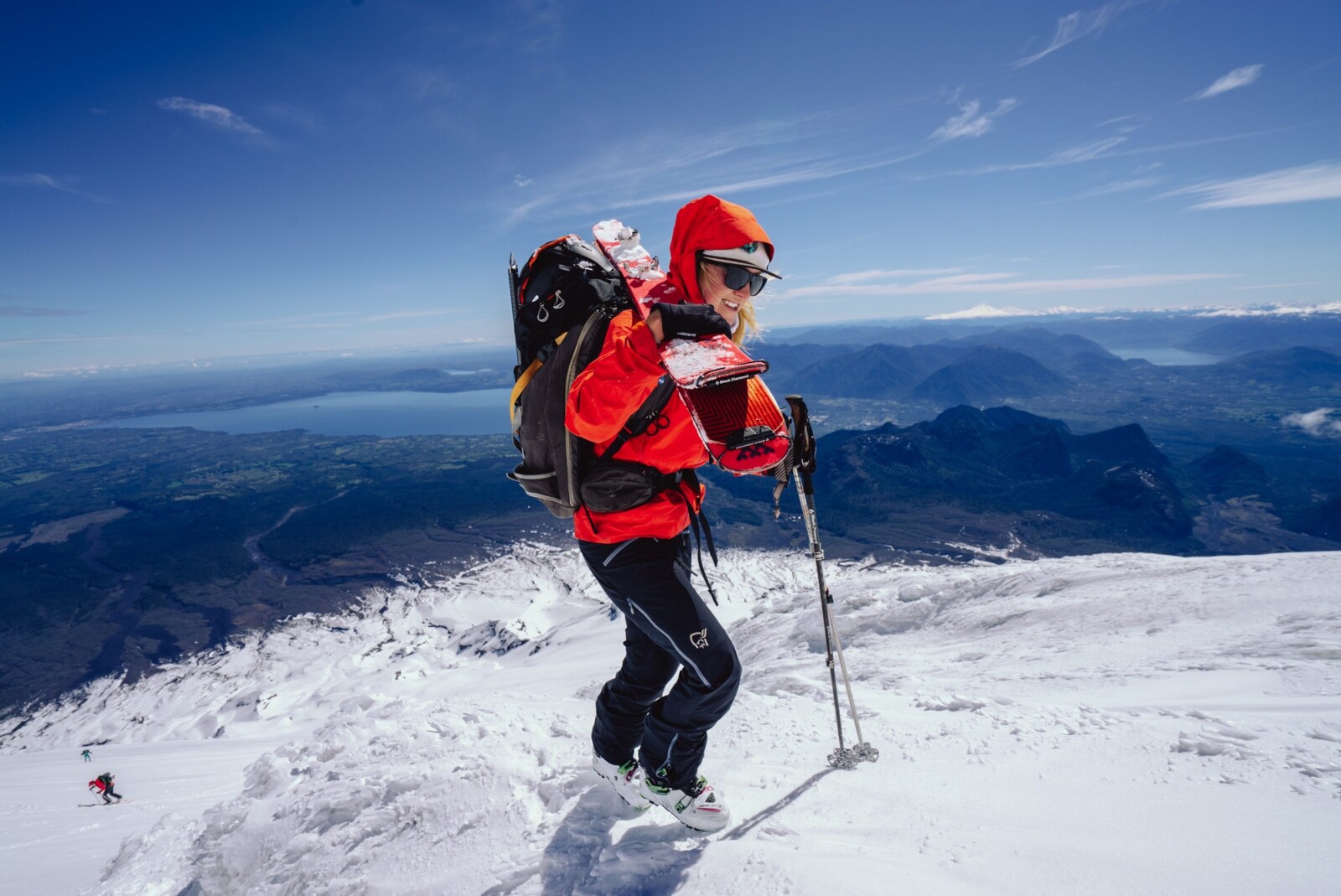
Register now

Your Questions

Patagonia Volcanoes Ski Expedition · Answered by the Guides

Straight answers to the questions skiers and splitboarders ask most before committing to the Patagonia volcanoes. Each answer is short and points you to the page with the full detail. If your question isn’t here, ask us. We answer every inquiry personally.

Still Have a Question?

Ask a guide. Tell us your background and what you’re unsure about, and you’ll get a straight answer from someone who knows these volcanoes. See dates & prices → · climbing@benegasbrothers.com · benegasbrothers.com
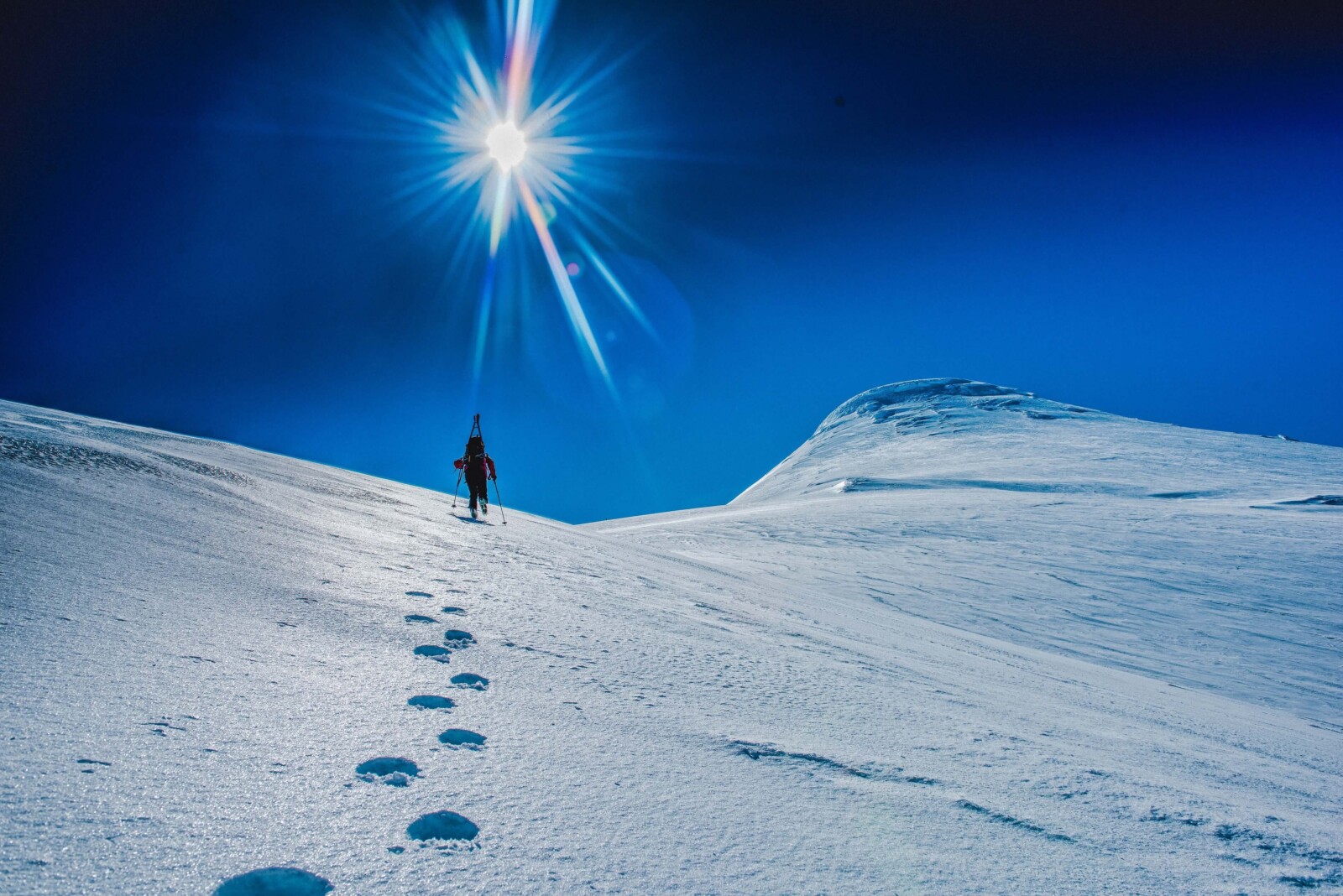
Ask a guide

Real backcountry touring experience, advanced downhill ability in variable snow, current avalanche training and excellent fitness. Expect days of 4,000 to 5,000 vertical feet, back to back. See Is This for Me?

Around fifteen days of genuine backcountry touring is the experience level we look for, including recent time in variable snow and on steep terrain. It’s a guideline, not a hard minimum: tell us honestly where you are and we’ll talk it through. That means skinning with a pack, transitioning efficiently, and skiing or riding terrain with consequence.

Probably not yet. Get a solid season of touring behind you and build toward around fifteen days. Strong downhill skiing doesn’t substitute for touring fitness or for comfort in consequential terrain. Tell us honestly where you are and we’ll talk it through. The same guideline applies to private expeditions.

Yes. Ice axe and crampon technique is taught and coached on the trip: self-arrest, moving on firm snow and walking a bootpack. Tell us at booking if you’ve never worn crampons, so your guides can plan the early days around it. On Osorno’s glacier, your guides manage the rope work and you follow their system. No glacier experience is required.

Yes. AIARE 1, AST 1 or the recognized equivalent in your country, plus real competence with beacon, shovel and probe. It is the one skill we can’t teach you here, and the only certification we ask for. If your training is several seasons old and unpracticed, take a refresher before you come. We run a beacon check every morning.

Most of the terrain is moderate and open. Some sections steepen to approximately 45 degrees, usually short pitches rather than sustained faces. You need to link controlled turns there without hesitation, in whatever snow the mountain gives you.

Very. Train seriously for three to five months before departure: uphill cardio with a loaded pack, leg and core strength, and back-to-back endurance days. Fitness isn’t just about finishing. A fit team gives your guides more terrain options.

Yes. This expedition is for skiers and splitboarders, who travel together, and the gear list covers both.

The minimum age is set by Chile’s and Argentina’s regulations and by insurance: skiers and splitboarders under 18 climb with a parent or guardian, and each skier or splitboarder’s insurance must cover their age. Families are welcome: younger skiers and splitboarders can join a scheduled team with a parent or guardian, or come on a private family expedition built around your family, and if a special permit is needed, we’ll help you apply.

No. You complete a medical history in the Registration Form. If you have a condition that cold, altitude or sustained exertion could affect, talk to your physician before you book and tell us about it.

Tell us your background and we’ll tell you honestly whether you’re ready or exactly what is missing. Usually it’s touring days, avalanche training or fitness, and all three are timing problems, not verdicts. If mountaineering skills are what you want to build, the Ecuador Mountaineering School teaches them with instruction built in. Mexico Volcanoes is another step at altitude. A private Patagonia trip can also be shaped around where you are now.

Late September into October gives the most consistent weather windows of the spring season. Generally the later you go, the better the weather, offset by rising snow lines on the lower approaches. Wind is always a factor on the upper volcanoes.

Melt-freeze spring conditions. We time ascents to skin in the cool of the morning and ski sun-softened corn on the descent. Powder days happen, but corn is the plan.

Valley highs run roughly 41–59°F / 5–15°C. Summit days bring 14–32°F / −10 to 0°C ambient, with serious wind-chill on the upper cones. Layer for the ridge, not the valley.

The four volcanoes range from 8,701 to 10,255 ft (2,652–3,125 m). That’s moderate by Andean standards, but enough to notice if you arrive from sea level. Fitness matters more than altitude on this program, and no pre-acclimatization is required.

That isn’t guaranteed, and no one can promise it. The itinerary is built around four primary volcano objectives, but volcanic alert levels, park access, lift operations, weather and snowpack decide what is possible each day. Villarrica in particular has been restricted or closed to the upper cone in multiple recent seasons.

We don’t publish one. Results depend on the season, the conditions and the team, and a single number would hide all of that. Ask a guide and we’ll talk you through recent seasons.

Your guides find the best available alternative. Eleven seasons on these volcanoes means we usually know where it is. A summit called off for conditions isn’t a refundable event. Turning around at the right moment is a professional decision.

We never promise either. Villarrica is an active volcano, and CONAF and the park authorities can restrict or close the upper cone on short notice depending on the alert level. Your guides and current restrictions set the high point on the day.

A maximum of six skiers and splitboarders, with a 3:1 client-to-guide ratio: a full team of six travels with two guides. Small teams move faster, decide faster and reach terrain a larger group can’t access safely. You won’t disappear into the group.

BBE’s guide team, who guide on skis year-round: winters in the Wasatch backcountry, spring in the Andes. Every departure has an IFMGA-certified lead guide, and all our guides hold IFMGA, AMGA or the equivalent Chilean national certification. The program is built and run to ski-specific standards, including AMGA Ski Mountaineering Guide certification and AIARE Level III avalanche certification.

Scheduled departures are led by BBE’s guide team, run to the same standards. On this ski program, founder-led private trips are led by Willie Benegas on request, confirmed in writing in the trip terms. See Private & Custom Expeditions.

It moves. You sleep in three towns, Malalcahuello, Pucón and Puerto Varas, and drive roughly 430 miles south across the week. That’s the trade for skiing four distinct volcanoes instead of one zone all week.

All of them, from dinner on Day 1 through breakfast on Day 8, including trail food on activity days. Only alcoholic drinks and personal beverages are on your own account. Bring a few of your own favorite snacks for activity days.

Usually, with advance notice, including vegetarian and vegan. Options are more limited in small mountain towns than in a city, so tell us when you book rather than on arrival.

Breakfast usually falls between 5 and 7 a.m., earlier on the bigger volcanoes. Then the drive or lift to the objective, a beacon check, the ascent and descent, and back to town for dinner and a briefing on the next day. Expect 6 to 10 hours from vehicle to vehicle. See Life on the Expedition.

Yes. Day 4 in Pucón is a scheduled recovery day, and a rest day in town is available any day you need it. Tell your guide the evening before if you can. It’s never treated as a failure.

Small teams and a 3:1 ratio exist so pace can be managed. Your guides set the day’s timing around the whole team and will tell you honestly if a particular objective isn’t the right call for you that day.

Many skiers use it that way. The trip runs right before most North American resorts open, and four mountain days of real vertical on the volcanoes is a strong start to your own season.

Mobile service and Wi-Fi are reliable in Malalcahuello, Pucón and Puerto Varas. On mountain days, connectivity can be limited or absent. Your guide team carries satellite and radio communications throughout.

Seven nights in hotels and mountain lodges: two in Malalcahuello, three in Pucón and two in Puerto Varas. No camping and no dormitories. Every property has hot showers, Wi-Fi, a place to dry skins and boots, and secure ski storage. See Where You’ll Stay.

Rooms are double occupancy. If you travel alone, you normally share with a teammate of the same gender. Single rooms are available on request; we’ll quote the cost when you ask.

Hotel names are provided in the pre-departure information, along with addresses and contact details. Leave a copy with someone at home.

Yes, in Pucón and Puerto Varas. The three-night stay in Pucón is the natural point to use it, so pack accordingly rather than bringing eight days of clothing.

Yes. You fly into Temuco (ZCO) and out of Puerto Montt (PMC). Booking a round trip into Temuco is the most common and most expensive booking error on this trip. Book Santiago to Temuco at the start and Puerto Montt to Santiago at the end.

Fly internationally into Santiago (SCL), ideally at least a day before the expedition starts, then take a domestic flight to Temuco on Day 1. We coordinate that flight so the whole team arrives together, and our team meets you at Temuco Airport for the group transfer; send us your proposed flights before you book. On Day 8 we drop you at Puerto Montt Airport: book an afternoon flight, leaving enough time to connect in Santiago to your international flight home. See Flights & Getting to Temuco.

Once you’ve paid in full. International and domestic flights are yours to book. After that, book early: the domestic legs run on limited schedules.

At least three hours. You clear immigration and customs, collect your bags and re-check them for the domestic flight, unless your airline confirms otherwise.

It usually catches up within a day or two. That’s why your boots, beacon and a set of base layers belong in your carry-on. A tracking tag in each checked bag makes the whole conversation shorter.

U.S., Canadian, UK and EU passport holders can enter Chile visa-free as tourists for up to 90 days. Your passport should be valid at least six months beyond your return. If you hold another passport, check with a Chilean consulate before booking flights. See Your Expedition Checklist.

Yes, a modest supply. Chile enforces strict agricultural rules, so check your snacks against current SAG rules and declare anything containing nuts, dried fruit or meat on arrival. Declaring is free; not declaring can mean a fine.

Your own, already tested. For skis, 90–105 mm underfoot handles corn and wind crust and stays light enough for four days of climbing. Ski or splitboard crampons that match your bindings are required. See the Patagonia Volcanoes Gear List.

Yes. You bring your own beacon, shovel and probe, plus an ice axe, boot crampons, helmet and harness. The axe and crampon technique is taught on the trip, but the equipment is yours. Fit your crampons to your ski boots at home before you travel. Limited local rental of axes and crampons may exist, but it can’t be assumed: contact us at least three weeks before departure.

The expedition price is on Dates & Prices. On top of it, plan for flights, required rescue coverage, travel insurance, tips, gear and personal spending. What to Budget For lays it all out.

Guiding with an IFMGA-certified lead guide and a 3:1 ratio, seven nights of lodging, all meals from dinner on Day 1 through breakfast on Day 8, all scheduled ground transport from Temuco to Puerto Montt, standard access fees, lift access at Corralco and the Osorno ski area when the lifts operate and your guides use them, group technical and safety equipment, and axe and crampon instruction. The full list is on Dates & Prices.

International and domestic flights and baggage fees, rescue insurance (required) and travel insurance (strongly recommended), personal equipment, tips, alcohol and personal drinks, hot springs and optional activities, a single room, and nights outside the expedition dates. What to Budget For has the detail.

The guideline for the guide team is 7–10% of the trip cost, which covers local staff and drivers too. Tips are cash only, and Chilean pesos are easiest. Beyond tips, a modest amount of pesos covers incidentals, since meals and lodging are included. Temuco, Pucón and Puerto Varas have reliable ATMs; Malalcahuello may not, so arrive with pesos in hand.

Rescue and medical evacuation coverage is required on this expedition. It must cover backcountry skiing, splitboarding and ski mountaineering at the trip’s elevations, helicopter rescue and international medical transport. We recommend Global Rescue or Ripcord. You can buy it any time, but it must be in place before departure. Travel insurance is strongly recommended, but not required. See Trip Insurance & Evacuation Coverage.

A 20% deposit reserves your place, and the balance is due 120 days before departure. Cancellations must be in writing. Refunds depend on how much notice you give, and the fixed booking fee is non-refundable. Full terms are on Dates & Prices. Travel insurance with cancellation cover is the way to protect what you’ve paid.

Ask a guide first. We’ll talk through your background, then send a link to our online registration form. There you complete a reservation form and pay your deposit, then the Registration Form, a passport copy, and the Terms & Conditions and Release.

Each departure takes a maximum of six, so if a specific date matters to you, reach out early. Booking early also gives you time to train and, if you need one, to take an avalanche course. Current departures are on Dates & Prices.

Yes. A private expedition runs on dates you request, with your own team and your own objectives; we confirm feasibility for the season and conditions. See Private & Custom Expeditions.

Yes. Private expeditions have no minimum group size and a maximum of six.

Four volcanoes. One road south.

Maximum six skiers and splitboarders on the team, at a 3:1 client-to-guide ratio. A full team of six runs two guides.

Price$5,500 per person
Private & Custom Your dates. Your team.

This trip can run privately, on the dates that work for you.

Scheduled departures
  • Saturday, Sep 25 - Saturday, Oct 2, 2027Scheduled departure
  • Saturday, Oct 2 - Saturday, Oct 9, 2027Scheduled departure
  • Saturday, Sep 30 - Saturday, Oct 7, 2028Scheduled departure

Questions first? Ask a guide

Location:
Patagonia, Chile
Group:
Maximum 6 · 3:1 client-to-guide ratio
Duration:
8 Days
Skill:
Intermediate to advanced
Activities:
Ski mountaineering, splitboarding, skiing
Pricing

All prices are in US dollars.

Four volcanoes. One road south.

Maximum six skiers and splitboarders on the team, at a 3:1 client-to-guide ratio. A full team of six runs two guides.

Book now

Private & Custom

Make Patagonia Volcanoes Ski Expedition your own expedition

Every trip we run can also run privately: on your dates, with your people, built around your goal. Same guides, same safety standard as our scheduled departures.

Your dates

We set the departure around your calendar, not the other way round.

Your people

Family, friends, a company team, or just you and a guide.

Your goal

Training for a bigger peak, a winter or speed attempt, a film, or a route that runs from summit to ocean.

Your price

Private trips are quoted for your group size, dates and plan.

Patagonia Volcanoes Ski Expedition

Scheduled Departure

Maximum 6 · 3:1 client-to-guide ratio · 8 days
Price per Person $5,500

Seven nights in hotels and mountain lodges, all meals from dinner on Day 1 through breakfast on Day 8, all scheduled ground transport from Temuco to Puerto Montt, standard access fees, lift access at Corralco and the Osorno ski area when the lifts operate, and professional guiding at 3:1.

Private & Custom

Your dates · Your team
Priced individually On request

Private trips for up to six, no minimum, on dates you request; we confirm feasibility for the season and conditions.

The BBE Advantage

Patagonia Volcanoes Ski Expedition — Patagonia, Chile

Four Volcanoes, Four Characters

Lonquimay, Llaima, Villarrica and Osorno: big elevation, open faces and spring corn, with no two days alike.

Patagonia Volcanoes Ski Expedition — Patagonia, Chile

A Road Trip, Not a Lodge

We move south objective by objective through Malalcahuello, Pucón and Puerto Varas, reading the weather and picking our days.

Patagonia Volcanoes Ski Expedition — Patagonia, Chile

Built on Snow

BBE guides on skis year-round: winters in the Wasatch, spring in the Andes.

Professional Mountain Standards

Our guide team includes internationally and nationally certified mountain professionals.

AMGA — American Mountain Guides Association logo
IFMGA / UIAGM — International Federation of Mountain Guides Associations logo
AAGM — Asociación Argentina de Guías de Montaña logo

Related Trips