Global Expeditions Nepal

Everest Base Camp Trek

Everest Base Camp Trek · Khumbu Valley, Nepal · 17 Days · Helicopter In and Out · Maximum Eight Trekkers

17 Days Group: Maximum 8 trekkers $6,250 per person (2027)

The Trek

Everest Base Camp Trek · Khumbu Valley, Nepal · 17 Days · Helicopter In and Out · Maximum Eight Trekkers

Most people who want to walk to Everest Base Camp are not short on motivation. They are short on time. This trek is built around that: seventeen days, almost all of them spent in the mountains rather than getting to them.

You fly by helicopter into Lukla, walk a quieter line through the Khumbu with two full acclimatization days, spend two nights at Gorak Shep, walk to Base Camp, and fly out by helicopter from Pheriche.

No climbing experience is required. Fitness, patience and an honest approach to altitude are.

17,598ftEverest Base Camp · 5,364 m, a day visit
17Days, Kathmandu to Kathmandu
2Full acclimatization days: Namche and Pheriche
8Trekkers maximum, two certified guides
HeliIn to Lukla, out from Pheriche
SpringA day visit to our Everest camp

Seventeen Days, and Not One of Them Wasted

The standard trek costs you days you never planned to spend. A pre-dawn drive to Ramechhap, because Lukla flights move out of Kathmandu in peak season. A day, sometimes three, sitting in a lodge waiting for weather so a small plane can land on a short uphill runway. Then three days walking back down a valley you have already walked up, to catch the same flight in reverse.

We built this trek to remove all of it.

The standard trek

  • A pre-dawn drive to Ramechhap for the Lukla flight
  • Days lost waiting for weather at Lukla
  • Three days walking back down the same valley
  • Namche to Tengboche on the main trail in one day

Benegas Brothers Everest Base Camp Trek

  • Helicopter direct from Kathmandu to Lukla
  • The quieter line through Khumjung and Phortse
  • Two acclimatization days, at Namche and Pheriche
  • Helicopter out from Pheriche
  • Eight trekkers maximum

You fly in by helicopter, direct from Kathmandu to Lukla. No Ramechhap transfer, no 4 a.m. bus, and far less exposure to the delays that eat the front end of a Khumbu itinerary.

You fly out by helicopter from Pheriche. One long descent, a recovery day, and then the Khumbu from above on the way back to Kathmandu, instead of three more days on foot.

Helicopters carry a 15 kg / 33 lb baggage limit per trekker. Flights & Getting to Kathmandu and the Packing List explain how to pack for it.
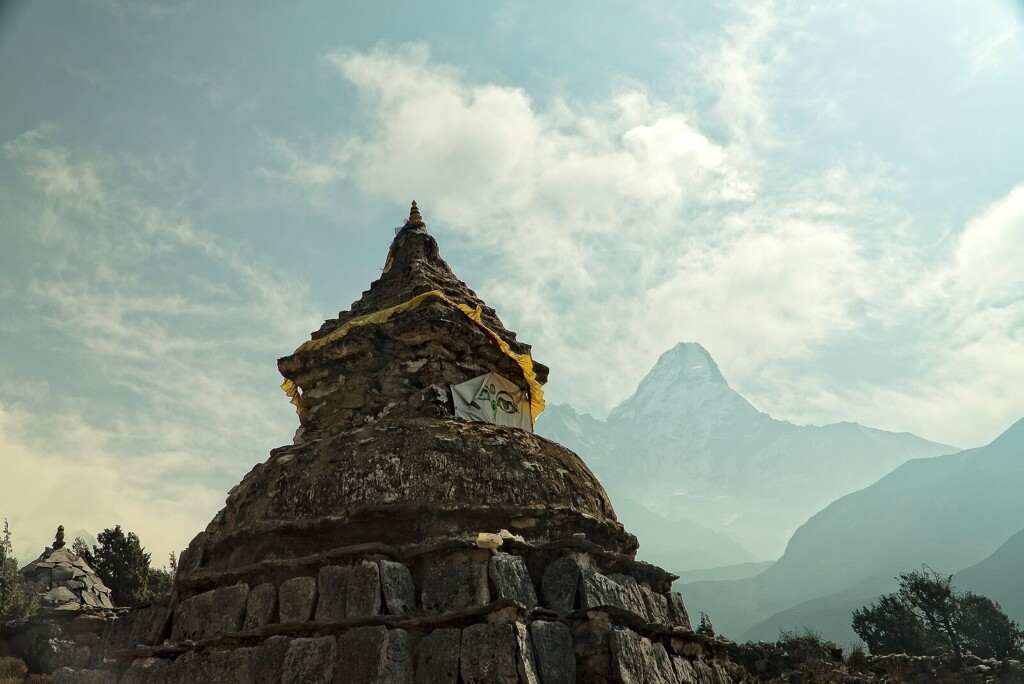
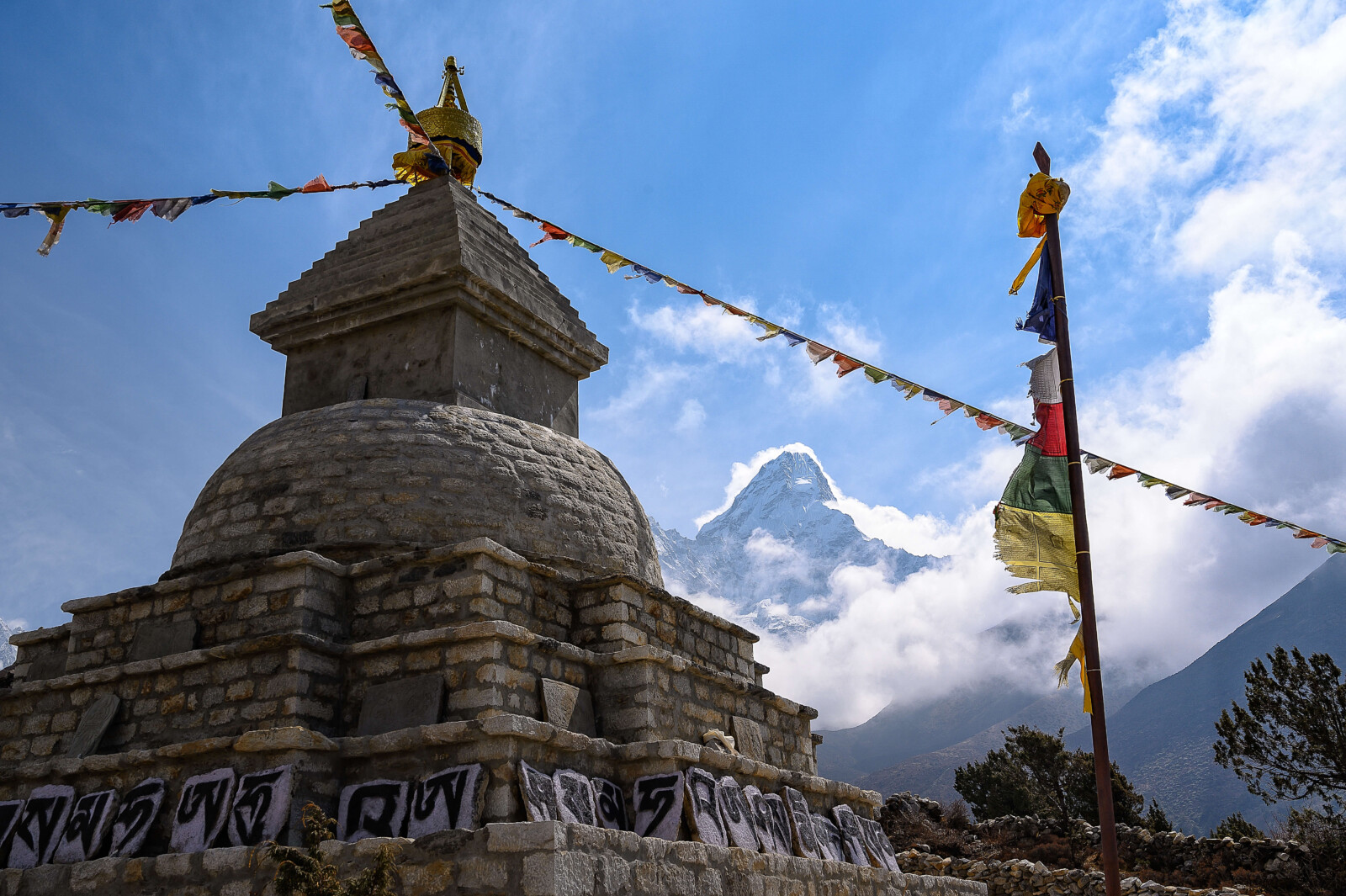
Stupa with Ama Dablam behind on the Everest Base Camp trek, Nepal

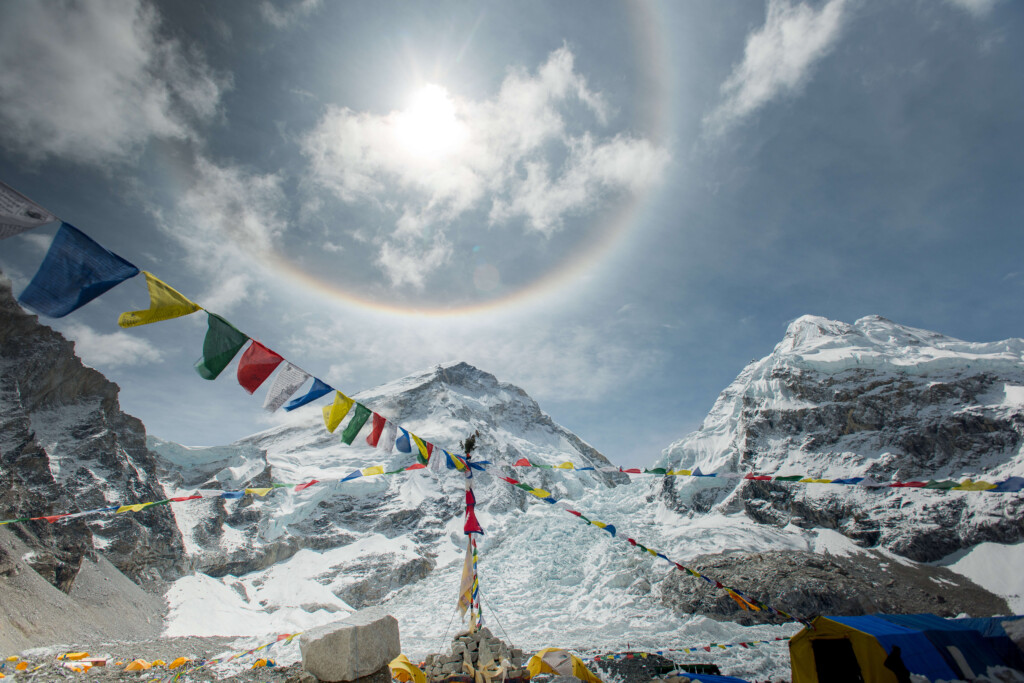
We Run Our Own Expedition on This Mountain

Some companies that sell the Everest Base Camp Trek are booking agents. They take your deposit in one country and hand you to a local operator in another, and nobody from the company you paid ever meets you.

We are an operator. Benegas Brothers Expeditions runs its own Everest expedition on the same mountain your trek walks toward. Same logistics. Same relationships in the same valley, built over many seasons.

Your guides are certified, experienced at altitude, and work this valley season after season. They are with the team from your arrival at Kathmandu airport to your departure transfer, not a crew assembled for the week. You will know who is leading your trek before you leave home.

No One Sleeps at Base Camp on a Trek Now

Since April 2026, Nepal restricts overnight stays at Everest Base Camp to climbers holding permits and their registered expedition staff. Trekkers walk in, spend time there, and return to Gorak Shep to sleep.

We say this plainly because it matters when you compare treks. If a trek you are looking at still advertises a night at Base Camp, ask when that page was last updated, and ask how they plan to deliver it.

What it means for you in practice:

Highest nightGorak Shep, 16,942 ft / 5,164 m, two nights (Days 12 and 13)
Base Camp17,598 ft / 5,364 m, a day visit on Day 13
Kala Patthar18,192 ft / 5,545 m, optional, the best view of Everest on the trek

That is how the trek has always worked for the great majority of the people who do it. Day by Day shows the full schedule.

A Visit to Our Everest Camp

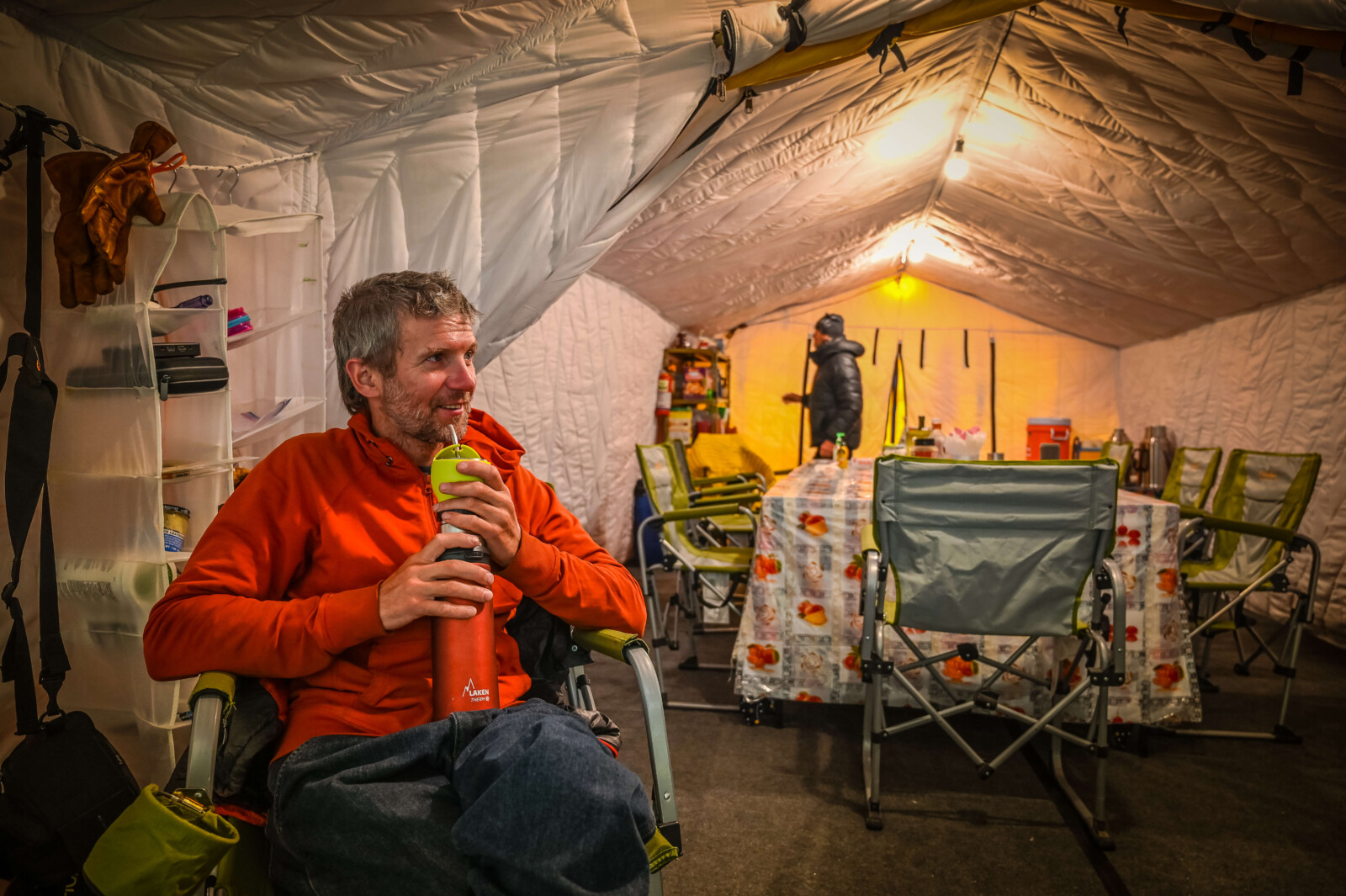
When BBE is running an Everest expedition at the same time as your trek, your Base Camp day includes a visit to our camp, so you spend part of the day inside it rather than looking at it from the moraine.

It means a cup of tea in the dining tent, a meal from our kitchen crew, and time with whoever from our Everest team is in camp that day: what the icefall is doing, how the route is forming, what the next rotation looks like.

If we don’t have an expedition on the mountain that season, we walk around Base Camp and usually run into old friends.

As with every day on the trek, weather and conditions on the day come first.

On fall departures there is no BBE camp on the glacier. Base Camp is the standard day visit, and autumn gives you clear post-monsoon air and quieter trails in return.

The Quieter Line Through the Khumbu

From Lukla (9,301 ft / 2,835 m) the route follows the Dudh Koshi through Phakding into Sagarmatha National Park, then up the long hill to Namche Bazaar (11,286 ft / 3,440 m), where a full day is set aside to let your body catch up.

Then it leaves the main trail. The standard route runs from Namche to Tengboche in a single day. This one climbs instead to the twin villages of Khumjung and Khunde, home to the school and hospital Edmund Hillary built, and traverses a quiet ridge to Phortse, a mountaineering village far less busy than the main trail. It rejoins the classic line at Tengboche, where the monastery sits on a saddle facing Ama Dablam and Everest.
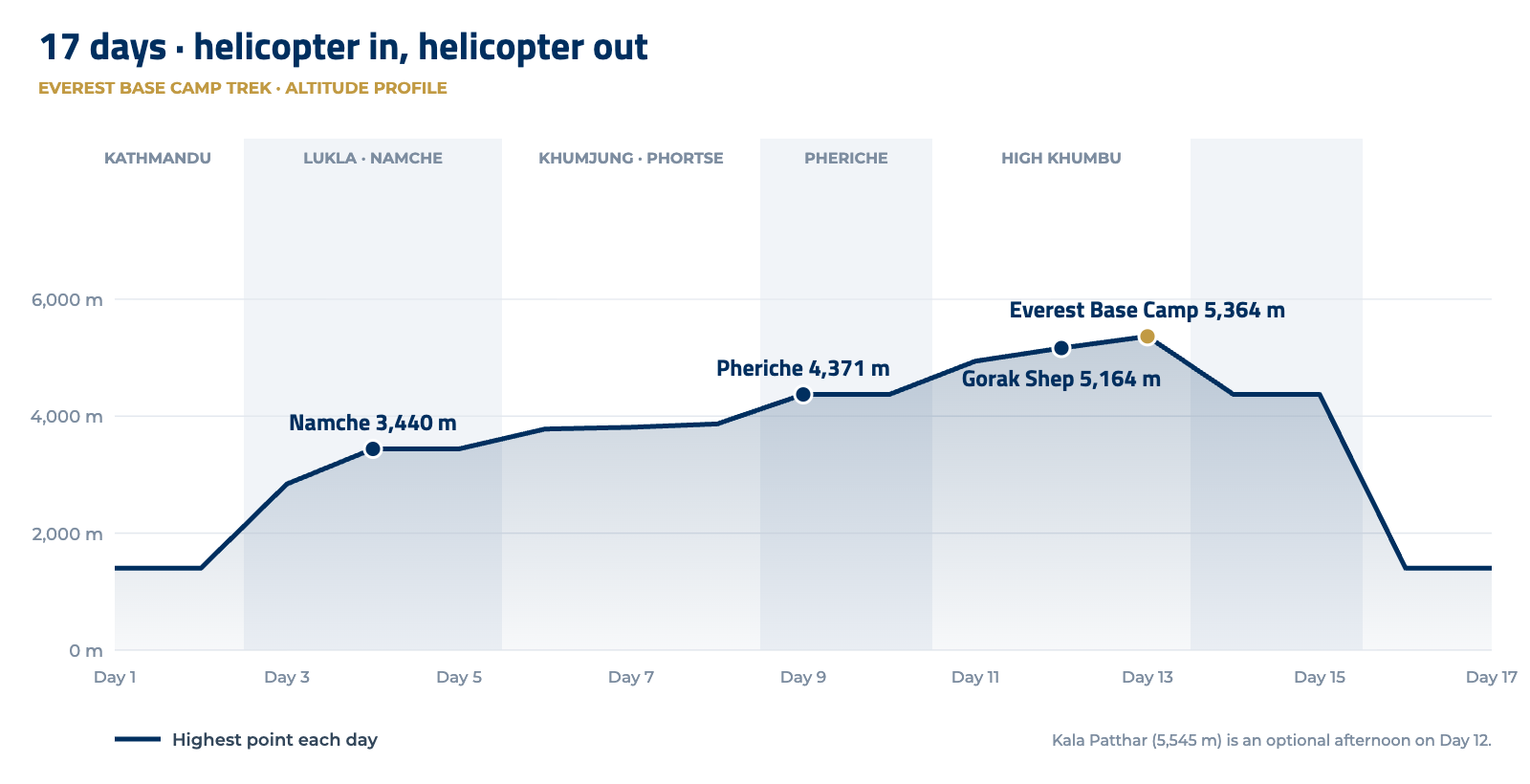
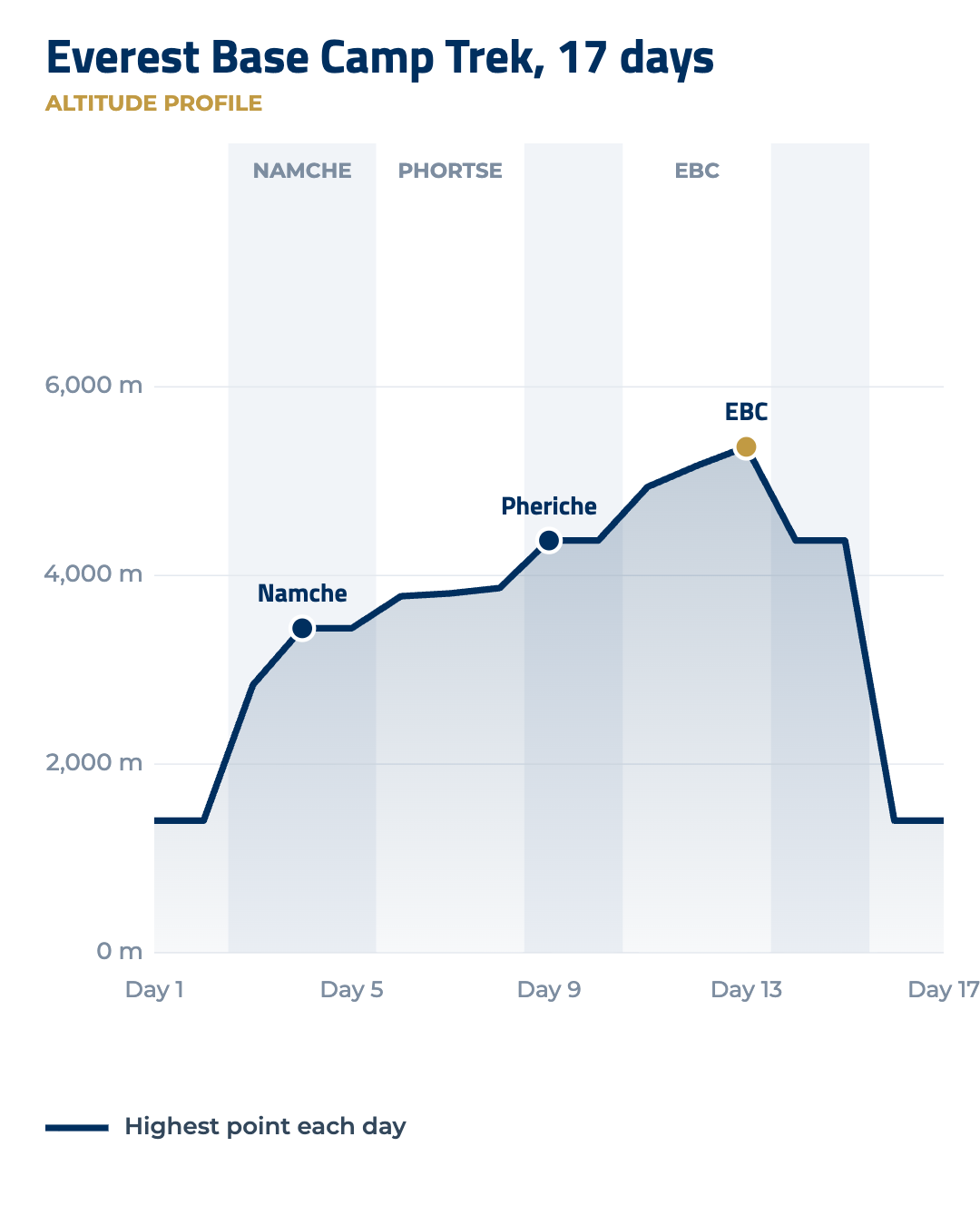
Altitude profile of the 17-day Everest Base Camp Trek: Kathmandu, Lukla, Namche 3,440 m, Khumjung, Phortse, Tengboche, Pheriche 4,371 m, Lobuche, Gorak Shep 5,164 m and Everest Base Camp 5,364 mAltitude profile of the 17-day Everest Base Camp Trek: Kathmandu, Lukla, Namche 3,440 m, Khumjung, Phortse, Tengboche, Pheriche 4,371 m, Lobuche, Gorak Shep 5,164 m and Everest Base Camp 5,364 m
Highest point reached each day. You reach Base Camp during the day and sleep at Gorak Shep. See the full itinerary, day by day.

From Tengboche the trail drops through the rhododendron forest at Deboche and climbs past Pangboche to Pheriche (14,340 ft / 4,371 m): the second acclimatization day, and the site of the Himalayan Rescue Association clinic.

Then it is high country. Lobuche (16,207 ft / 4,940 m), past the memorial stones at Thukla Pass. Gorak Shep, the last settlement before the glacier, with an optional afternoon climb of Kala Patthar for the view of Everest’s southwest face. The next morning you walk the moraine of the Khumbu Glacier to Base Camp, and back to Gorak Shep for the night.

Acclimatization, With Room to Move

Altitude is the single variable that decides whether people finish this trek well, tired, or not at all. The schedule is built around it:

  • Two full acclimatization days, at Namche and at Pheriche
  • A slower line through Khumjung and Phortse instead of a straight run to Tengboche
  • A deliberately unhurried pace above 13,100 ft / 4,000 m
  • A recovery and weather day at Pheriche before the helicopter out

That last day is not filler. Helicopters in the Khumbu fly on weather, and a schedule with no slack turns one cloudy morning into a missed international flight. The day is there so a bad sky costs you nothing, and so the long descent from Gorak Shep is followed by rest rather than a rush to the landing zone.

Maximum Eight Trekkers, Two Guides

Every scheduled departure is capped at eight trekkers, with a 4:1 client-to-guide ratio: two certified guides for a full team of eight. Porters and yaks carry the duffels and lodge staff run the teahouses. We do not count them as guides.

The cap is there for a reason. On this route the guide who notices how you slept, how you are eating, and how your pace changed between Pheriche and Lobuche is the one who catches an altitude problem early instead of late. You will never disappear into the group.

Private treks can be personally led by Willie or Damian Benegas on request, confirmed in writing in the trip terms. See Private & Custom Treks.

If you are comparing operators, compare team size, guide certification and the acclimatization schedule. Those answers tell you more than any price list.

Who This Trek Suits

No climbing experience is required. There is no rope, ice axe or crampon work anywhere on the route. Fitness is required: you need to hike several hours a day, on uneven ground, on consecutive days, at altitude.

If you can put in a full day in the hills with a light pack and get up and do it again the next morning, you have the base to build on. Plan on at least three to four months of training.

Is This for Me? covers training, altitude and an honest readiness check in detail.

Where the Khumbu Can Lead

For many people, walking to Base Camp is a complete objective on its own. For others it is the first look at what high mountains ask of them.

There is no fixed ladder.

Ready to Walk Into the Khumbu?

Tell us where your fitness is, what you have done before, and what you want this trek to be. Every trekker is personally reviewed before booking. If this is the right trip, and the right year, we will say so. If something else should come first, we will say that too.

We don’t simply guide expeditions. We help people build a lifetime in the mountains.

Ask a Guide

See dates & prices · climbing@benegasbrothers.com · benegasbrothers.com
Ask a guide

Day by Day

Everest Base Camp Trek · 17 Days · Kathmandu to Kathmandu

Seventeen days: two in Kathmandu at the start, twelve walking, a recovery day at Pheriche, the helicopter back to Kathmandu, and the flight home.

The schedule is built around acclimatization rather than distance. Two full acclimatization days sit in the route, one at Namche and one at Pheriche, and the pace above 13,100 ft / 4,000 m is deliberately slow. The mileage on paper looks modest. At altitude it does not feel that way, and that is the point.

Duration: 17 days, Kathmandu to Kathmandu
Highest point: Kala Patthar, 18,192 ft / 5,545 m (optional); Base Camp, 17,598 ft / 5,364 m
Highest night: Gorak Shep, 16,942 ft / 5,164 m, two nights
Nights: 3 in Kathmandu, 13 in trail lodges
Meals: all meals on trek from arrival in Lukla; breakfast in Kathmandu

Altitude profile of the 17-day Everest Base Camp Trek: Kathmandu, Lukla, Namche 3,440 m, Khumjung, Phortse, Tengboche, Pheriche 4,371 m, Lobuche, Gorak Shep 5,164 m and Everest Base Camp 5,364 mAltitude profile of the 17-day Everest Base Camp Trek: Kathmandu, Lukla, Namche 3,440 m, Khumjung, Phortse, Tengboche, Pheriche 4,371 m, Lobuche, Gorak Shep 5,164 m and Everest Base Camp 5,364 m
Highest point reached each day. Kala Patthar (18,192 ft / 5,545 m) is an optional afternoon on Day 12.

The 17 Days at a Glance

Each bar shows where you sleep that night. ▲ marks the day’s high point. Tap a day to open it.

In each day below, altitude reads start → high point → where you sleep. Distances and hiking times are estimates.

Climb high, sleep low

Some days climb well above where you sleep. The gap between the day’s high point and the night’s camp is how your body adapts.

Times are estimates

Hiking times change with the team and the conditions. A slow, steady pace is the plan, not a problem.

The plan can flex

Weather, how the team is acclimatizing and your guides’ judgment can change the daily plan. That flexibility is part of the plan.

Good to know

Each day lists distance, moving time, elevation change and where you sleep. These figures are typical, not fixed. Conditions, weather and how the team is moving on the day take priority over the schedule, and your guides will adjust when adjusting is the right call.

In Kathmandu, breakfast is included, plus the welcome dinner on Day 1. On the trail, all meals are included from arrival in Lukla.

Altitude: about 4,600 ft / 1,400 m

Your guides meet you outside the arrivals hall and take you to the Hotel Yak & Yeti. They are with the team from here until your departure transfer on Day 17. In the evening the team gathers for orientation and a welcome dinner: the first time everyone is in the same room.

Arrive as early in the day as you can. It makes Day 1 far more comfortable.

Sleep: Hotel Yak & Yeti, Kathmandu · Meals: welcome dinner

Altitude: about 4,600 ft / 1,400 m

The morning takes in Boudhanath Stupa, Swayambhunath and Pashupatinath, three of the most significant sites in the Kathmandu Valley and useful context for the Buddhist Khumbu you are about to walk through.

The afternoon is the trek briefing and the gear check. Every item comes out of the duffel. This is where a missing layer or the wrong sleeping bag gets found and solved, in a city with gear shops on every corner, rather than at 13,000 ft where it cannot be fixed. It is also where your bag gets checked against the 15 kg / 33 lb helicopter limit.

Sleep: Hotel Yak & Yeti, Kathmandu · Meals: breakfast

Altitude: Lukla 9,301 ft / 2,835 m → Phakding 8,563 ft / 2,610 m · Distance: about 5 mi / 8 km · Moving time: 3–4 hours · Net elevation: −738 ft / −225 m

A helicopter carries you from Kathmandu directly into Lukla. No Ramechhap transfer, no pre-dawn drive, and far less of the delay that comes with fixed-wing traffic into an airstrip that closes whenever the cloud comes in.

You meet the porter team at Lukla, then walk. The first day is deliberately gentle and mostly downhill, following the Dudh Koshi through Ghat and small terraced villages to Phakding. Prayer wheels, mani stones, the river running grey with glacial silt. It is a short day on purpose.

Sleep: teahouse, Phakding, 8,563 ft / 2,610 m · Meals: all

Altitude: 8,563 ft → 11,286 ft / 3,440 m · Distance: about 7 mi / 11 km · Moving time: 5–6 hours · Elevation gain: +2,723 ft / +830 m

The first substantial day. The trail crosses and recrosses the Dudh Koshi on high suspension bridges, enters Sagarmatha National Park at Monjo, and then climbs the Namche Hill: a steady 2,000 ft / 600 m of switchbacks through pine forest. Roughly two-thirds of the way up, on a clear morning, a gap in the trees gives the first view of Everest.

Namche is the commercial heart of the Khumbu: a horseshoe of lodges, bakeries, gear shops and a Saturday market built into the hillside.

Sleep: teahouse, Namche Bazaar, 11,286 ft / 3,440 m · Meals: all

Altitude: 11,286 ft → about 12,730 ft / 3,880 m → 11,286 ft · Distance: about 3 mi / 5 km · Moving time: 2–3 hours · Elevation gain: +1,444 ft / +440 m, returning to Namche

You sleep at Namche a second night and spend the day climbing above it: climb high, sleep low.

The morning hike goes up to the Everest View Hotel for the panorama of Everest, Lhotse and Ama Dablam. The afternoon is free: the Sherpa Culture Museum, the National Park visitor centre, or a bakery and a book.

Rest here is doing real physiological work.

Sleep: teahouse, Namche Bazaar, 11,286 ft / 3,440 m · Meals: all

Altitude: 11,286 ft → 12,402 ft / 3,780 m · Distance: about 3 mi / 5 km · Moving time: 2–3 hours · Elevation gain: +1,116 ft / +340 m

A short day onto the shelf above Namche and into the twin villages of Khumjung and Khunde: the heart of Sherpa community life in the Khumbu, and home to the school and hospital Edmund Hillary built in the 1960s.

The standard route runs straight from Namche to Tengboche. Going this way costs a day and gives you a gentler acclimatization profile and an afternoon in a working Sherpa village rather than on the main trekking trail.

Sleep: teahouse, Khumjung or Khunde, 12,402 ft / 3,780 m · Meals: all

Altitude: 12,402 ft → 12,500 ft / 3,810 m · Distance: about 4.5 mi / 7 km · Moving time: 3–4 hours · Net elevation: +98 ft / +30 m, with a descent and reclimb on the way

A traverse along a high ridge with Ama Dablam and Thamserku across the valley, then a descent to the river and a climb into Phortse.

Phortse is quiet, terraced and far less visited than the main trail. It is home to many of the climbers who work on Everest and the peaks around it, and the Khumbu Climbing Center is here.

Sleep: teahouse, Phortse, 12,500 ft / 3,810 m · Meals: all

Altitude: 12,500 ft → 12,687 ft / 3,867 m · Distance: about 4.5 mi / 7 km · Moving time: 3–4 hours · Elevation change: −820 ft / −250 m, then +985 ft / +300 m

The trail contours around to Phortse Tenga, drops to the river, and climbs through forest to the saddle at Tengboche.

Tengboche Monastery is the spiritual centre of the Khumbu. The monastery sits on an open saddle with Ama Dablam directly opposite and Everest and Lhotse behind. Afternoon prayers are usually open to visitors.

Sleep: teahouse, Tengboche, 12,687 ft / 3,867 m · Meals: all

Altitude: 12,687 ft → 14,340 ft / 4,371 m · Distance: about 6 mi / 10 km · Moving time: about 5 hours · Elevation gain: +1,653 ft / +504 m net

Down through the rhododendron forest at Deboche, across the Imja Khola, and up past Pangboche, the oldest monastery in the Khumbu, into open, treeless high country. The vegetation thins to scrub and then to nothing. The valley widens and the wind picks up.

Pheriche sits in a broad glacial trough. From here on, altitude is the main event.

Sleep: teahouse, Pheriche, 14,340 ft / 4,371 m · Meals: all

Altitude: 14,340 ft, climbing 1,300 to 1,650 ft / 400 to 500 m above the village and returning · Distance: about 3 mi / 5 km · Moving time: 2–3 hours

The second acclimatization day, and the more important of the two.

The morning is a climb on the ridges above the village, typically toward Nangkartshang or the shoulder above Dingboche, depending on conditions and how the team is moving. Then back to Pheriche to sleep. Ama Dablam, Makalu and Island Peak come into view.

Pheriche is also the site of the Himalayan Rescue Association clinic, staffed in season by volunteer physicians. Their afternoon altitude talk is worth an hour of anyone’s time, and the clinic is one reason this village is the right place for a rest day.

Sleep: teahouse, Pheriche, 14,340 ft / 4,371 m · Meals: all

Altitude: 14,340 ft → 16,207 ft / 4,940 m · Distance: about 5.5 mi / 9 km · Moving time: about 5 hours · Elevation gain: +1,867 ft / +569 m

Up the valley to Thukla, then the steep pull onto Thukla Pass: a short, hard climb that most people remember.

The top of the pass is a field of stone memorials to climbers and Sherpas who died on Everest and the surrounding peaks, including Scott Fischer and Babu Chiri Sherpa. It is a quiet place and worth stopping in. From there the trail runs along the lateral moraine of the Khumbu Glacier to Lobuche.

Sleep: teahouse, Lobuche, 16,207 ft / 4,940 m · Meals: all

Altitude: 16,207 ft → 16,942 ft / 5,164 m; optional Kala Patthar 18,192 ft / 5,545 m · Distance: about 3 mi / 5 km · Moving time: about 3 hours, plus 2–3 hours for Kala Patthar · Elevation gain: +735 ft / +224 m, plus +1,250 ft / +381 m optional

A short but demanding morning over glacial moraine to Gorak Shep, a handful of lodges on a sandy flat beside the glacier and the last settlement before Base Camp. This is your base for the next two nights.

The afternoon offers the optional climb of Kala Patthar: steep, slow work above the village to the best view of Everest on this trek. From Base Camp itself the summit is hidden behind Nuptse. From Kala Patthar the whole southwest face stands up in front of you, and in late afternoon light it is the photograph people come for.

It is optional for a reason. If the day has taken more out of you than expected, the right decision is to rest for tomorrow. Your guides may also move Kala Patthar to the following afternoon, depending on weather and how the team is going.

Sleep: teahouse, Gorak Shep, 16,942 ft / 5,164 m · Meals: all

Altitude: 16,942 ft → 17,598 ft / 5,364 m → 16,942 ft · Distance: about 5 mi / 8 km round trip · Moving time: 5–6 hours · Elevation gain: +656 ft / +200 m, returning to Gorak Shep

The day you came for.

You follow the moraine of the Khumbu Glacier to Base Camp, on a route across shifting ice and rock that changes shape year to year, marked by cairns and prayer flags. The icefall is directly above, and on a still morning you can hear it working.

When BBE is running an Everest expedition at the same time, your Base Camp day includes a visit to our camp: tea in the dining tent, a meal from our kitchen crew, and time with whoever from our Everest team is in camp that day. As with every day on the trek, weather and conditions on the day come first.

If not, we walk around Base Camp and usually run into old friends.

Either way you return to Gorak Shep for the night. Since April 2026, Nepal restricts overnight stays at Base Camp to permitted climbers and their registered expedition staff. Your Questions has the detail.

Sleep: teahouse, Gorak Shep, 16,942 ft / 5,164 m · Meals: all

Altitude: 16,942 ft → 14,340 ft / 4,371 m · Distance: about 9 mi / 15 km · Moving time: 5–7 hours · Elevation loss: −2,602 ft / −793 m

The longest descent of the trek, and the day most people feel the change.

You leave after breakfast and drop the full length of the upper valley: past Lobuche, over Thukla Pass and into Pheriche. Nearly 2,600 ft of descent in one push, on tired legs.

It is also the day the altitude lifts. Every hour walking down puts more oxygen in the air, and by Pheriche people are eating and sleeping properly for the first time in days.

Sleep: teahouse, Pheriche, 14,340 ft / 4,371 m · Meals: all

Altitude: 14,340 ft / 4,371 m

A flexible day, built into the schedule on purpose.

Helicopters in the Khumbu fly on weather. An itinerary with no slack is one where a single cloudy morning becomes a missed international flight. This day exists so that a bad sky costs you nothing, and so that the descent from the high valley is followed by rest rather than a rush to the landing zone.

If the weather is clear and you feel strong, it is a free day in the high Khumbu: short walks, the HRA clinic, a bakery, and perhaps the first hot shower in a while.

Sleep: teahouse, Pheriche, 14,340 ft / 4,371 m · Meals: all

Altitude: 14,340 ft → about 4,600 ft / 1,400 m

A morning flight, weather permitting: down the valley you walked up in about forty minutes, with the whole route laid out beneath you and the Everest massif behind.

The afternoon in Kathmandu is yours. Most people spend it in a hot shower, then in Thamel, then asleep.

Sleep: Hotel Yak & Yeti, Kathmandu · Meals: breakfast

Your guides see you onto the airport transfer. The trek ends in Kathmandu.

Meals: breakfast

Weather and Flexibility

Everything above is the plan. In the Khumbu the plan is a starting position, not a promise.

Weather closes helicopter windows. Someone acclimatizes more slowly than expected and needs an extra night lower. A trail section gets rerouted after a landslide. Your guides will change the schedule when changing it is the right call, and the reasoning will always be explained rather than announced.

The buffer sits where it matters most: Day 15 at Pheriche, between the high valley and the helicopter out.

Reaching Base Camp is the goal. Getting everyone there in good shape, and home again in good shape, is the job. For how hard each part feels, read Is This for Me? For hotels and lodges, see Where You’ll Stay.

Your Guide Team

There are two certified guides for a full team of eight, a 4:1 client-to-guide ratio. They are with you from arrival at Kathmandu airport to your departure transfer: pacing the group, running the morning health checks, coordinating porters and lodges, and making the decisions that matter when altitude or weather turns.

They work this valley season after season, and you will know who is leading your trek before you leave home. Porters and yaks carry the duffels, so you walk with a light daypack.

Questions About the Itinerary?

Ask us about any day, any section of trail, or how the schedule would work for you.

Read next: Is This for Me? · Where You’ll Stay · Life on the Trek · Flights & Getting to Kathmandu · Your Questions · Dates & Prices

Ask a guide · See dates & prices · climbing@benegasbrothers.com

Is This for Me?

Everest Base Camp Trek · An Honest Answer, Not a Sales Pitch

This is the page where we tell you the truth rather than sell you the trip.

The Everest Base Camp Trek is achievable for a great many people who have never climbed anything. It is not achievable for everyone who wants to go, and the gap between those two groups is almost never about willpower. It is about preparation, honest self-assessment, and how a particular body handles thin air. Read this before you book, not after.

The Everest Base Camp Trek at a Glance

Technical skillnone required. No rope, ice axe or crampons
Walking daystwelve, usually 4 to 7 hours on the trail
Daypack10 to 15 lbs. Porters and yaks carry the duffels
Highest nightGorak Shep, 16,942 ft / 5,164 m, two nights in a row
Highest pointsBase Camp 17,598 ft / 5,364 m; Kala Patthar 18,192 ft / 5,545 m (optional)
Training timeat least three to four months
FamiliesWelcome
Team sizemaximum eight trekkers, two certified guides (4:1)

What This Trek Actually Asks of You

No climbing skills. There is no technical ground anywhere on this trek. If you can hike, you can do the movement.

Twelve days on your feet. This is the part people underestimate. A single hard day in the hills is very different from twelve of them, on rocky and uneven trail, with tired legs, imperfect sleep, and less oxygen every day.

Four to seven hours of walking on a typical day, with a light daypack. You carry water, layers, camera and snacks.

Two consecutive nights at 16,942 ft / 5,164 m. Gorak Shep is your base for the Base Camp day and the highest sleeping elevation of the trek. Two nights at that altitude is harder than one, and it is the part of the schedule your guides watch most closely. You reach Base Camp and the optional Kala Patthar during daylight and sleep lower both nights.

Simple conditions. Teahouse lodges with basic rooms and shared bathrooms, unheated bedrooms, and cold mornings. Comfortable, but not comfortable in a hotel sense. Life on the Trek explains what a day looks like.

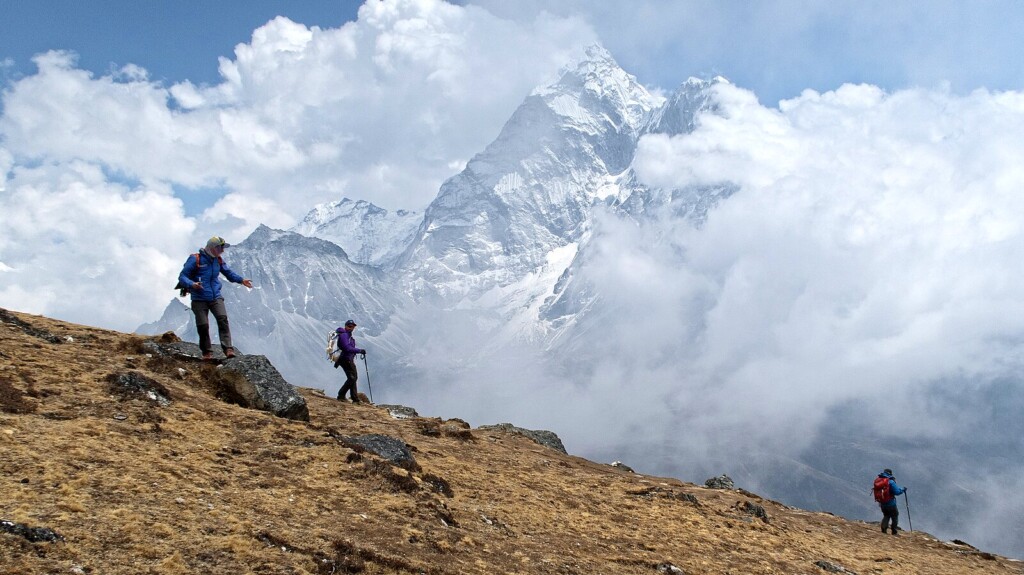
Trekkers on a ridge below Ama Dablam in the Khumbu, Nepal

The Honest Version of Altitude

Altitude is the single biggest factor in whether this trek goes well, and it is largely outside your control.

Fitness helps you walk. It does not determine how you acclimatize. Very fit people get altitude sickness and unremarkable people sail through, and there is no reliable way to predict which one you are until you go up. If you have been high before and know how you respond, tell us. It is genuinely useful information.

Mild symptoms are normal and expected. Headache, poor appetite, broken sleep, breathlessness on small efforts and strange dreams affect most people somewhere above 13,100 ft / 4,000 m. They are uncomfortable, not dangerous, and they usually settle within a day or two as your body adapts.

The serious forms are rare and are treated by going down. High-altitude pulmonary and cerebral edema are the conditions your guides watch for, and the treatment is descent: immediately, without debate, at any hour. Your guide makes that call, and the schedule comes second to it. Recognizing it early is a large part of what you are paying for.

Report symptoms early. Tell your guide about a headache on the day it starts, not three days later when it has become a problem. Every morning your guide runs a health check, including oxygen saturation, and that is the place to say you slept badly or your head hurts. Reported early, there are almost always options. Reported late, there is only one.

We build the schedule around this. Two full acclimatization days, at Namche and at Pheriche. A deliberately slow pace above 13,100 ft / 4,000 m. A recovery day at Pheriche on the way out. And the Himalayan Rescue Association clinic in Pheriche, sitting exactly where the acclimatization day falls.

Altitude medication: talk to your doctor well before departure, not in Kathmandu and not on the trail. It is a decision for you and your doctor, not for us.

Fitness: Can You Do These?

This is not about athletic talent. It is about whether your body keeps working, day after day, when it is tired. Use this as an honest self-check, not a pass/fail test.

  • Hike several hours on consecutive days without excessive fatigue. If back-to-back days feel manageable rather than heroic, you have the base.
  • Carry a 10 to 15 lb pack over real elevation gain at a steady pace. Test it on hills, not on the flat.
  • Get up and do it again the next morning. The consecutive part is what this trek asks for twelve days running.

If you cannot do these yet, that is fine. It tells you how long your training needs to be.

How to Train

Consistency over intensity. Time on your feet over speed. A body that is used to walking uphill for hours, on consecutive days, with a pack.

Start at least three to four months out if you are already reasonably active. Longer if you are starting from a lower base: six months is not excessive, and nobody has ever arrived here over-prepared.

Aerobic base, four to five sessions a week. Build from 30 to 40 minutes up to 45 to 60. Walking, hiking, incline treadmill, stairs or stepmill, and cycling in the early phases. Keep the pace conversational: you should be able to speak in short sentences. That zone is where the adaptations that matter happen.

Hiking is the training. Nothing substitutes for it. Start on moderate terrain, add hills, then add pack weight, working up to 10 to 15 lbs. Focus on steady pacing, efficient footwork and posture rather than pushing hard.

Strength twice a week, 30 to 45 minutes. Squats, step-ups, lunges, light-to-moderate deadlifts, rows, push-ups and overhead presses. Lower body, core and upper back: the muscles that carry a pack and hold you upright at the end of a long day. Work in the 10 to 15 rep range with real attention to form.

Mobility and balance. Five to ten minutes of stretching after every session (hips, hamstrings, calves, quads, lower back), plus single-leg balance work. It keeps small niggles from becoming trip-ending injuries.

The benchmark to aim for. In the final four to six weeks you should be comfortable hiking on consecutive days, sustaining several hours of effort, and carrying a 10 to 15 lb pack over real elevation gain at a steady pace.

Taper the final week. Volume down; rest, hydration and mobility up. You cannot gain fitness in the last seven days. You can absolutely arrive tired.

Our in-house trainer, Gustavo Cevallos, can build you a program around your timeline, your starting point and your schedule. Ask us.

Recommended reading: Training for the Uphill Athlete for the physiology and the programming. The Upside of Stress by Kelly McGonigal, PhD, for the part of this that happens between your ears.

Who Does Well Here

People who train specifically rather than generally. People who walk their own pace instead of racing the group. People who eat and drink when they do not feel like it: appetite disappears at altitude, and eating anyway is a skill. People who report a headache on the day it starts.

And people who understand that the point of the trek is the twelve days, not the last two hours.

Who Struggles

People who arrive undertrained and expect determination to close the gap. It does not, and at altitude it costs more than it does at home.

People who hide symptoms because they do not want to hold up the group or waste the money. This is the single most dangerous behaviour on a trek like this. Tell us early and there are almost always options. Tell us late and there is only one.

People who need control over the schedule. Weather moves, helicopters do not fly, plans change.

Age, Health and Insurance

Age. The minimum age is set by Nepal’s regulations and by insurance: trekkers under 18 climb with a parent or guardian, and each trekker’s insurance must cover their age. Families are welcome: younger trekkers can join a scheduled team with a parent or guardian, or come on a private family expedition built around your family, and if a special permit is needed, we’ll help you apply. There is no upper age limit: preparation matters far more than the number.

Health. Talk to your physician about your fitness for sustained exertion at altitude, and tell us about any underlying condition: cardiac, respiratory, blood pressure, diabetes, recent surgery, or anything else that affects how you manage long days high up. Disclosure is not a disqualification. A condition we know about can be planned around. The same condition surfacing at 16,000 ft is a serious problem for you and for everyone with you.

Insurance. Rescue and evacuation cover is required on this trek, to at least 6,000 m / 19,700 ft, including helicopter evacuation. You can buy it any time, but it must be in place before departure. Travel insurance is strongly recommended, not required. Trip Insurance & Evacuation Coverage has the detail.

Following Guide Decisions

Your guides make the calls that shape the trek: when to slow down, when someone needs an extra night lower, whether Kala Patthar happens on Day 12 or Day 13, and when a trekker should go down.

BBE reserves the right to turn back any trekker we believe is not fit to continue safely. That decision is always about conditions and safety, never about pace or pride. Turning around is a professional decision, not a failure, and this trek only works if you are willing to accept it.

Not Ready Yet? That Is a Plan, Not a Rejection

If this is more than your current base supports, the answer is a season of preparation, not a smaller ambition.

Get multi-day hiking into your legs: consecutive days with a pack, back to back. If you want real altitude experience first, Kilimanjaro with our team gives you high, non-technical days and a genuine sense of how your body handles thin air.

Then come to the Khumbu with the base already built. It is a much better trip that way.

Still Deciding?

Tell us honestly where your fitness is and what you have done before. We will tell you honestly whether this is the right year. We would far rather have that conversation now than at Lobuche.

Ask a Guide

See dates & prices · climbing@benegasbrothers.com · benegasbrothers.com
Ask a guide

Before You Go

Everest Base Camp Trek · Before You Go

Preparing for the Everest Base Camp Trek: Start Here

The trekkers who arrive in Kathmandu relaxed are the ones who sorted their insurance and their gear months ago, not weeks. This page puts your preparation in order: what to do, when, and where to find the details. Handle it early, and your energy in the final weeks goes into training, not logistics.

Three Things to Know Now

Rescue and evacuation cover is required on this trekRequired

To at least 6,000 m / 19,700 ft, including helicopter evacuation. You can buy it any time, but it must be in place before departure. We recommend Global Rescue (add its High-Altitude Evacuation Package) or Ripcord. Travel insurance is strongly recommended, not required.

You fly in and out by helicopter, so you pack to 15 kg / 33 lb15 kg / 33 lb

That is your total, duffel and daypack combined, and it is a safety limit, not a guideline. Everything else waits for you at the hotel in Kathmandu.

The Khumbu runs on cash$700–1,000

Bring a $700 minimum, $700–1,000 recommended, in clean US dollars issued after 2013, with your tips for the team included. The Nepal visa fee is paid in cash on arrival, on top of that.

Your Seven Preparation Guides

Your Preparation Timeline

When you book

  • Through the registration link we email you, complete the reservation form and pay your deposit by the invoice we send; then complete your Registration Form (medical history and emergency contacts), passport copy, Terms & Conditions and Release
  • Check your passport: valid at least six months beyond your return date, with a blank visa page
  • Consider travel insurance now. Pre-existing-condition waivers usually depend on buying soon after your deposit
  • Read the packing list, so your boots and sleeping bag have time to be tested
  • Talk to your physician about altitude, altitude medication and any medical conditions

Any time before departure

  • Buy your rescue and evacuation coverage. You can buy it any time, but it must be in place before departure. Email us the certificate when you have it

120 days before departure

  • Your balance is due. (If you book within 120 days, full payment is due at booking.)

Once you’ve paid in full

  • Send us your proposed flights to Kathmandu, then book them on a changeable fare, and email your final itinerary to climbing@benegasbrothers.com

At least 3–4 months before

  • Structured training under way: at least three to four months, longer from a lower base. See Is This for Me?
  • Break in your boots and test your layers on back-to-back hiking days, working up to a 10–15 lb pack

At least 3 weeks before

  • Tell us about any gear you plan to rent in Kathmandu

In the 15 days before you arrive

  • Complete Nepal’s online arrival / visa form and print the barcode receipt. Not earlier: forms submitted more than 15 days ahead are cleared
  • Install WhatsApp and check it works. It is how we run team communications

The final 2 weeks

  • Do a full pack-out using the packing list, weighed: 15 kg / 33 lb total, both bags
  • Get your cash: clean US dollars issued after 2013 (see What to Budget For)
  • Ease off your training. Arrive rested, not worn out
  • Save copies of your passport, insurance certificate and visa receipt to your phone and the cloud

Arrival day

Your guides meet you outside the terminal at Kathmandu with a BBE sign and take you to the Hotel Yak & Yeti. They stay with the team until your departure transfer on Day 17. That evening the team gathers for orientation and a welcome dinner. Day 2 is the cultural morning and the full gear check, the last point where anything can be fixed in a city with gear shops on every corner. From then on, logistics are our job. Yours is walking.

Still Deciding?

This section assumes you’re going. If you’re still working out whether this is the right year, how you handle altitude, or what happens if you have to turn back, start with Is This for Me? and Your Questions.

If you’d like a shorter first high-altitude trip before the Khumbu, Kilimanjaro is a good step. If you want to learn to climb, look at the Ecuador Mountaineering School. If Base Camp is a goal on the way to the summit, see our Everest expedition. For different dates or your own group, see Private & Custom Treks.

Questions While You Prepare?

Boot choices, sleeping bag ratings, insurance fine print, training doubts, flight timing: ask early. Small questions are easiest to solve months out. See dates & prices · climbing@benegasbrothers.com · benegasbrothers.com
Ask a guide

Your Trek Checklist

Nepal issues a visa on arrival and we arrange your trekking permits, so the paperwork for this trek is lighter than most. A few pieces still take time, and one or two can’t be fixed once you’ve landed in Kathmandu. This page lists everything BBE needs from you, what you arrange yourself, and when.

Your Paperwork at a Glance

Everything BBE needs from you, in the order you’ll do it. Tick items off as you go; your ticks are saved on this device. The details for each item are below.

Step 1At booking, in the registration formDone together with your deposit

Step 2Buy, then send to BBEEmail climbing@benegasbrothers.com

Step 3Arrange and carryNeeded on the trip

At Booking

How booking works. When you ask about the trek, we reply by email with the trip details and a link to our online registration form. Everything in this section is done there.

Reservation form. Your full name, email, date of birth and address, plus any notes for our program staff about your reservation.

Deposit. The reservation form includes a link to pay your deposit. Your place is confirmed once BBE receives it. Amounts and deadlines are on Dates & Prices.

Complete at Booking

Registration Form. Your personal profile, emergency contacts, medical history and trekking experience. Medical information stays within the guiding team and is used to plan for your safety. Be thorough and honest. If you have been to altitude before and know how you respond, tell us: it is genuinely useful.

Passport. A copy of your passport photo page. We use it to arrange your trekking permits.

Terms & Conditions. BBE’s booking, payment and cancellation terms. Read them before you sign.

Release. A liability release acknowledging the inherent risks of high-altitude trekking. Read it carefully. It means what it says.

When: complete these in the registration form at booking, with your deposit.

Send us later. As soon as you have them, email climbing@benegasbrothers.com your international flight itinerary (we use it to set up your airport pickup) and your rescue and evacuation insurance certificate. Rescue and evacuation cover is required on this trek; you can buy it any time, but it must be in place before departure.

Balance payment. Due 120 days before departure. If you book within 120 days of departure, full payment is due at booking.

Trekking Permits: We Handle These

Two permits are required to walk this route: the Sagarmatha National Park entry permit and the Khumbu Pasang Lhamu Rural Municipality permit.

BBE arranges both, and both are included in your trip price. You don’t queue for them, budget for them or carry cash for them. Your passport copy in the registration form is all we need.

The Nepal Visa

Visa on arrival. Nepal issues a tourist visa on arrival at Tribhuvan International Airport in Kathmandu. A 30-day visa covers this trek comfortably. The fee is paid in cash at the airport and is not included in your trip price. Current fees are on Flights & Getting to Kathmandu and What to Budget For.

Complete the online arrival / visa form first, in the 15 days before you arrive. Completing it on Nepal’s official immigration portal and printing the barcode receipt moves you through a much shorter queue after a long journey. Submit it no more than 15 days before arrival: earlier submissions are cleared automatically.

Print the receipt. Immigration officers frequently refuse digital copies shown on a phone.

Health Preparation

See your physician. If you have any condition that altitude, cold or consecutive long days could affect, discuss this trek with your physician before you book, and be open about it in your registration form. Conditions that are well managed at sea level can behave differently at Gorak Shep, 16,942 ft / 5,164 m.

Altitude medication. If you are considering medication to help with altitude, talk to your doctor well before departure, not in Kathmandu and not on the trail. It is a decision for you and your doctor, not for us.

Prescription medications. Bring everything you take, for the full trip plus a few extra days, in your carry-on with copies of your prescriptions.

Vaccinations. None are mandatory for entry to Nepal. Up-to-date polio, tetanus and hepatitis A are worth discussing with your doctor. Check the CDC’s current guidance close to departure, since recommendations change.

First aid. Bring a small personal kit for blisters, minor aches and an upset stomach. Your guides carry team first aid kits.

Training

Start structured training at least three to four months before departure if you are already reasonably active, and longer from a lower base. Hiking is the training: hills, then pack weight, working up to 10–15 lb, and then back-to-back days. Is This for Me? sets out what to build toward, and our in-house trainer, Gustavo Cevallos, can build you a plan around your timeline.

Gear and Rentals

Read the packing list early. Boots and a sleeping bag are the two items that can’t be fixed late. Boots need to be broken in on real training days.

Rentals in Kathmandu. Some bulky items and accessories can be rented in Kathmandu. Tell us at least three weeks before departure so we can reserve them properly. Rentals are paid directly to the shop.

Travel

Passport. Valid at least six months beyond your return date, with at least one blank visa page. Check it today: renewals take longer than people expect.

Flights. A departure is confirmed when we tell you so in writing. Please buy nonrefundable flights only after your departure is confirmed. Book your international flights to Kathmandu once you’ve paid in full, and send us your proposed itinerary before you buy. Favor changeable fares. The helicopter flights inside Nepal are booked by BBE and included.

The Final Two Weeks

  • Complete the online arrival / visa form and print the barcode receipt
  • Do a full pack-out using the packing list, weighed: 15 kg / 33 lb total, duffel and daypack combined
  • Get your cash in clean US dollars issued after 2013 (see What to Budget For)
  • Install WhatsApp and check it works
  • Ease off your training. Arrive rested, not worn out
  • Save copies of your passport, insurance certificate and visa receipt to your phone and a cloud account, and carry paper copies separate from the originals

Bring With You to Nepal

Keep all of this in your carry-on:

  • Passport, valid six months beyond your return date, with a blank visa page
  • Printed barcode receipt from the online arrival / visa form
  • Two passport photos, 1.5 × 1.5 in, white background
  • The visa fee in cash, in clean US dollars issued after 2013
  • Printed flight itinerary, and our contact and emergency numbers
  • Rescue and evacuation insurance certificate and your insurer’s 24-hour emergency number
  • Prescription medications and copies of prescriptions

Arrival Day

Your guides meet you outside the terminal at Kathmandu with a BBE sign and take you to the Hotel Yak & Yeti. They stay with the team until your departure transfer. Orientation and a welcome dinner follow that evening. Day 2 is the cultural morning and the full gear check, with Kathmandu’s gear shops still on hand if anything is missing. From then on, logistics are our job. Yours is walking.

Questions?

Paperwork is the least interesting and most fixable part of preparing for a trek. Ask early. Back to Before You Go · climbing@benegasbrothers.com · benegasbrothers.com
Ask a guide

Trip Insurance & Evacuation Coverage

This trek sleeps two nights at Gorak Shep, 16,942 ft / 5,164 m, and the optional hike to Kala Patthar reaches 18,192 ft / 5,545 m. Many travel policies exclude trekking above a set altitude, and the exclusion is usually buried in the fine print, which means they exclude this trip. This page explains the two kinds of cover, which one is required, and how to confirm yours before you rely on it.

Required by BBERescue and evacuation coverage

Required on every BBE international expedition. It pays to get you off the mountain and to proper medical care. The coverage it must include for this trip is listed below.

Strongly recommendedTrip insurance

Protects the money you’ve spent if illness, a family emergency or a travel disruption stops or cuts short your trip.

Rescue and Evacuation Coverage: Required

Rescue and evacuation cover is required on this trek, to at least 6,000 m / 19,700 ft, including helicopter evacuation. You can buy it any time, but it must be in place before departure, and we ask for your certificate before you fly. It pays for rescue, emergency treatment and transport to medical care if you’re injured or ill in the mountains. Without it, you are responsible for every cost of your own evacuation and treatment, and your standard health insurance almost certainly won’t cover mountain rescue in Nepal.

Your policy must cover all of the following:

  • Altitude: trekking to at least 6,000 m / 19,700 ft. That gives headroom above Kala Patthar.
  • Helicopter evacuation, stated explicitly in the policy. In the Khumbu, a helicopter is the only realistic way out quickly.
  • Activity: high-altitude trekking, with no activity exclusion.
  • Destination: Nepal, for your full travel dates.
  • Medical treatment and transport: emergency treatment, including hospital care in Kathmandu, and onward medical transport or repatriation if needed.
  • 24-hour emergency assistance that can coordinate an evacuation in real time.

Trip Insurance: Strongly Recommended

Travel insurance is strongly recommended, not required. Comprehensive trip insurance covers trip cancellation and interruption, flight delays and missed connections, lost or delayed baggage, and medical costs while traveling.

It matters on this trek for a specific reason. Helicopters in the Khumbu fly on weather. The schedule holds a recovery day at Pheriche for a poor flying morning, but if a genuinely extended delay occurs, extra nights and rebooking your international flight are your cost. BBE’s cancellation terms are also based on how much notice you give, and refunds are not given for illness, altitude illness, missed flights, weather delays or leaving the trek early (see Dates & Prices). In many of those situations, trip insurance is the only way to recover your costs.

Rescue cover and trip insurance are often sold separately, and buying one doesn’t give you the other.

When to Buy

Rescue and evacuation coverage: you can buy it any time, but it must be in place before departure. Buying it a few months out leaves time to fix any gap in the altitude or helicopter clauses.

Trip insurance: soon after your deposit. Some benefits, such as pre-existing-condition waivers and Cancel for Any Reason options, are only available for a limited time after your first trip payment. Check your provider’s rule.

What to Confirm With Your Insurer

Before you buy, give the provider this description:

“I will take part in a professionally guided trek to Everest Base Camp in the Khumbu region of Nepal. It includes helicopter flights from Kathmandu to Lukla and from Pheriche to Kathmandu, twelve days of trekking between teahouse lodges, two nights at Gorak Shep at 16,942 ft / 5,164 m, a day visit to Everest Base Camp at 17,598 ft / 5,364 m, and an optional hike to Kala Patthar at 18,192 ft / 5,545 m. There is no technical climbing, rope, ice axe or crampon use.”

Then ask them to confirm in writing:

  • The maximum altitude covered, and that it is at least 6,000 m
  • That helicopter evacuation is included
  • That high-altitude trekking is not excluded
  • The coverage limits for evacuation and for medical treatment
  • How to reach their emergency assistance line from Nepal, and whether you must call before an evacuation
  • Whether pre-existing conditions are covered, and what the purchase deadline is

If they won’t clearly confirm those points, choose another policy. Policies change, so ask again if you renew.

Providers We Recommend

We recommend Global Rescue or Ripcord. With Global Rescue, add the High-Altitude Evacuation Package; standard membership covers field rescue only to 15,000 ft / 4,600 m, below Lobuche, Gorak Shep and Base Camp. Whichever you choose, confirm the plan covers helicopter evacuation to at least 6,000 m / 19,700 ft. You may use any provider whose policy meets every point above.

What to Send Us

Email your rescue and evacuation certificate to climbing@benegasbrothers.com as soon as you buy it. It should show the provider, policy or membership number, coverage dates and the 24-hour emergency number. Your guides carry these details on the trail. Keep a copy on your phone and a paper copy in your daypack.

BBE doesn’t sell insurance and can’t interpret or guarantee an individual policy.

What Evacuation Actually Involves

Insurance up here is not passive. If a trekker becomes sick or injured, the guide team assesses the situation and decides on the safest practical response. That can include first aid, descending with a member of the team to a lower village, a visit to the Himalayan Rescue Association clinic at Pheriche, or a helicopter evacuation to Kathmandu. Descent is the treatment for serious altitude illness, and it happens immediately, at any hour.

You or your guide must contact your provider as soon as possible to secure authorization. Many insurers require notification before, or immediately after, an evacuation for the claim to stand.

Helicopters in the Khumbu fly on weather, and a flight is never guaranteed. Cloud, wind and aircraft availability all limit when a helicopter can reach you, and sometimes the first part of an evacuation is on foot, downhill. Your policy must cover a helicopter for the times one can fly. Don’t plan around it.

Keep documentation as you go: written confirmation of any airline or helicopter delay, itemized receipts for extra hotels, meals or transport, and medical reports from any clinic that treats you. Claims are far smoother with paperwork than without.

Your financial responsibility. Rescue providers and hospitals may ask for payment before they act, even when you’re insured. Travel with a credit card with real available credit, and save your policy number, emergency number and claim instructions offline. Any cost your insurance doesn’t pay remains yours.

BBE doesn’t control rescue services, aircraft, hospitals or insurance decisions. What good coverage does is take cost out of the decision and get you to proper care quickly.

Questions About Your Policy?

Send us what your insurer told you, and we’ll tell you if anything looks missing. We can’t approve a policy for you, but we can point out the gaps we see most often. Back to Before You Go · climbing@benegasbrothers.com · benegasbrothers.com
Ask a guide

Flights & Getting to Kathmandu

On this trek you arrange one thing: getting yourself to Kathmandu and home again. Everything after the airport is ours, including the transfers, the hotel and both helicopter flights. Two things on this page shape the whole trip: when you book your flights, and the weight limit you pack to. Get both right and the rest of your travel is uneventful, which is exactly what you want.

Before You Book

A departure is confirmed when we tell you so in writing. Please buy nonrefundable flights only after your departure is confirmed. Book your international flights once your place is confirmed and you’ve paid in full. Send us your proposed itinerary before you buy, so we can match your airport pickup to it and flag any connection that looks too tight. Book with your full legal name exactly as it appears in your passport, and favor a changeable fare: it is worth the modest difference on a trip that runs on mountain weather.

Flying to Kathmandu

Fly into Tribhuvan International Airport, Kathmandu (KTM). Kathmandu is served through the Gulf hubs, Delhi, Bangkok and Singapore. Spring and autumn are both high season for Nepal, so fares climb in the final weeks before departure. Book as soon as you’ve paid in full.

When to Arrive and When to Leave

Arrive on Day 1, as early in the day as you can. Day 1 includes orientation and a welcome dinner, and a late-evening landing means going straight into both after a very long journey. Arriving a day early gives you a margin against a missed connection or a delayed bag; we can help you book the extra night.

Fly home on Day 17. Depending on your routing, you may land at home the same day or the next. If you have a critical commitment the day after you get home, add a day. The Day 15 recovery day at Pheriche exists because helicopters don’t always fly, and a flexible ticket is cheap protection if the weather runs longer than that.

Entering Nepal

Visa on arrival. Nepal issues a tourist visa on arrival at Tribhuvan International Airport, paid in cash at the airport. A 30-day visa covers this trek comfortably. Fees as of 2026, set by Nepal’s Department of Immigration:

  • 15 days: $30
  • 30 days: $50
  • 90 days: $125

Pay in US dollars, with clean notes issued after 2013. Fees change, and we confirm the current figure with you before departure.

Complete the online arrival / visa form in the 15 days before you arrive. Use Nepal’s official immigration portal, nepaliport.immigration.gov.np, no more than 15 days before arrival. Submit it earlier and the system clears it. You receive a submission receipt with a barcode: print it. Immigration officers frequently refuse digital copies shown on a phone.

The arrival sequence.

  1. Payment counter first. Skip the kiosks, go straight to the bank counter, pay in cash and keep the receipt.
  2. Immigration. Join the Visa on Arrival line with your passport, payment receipt and printed barcode.
  3. Check your dates before you walk away. Errors on the stamp are painful to correct afterwards.

Your passport. Valid at least six months beyond your return date, with at least one blank visa page. Your Trek Checklist lists everything to carry.

Inside Nepal: Helicopter In and Out

Both flights inside Nepal are by helicopter, and both are included:

  • Day 3: Kathmandu to Lukla, 9,301 ft / 2,835 m, flying direct from Kathmandu. You meet your porters and walk to Phakding the same day.
  • Day 16: Pheriche, 14,340 ft / 4,371 m, to Kathmandu, about forty minutes down the valley you walked up.

Why not the usual fixed-wing flight to Lukla? In peak season, scheduled flights to Lukla move out of Kathmandu to Ramechhap. That means a pre-dawn drive followed by a wait for weather, and delays of one to three days are common. Flying direct by helicopter removes the drive and most of that delay. Flying out from Pheriche also saves three days of walking back down a valley you have already walked up.

If the Helicopter Can’t Fly

Helicopters in the Khumbu fly on weather, and occasionally they don’t fly at all. That is why the schedule holds a recovery and weather day at Pheriche on Day 15, between the descent from Gorak Shep and the flight out. A poor weather morning costs you a comfortable rest day, not your flight home.

If a genuinely extended delay occurs, additional nights and any rebooking of your international flight are your responsibility. That is what travel insurance is for, and why a changeable ticket is worth having. Your guides will keep you informed and look after the team on the ground while we wait for the weather.

The 15 kg Limit: Read This Before You Pack

Because we fly by helicopter, weight is a strict safety limit rather than a guideline.

Your total is 15 kg / 33 lb per person, duffel and daypack combined, on both helicopter flights.

Everything you bring has to earn its place, and anything not going to the mountains stays in secure storage at the Hotel Yak & Yeti. Organize your luggage into three roles before you leave home:

1. The checked bag. Your bulk gear: sleeping bag, poles, most of your clothing. Use a durable, water-resistant duffel rather than a hard suitcase; it becomes your trek bag, handled by porters and carried by pack animals. Pack it assuming you may not see it for 24 hours.

2. The carry-on. The same backpack you will use on the trail. It never leaves you: passport, documents, cash, all medication, a full change of trekking clothes and your electronics.

3. The Kathmandu bag. Not a third bag at the airport, but the part of your kit you set aside at the hotel: clean clothes for after the trek, extra toiletries, anything with no purpose at altitude. It waits in storage while you’re in the Khumbu.

BBE tip

Wear your boots on the plane. It helps your weight allowance, and it means the one item you can’t replace, broken-in boots, arrives when you do.

On Day 2 we weigh and reorganize everything into its final trekking configuration. The Everest Base Camp Trek Packing List has the detail.

Arriving in Kathmandu

Baggage takes 30 to 60 minutes. This is normal. Make your bags easy to spot: name tags, colored ribbon, anything distinctive.

Clear customs through the Green Channel unless you have something to declare.

As you exit, people will offer to carry your luggage. Politely decline. They are not airport staff, and the help usually comes with an unexpected fee.

Your guides wait outside the terminal with a BBE sign, and they stay with the team until your departure transfer. Missed pickups are very rare. If you don’t spot them immediately, stay in the arrivals area and keep looking rather than wandering off. It is crowded and slightly chaotic, and that is normal. If you have waited 45 minutes with no contact, make your own way to the Hotel Yak & Yeti and our team will reconnect with you there.

Airport transfers in Kathmandu are included on arrival and departure. There is no need to tip your driver or the airport representative.

Setting Up Communications

Install WhatsApp before you fly and check it works. It is our main communication tool throughout the trek, and we set up a group chat for your team once everyone is in Kathmandu. Kathmandu airport has free Wi-Fi, so you can connect the moment you land.

For cellular service, buy a local SIM at the airport or in Thamel; you need a passport copy and a photo. Ncell and Nepal Telecom both have solid coverage in the city. Set it up and test it in Kathmandu, because troubleshooting gets much harder on the trail.

If Something Goes Wrong

Flight delayed or connection missed. Contact us right away at climbing@benegasbrothers.com, before you rebook if you can. Our Kathmandu team can move a pickup or rearrange a transfer far more easily with notice. Your Kathmandu operations contact and in-country number are in your trip documents.

Bag delayed. Report it to the airline before you leave the airport, then tell us. With your boots, medications and a change of trekking clothes in your carry-on, most other items can be borrowed, rented or bought in Kathmandu before the Day 3 flight.

Keep written confirmation of any delay. Your insurer will ask for it.

Questions Before You Book?

A quick email now saves rebooking fees later. Back to Before You Go · climbing@benegasbrothers.com · benegasbrothers.com

Ask a guide

Where You'll Stay

Two kinds of accommodation across seventeen days: a proper hotel in Kathmandu at each end, and family-run teahouse lodges through the Khumbu. That is three hotel nights and thirteen lodge nights, two of them at Gorak Shep, the highest. Knowing what each one is actually like is most of what you need to enjoy them.

Night by Night

  • Night 1 (Day 1): Hotel Yak & Yeti, Kathmandu, about 4,600 ft / 1,400 m
  • Night 2 (Day 2): Hotel Yak & Yeti, Kathmandu
  • Night 3 (Day 3): teahouse, Phakding, 8,563 ft / 2,610 m
  • Night 4 (Day 4): teahouse, Namche Bazaar, 11,286 ft / 3,440 m
  • Night 5 (Day 5): teahouse, Namche Bazaar, acclimatization day
  • Night 6 (Day 6): teahouse, Khumjung or Khunde, 12,402 ft / 3,780 m
  • Night 7 (Day 7): teahouse, Phortse, 12,500 ft / 3,810 m
  • Night 8 (Day 8): teahouse, Tengboche, 12,687 ft / 3,867 m
  • Night 9 (Day 9): teahouse, Pheriche, 14,340 ft / 4,371 m
  • Night 10 (Day 10): teahouse, Pheriche, acclimatization day
  • Night 11 (Day 11): teahouse, Lobuche, 16,207 ft / 4,940 m
  • Night 12 (Day 12): teahouse, Gorak Shep, 16,942 ft / 5,164 m, after the optional hike to Kala Patthar
  • Night 13 (Day 13): teahouse, Gorak Shep, 16,942 ft / 5,164 m, after your day at Base Camp
  • Night 14 (Day 14): teahouse, Pheriche, 14,340 ft / 4,371 m
  • Night 15 (Day 15): teahouse, Pheriche, recovery and weather day
  • Night 16 (Day 16): Hotel Yak & Yeti, Kathmandu, after the helicopter out
  • Day 17: departure

Kathmandu: Hotel Yak & Yeti

Three nights included: your first two nights before the trek and one night on your return.

The Yak & Yeti is a historic five-star hotel in central Kathmandu. It has the things that matter after a long flight and after two weeks in the mountains: a proper bed, reliable hot water, good food, dependable Wi-Fi and secure storage for the gear you leave behind.

Breakfast is included. Lunches and dinners in Kathmandu are not, apart from the welcome dinner on Day 1. What to Budget For covers them.

Storage. The hotel holds your Kathmandu bag in secure storage the whole time you are in the Khumbu, and it is waiting when you fly back in.

Extra nights. If you want a day or two either side of the trek, we can arrange extra nights at the same hotel, at your cost.

Room Sharing and Single Rooms

Room sharing. Rooms are double occupancy as standard, at the hotel and on the trail, where teahouse rooms are twin-share. If you’re traveling alone, we do our best to pair you with another member of the team.

Single rooms. Single rooms are available on request; we’ll quote the cost when you ask. Request one when you book.

One honest limitation, and what we do about it. A private room is straightforward at the Hotel Yak & Yeti and through the lower and middle valley. At Gorak Shep, and sometimes at Lobuche, the lodges are small and simply built, and single rooms are often not available. If we can’t give you a single room on a night you’ve paid for, we refund that portion. We would rather return the money than charge you for something you didn’t get.

On the Trail: Teahouse Lodges

The teahouse network is what makes this trek possible: small, family-run lodges providing shelter, food and a place to recover each evening. They are working homes and community spaces, not hotels.

Rooms are twin-share, simply built and unheated at every elevation. Walls are thin. This is why your sleeping bag rating matters. Lodge blankets are extra insulation on top of your own bag, not a substitute for it.

The common room is the heart of the lodge, and usually the only heated space, warmed by a central bukhari stove. It is where everyone gathers in the afternoon and evening for tea, meals and the daily briefing, and where many of the trek’s best conversations happen.

Standards drop as you climb, and that is the environment, not a failure of it. Namche has bakeries, hot showers and Western-style flush toilets. Higher up you’ll find squat and long-drop toilets, thinner walls and colder nights.

Extras are pay-as-you-go. Wi-Fi, device charging and hot showers all cost money, vary lodge by lodge and get more expensive with altitude. Above about 13,100 ft / 4,000 m, most trekkers stop showering and switch to a wash-cloth routine. Life on the Trek has the detail.

Gorak Shep: Your Highest Nights

Two nights at 16,942 ft / 5,164 m, on Days 12 and 13, with your Base Camp day in between.

Gorak Shep is a handful of lodges on a sandy flat beside the Khumbu Glacier. It is the most basic accommodation on the route: simple rooms, thin walls and genuinely cold nights. It is also the last settlement before Base Camp.

Two consecutive nights at this elevation are the hardest part of the trek for most people. Expect broken sleep. It is normal, your guides expect it, and it ends when you start walking downhill on Day 14.

No Overnights at Base Camp

Trekkers can’t sleep at Everest Base Camp. Since April 2026, Nepal restricts overnight stays at Base Camp to climbers holding permits and their registered expedition staff. That applies to every trekking group, not only ours.

You reach Base Camp, 17,598 ft / 5,364 m, on a day visit on Day 13 and walk back to sleep at Gorak Shep. When BBE is running an Everest expedition at the same time, your Base Camp day includes a visit to our camp: tea in the dining tent, a meal from our kitchen crew, and time with whoever from our Everest team is in camp that day. As with every day on the trek, weather and conditions on the day come first. If not, we walk around Base Camp and usually run into old friends.

If you see a trek advertising a night at Base Camp, that information is out of date.

What “Comfortable” Means Here

We select clean, safe, well-run places to sleep. In Kathmandu that means genuine comfort. In the Khumbu it means warm food, a dry room and people who look after you well.

If you arrive expecting hotel standards above Namche, you’ll be disappointed. If you arrive expecting a working mountain valley that has hosted travelers for generations, you’ll enjoy every night of it.

Questions About Where You’ll Stay?

Back to Before You Go · climbing@benegasbrothers.com · benegasbrothers.com
Ask a guide

Life on the Trek

“Take care of the mountain, and the mountain will take care of you.” It is the Benegas Brothers’ motto, and the rule we climb by.

Base Camp is one day. The trek is seventeen.

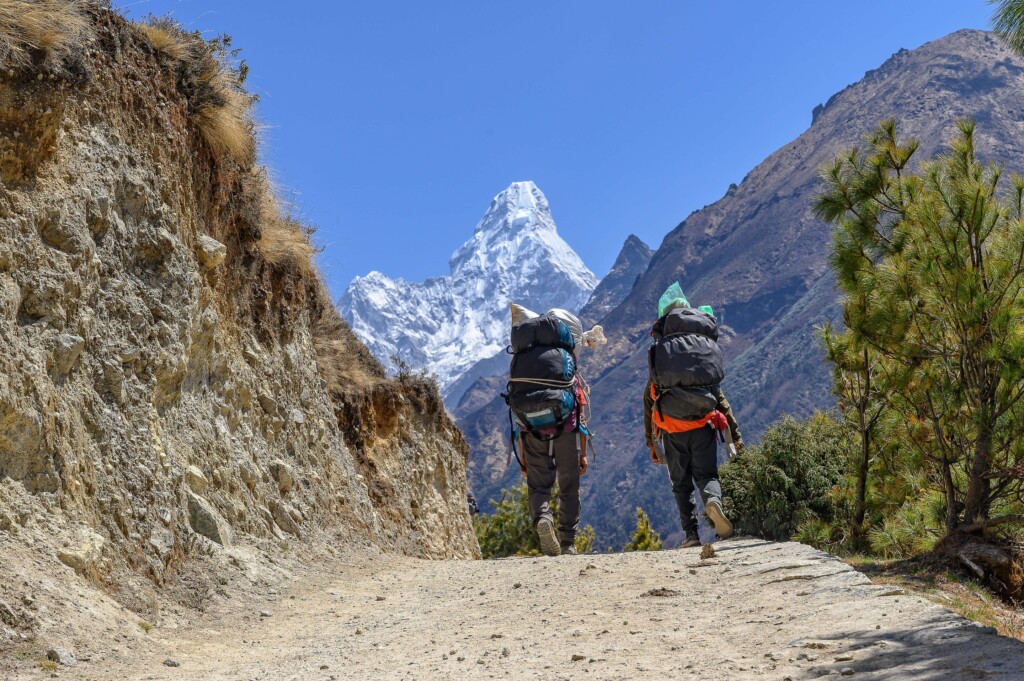
Trekker on the trail below Ama Dablam, Khumbu

What separates trekkers who thrive from those who merely get through is not fitness alone. It is how they handle the daily realities: eating when appetite fades, sleeping poorly at altitude, keeping their kit organized in a cold lodge room, and telling their guide early when something feels wrong.

Here is what twelve days of walking in the Khumbu actually look like, and how to prepare for them.

The Daily Rhythm

06:30–07:00: Pack and sort. Your duffel is packed and locked before you go to breakfast. Everything you need for the day moves into your daypack.

07:00–07:30: The hand-off. The duffel goes to the collection point before you sit down to eat. This deadline is firm. Porters and pack animals need to move ahead of the team, and a late bag holds up everyone.

07:30–08:30: Breakfast and briefing. Fuel up while your guide runs the morning health check and briefs the team on the day’s trail and altitude plan.

08:30–15:30: Walking. Daypack only. Steady pace, regular stops, tea somewhere in the middle.

15:30–16:30: Arrival and recovery. Your duffel is waiting. Change into dry clothes, drink something hot, rest.

Evenings are spent in the common room around the stove: tea, dinner, cards, conversation and an early night. Most people are in their sleeping bags by 20:30 and sleep better for it.

Two acclimatization days break the walking, at Namche on Day 5 and Pheriche on Day 10. You climb high in the morning and come back down to sleep. Rest on those days is doing real work.

The Morning Health Check

Every morning at breakfast, your guide checks each trekker, including oxygen saturation with a pulse oximeter. It takes a couple of minutes, and it is the most useful conversation of the day. This is where you say if you slept badly, your head hurts or you couldn’t eat dinner.

Your guide is also watching all day: pace, breathing, appetite, energy, sleep and mood. Those observations, together with the morning numbers, drive every decision on the trail.

Report Symptoms Early

Mild symptoms are normal. Headache, poor appetite, broken sleep, breathlessness on small efforts and strange dreams affect most people somewhere above 13,100 ft / 4,000 m. They are uncomfortable, not dangerous, and usually settle within a day or two as your body adapts.

Tell your guide right away, without waiting to see if it gets better, if you have:

  • A headache that doesn’t ease with water and rest
  • Nausea or vomiting
  • Dizziness, confusion or loss of coordination
  • Shortness of breath at rest
  • Unusual tiredness
  • Chest tightness or a persistent cough

The serious forms are rare, and they are treated by going down: immediately, at any hour, without debate. Your guide makes that call, and the schedule comes second to it. Turning around is a professional decision, not a failure.

Hiding symptoms is the most dangerous thing anyone does on this trek. People do it because they don’t want to hold up the group or waste the money. Reported early, there are almost always options: a slower day, an extra night lower down, descending with a member of the team to wait for the group. Reported late, there is only one. A small problem on Day 6 stays small. The same problem reported on Day 10 is a different conversation.

Medical support on the route. Your guides are trained in wilderness first response and carry team first aid kits. The Himalayan Rescue Association clinic at Pheriche is staffed in season by volunteer physicians. Their afternoon altitude talk is worth an hour on the Day 10 acclimatization day.

Food and Eating at Altitude

All meals on the trek are included from arrival in Lukla. Meals are cooked fresh in small lodge kitchens: dal bhat, noodles, soups, potatoes, eggs, porridge, and some very good bakery food in Namche. It is hearty, and repetitive in a way you stop minding. Ordering together as a group and allowing time for cooking keeps everything running.

Go vegetarian above Namche. Meat is carried into the region without refrigeration and is often several days old by the time it reaches the higher villages. This is standard practice for guides and experienced trekkers, and it is the easiest way to avoid a stomach problem at 14,800 ft / 4,500 m.

Eat even when you don’t want to. Appetite fades at altitude, exactly when your body needs fuel most. Eating anyway is a skill, and it makes a real difference by Day 12.

Dietary needs. We accommodate most requirements, including vegetarian, vegan and gluten-free, with notice. Tell us when you book rather than on the trail: the kitchens are small and the supply chain is a yak.

Water and Hot Drinks

Hydration is one of your best defenses against altitude symptoms. Drink steadily all day, starting before you feel thirsty. Our team filters or boils drinking water. Carry two to three 1-liter bottles to fill; bottled water is sold higher up, but it gets expensive and adds to the waste the valley has to carry out.

BBE tip

Order a large thermos of tea for the table rather than individual cups. It is cheaper, it stays warmer, and it keeps everyone drinking.

Sleeping at Altitude

Light sleep, vivid dreams and waking in the night are common above 13,100 ft / 4,000 m. The two nights at Gorak Shep, 16,942 ft / 5,164 m, are the hardest, and they are why the days below are deliberately unhurried.

  • Bedrooms are unheated at every elevation. Your sleeping bag is how you recover, not a comfort item.
  • Put tomorrow’s layers inside your sleeping bag so they’re warm in the morning.
  • Sleep with your phone and camera batteries in your bag. Cold flattens them overnight.
  • Keep your headlamp within reach, and bring earplugs: lodge walls are thin.

Hygiene, Showers and Toilets

Showers are available at lower elevations for a fee. Above about 13,100 ft / 4,000 m most people stop and switch to wet wipes and a wash cloth. Getting wet and cold at altitude is a real way to get ill.

Toilets range from Western-style flush in Namche to squat and long-drop higher up. Never flush toilet paper. It goes in the bin provided. A blockage in a village with no plumbing infrastructure is a serious problem for the family who lives there.

Hand sanitizer lives in your daypack and gets used before every meal. Most illness on this trek is gastrointestinal, and most of it is preventable.

Wi-Fi, Charging and Staying in Touch

Good enough to stay in touch. Not good enough to depend on in real time.

Wi-Fi is lodge by lodge, and you pay for it. Most teahouses sell a prepaid card: you buy it at the lodge, scratch off a code and connect. Availability, speed and price vary from village to village and lodge to lodge. Some are good, some barely work, and none of it is guaranteed. Buy the card at the lodge where you’re staying rather than assuming the next one will have it.

Charging is lodge by lodge too. Devices charge in the common room, for a fee that rises with altitude. Carry a power bank and keep it warm at night.

Cellular service is patchy and should never be treated as an emergency system. Both Wi-Fi and cell service degrade with altitude and weather.

WhatsApp. We run team communications through a WhatsApp group set up in Kathmandu.

Tell your family before you leave that you’ll be in touch when you can, that a quiet day or two is completely normal, and that no news is not bad news. That conversation prevents a great deal of worry at home.

Trail and Teahouse Etiquette

The Khumbu is a living cultural landscape, not a trekking facility. Moving through it well is straightforward.

Yield to yaks and porters, always, and step to the mountain side of the trail, never the drop side. Loads are wide and unpredictable.

Pass mani walls, stupas and chortens on the left, moving clockwise, following Buddhist tradition.

Take your boots off before entering a lodge. Most people change into sandals, Crocs or down booties.

Use your right hand to eat and to pass things. Avoid pointing at people or at sacred peaks; an open hand does the job.

Eat where you sleep. Rooms are inexpensive because lodges depend on meal orders. Eating dinner and breakfast at your lodge is how the whole system works.

Ask before photographing people. Almost everyone says yes. Asking is the point.

Your Guides

Your guide team is with you from arrival at Kathmandu airport to your departure transfer: pacing the group, running the morning health checks, coordinating porters and lodges, and making the decisions that matter when altitude or weather turns. There are two certified guides for a full team of eight. They work this valley every season, and you will know who is leading your trek before you leave home.

When the Plan Changes

In the Khumbu, the plan is a starting position, not a promise. Weather closes helicopter windows. Someone acclimatizes more slowly and needs an extra night lower down. A trail section gets rerouted after a landslide. Your guides change the schedule when changing it is the right call, and they explain the reasoning rather than announce it. Getting everyone to Base Camp in good shape, and home again in good shape, is the job.

Questions About What the Days Actually Feel Like?

Back to Before You Go · climbing@benegasbrothers.com · benegasbrothers.com
Ask a guide

Everest Base Camp Trek Packing List

Good equipment makes almost as much difference to your comfort as your training does, and poor equipment is the most common avoidable problem on this trek. On this trip there is one more constraint: everything you take into the mountains has to fit inside 15 kg / 33 lb. This page explains how to build a kit that works within that limit. The full list, every item with recommended models, is a download you can print and take shopping.

Start With the Weight Limit

15 kg / 33 lb total per person, duffel and daypack combined, because we fly in and out by helicopter.

This is a hard safety limit, and it shapes every other decision on this page. If an item doesn’t have a clear job, it doesn’t come. Anything you need only in the city stays in storage at the Hotel Yak & Yeti.

How to Think About Your Gear

The Khumbu runs from warm, pleasant valley walking near Lukla to hard cold and wind at Gorak Shep. Your kit has to work across all of it, and it has to be light.

Layering, not bulk. Several thin layers beat one thick one every time. They adapt, they dry faster and they let you regulate temperature while moving instead of overheating and then chilling. Layers are also the lightest way to be warm, which matters inside 15 kg.

Your feet are the trip. Boots that are broken in, comfortable over long days on rocky, uneven ground, and already proven on multi-day walks. Don’t arrive in new boots.

Your sleeping system is how you recover. Teahouse bedrooms are unheated at every elevation. Poor sleep at altitude compounds fast: you eat less, recover less and acclimatize worse.

Your daypack is your life support during the day. Once your duffel is handed over each morning, you won’t see it again until evening. Water, layers, snacks, sun protection, blister kit and camera live on your back, typically 10–15 lb / 4.5–7 kg.

The Items Worth Investing In

Sleeping bag. Rated to 5°F to −4°F / −15°C to −20°C, down rather than synthetic for its weight and packability. This is the single item most worth spending real money on. If you know you sleep cold, go warmer.

Boots. Waterproof, mid-height hiking boots for stability and ankle support, broken in on real training days. Wear them on the plane so they can’t get lost.

Insulated parka with hood. A down parka that fits over your other layers, for cold evenings, early starts at Gorak Shep and Kala Patthar, and as an emergency layer.

These are also the items that can’t be sorted out late. Kathmandu’s cheaper copies are exactly where people get caught out.

Your Systems

Packs and bags. One durable, water-resistant duffel for the trek, a daypack that also serves as your carry-on, a separate bag to leave at the hotel in Kathmandu, and luggage locks.

Sleep. Your sleeping bag and a compression stuff sack. No sleeping pad is needed: every night on the trail is in a teahouse bed.

Feet. Hiking boots, casual shoes for town and lodge evenings, and four or more pairs of wool or synthetic socks.

Upper body. At least five layers that work together: two light base layers or sun hoodies, a light fleece, a medium insulating layer, a waterproof hard shell with hood, and your insulated parka.

Lower body. Non-cotton underwear, a base-layer bottom, trekking pants or convertible shorts for the lower valley, softshell pants for colder days, waterproof shell pants with full-length side zips, and insulated pants (optional).

Head and hands. Warm hat, sun hat, buff, headlamp with spare batteries, and glacier glasses with full side coverage. Lightweight gloves and insulated, wind- and water-resistant gloves.

Trail kit. Lightweight collapsible trekking poles, microspikes (optional) for snow or ice on the trail, two to three 1-liter water bottles, an insulated mug, personal water treatment drops as a backup (our team filters or boils drinking water), and hand warmers.

Health and personal. Sunscreen SPF 30 or higher, SPF lip balm, toilet paper, hand sanitizer, wet wipes, a quick-dry towel, travel-size soap, a small personal first aid kit with blister care, and your personal medications. Altitude medication: talk to your doctor. Our guides carry team first aid kits.

Electronics and documents. Camera or phone, power bank, travel power adapter, passport and copies, flight itinerary and passport photos. Snacks you already know you like, for the trail.

How Your Gear Travels

Once you leave Kathmandu your kit splits in two and stays that way.

The duffel: your mobile base camp. Sleeping bag, spare clothing and everything you need at the lodge in the evening. Carried between villages by our porters and pack animals. Packed and locked before breakfast every morning. The hand-off deadline is firm, so the porters can move ahead of the group rather than chase it.

The daypack: your active system. Everything you need between breakfast and arrival. If it is in the duffel, you don’t have it.

The Kathmandu bag. City clothes, extra toiletries and anything with no purpose at altitude, in storage at the hotel until Day 16.

Together, the duffel and daypack must stay inside 15 kg / 33 lb. Flights & Getting to Kathmandu covers packing for your international flights.

Buy, Rent or Borrow

Buy and test in advance: boots, outer shell layers and your sleeping bag. These can’t be sorted out late.

Rentable in Kathmandu: some bulky items and accessories. Thamel has plenty of gear shops, but quality varies enormously and counterfeit brands are common.

If you plan to rent anything, tell us at least three weeks before departure so we can arrange it properly rather than shopping in a hurry on Day 2. Rentals are paid directly to the shop.

Three Chances to Get It Right

Before you book flights. Read the list and work out what you own, what you need and what you can borrow. Sales exist, and last-minute is where budgets get hurt.

In conversation with us. Call or email and ask. Our guides have used this equipment in this valley for years.

Day 2 in Kathmandu. A full gear check with your guide. Everything comes out of the duffel. Your guide checks the critical items, confirms you’re inside the weight limit, and helps you split your kit into the trek duffel and the bag that stays in the city. Anything missing gets solved in Thamel that afternoon.

That last checkpoint is why nobody should panic about this page. But arrive with the big items already right: Day 2 is for fine-tuning, not for buying a sleeping bag.

What BBE Provides

  • Porter and yak support for your duffel between villages
  • Group equipment and team first aid kits
  • Teahouse lodging with beds throughout the Khumbu
  • Secure storage for your Kathmandu bag at the hotel

Questions About Gear?

Gear questions are exactly what Ask a Guide is for. Boot choices, bag ratings and what fits inside 15 kg: ask early. Back to Before You Go · climbing@benegasbrothers.com · benegasbrothers.com
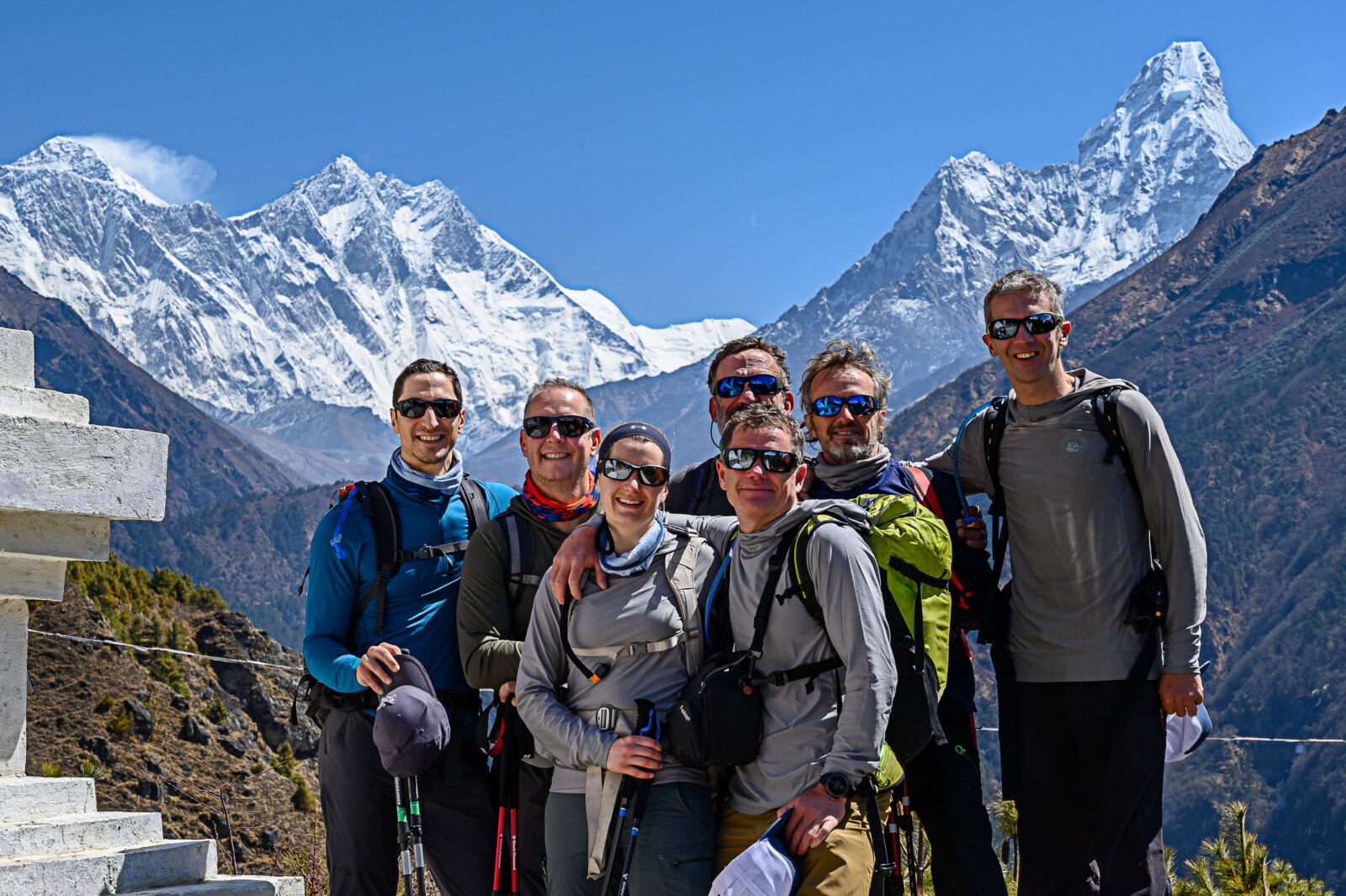
Ask a guide

What to Budget For

The trip price is not the whole cost, and no honest operator pretends otherwise. The price is on Dates & Prices, with departures and booking terms. This page covers everything beyond it: what’s already included, what you pay separately, how much cash to carry and what to hold in reserve. Then you arrive in Kathmandu with nothing left to figure out.

Visa and cash in Nepal$750–1,050

Beyond the trip price, flights, insurance and gear.

Cash for Nepal$700–1,000

Tips, the Puja, Kathmandu meals and trail extras.

Nepal visa$50

30 days, cash on arrival.

Your Budget at a Glance

RequiredCosts every climber pays
  • Nepal visa30 days, cash on arrival$50
  • Rescue and evacuation coverageVaries by provider, age and coverageVaries
  • International flightsGet quotesVaries
Strongly recommended
  • Travel insuranceVariesVaries
Personal spending
  • Tips, the Puja, Kathmandu meals, trail extrasRecommended$700–1,000
OptionalOnly if you add them
  • Single roomQuoted on requestOn request

Tips: How They Work

Tipping is customary and expected in Nepal, and it is a meaningful part of what the guiding and portering teams earn. Plan for it as a real line item.

Tips: $250–450 per trekker. This covers the whole team: guides, porters and support staff.

Puja contribution: $20–50, voluntary. The Puja is the blessing ceremony that opens a Himalayan expedition. If your departure’s Base Camp day coincides with one, a contribution is customary and appreciated. We can’t promise your departure will take part.

How it works. Tips are given in cash at the end of the trek. Your guide collects and distributes them so the whole team is looked after fairly, rather than depending on who happened to walk next to whom. You don’t need to tip your airport driver or the BBE representative in Kathmandu.

Tips and the Puja are included in the cash figure below. Don’t budget them twice.

Cash and Cards

Nepal, and the Khumbu especially, runs on cash.

Minimum$700
Recommended$700–1,000

That covers your lunches and dinners in Kathmandu, daily extras on the trail, your tips for the team and the Puja contribution, with a buffer. The visa fee is on top.

  • Which bills. Clean, high-quality US dollar notes issued after 2013. Money changers in Nepal refuse torn, worn, heavily creased or older notes. This catches people out every season.
  • A practical split. Change roughly $500 into Nepalese rupees before leaving Kathmandu.
  • Keep the rest in dollars. Hold the remainder in US dollars as a backup.
  • Small denominations. Bring some small notes. Change is hard to find in the high villages.
  • Cards. They work in Kathmandu at larger hotels and better restaurants, and essentially nowhere else. Acceptance in Namche is limited.
  • ATMs. They exist in Kathmandu and sometimes in Namche, but connectivity problems and withdrawal limits make them unreliable. Bring what you need from the start.

Split your cash into smaller portions rather than one block, and keep a rough running total. A budget that feels generous at Namche can be thin by Gorak Shep.

Contingency

Weather. The schedule already absorbs the most likely disruption: the Day 15 recovery day at Pheriche exists so a poor helicopter morning doesn’t cost you your flight home. But Himalayan weather occasionally beats any schedule. If a genuinely extended delay occurs, extra nights of lodging and meals and rebooking your international flight are your responsibility. This is exactly what travel insurance is for.

Emergency reserve: a few hundred dollars. Keep it beyond your planned cash, on a card or in cash. Most people never touch it. The ones who need it are very glad it is there.

Disruption and early departure. Costs from itinerary changes, delays or cancellations outside our control are not included, and unused trip services are not refunded. Cancellation terms are on Dates & Prices.

More cost details for this trip

What the Trip Price Covers

More than most people expect. From the moment you land in Lukla until you fly out of Pheriche, the trek is all-inclusive: all meals, all lodging, both trekking permits, porter and yak support, and your certified guides and full support team. The price also covers both helicopter flights (Kathmandu to Lukla and Pheriche to Kathmandu), three nights at the Hotel Yak & Yeti with breakfast, the Day 1 welcome dinner, group equipment and team first aid kits, and airport transfers in Kathmandu.

Once you’re on the trail, your only spending is on things you choose to buy. The controlling list of inclusions and exclusions is on Dates & Prices.

Required Costs

Rescue and evacuation coverage. Required on this trek, to at least 6,000 m / 19,700 ft, including helicopter evacuation. You can buy it any time, but it must be in place before departure. We recommend Global Rescue, with its High-Altitude Evacuation Package, or Ripcord. The cost depends on your age, your home country, the provider and the coverage level, so get a quote before you buy. A cheap policy that excludes altitude is the same as no policy. See Trip Insurance & Evacuation Coverage.

Nepal visa: $50 for 30 days. Paid in cash on arrival in Kathmandu, in clean US dollars issued after 2013. The 30-day visa covers this trek comfortably. If your plans extend either side of the trek:

  • 15 days: $30
  • 90 days: $125

Fees as of 2026, set by Nepal’s Department of Immigration. We confirm the current figure with you before departure.

Trekking permits: included. Both the Sagarmatha National Park permit and the Khumbu Pasang Lhamu Rural Municipality permit are arranged by BBE and included in your trip price. Nothing to budget and no cash to carry for either.

International flights to Kathmandu. Usually the largest cost after the trip price, and the one that varies most with your home city, season and routing, so we don’t publish a figure. You book these after full payment. Get real quotes before you finalize your budget, and favor a changeable fare.

Personal gear. Depends entirely on what you already own. An experienced hiker with good boots, a warm sleeping bag and a working layering system may need very little. Someone starting from scratch is looking at a real investment, and the sleeping bag is the item to spend on. Buy in off-season sales, or rent bulky items in Kathmandu and pay the shop directly. See the Everest Base Camp Trek Packing List.

Strongly Recommended

Travel insurance: varies. Cancellation, interruption, flight delays, baggage and travel medical. Strongly recommended, not required. The cost depends on your trip cost, age and the cover you choose. It’s a different product from rescue coverage, and it is what covers the costs below under Contingency.

Daily Extras on the Trail

Small purchases every day, and they add up. Typical prices:

Wi-Fiabout $5–10 a day

By prepaid card at the lodge.

Charging devicesabout $2–10 per charge
Hot showers, lower elevationsabout $5–10
Soft drinksabout $3–5

Rising with altitude.

Bottled water at high elevation$3 or more per liter
Bakery and café stops in Namchevariable

And worth it.

Everything costs more as you go up, because everything is carried up on someone’s back or a yak. That is the real cost of transport, not a markup. Namche is where spending tends to jump: it is the last place with real bakeries and espresso before the high valley.

Meals and Spending in Kathmandu

In Kathmandu, your hotel, breakfast and the Day 1 welcome dinner are included. Other lunches and dinners in the city are yours, along with alcoholic drinks and personal purchases. These are covered by the cash figure below.

Optional Costs

Single room. Single rooms are available on request; we’ll quote the cost when you ask. At Gorak Shep, and sometimes at Lobuche, single rooms are often not available. If we can’t give you one on a night you’ve paid for, we refund that portion. See Where You’ll Stay.

Extra nights in Kathmandu. Many trekkers add a day or two either side, for the temples, Bhaktapur or Patan, or simply to recover before flying home. Easy to arrange, at your cost.

Private and custom extensions. Extra days in the valley or a longer route are quoted individually. See Private & Custom Treks.

Budget Summary

Beyond the trip price, in US dollars:

International flightsvaries; get quotes
Rescue and evacuation coveragevaries by provider, age and coverage

Required

Travel insurancevaries

Strongly recommended

Nepal visa, 30 days$50
Trekking permitsincluded in the trip price
Personal geardepends on what you already own
Cash for Nepal, including tips, the Puja, Kathmandu meals and trail extras$700–1,000 recommended
Single roomoptional, quoted on request
Emergency reservea few hundred dollars, ideally untouched

Beyond the trip price, your flights, your insurance and your gear, plan on roughly $750–1,050 for the visa and your cash in Nepal.

Questions About Costs?

Tell us where you’re flying from and what gear you already own, and we’ll give you an honest estimate rather than a brochure figure. See dates & prices · climbing@benegasbrothers.com · benegasbrothers.com
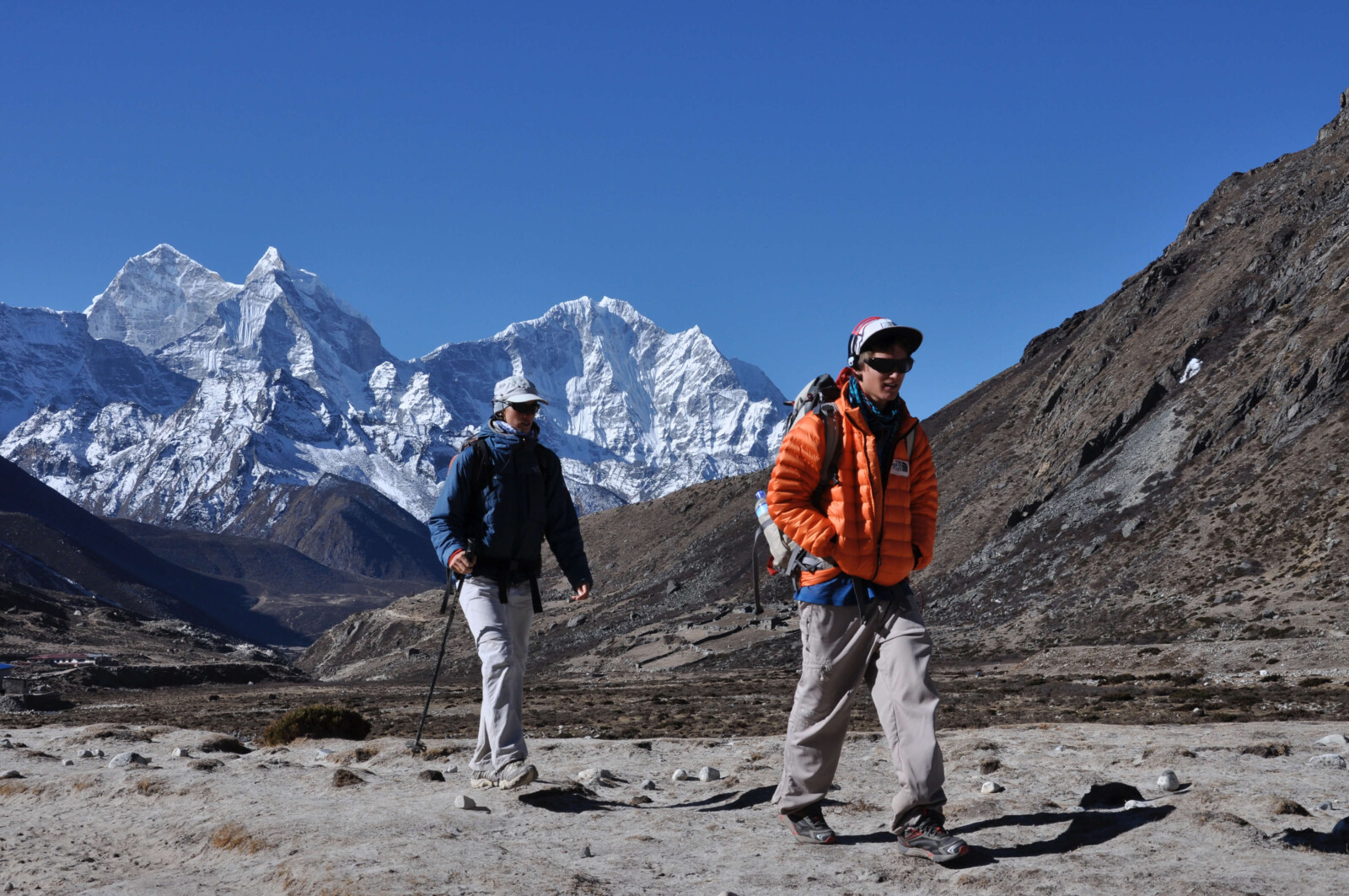
Ask a guide

Private & Custom Treks

Everest Base Camp Trek · Your Dates, Your Group, Your Pace

Our scheduled departures work for most people. Sometimes they don’t fit, and that is easily solved. If you want the trek for your own group, on dates that suit you, or a longer route through the high valleys, we build it around you, with the same guide standards, helicopter logistics and teahouse network as every BBE departure in the Khumbu.

Private doesn’t mean easier, and it doesn’t mean shorter. It means the trek is designed around your group.

Who Private Treks Suit

  • Families and groups of friends who want to walk only with each other
  • Trekkers who need dates outside the scheduled departures
  • Groups who want the pace set entirely by their own team rather than shared with strangers
  • Photographers who want time built in for light rather than for mileage
  • Trekkers who want more time in the Khumbu, or a longer route through the high valleys
  • Companies, universities, alumni groups and charitable fundraising treks

What You Can Customize

Dates. Our scheduled departures run in spring and fall, the two main trekking seasons in the Khumbu. A private trek runs on dates you request, and we’ll tell you honestly how the valley looks in the window you have in mind.

Your group. Everything on the scheduled program stays the same: the route, the guide team and the helicopter logistics. What changes is that the team is only you. Staffing is planned for your group size, with at least one certified guide for every four trekkers, and a full support team of porters and yaks.

Route and extensions. The 17-day schedule is built to be efficient. It is not the only way to do this. Common additions:

  • Extra days in Namche or Phortse, for a slower pace through the valley
  • The Gokyo lakes, as a side trip into the next valley west
  • The Cho La, the high pass between the Gokyo valley and the Everest side of the Khumbu
  • Simply walking the high valley more slowly, with more time at each village

Pace and acclimatization. A private trek lets the daily pace fit your group: a longer, gentler version for a group that wants the experience without the pace. It doesn’t shorten what your body needs. We won’t build a private itinerary with less acclimatization than this altitude requires, and a private trek doesn’t change the fact that no one can promise you’ll reach Base Camp.

Photography and culture. Itineraries built around light rather than mileage, more time at the monasteries, or a schedule timed around a festival where the calendar allows.

Base Camp on spring dates. Nepal no longer allows trekkers to sleep at Everest Base Camp, so every trek, private or scheduled, sleeps at Gorak Shep (16,942 ft / 5,164 m) and visits Base Camp during the day. If your private trek is timed while BBE is running an Everest expedition, Base Camp day includes a visit to our own Everest camp. If not, we walk around Base Camp and usually run into old friends. As with every day on the trek, weather and conditions on the day come first.

Groups and Organizations

We run this trek for corporate teams, universities, alumni groups and charitable fundraising treks.

These need more coordination than a standard booking: briefings for trekkers at very different fitness levels, documentation for your organization’s risk management, and often a longer preparation runway. We are set up for it. Start the conversation early, ideally a year out.

Families and Younger Trekkers

The minimum age is set by Nepal’s regulations and by insurance: trekkers under 18 climb with a parent or guardian, and each trekker’s insurance must cover their age. Families are welcome: younger trekkers can join a scheduled team with a parent or guardian, or come on a private family expedition built around your family, and if a special permit is needed, we’ll help you apply. Fitness, health and preparation matter far more than age, and every trekker completes the Registration Form in our online registration form at booking.

Led by Willie or Damian

Willie or Damian Benegas can personally lead a private Everest Base Camp Trek on request. BBE runs its own Everest expedition in this valley, and a founder-led trek puts that experience on the trail with you, subject to their schedules.

A founder’s participation applies only when it is confirmed in writing in your trip terms, never assumed. Our scheduled Everest Base Camp Trek departures are led by our certified guide team.

How a Proposal Comes Together

Every private and custom trek is quoted individually. The price depends on the number of days, your group size, the route and extensions you choose, and the helicopter and lodge logistics.

Lead time matters. Helicopters, lodges and experienced staff are arranged well ahead for the spring and fall seasons, so give us as much lead time as you can. Six months is workable; a year is comfortable.

Tell Us What You Have in Mind

Send us the shape of it: how many people, roughly when, what matters most to you, and anything about the group we should know, including whether you’d like Willie or Damian to lead. We’ll come back with a realistic plan and honest advice about what works in a Khumbu season. We answer every inquiry personally.

Ask a Guide

See dates & prices · climbing@benegasbrothers.com · benegasbrothers.com
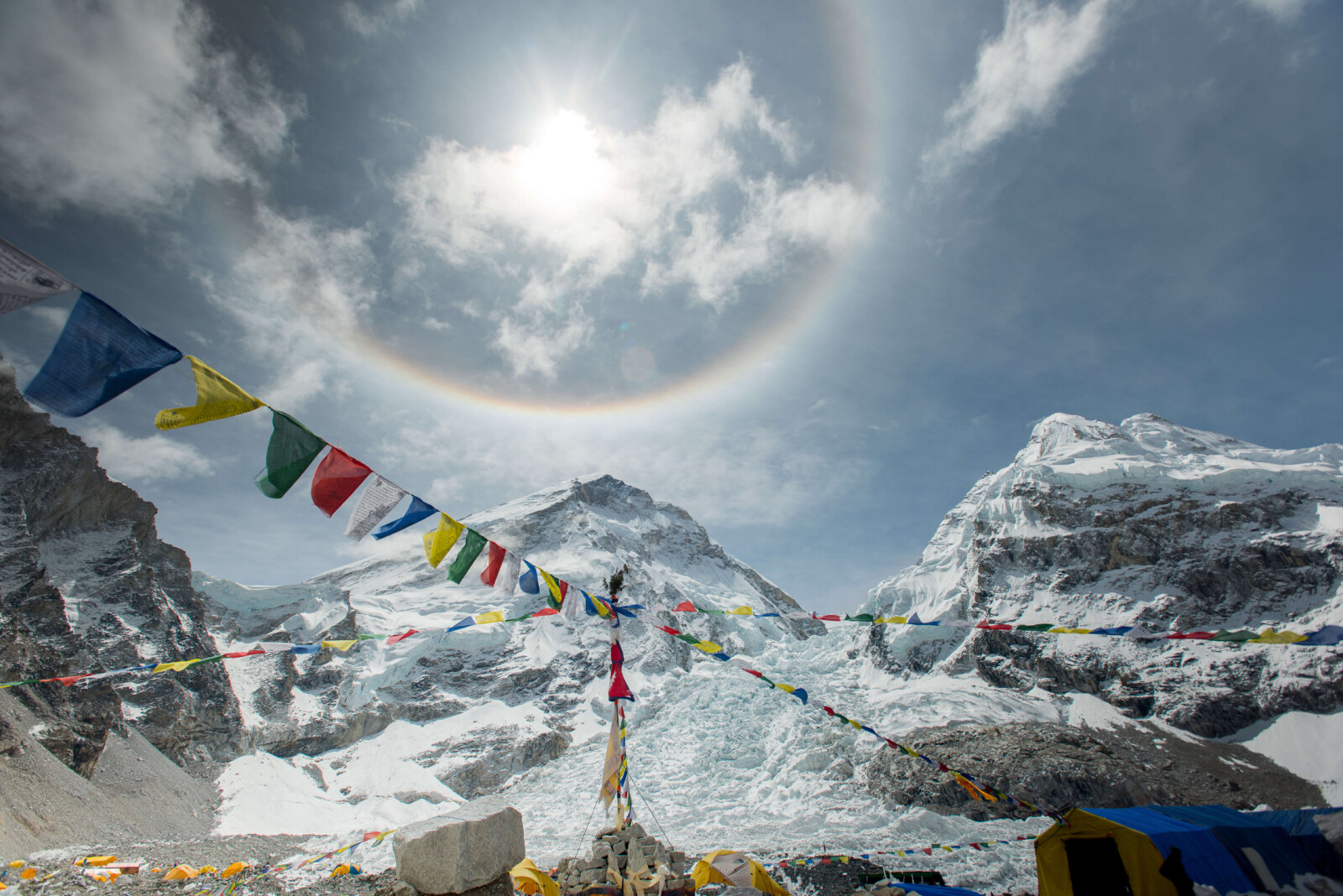
Ask a guide

Dates & Prices

Everest Base Camp Trek · 17 Days · Khumbu Valley, Nepal · Helicopter In and Out · Maximum Eight Trekkers

Everything you need to book: departures, the price, what it covers and the terms. If you’re still deciding, start with Is This for Me? or talk to a guide first. Every trekker speaks with us before booking, so we can make sure this is the right trip, and the right year, for you.

2027 and 2028 Departures

Expedition price$6,250

USD per person.

Deposit to book20%

Of the expedition price. Includes a $350 non-refundable booking fee.

Balance120 days

Due 120 days before departure. Inside 120 days, you pay in full at booking.

Spring 2028: $7,500 USD per person. Both trekking permits are included in the price.

Departures

Spring 2027: April 17 – May 3, 2027Scheduled departure
Fall 2027: October 9 – 25, 2027Scheduled departure
Spring 2028: April 15 – May 1, 2028Scheduled departure

Each departure takes a maximum of eight trekkers, with two certified guides for a full team of eight. A departure is confirmed when we tell you so in writing. Please buy nonrefundable flights only after your departure is confirmed.

Day 1 is your arrival in Kathmandu and Day 17 is your departure. Depending on your routing home you may land the same day or the day after, so book your international flights accordingly. See Flights & Getting to Kathmandu. The full itinerary is on Day by Day.

Spring or Fall?

Both seasons run the same route, the same schedule and the same logistics, and both reach Base Camp the same way.

Spring: when BBE is running an Everest expedition at the same time, Base Camp day includes a visit to our camp on the glacier, with weather and conditions on the day coming first; if not, we walk around Base Camp and usually run into old friends. Fall has no BBE camp, but gives you the clearest air of the year and noticeably quieter trails.

Ask us and we’ll tell you honestly which suits you better.

Where You Sleep at Base Camp

Since April 2026, Nepal restricts overnight stays at Everest Base Camp to climbers holding permits and their registered expedition staff. Trekkers reach Base Camp during the day and sleep at Gorak Shep (16,942 ft / 5,164 m): two nights, on Days 12 and 13. That is the highest night of the trek.

If you are comparing this trek with one advertising a night at Base Camp, that page has not been updated. Under the current rules, trekkers can’t legally stay there.

What’s Included — and What Isn’t

Included in the price

Before you go
In Kathmandu
  • Airport transfers in Kathmandu, with your guides meeting you on arrival and staying with the team through your departure transfer
  • Three nights at the Hotel Yak & Yeti on a shared room basis, with breakfast: two before the trek and one on your return
  • Welcome dinner on Day 1
Helicopter flights
  • Helicopter from Kathmandu to Lukla on the way in, and from Pheriche to Kathmandu on the way out, flying direct rather than via Ramechhap. The helicopter weight limit is 15 kg / 33 lb per person, both bags combined.
On the trek
  • Certified guides, two for a full team of eight, and a full support team
  • Porter and yak support for your duffel between villages
  • Teahouse lodging throughout the Khumbu
  • All meals on trek, from arrival in Lukla
  • Both trekking permits: Sagarmatha National Park and Khumbu Pasang Lhamu Rural Municipality
  • Group equipment and team first-aid kits

Not included

  • International flights to and from Kathmandu
  • The Nepal visa fee, paid in cash on arrival
  • Rescue and evacuation insurance (required) and travel insurance (strongly recommended)
  • Medical, hospitalization or evacuation costs
  • Lunches and dinners in Kathmandu, apart from the welcome dinner
  • Personal gear and equipment, and any rentals in Kathmandu
  • Alcoholic drinks and personal purchases
  • Wi-Fi, device charging and hot showers on the trail
  • Tips for the guide and support team
  • The voluntary Puja contribution
  • A single room (available on request; we’ll quote the cost when you ask)
  • Extra hotel nights in Kathmandu before or after the trek
  • Costs arising from itinerary changes, delays or cancellations outside our control

What each of these typically costs is on What to Budget For.

Single Rooms

Rooms are double occupancy as standard, and if you are traveling alone we’ll pair you with another member of the team where we can.

Single rooms are available on request; we’ll quote the cost when you ask.

One honest limitation, and what we do about it. A private room is straightforward at the Hotel Yak & Yeti and through the lower and middle valley. At Gorak Shep, and sometimes at Lobuche, the lodges are small and simply built, and single rooms are often not available. No operator can change that.

If we can’t give you a single room on a night you’ve paid for, we refund that portion. We would rather return the money than charge you for something you did not get.

Your Total Trip Cost

The expedition price is the biggest number, not the only one. Typical ranges per climber, in U.S. dollars:

Trip price (Spring and Fall 2027)$6,250
Visa and cash in Nepal$750–1,050
Typical total, before flights and gearabout $7,000–7,300

Not included in that total: international flights, rescue and travel insurance, personal gear and a single room. Spring 2028 is $7,500. The full breakdown is on What to Budget For.

Payment & Cancellation

Deposit: $1,250 (2027) or $1,500 (2028) (20% of the trip price), due at booking. $350 of it is a nonrefundable booking fee.

Balance: $5,000 (2027) or $6,000 (2028), due 120 days before the start date. Booking within 120 days? Full payment is due at booking.

How to pay: bank transfer/ACH (no fee), wire transfer (you pay the bank fees) or credit card (3% surcharge). All prices are in U.S. dollars.

If you cancel:

  • 121 days or more before the start date: full refund, less the $350 booking fee
  • 90 to 120 days: 50% refund, after the $350 booking fee
  • 89 days or fewer: no refund

Can’t make it? Send a qualified climber in your place at no BBE fee.

Insurance: medical and rescue/evacuation coverage required. Trip cancellation insurance strongly recommended.

Once the trip begins, payments are nonrefundable.

Read the full Payment & Cancellation Policy →

Insurance

Rescue and evacuation cover is required on this trek, to at least 6,000 m / 19,700 ft, including helicopter evacuation from the Khumbu, with no altitude exclusion below that. Many standard travel policies and credit-card cover exclude trekking at this altitude, so read the altitude and activity clauses carefully. You can buy it any time, but it must be in place before departure. Send us your policy number and emergency contact line before you leave home.

Coverage pays for a rescue; it can’t guarantee one. Evacuation always depends on weather and conditions.

Travel insurance is strongly recommended, not required. In many situations it’s the only way to recover costs from disruptions outside anyone’s control, including the reasons listed under What’s not refundable. See Trip Insurance & Evacuation Coverage.

Private Treks

A private trek runs on your dates, for your group alone, with the same route, guide standards and helicopter logistics. It can add extra days in Namche or Phortse, the Gokyo lakes or the Cho La.

Led by Willie or Damian Benegas: on request, priced individually. A founder’s participation applies only when it is confirmed in writing in your trip terms.

Every private trek is priced individually, based on length, group size, route and logistics. See Private & Custom Treks.

How to Book

  1. Talk to us first. Tell us about your trekking background, your fitness and your timeline. We’ll tell you honestly whether this is the right trip and the right year.
  2. Register online. Choose your departure and complete your registration online and pay your deposit by the invoice we send.
  3. Prepare properly. From the moment you book you have our team, a training plan if you want one, and the full Before You Go guide.

When to Book

Book when you’re ready to commit to the preparation. We recommend at least three to four months of training, longer if you are starting from a lower base, with time to build fitness, break in your boots and test your gear on back-to-back days.

Once you’ve paid in full, book your international flights to Kathmandu. Rescue and evacuation cover can be bought any time, as long as it is in place before departure.

Ready to Book?

climbing@benegasbrothers.com · benegasbrothers.com
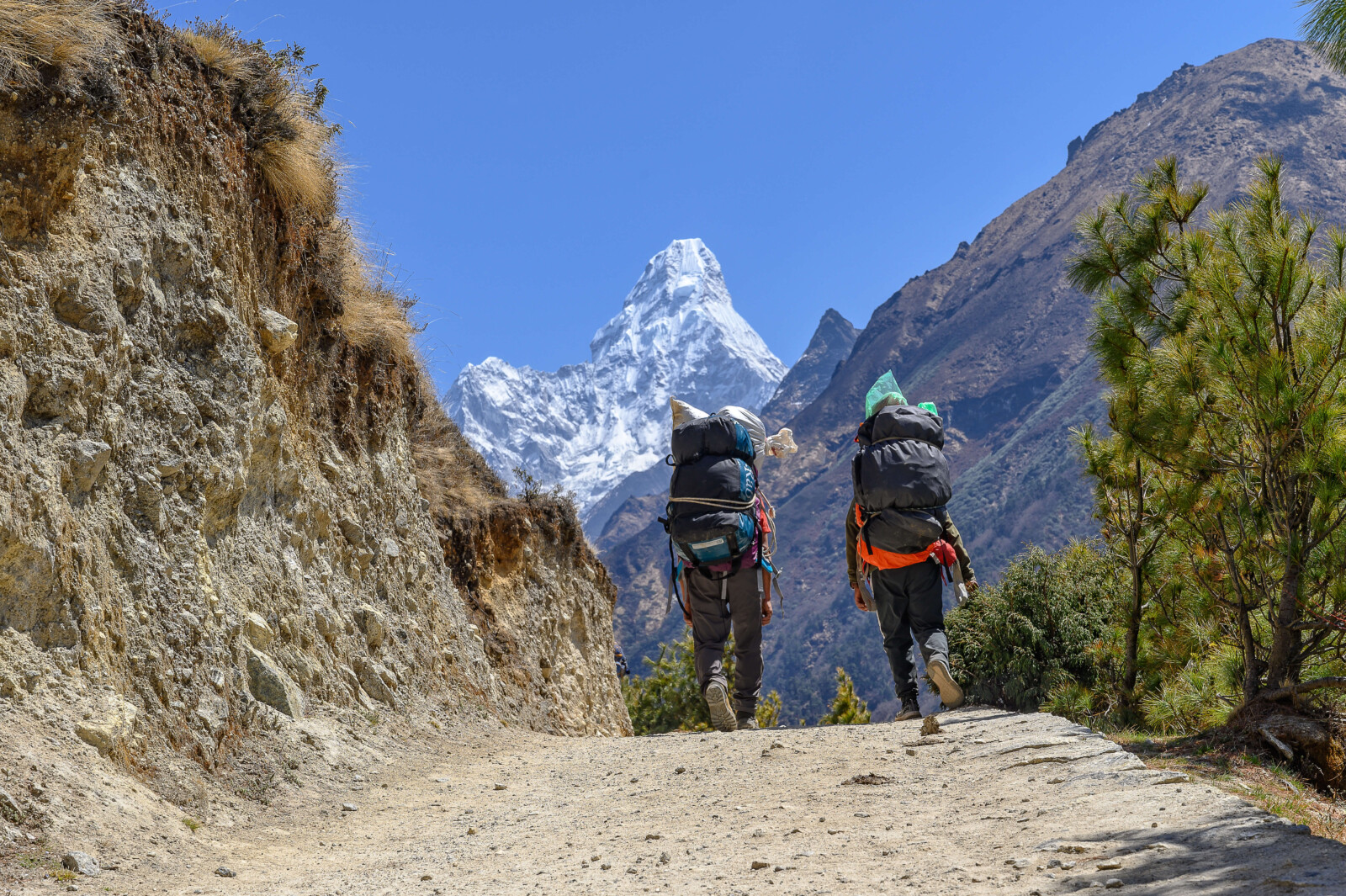
Ask a guide

Your Questions

Everest Base Camp Trek · Answered by the Guides

Straight answers to the questions trekkers ask most before committing to the Everest Base Camp Trek. Each answer is short and points you to the page with the full detail. If your question isn’t here, ask us. We answer every inquiry personally.

Still have a question? Ask us directly. We would far rather answer it now than have you arrive with it unanswered. Ask a guide · See dates & prices · climbing@benegasbrothers.com

No, and nor can anyone else on a trek.

Since April 2026, Nepal restricts overnight stays at Everest Base Camp to climbers holding permits and their registered expedition staff. Trekkers walk in, spend time there, and return to Gorak Shep (16,942 ft / 5,164 m) for the night. We sleep two nights at Gorak Shep, on Days 12 and 13, with the Base Camp day in between.

If another trek advertises a night at Base Camp, that page has not been updated. We would rather you heard this from us than discovered it halfway through booking.

Everest Base Camp (17,598 ft / 5,364 m) is a day visit on Day 13: the walk in along the glacier, time at Base Camp, and the walk back to Gorak Shep.

When BBE is running an Everest expedition at the same time, Base Camp day includes a visit to our camp: tea in the dining tent, a meal from our kitchen crew, and time with whoever from our Everest team is in camp that day. As with every day on the trek, weather and conditions on the day come first.

If not, we walk around Base Camp and usually run into old friends.

Gorak Shep, 16,942 ft / 5,164 m, for two nights: Days 12 and 13. It is the highest sleeping elevation of the trek and the hardest part of the schedule for most people. Expect broken sleep. It is normal, your guides expect it, and it ends when you start walking downhill on Day 14. See Where You’ll Stay.

Not from Base Camp itself. Nuptse blocks the view of the summit from down on the glacier. This surprises people, so it is worth knowing before you go.

The view you have seen in photographs comes from Kala Patthar (18,192 ft / 5,545 m), the optional climb from Gorak Shep on Day 12, where the southwest face of Everest stands up in front of you. In late-afternoon light it is the finest view of the mountain on the trek.

On spring departures, sometimes. We won’t promise it.

The Puja is the blessing led by Sherpa lamas that opens every Himalayan expedition, and nothing on our Everest climb begins without it. If your Base Camp day lands when it is happening, you are welcome at it, but that depends on timing we don’t control. If your departure does take part, a voluntary contribution is customary; see What to Budget For.

Both seasons follow the same route, the same schedule and the same logistics, and both reach Base Camp the same way.

One difference: in spring, when BBE is running an Everest expedition, Base Camp day includes a daytime visit to our camp; when we aren’t, we walk around Base Camp and usually run into old friends. In fall there is no expedition camp of ours. What fall gives you instead is the clearest air of the year, post-monsoon skies and noticeably quieter trails. Plenty of people prefer it. Ask us and we’ll give you an honest answer for your situation. Current departures are on Dates & Prices.

Because it removes the two things that most often disrupt this trek. In peak season, fixed-wing flights to Lukla move out of Kathmandu to Ramechhap, which means a pre-dawn drive followed by a wait for weather, and delays of one to three days are common. We fly you directly from Kathmandu to Lukla on the way in, and from Pheriche back to Kathmandu on the way out, which also saves three days of walking back down a valley you have already walked up.

Helicopters in the Khumbu fly on weather, and occasionally they don’t fly at all. That is why the schedule holds a recovery day at Pheriche on Day 15, between the descent from the high valley and the flight out. A poor-weather morning costs you a comfortable rest day rather than your flight home. If a genuinely extended delay occurs, additional nights and any flight rebooking are your responsibility, which is what travel insurance is for.

No. There is no rope, ice axe, crampon work or technical ground anywhere on this trek. If you can hike, you can do the movement.

Fit enough to hike four to seven hours a day, on rocky, uneven ground, for twelve days, with a light daypack.

The consecutive part is what people underestimate. One hard day in the hills is very different from twelve in a row. If you can do a full day out with a pack and get up and do it again the next morning, you have the right base to build from. We recommend at least three to four months of preparation, longer if you are starting from a lower base. See Is This for Me?

Tell us honestly where your fitness is and what you’ve done before. If this is the right year, we’ll say so. If it isn’t, that’s a plan, not a rejection: get multi-day hiking into your legs, and if you want real altitude experience first, Kilimanjaro with our team gives you high, non-technical days and a genuine sense of how your body handles thin air. Then come to the Khumbu with the base already built.

The minimum age is set by Nepal’s regulations and by insurance: trekkers under 18 climb with a parent or guardian, and each trekker’s insurance must cover their age. Families are welcome: younger trekkers can join a scheduled team with a parent or guardian, or come on a private family expedition built around your family, and if a special permit is needed, we’ll help you apply.

There is no upper age limit. We have taken people through the Khumbu across a very wide range of ages, and preparation matters far more than the number on your passport.

Possibly. Tell us about it.

Disclosure is not disqualification. What matters is that you consult your physician about taking part and that we know in advance, through the Registration Form you complete in our online registration form at booking, so the guide team can plan around it. A condition we know about is manageable. The same condition surfacing at Lobuche, at 16,207 ft / 4,940 m, is a serious problem for you and for everyone with you.

None are mandatory. Up-to-date polio, tetanus and Hepatitis A are worth discussing with your doctor. Check the CDC guidance close to your departure, since recommendations change. Bring a personal medical kit; the contents are on the packing list.

Mild symptoms (headache, poor appetite, broken sleep, breathlessness) are common above about 13,000 ft / 4,000 m and usually settle within a day or two as you adapt. They are uncomfortable, not dangerous.

The serious forms are rare, and the treatment is descent: immediately, at any hour, without debate. Your guides watch for this constantly and run a morning health check every day, including oxygen saturation.

Tell your guide early. Hiding a headache because you don’t want to hold up the group is the most dangerous thing anyone does on this trek. Reported early, there are almost always options. Reported late, there is only one.

Talk to your doctor. Whether altitude medication is right for you is a decision for you and your physician, and the right time for that conversation is months before departure, not in Kathmandu. If your doctor prescribes something, bring it and tell your guides at the Kathmandu orientation, so they know what you are taking.

No, and this is worth understanding.

Fitness determines how comfortably you walk. It does not determine how you acclimatize. Very fit people get altitude sickness and unremarkable people sail through, and there is no reliable way to predict which you are until you go up. If you have been to altitude before and know how you respond, tell us. That is genuinely useful information.

We get you down safely and comfortably, and we work out the rest from there.

Depending on where you are and what is happening, that might mean descending with a member of the team to a lower village and waiting for the group, or a helicopter evacuation to Kathmandu. Your guides make that call based on conditions and your safety.

We reserve the right to turn back any trekker we believe is not fit to continue safely. Turning around is a professional decision, always about safety, never about pace or pride.

Your guides are trained in wilderness first response, carry team first-aid kits, and have managed altitude and injury in this valley across many seasons.

The route also passes the Himalayan Rescue Association clinic at Pheriche, staffed in season by volunteer physicians, which is one reason the second acclimatization day sits exactly where it does.

Benegas Brothers Expeditions is not a licensed medical provider. Evacuation always depends on weather and conditions, which is why rescue and evacuation insurance is required on this trek.

A maximum of eight trekkers, with two certified guides for a full team of eight, and a support team of porters and yaks. We don’t count porters as guides.

On this route the guide who notices how you slept, how you are eating, and how your pace changed between Pheriche and Lobuche is the one who catches an altitude problem early rather than late. Eight is the number that keeps that possible. You won’t disappear into the group.

A certified guide team selected by us, experienced at altitude and working this valley season after season, not a crew assembled for the week.

We run our own Everest expedition here, which is why our relationships in this valley run as deep as they do. You will know who is leading your trek before you leave home, and your guides are with the team from arrival at Kathmandu airport to your departure transfer.

Scheduled departures are led by BBE’s certified guide team, run to the same standards. Willie or Damian can personally lead a private Everest Base Camp Trek on request, confirmed in writing in your trip terms. See Private & Custom Treks.

Yes. A private trek is the whole program run for your group alone, on dates that suit you, with the same route, guide standards and helicopter logistics. Extra days in Namche or Phortse, the Gokyo lakes and the Cho La are all common additions, as is simply walking the high valley more slowly. Give us as much lead time as you can: six months is workable, a year is comfortable. See Private & Custom Treks.

Yes, regularly. Those bookings need more coordination (mixed fitness levels, briefings, and risk documentation for the organization), so start the conversation early, ideally a year ahead.

Fresh, hearty, and repetitive in a way you stop minding. Dal bhat, noodles, soups, potatoes, eggs, porridge, and a surprising amount of very good bakery food in Namche. All meals on the trek are included from Lukla. Go vegetarian above Namche: meat is carried up without refrigeration and is often several days old by the time it arrives. See Life on the Trek.

Yes, with notice. Vegetarian, vegan and gluten-free are all manageable. Tell us when you book rather than on the trail, because the kitchens are small and the supply chain is a yak.

The common room is heated by a central stove, and it is where everyone spends the evening. Bedrooms are not heated at any elevation. Nights are warm and pleasant in the lower valley near Lukla, genuinely cold above Pheriche, and coldest at Gorak Shep. That is why a sleeping bag rated to 5°F to −4°F / −15°C to −20°C is essential rather than optional.

Namche has bakeries, hot showers and Western-style flush toilets. By Lobuche and Gorak Shep you are looking at simple rooms, thin walls, squat or long-drop toilets, and no showering. Nothing about it is unsafe or unclean; it is simply what can be built and supplied at 16,000 ft. See Where You’ll Stay.

Variable, and increasingly basic as you climb. Toilet paper always goes in the bin, never down the toilet. Hot showers are available lower down for a fee, and above about 13,000 ft / 4,000 m most people stop showering, because getting wet and cold at altitude is a real way to get ill.

Usually, but not reliably. Wi-Fi is lodge by lodge and you buy a prepaid card at the lodge. Quality varies enormously and none of it is guaranteed. Cellular service is patchy and should never be treated as an emergency system. Tell your family before you leave that a day or two of silence is completely normal.

In the common room, for a fee, lodge by lodge. Carry a power bank, and sleep with your batteries inside your sleeping bag: cold flattens them overnight.

10 to 15 lb: water, layers, snacks, camera, sun protection and a blister kit. Porters and yaks carry your duffel between villages.

Most people are glad of them, particularly on the long descent from Gorak Shep to Pheriche on Day 14. They are on the packing list, they pack into the duffel, and they save your knees on the steep ground.

15 kg / 33 lb per person in total, duffel and daypack combined, because of the helicopter. It is a safety limit, not a guideline. See Flights & Getting to Kathmandu.

Yes. Anything that isn’t coming to the mountains stays in secure storage at the Hotel Yak & Yeti in Kathmandu for the whole time you are in the Khumbu, and it is waiting for you when you fly back in.

Some of it, yes: bulkier items and accessories. Tell us at least three weeks before departure so we can reserve it properly, and expect to pay the shop directly. Boots, shell layers and your sleeping bag are the items to own and test at home; quality in Thamel varies enormously and counterfeits are common. See the Everest Base Camp Trek Packing List.

The Day 2 gear check in Kathmandu exists for exactly that, and Thamel is full of gear shops. What can’t be fixed there is a sleeping bag or boots you have never worn. Arrive with those already right.

Once you’ve paid in full. You book your international flights to and from Kathmandu (KTM); we arrange the helicopters. Spring and fall are both high season for Nepal, so don’t leave it late, and consider a changeable fare. See Flights & Getting to Kathmandu.

You can, and plenty of people do. Completing the online arrival / visa form within 15 days of arrival and printing the barcode receipt simply moves you through a much shorter queue after a long journey. Either way, bring the fee in clean USD cash. Your passport must be valid for at least six months beyond your return date, with a blank visa page. See Your Trek Checklist.

Tell us while it is happening rather than after you land. Our Kathmandu team can move a pickup, rearrange a transfer, or start sorting replacement gear far more easily with notice. Keep written confirmation of any delay; your insurer will ask for it.

No. Transfers and the airport meet are part of your trip, and there is no expectation of a tip for either.

The trip price, what it includes and the payment schedule are on Dates & Prices. On top of it, plan for international flights, required rescue and evacuation insurance, the Nepal visa, gear, cash for Nepal and tips. What to Budget For lays it all out.

No. BBE arranges both the Sagarmatha National Park permit and the Khumbu Pasang Lhamu Rural Municipality permit, and both are included in your trip fee. Bring passport copies and we take care of the rest.

Yes. Rescue and evacuation cover is required on this trek, to at least 6,000 m / 19,700 ft, including helicopter evacuation. Standard travel policies and credit-card cover often exclude trekking at this altitude, so check the clauses. We recommend Global Rescue, with its High-Altitude Evacuation Package, or Ripcord. You can buy it any time, but it must be in place before departure, and we ask for your policy number before you fly. Travel insurance is strongly recommended, not required. See Trip Insurance & Evacuation Coverage.

$700 minimum, and $700 to $1,000 recommended, in clean USD notes issued after 2013. That single figure covers your Kathmandu meals, daily extras on the trail, tips and the Puja contribution, with a buffer. Change about $500 into Nepalese rupees before you leave Kathmandu. See What to Budget For.

$250 to $450 per trekker, covering the whole team: guides, porters and support staff. Your lead guide collects and distributes it at the end of the trek so everybody is looked after fairly. Add a voluntary Puja contribution of $20 to $50 if your departure takes part. Both are included in the cash figure above, so don’t budget them twice.

Cards work in Kathmandu at larger hotels and restaurants and essentially nowhere else. ATMs exist in Kathmandu and sometimes Namche, but connectivity and withdrawal limits make them unreliable. Carry the cash you need from the start.

Nepal is strict about the condition of USD notes. Torn, worn, heavily creased or pre-2013 notes are routinely refused. Ask your bank for clean, recent, large-denomination notes before you fly, and bring some small bills too: change is scarce in the high villages.

Rooms are double occupancy as standard, and we’ll pair you with another member of the team where we can. Single rooms are available on request; we’ll quote the cost when you ask. At Gorak Shep, and sometimes Lobuche, single rooms are often not available, and if we can’t provide one on a night you’ve paid for, we refund that portion.

A 20% deposit reserves your place, including a non-refundable booking fee, and the balance is due 120 days before departure. Cancellations must be in writing, and refunds depend on how much notice you give. Full terms are on Dates & Prices. Trip cancellation and interruption insurance is strongly recommended.

Early enough to prepare properly. Three to four months of training is the minimum we recommend, and most people want longer once they start.

We Run Our Own Expedition on This Mountain

We are an operator. Benegas Brothers Expeditions runs its own Everest expedition on the same mountain your trek walks toward. Same logistics. Same relationships in the same valley, built over many seasons.

Price$6,250 per person (2027)
Private & Custom Your dates. Your team.

This trip can run privately, on the dates that work for you.

Scheduled departures
  • Saturday, Apr 17 - Monday, May 3, 2027Scheduled departure
  • Saturday, Oct 9 - Monday, Oct 25, 2027Scheduled departure
  • Saturday, Apr 15 - Monday, May 1, 2028Scheduled departure

Questions first? Ask a guide

Location:
Nepal
Group:
Maximum 8 trekkers
Duration:
17 Days
Skill:
Beginner to Advanced, good fitness encouraged
Activities:
Trekking
Pricing

All prices are in US dollars.

We Run Our Own Expedition on This Mountain

We are an operator. Benegas Brothers Expeditions runs its own Everest expedition on the same mountain your trek walks toward. Same logistics. Same relationships in the same valley, built over many seasons.

Book now

Private & Custom

Make Everest Base Camp Trek your own expedition

Every trip we run can also run privately: on your dates, with your people, built around your goal. Same guides, same safety standard as our scheduled departures.

Your dates

We set the departure around your calendar, not the other way round.

Your people

Family, friends, a company team, or just you and a guide.

Your goal

Training for a bigger peak, a winter or speed attempt, a film, or a route that runs from summit to ocean.

Your price

Private trips are quoted for your group size, dates and plan.

Everest Base Camp Trek

Spring or Fall 2027

Maximum 8 trekkers · 17 days
Price per Person, 2027 $6,250

Helicopter Kathmandu–Lukla and Pheriche–Kathmandu, certified guides (two for a full team of eight) and a full support team, both trekking permits, all meals on trek, teahouses, three nights at the Hotel Yak & Yeti, porters and yaks.

Spring 2028

Maximum 8 trekkers · 17 days
Price per Person, 2028 $7,500

The same route, schedule and logistics.

The BBE Advantage

Everest Base Camp Trek — Nepal

Helicopter In and Out

Direct from Kathmandu to Lukla, and out from Pheriche: no Ramechhap transfer, and no three days walking back down the same valley.

Everest Base Camp Trek — Nepal

The Quieter Line

Through Khumjung and Khunde, and a quiet ridge to Phortse, a mountaineering village far less busy than the main trail.

Everest Base Camp Trek — Nepal

A Visit to Our Everest Camp

When BBE is running an Everest expedition at the same time, your Base Camp day includes a visit to our camp. If not, we walk around Base Camp and usually run into old friends.

Professional Mountain Standards

Our guide team includes internationally and nationally certified mountain professionals.

AMGA — American Mountain Guides Association logo
IFMGA / UIAGM — International Federation of Mountain Guides Associations logo
AAGM — Asociación Argentina de Guías de Montaña logo

Related Trips