Global Expeditions Alaska

Denali Expedition

24 days Group: Up to 6 climbers

The Climb

Denali · West Buttress · Alaska · Private and custom departures

Denali is North America’s highest peak, and not by a small margin. At 20,310 ft / 6,190 m it rises about 18,000 ft / 5,500 m from its base, the largest base-to-summit rise of any mountain entirely above sea level. Arctic weather, three weeks on a glacier and a team that carries every ounce of its own gear make it one of the hardest of the Seven Summits.

20,310ftSummit · 6,190 m
13,000ftClimbed from the glacier landing · 3,962 m
~24Days, Anchorage to Anchorage
2:1Climbers per guide · up to 6 climbers, 3 guides
0Porters. You carry and sled your own loads
PrivateRun on your dates, on request

Who Runs the Climb

On Denali, Benegas Brothers Expeditions works exclusively with Mountain Trip Alaska, a long-time authorized concessioner of Denali National Park and Preserve. Guided climbs on Denali are limited to the park’s authorized concessioners, so every BBE Denali expedition is offered through Mountain Trip. They are a trusted partner. Mountain Trip has guided the West Buttress every season since 1976 except 2020, and every lead guide has at least five Denali expeditions before leading; many have 20, 30 or more.

The partnership gives your team Mountain Trip’s established Denali systems: weather forecasting, cached-equipment strategy and decades of route knowledge. Teams climb at a 2:1 ratio: up to six climbers with three guides.

The West Buttress Route

The West Buttress is the classic route on Denali, pioneered by the cartographer and mountaineer Bradford Washburn in 1951. There is no approach trek: the expedition starts the moment the ski plane drops you on the Kahiltna Glacier at 7,200 ft / 2,195 m.

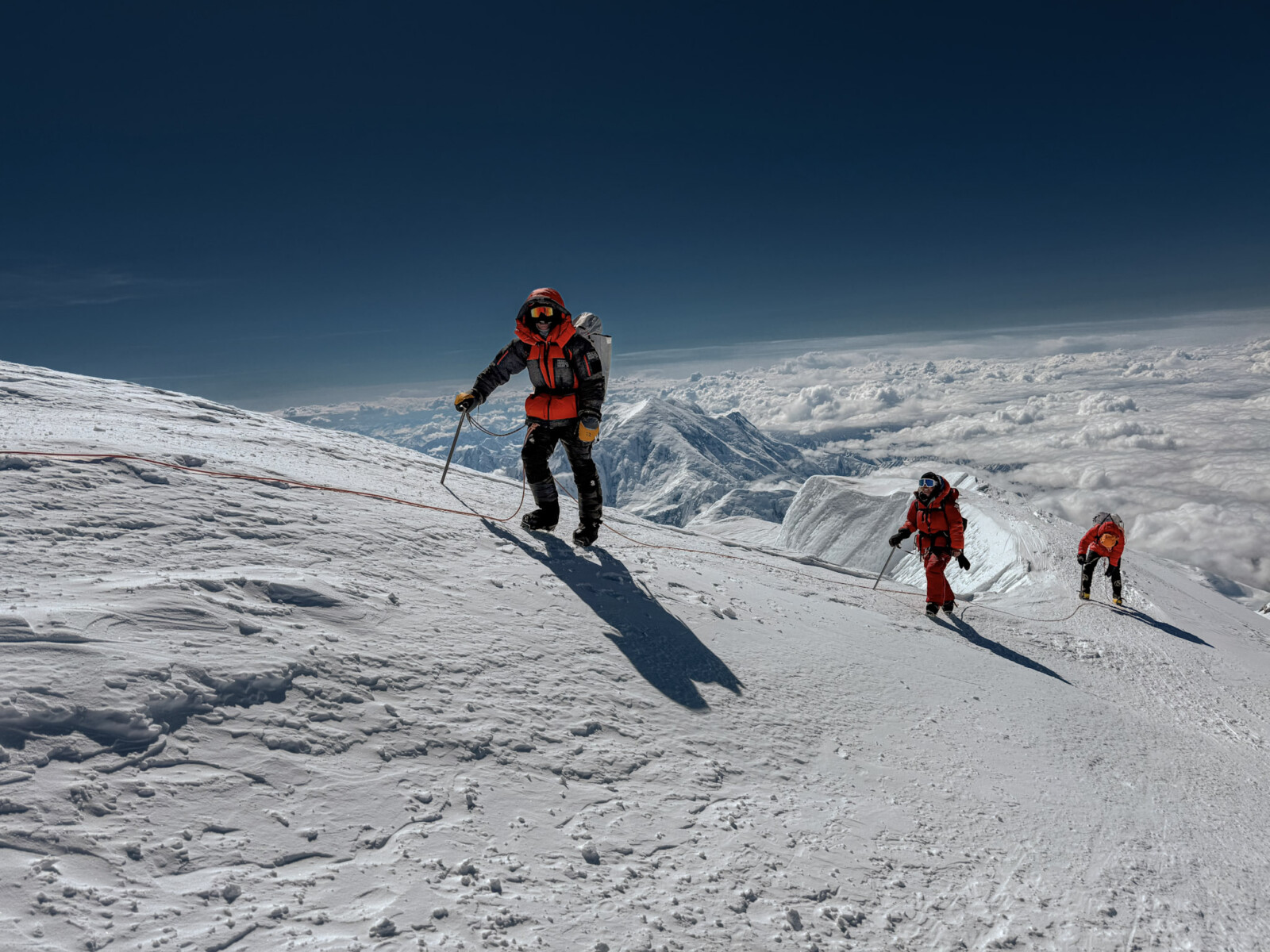
The route has no vertical rock or ice climbing, but it demands sustained glacier travel, heavy load carrying, fixed-line ascending on steep snow, and three weeks of performing in arctic conditions.

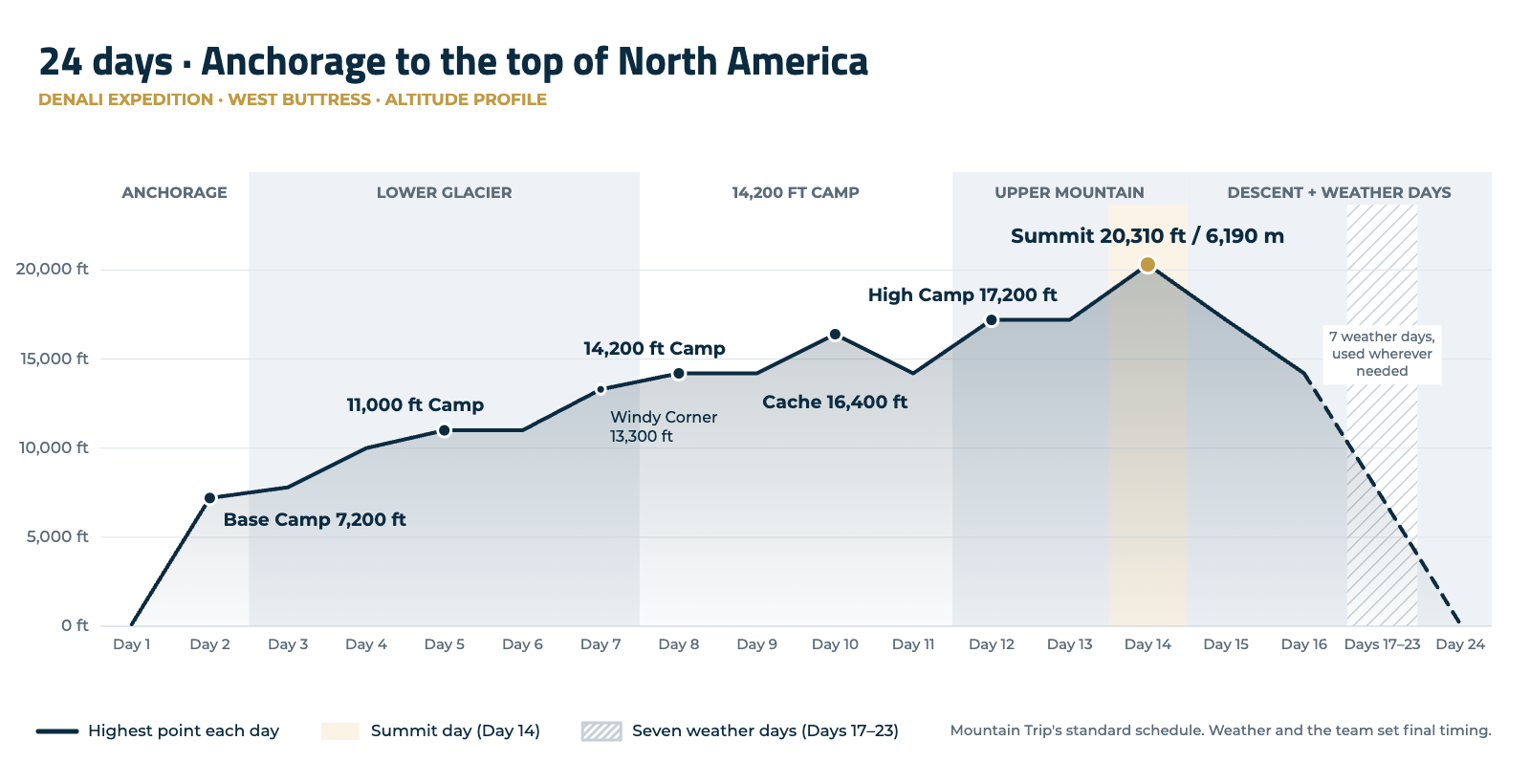
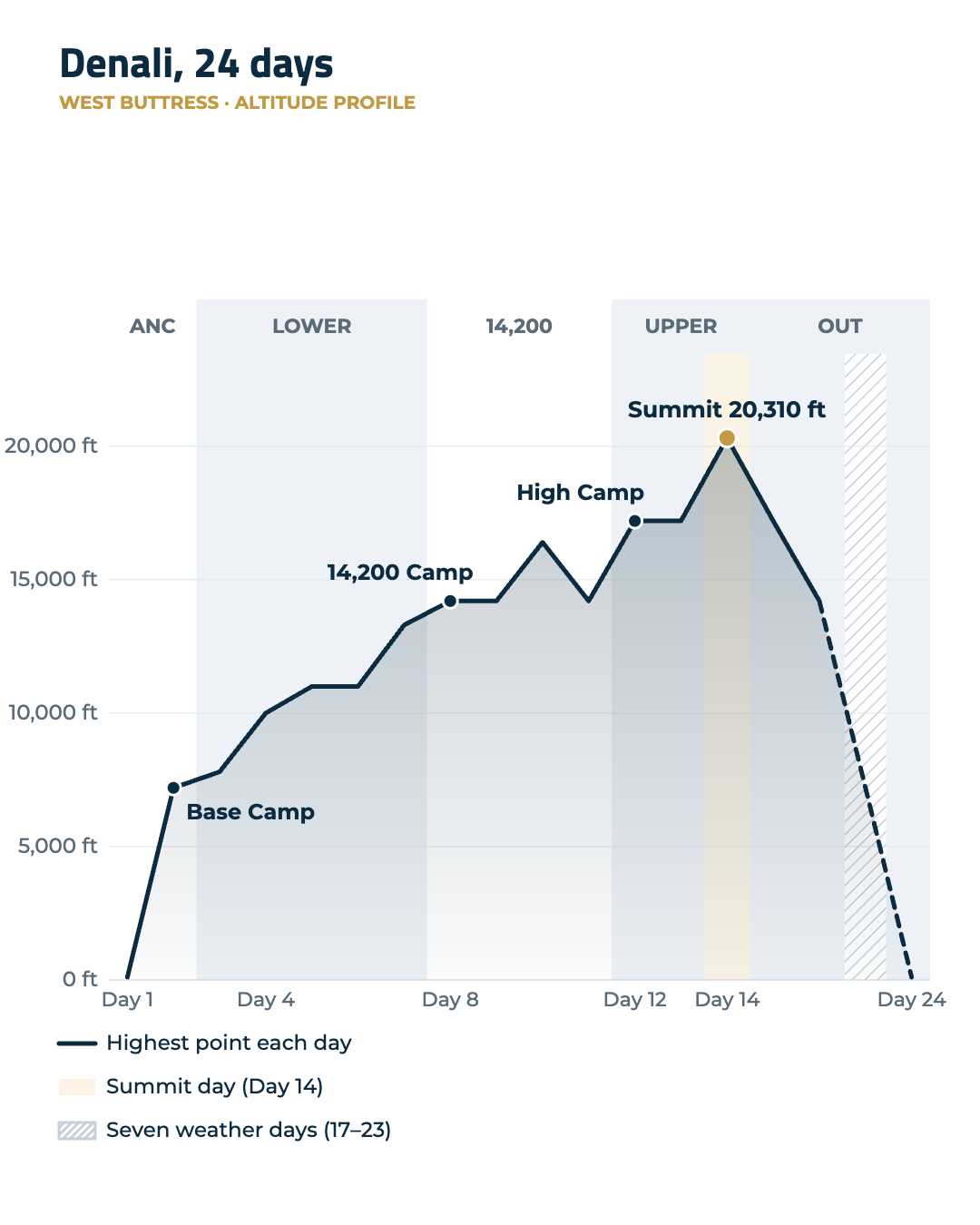
Altitude profile of the 24-day Denali West Buttress expedition: Anchorage, Base Camp 7,200 ft, 11,000 ft Camp, Windy Corner, 14,200 ft Camp, High Camp 17,200 ft and the summit at 20,310 ft / 6,190 m on Day 14Altitude profile of the 24-day Denali West Buttress expedition: Anchorage, Base Camp 7,200 ft, 14,200 ft Camp, High Camp 17,200 ft and the summit at 20,310 ft on Day 14
Highest point reached each day on Mountain Trip’s standard 24-day schedule. See Day by Day.
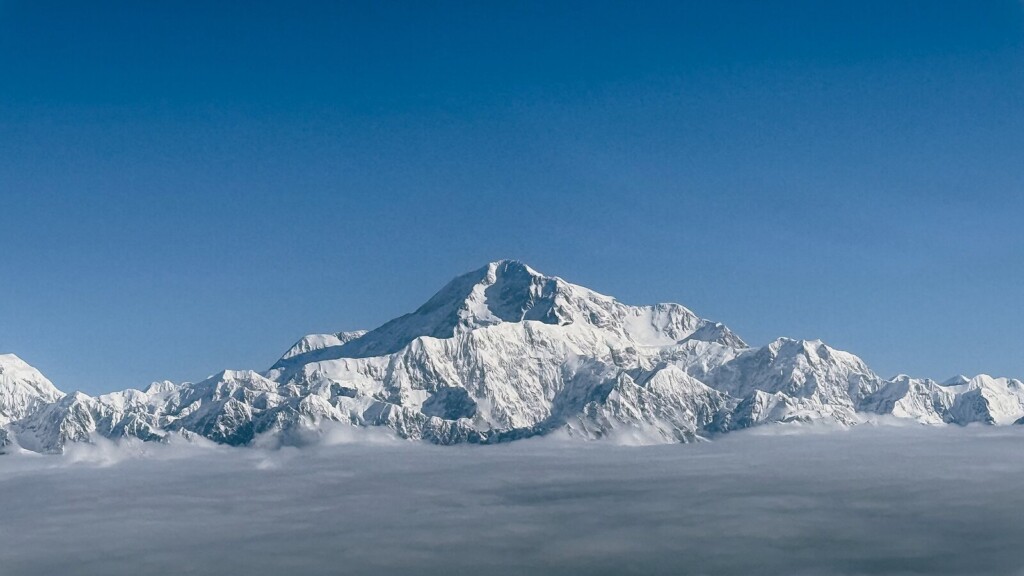
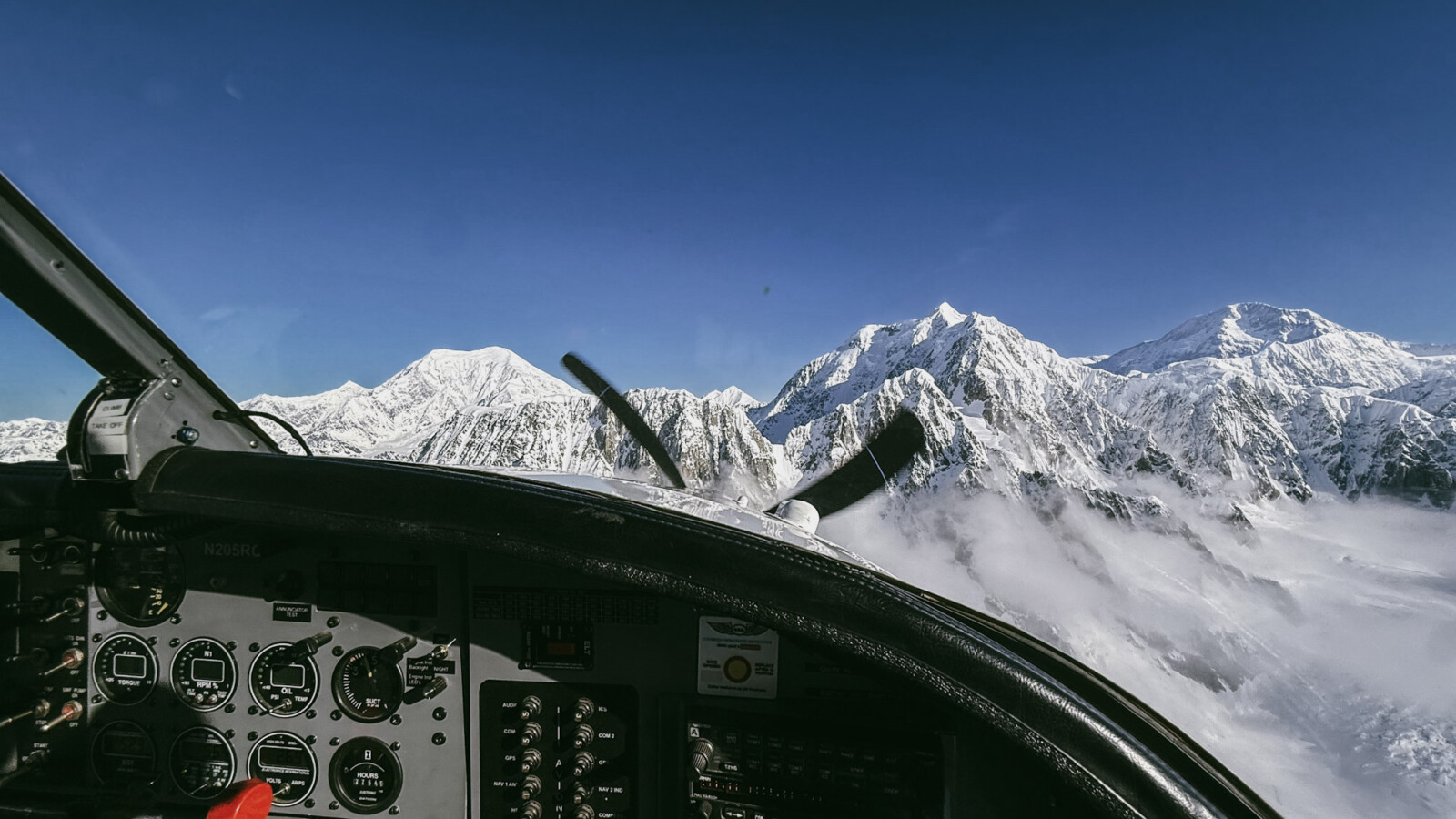
Denali rising above a sea of clouds, Alaska

What Makes Denali Different

Relief13,000 ft / 3,962 m

From the glacier landing to the summit. More vertical than Everest’s South Col route from Base Camp.

Latitude62°N

Lower barometric pressure than at the same height further south. The summit feels closer to 23,000 ft / 7,010 m.

Cold-40°F / -40°C

Reached on the upper mountain, with storms that can pin teams for days.

Self-sufficiencyNo porters

No yaks and no serviced camps. Your team carries and sleds every ounce of gear and food.

DurationThree weeks

Living and working on the glacier for the whole program.

Denali takes specific skills and training. If you are working toward it, we can plan the courses and expeditions to get you there. See Is This for Me?

Day by Day

Summit: Denali 20,310 ft / 6,190 m · Base Camp: Kahiltna Glacier 7,200 ft / 2,195 m · About 24 days, Anchorage to Anchorage, up to 22 on the mountain

This is Mountain Trip’s standard West Buttress schedule, and weather governs every phase of it. Summit day is planned for Day 14, and seven weather days (Days 17–23) are built in, because storms can pin a team at any camp for days. Guides adjust the plan to the conditions and the team.

Altitude profile of the 24-day Denali West Buttress expedition: Anchorage, Base Camp 7,200 ft, 11,000 ft Camp, Windy Corner, 14,200 ft Camp, High Camp 17,200 ft and the summit at 20,310 ft / 6,190 m on Day 14Altitude profile of the 24-day Denali West Buttress expedition: Anchorage, Base Camp 7,200 ft, 14,200 ft Camp, High Camp 17,200 ft and the summit at 20,310 ft on Day 14
Highest point reached each day. Summit day is planned for Day 14; Days 17–23 are weather days, used wherever they are needed.

The 24 Days at a Glance

Each bar shows where you sleep that night. ▲ marks the day’s high point. Tap a day to open it.

In each day below, altitude reads start → high point → where you sleep. Distances and hiking times are estimates.

Climb high, sleep low

Some days climb well above where you sleep. The gap between the day’s high point and the night’s camp is how your body adapts.

Times are estimates

Hiking times change with the team and the conditions. A slow, steady pace is the plan, not a problem.

The plan can flex

Weather, how the team is acclimatizing and your guides’ judgment can change the daily plan. That flexibility is part of the plan.

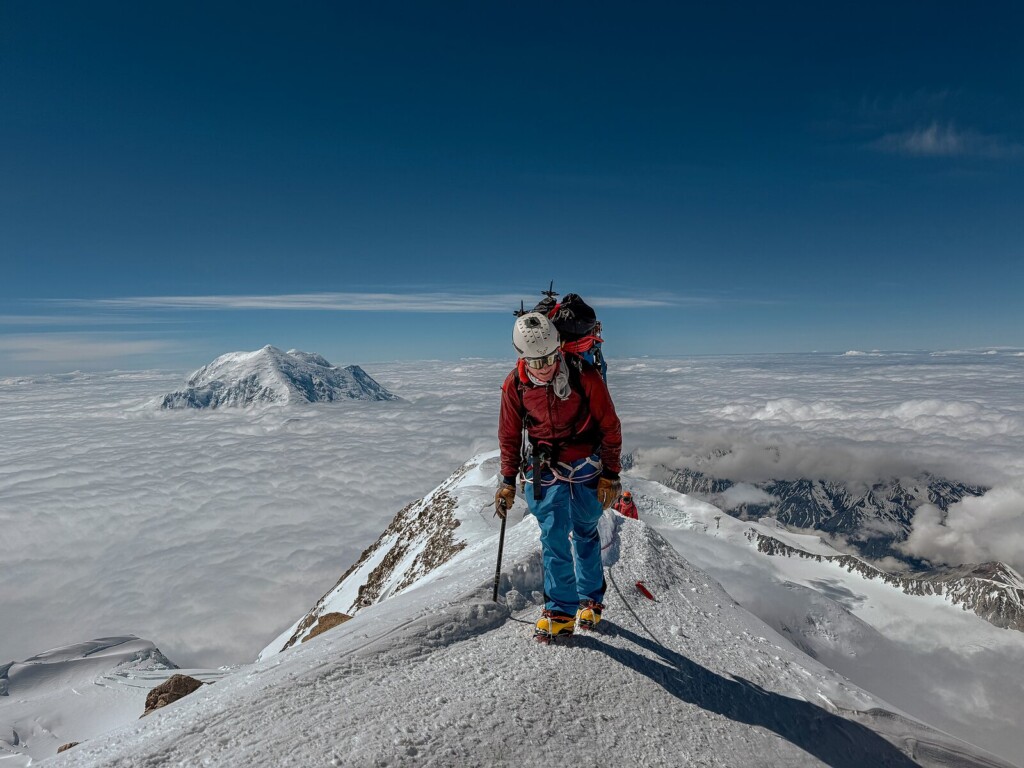
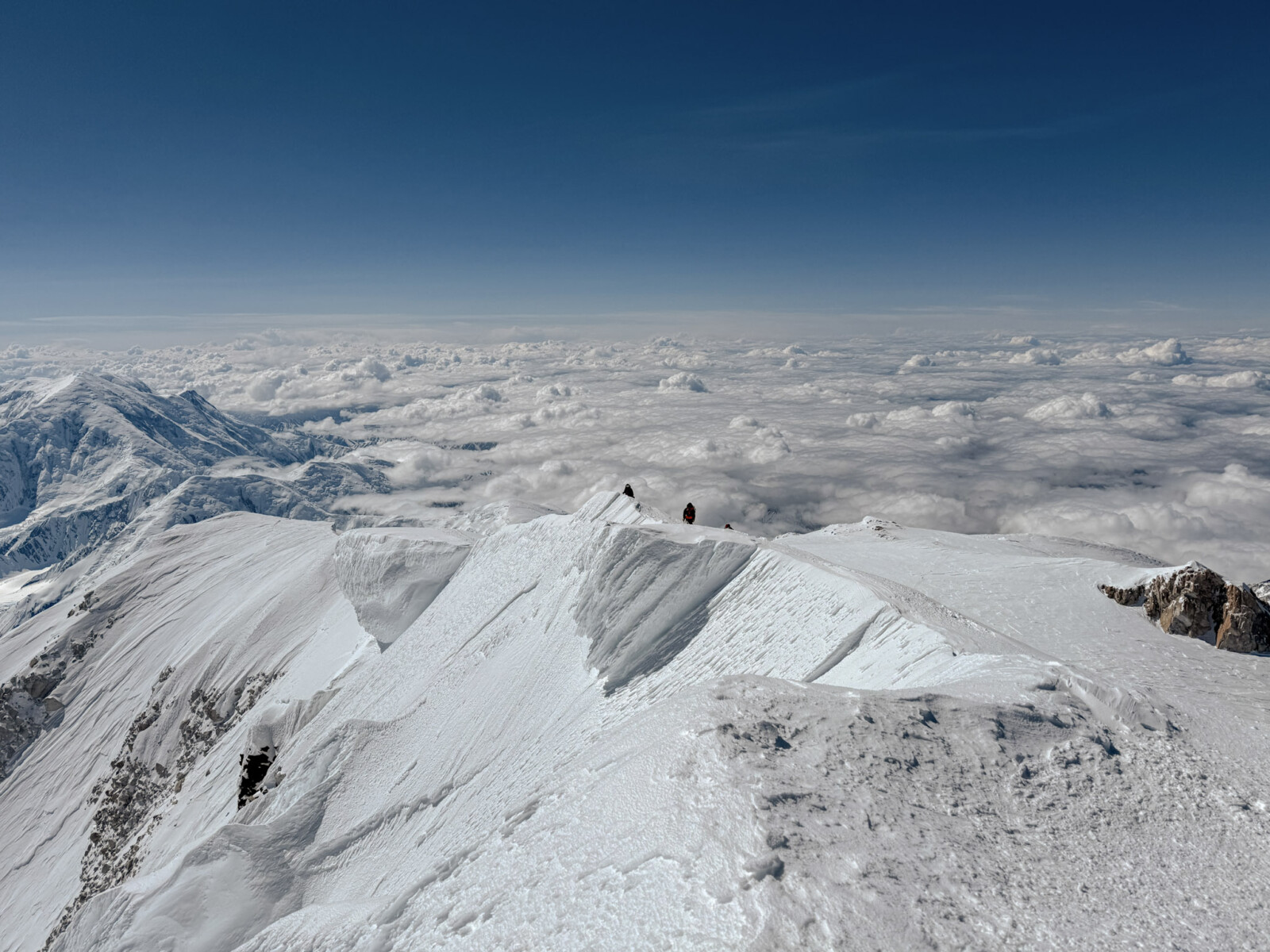
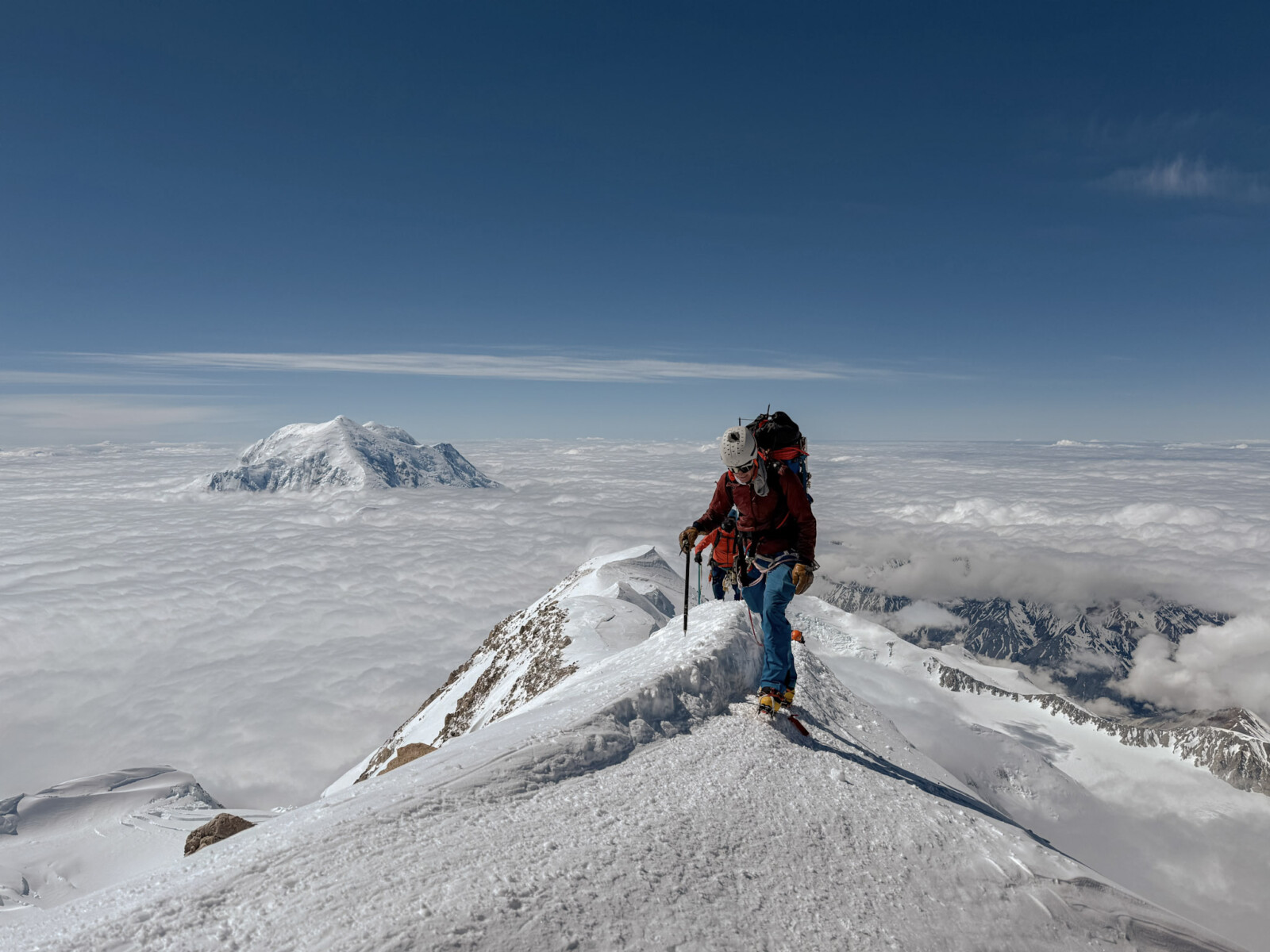
Climber on a snow ridge above the clouds on Denali, Alaska

Anchorage

The team meets in Anchorage, usually at 10 a.m. Guides check every piece of personal gear, and there is time for last-minute shopping and rentals. Shared hotel lodging and the airport transfer are included.

Overnight: Anchorage

Base Camp · 7,200 ft / 2,195 m

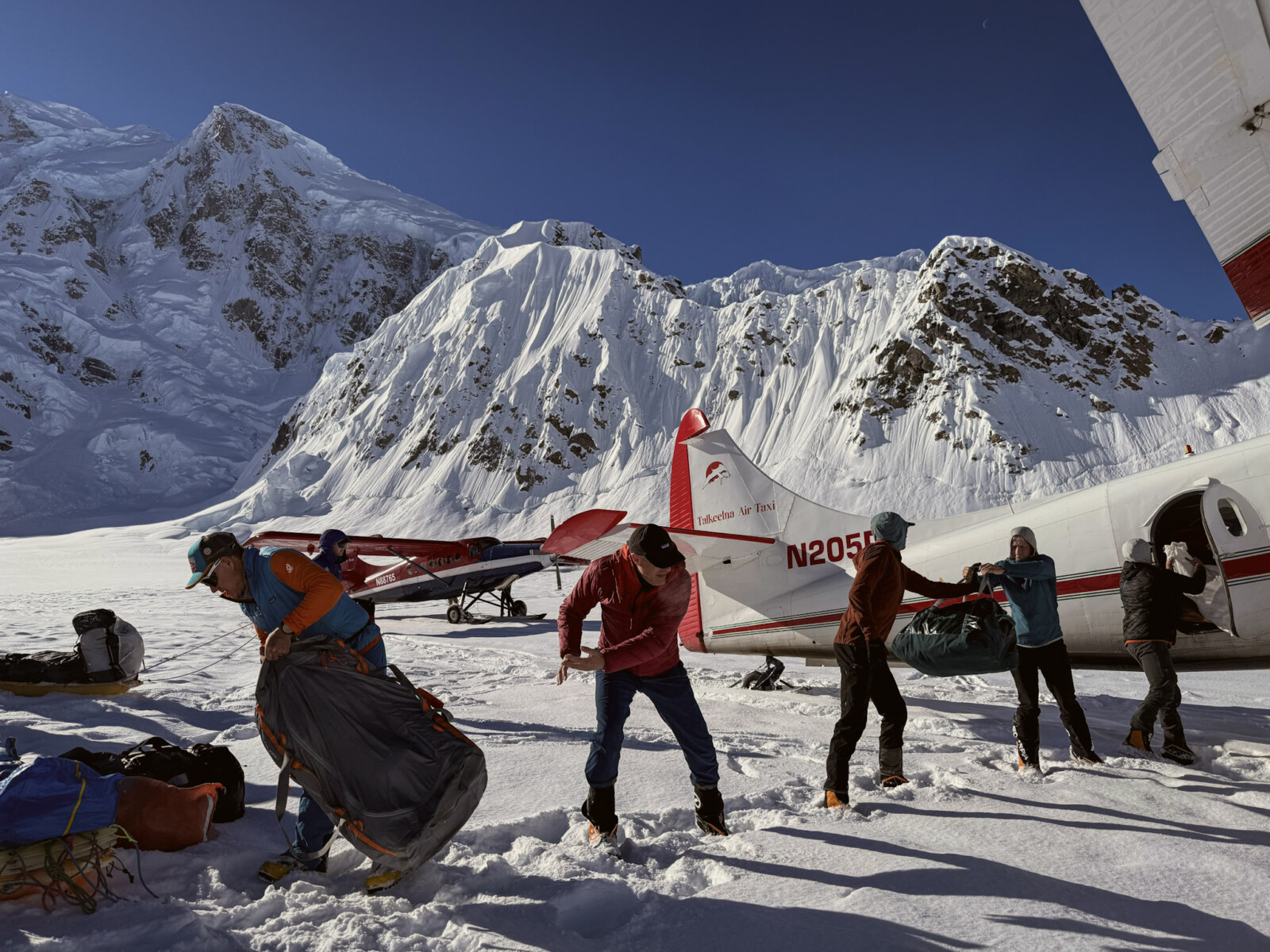
A drive of just over two hours to Talkeetna, registration with the National Park Service rangers, then, weather permitting, the ski-plane flight onto the Kahiltna Glacier. Base Camp goes up on arrival. If the weather holds the plane, the team waits in Talkeetna.

Overnight: Kahiltna Base Camp, 7,200 ft / 2,195 m

7,800 ft / 2,377 m · 5 miles / 8 km · +1,200 ft / +366 m · 4.5–6 hrs

A single carry down Heartbreak Hill and up the Kahiltna Glacier, roped together, pulling sleds. Setting the right pace here pays off higher up.

Overnight: 7,800 ft Camp, 2,377 m

8 miles / 12.9 km round trip · +2,200 ft / +671 m · 6–8 hrs

The classic climb-high, sleep-low day: loads are hauled up Ski Hill and cached, and the team returns to 7,800 ft to sleep.

Overnight: 7,800 ft Camp, 2,377 m

11,000 ft / 3,353 m · 4.75 miles / 7.6 km · +3,400 ft / +1,036 m · 5.5–7 hrs

Collect the cache and move up to 11,000 ft Camp, a broad basin with the Alaska Range in every direction.

Overnight: 11,000 ft Camp, 3,353 m

1.5 miles / 2.4 km round trip · +1,200 ft / +366 m · 1.5 hrs

An active rest day: a short trip back down to collect the cache left below camp.

Overnight: 11,000 ft Camp, 3,353 m

To 13,300 ft / 4,054 m · 4 miles / 6.4 km · +2,300 ft / +701 m · 6–7 hrs

Up Motorcycle Hill and Squirrel Hill and around Windy Corner, one of the most exposed spots on the route. Loads are cached and the team returns to 11,000 ft.

Overnight: 11,000 ft Camp, 3,353 m

14,200 ft / 4,328 m · 2.5 miles / 4 km · +3,200 ft / +975 m · 5–7 hrs

The move to 14,200 ft Camp in the Genet Basin, the largest camp on the route and home to the NPS ranger camp during the season.

Overnight: 14,200 ft Camp, 4,328 m

1 mile / 1.6 km round trip · +700 ft / +213 m · 1.5 hrs

A short back carry to the Windy Corner cache, then a review of the techniques the upper mountain needs: fixed lines, ascender work and running belays.

Overnight: 14,200 ft Camp, 4,328 m

To about 16,400 ft / 5,000 m · 2.4 miles / 3.9 km round trip · +2,200 ft / +671 m · 5–7 hrs

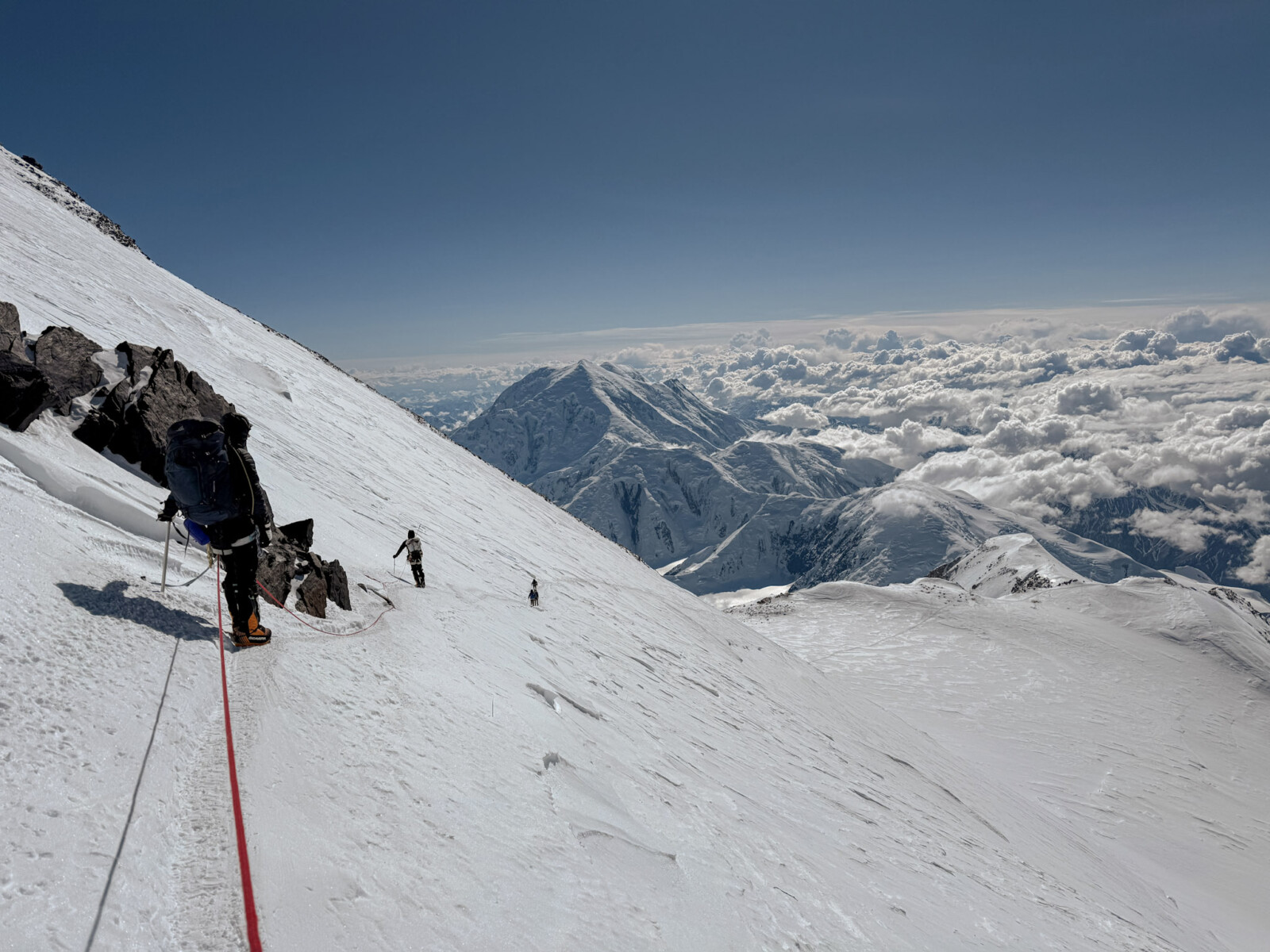
Up the fixed lines of the Headwall to the crest of the West Buttress. Loads are cached on the ridge and the team returns to 14,200 ft.

Overnight: 14,200 ft Camp, 4,328 m

14,200 ft / 4,328 m

A deliberate rest day. Guides watch each climber’s acclimatization and the forecast before committing to the upper mountain.

Overnight: 14,200 ft Camp, 4,328 m

17,200 ft / 5,242 m · 2 miles / 3.2 km · +3,000 ft / +914 m · 6–8 hrs

Up the fixed lines with full packs, collect the cache and follow the exposed ridge past Washburn’s Thumb to High Camp, the staging point for the summit.

Overnight: High Camp, 17,200 ft / 5,242 m

17,200 ft / 5,242 m

Rest and recover before the summit. Guides confirm conditions before committing.

Overnight: High Camp, 17,200 ft / 5,242 m

20,310 ft / 6,190 m · 5 miles / 8 km round trip · +3,000 ft / +914 m · 9–12+ hrs

Leave High Camp between 7 and 10 a.m. when conditions allow. Traverse up to Denali Pass at about 18,000 ft / 5,486 m, follow the upper mountain past Archdeacon’s Tower and across the Football Field, then climb the final summit ridge. The descent to High Camp starts straight after summit photos.

Overnight: High Camp, 17,200 ft / 5,242 m

7,200 ft / 2,195 m

Two demanding days reversing the whole route: down the fixed lines, through 14,200 ft Camp, past Windy Corner and down the lower glacier to Base Camp.

Overnight: Kahiltna Base Camp, 7,200 ft / 2,195 m

Seven contingency days

Seven days are built in for storms, which can hold a team at any camp. They are used wherever the weather demands, on the way up or on the way out. If they are not needed, the team flies out early.

Overnight: Wherever the weather holds the team

Anchorage

The ski plane takes the team back to Talkeetna when the weather allows, then group transport returns everyone to Anchorage for flights home. Glacier flights can be delayed, so book onward travel with flexibility.

Overnight: Home, or Anchorage at your cost

Continue Preparing

Read next: Is This for Me? · Life on the Mountain · Dates and Prices

Questions about the itinerary or your readiness? Ask a guide.

Is This for Me?

Denali is a capstone expedition, not a starting point. At 20,310 ft / 6,190 m it is lower than Everest or Aconcagua, but everything else is harder: arctic weather, carrying your own loads, three weeks of duration, the latitude effect on pressure, and complete self-sufficiency for every member of the team.

Technical Experience You Need

The West Buttress is Denali’s non-technical route, but by Denali’s standards that still means:

Glacier travelPracticed

Crampon technique, rope-team movement, self-arrest and crevasse rescue, efficient and not learned for the first time.

Fixed lines45–50° slopes

Comfortable using an ascender on steep snow with expedition gloves on. The Headwall is not the place to learn.

Load carrying80–100 lb / 35–45 kg

What each climber leaves Base Camp with, split between sled and pack, hauled over sustained terrain day after day.

Camp craftArctic conditions

Anchor a tent in high wind, manage gear and food in deep cold, and communicate well when tired.

The NPS, BBE and Mountain Trip require documented prior mountaineering experience from every guided Denali climber. Benchmarks: Aconcagua, Rainier, Shasta, Cotopaxi, a mountaineering course on glaciated terrain, or equivalent documented alpine experience. Prior experience above 18,000 ft / 5,486 m is strongly recommended.

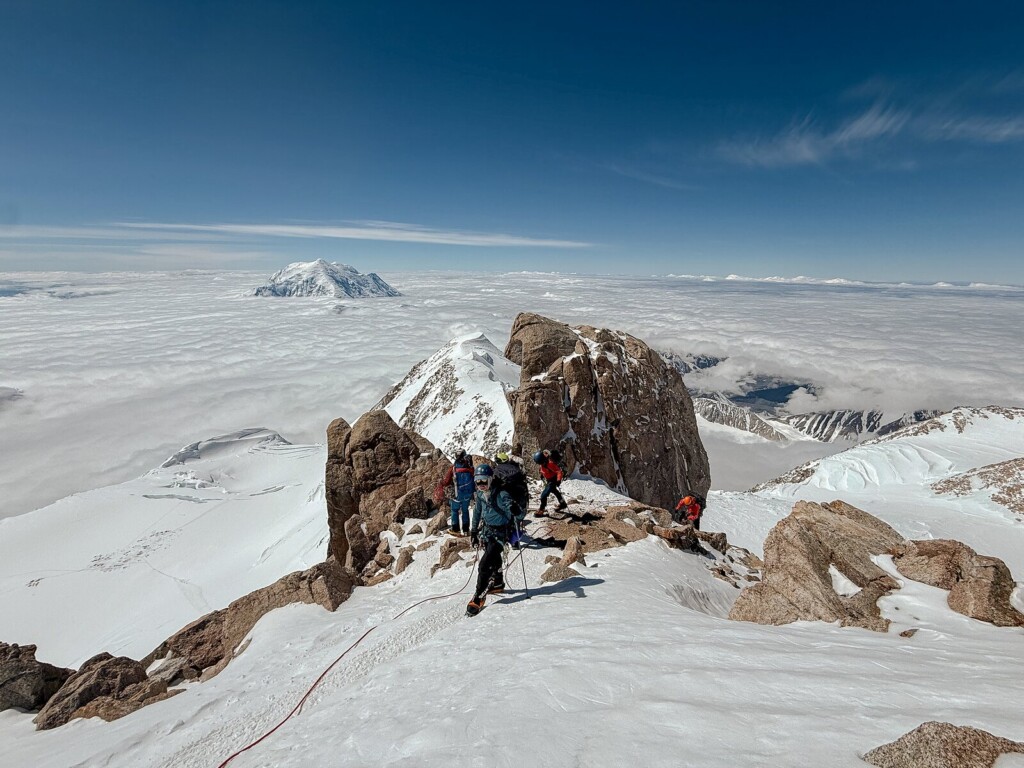
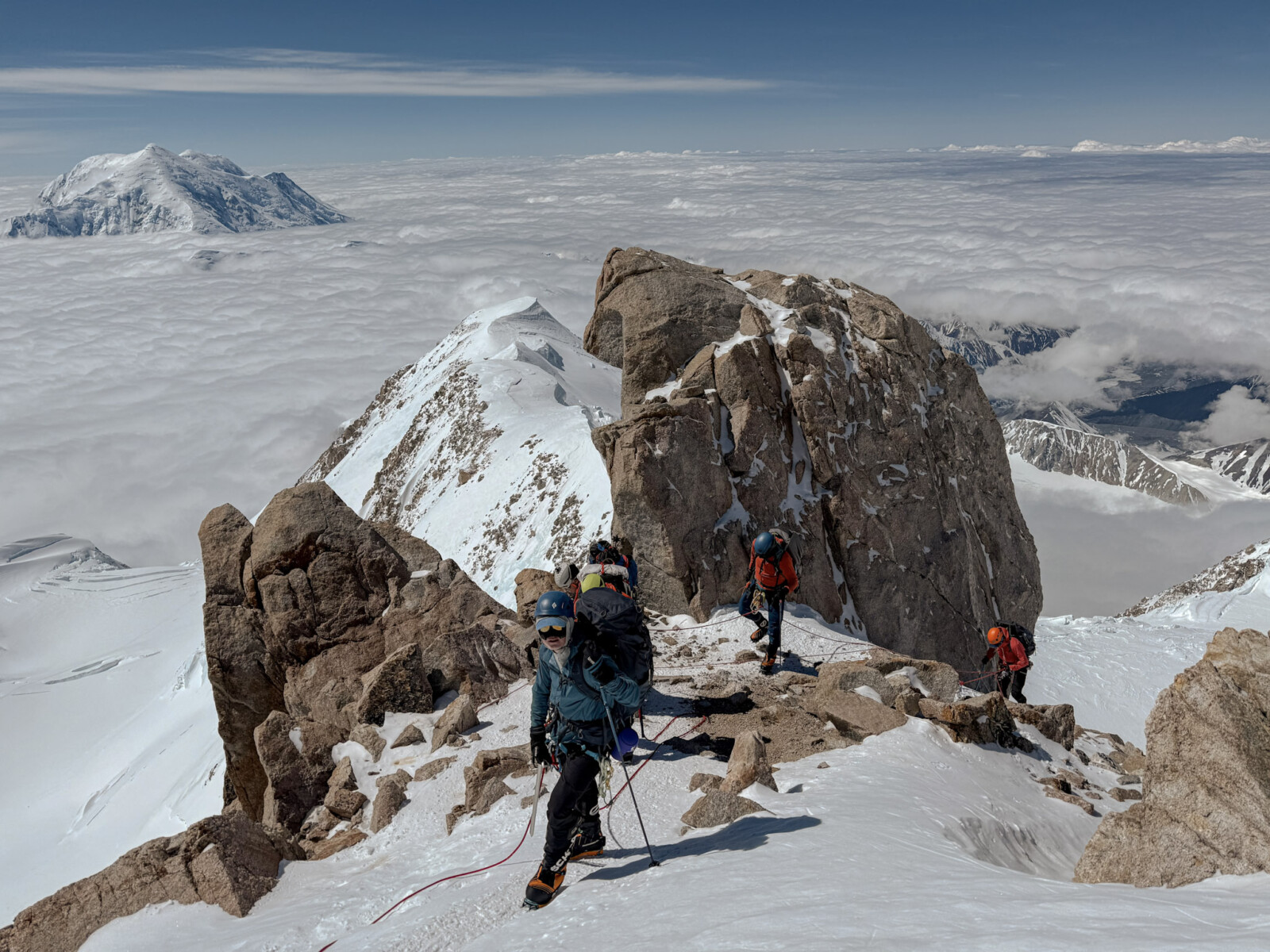
Climbers among the rocks on a high ridge of Denali, Alaska

Fitness You Need

The requirement is loaded uphill endurance over consecutive days, sustained for three weeks. You should be able to:

  • Move 80–100 lb / 35–45 kg between sled and pack for 6–8 hours on back-to-back days
  • Climb from 14,200 ft to the 16,400 ft cache and back in 6–8 hours
  • Keep working in the cold after poor sleep and with a reduced appetite
  • Recover and go again the next day, whatever the day before took

Start training at least six months before departure. BBE provides a full training plan to every confirmed climber: weighted pack hiking on steep terrain, back-to-back loaded days, cold exposure, and core and leg strength.

Rehearse the Systems at Home

The Headwall is not the place to learn ascender work. Our Wasatch Everest Prep Course is four days in Utah’s Wasatch with Willie or Damian Benegas: fixed lines, ascender work and a night at high camp, so the systems you need on Denali are familiar before you reach Alaska.

The Checkpoints on the Mountain

Guides decide who moves up, camp by camp. These are the standards Mountain Trip uses:

Before 14,200 ft CampBasics

Physical conditioning, looking after yourself and your gear, and sound technique: rest step, French technique, front pointing and running belays.

Before High Camp6–8 hrs

Efficient ascender work on the fixed lines, and the round trip from 14,200 ft to the 16,400 ft cache in 6–8 hours.

Before the summit7–8 hrs

Running belays in thick gloves and mittens, a share of the group summit gear, and the move to High Camp at an average of 7–8 hours.

Climbers who are not ready to move up safely do not move up. Over the past decade, fewer than 2% of Mountain Trip climbers could not take part enough to climb safely.

The Latitude Factor

At 62°N the air pressure is lower than at the same height further south, so the summit feels closer to 23,000 ft / 7,010 m than its measured 20,310 ft. Don’t assume your Andean or Himalayan acclimatization transfers directly.

The Mental Side

PatienceStorm days

Waiting out storms in a tent without frustration breaking the team.

ResilienceSummit day

Performing after weeks of accumulated effort.

Team firstRoped travel

On a rope in crevasse country, everyone’s safety is shared.

HonestyReport early

Telling your guides about symptoms, fatigue and concerns as soon as they start.

Not Ready Yet?

If Denali would be your first serious mountaineering objective, start with the Ecuador Mountaineering School, the Wasatch Everest Prep Course, Aconcagua or Kilimanjaro, and come back to Denali better prepared. The mountain will still be there. Ask a guide which step fits your experience.

Before You Go

Permits & Registration

Mountaineering special use fee$475 · age 24 and under $375

The 2027 NPS fee, per climber (2026: $450 and $350), plus the $15 park entrance fee.

Registration60 days ahead

Applications must be submitted at least 60 days before the climb.

Ranger check-inTalkeetna

Registration at the Walter Harper Talkeetna Ranger Station on Day 2, before the flight to the glacier.

Mountain Trip, as the authorized concessioner, handles the guided-climber paperwork, and you receive detailed instructions at booking. Travel and rescue insurance is not included; trip cancellation insurance is strongly recommended.

Getting to Talkeetna

Fly into Anchorage. The team meets there on Day 1, usually at 10 a.m., for the gear check. Up to two nights of shared hotel lodging in Anchorage and the airport transfer are included, and group transport takes the team to Talkeetna on Day 2 and back to Anchorage at the end.

Plan your return with room to spare. The ski plane only flies off the glacier when the weather allows, so delays are common. Don’t book tight connections in Anchorage on the last day.

Life on the Mountain

Three weeks on the Kahiltna Glacier have a rhythm of their own: move or carry, build camp, melt snow, eat, rest, and watch the weather. This is what daily life on Denali looks like, and what helps you thrive in it.

A Day on the Glacier

A carry or move day starts in the cook tent, with hot drinks and breakfast while the guides melt snow for the day’s water. The team ropes up, travels for six to eight hours, and either caches a load and returns or moves camp higher. Back in camp, the work continues: digging tent platforms, building snow walls, organizing gear and cooking dinner. Rest days are for recovering, practising skills and watching each climber’s acclimatization.

On the lower glacier in late May and June, teams often travel in the cool of the night or early morning, when the snow is firm and the crevasse bridges are strongest.

Carrying Your Own Loads

Denali has no porter support. Every ounce of gear, food and fuel for three weeks is carried or sledded by the team. The standard method is ferrying: carry a load up to a cache, descend to sleep lower, then return the next day to collect it and move up. It doubles the vertical but builds acclimatization. Leaving Base Camp, each climber moves about 80–100 lb / 35–45 kg, split between sled and pack; the sled takes most of it on the lower glacier.

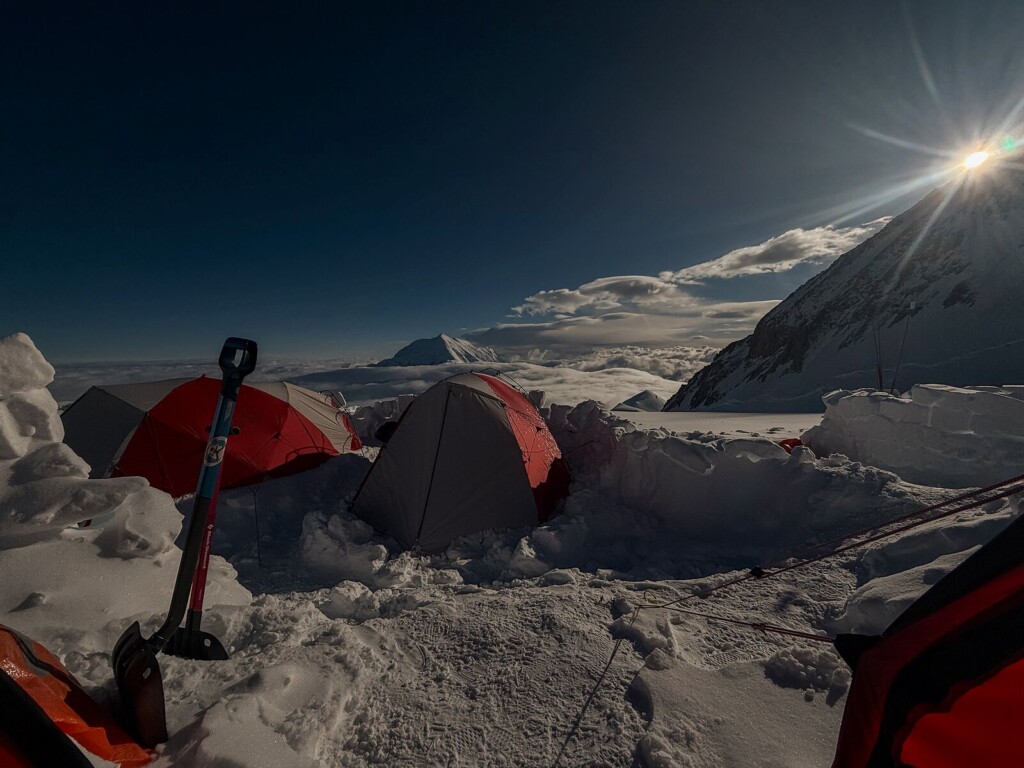
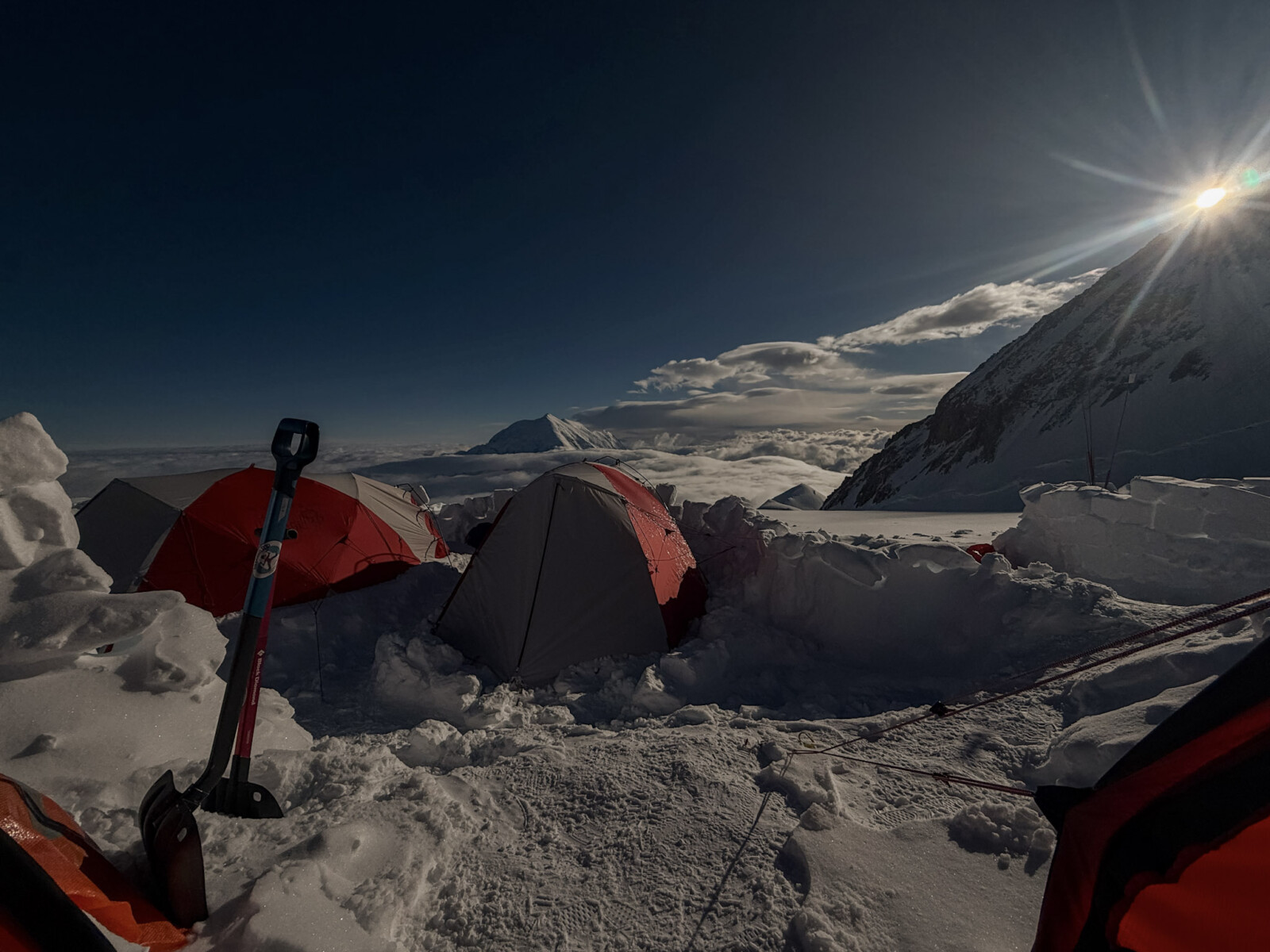
Tents at a high camp on Denali, Alaska

Eating Well on the Glacier

We take real pride in how our teams eat, and Denali is no exception. Every ounce of food is carried or sledded up the mountain, so nothing comes along by accident. But the cold works in our favor: the glacier is a natural freezer, which lets us bring real ingredients and cook proper meals in camp, not just freeze-dried packets.

Good food is fuel for three weeks of hard work, and a hot, real dinner after a long carry does as much for a team’s morale as a rest day. Tell us about any dietary needs when you book, and bring the snacks you know you will still want to eat when the altitude takes your appetite.

Water Comes from Snow

There is no running water on Denali. Every litre you drink, and every meal you eat, starts as snow melted on the stoves, so water takes time and fuel. Drink steadily, keep your bottles inside your pack and your sleeping bag so they don’t freeze, and expect the cook tent to run long on cold mornings.

Cold

The lower glacier can feel surprisingly warm in the Alaska summer sun. Above 14,200 ft / 4,328 m the arctic arrives: expect -4°F to -22°F / -20°C to -30°C at High Camp in normal conditions, and wind chills of -40°F / -40°C or worse in storms. Frost forms inside the tent overnight, and anything you need in the morning sleeps in your bag with you. Cold-injury prevention is a major focus for the guides on the upper mountain.

Light Almost Around the Clock

Around the June solstice the Alaska Range gets more than 20 hours of daylight, and even at night the sky never gets fully dark. You won’t need a headlamp much, but you will want an eye mask to sleep, and strong sun protection for long days on the snow.

Wind, Snow Walls and Storm Days

Wind is one of Denali’s biggest hazards: the National Park Service has recorded gusts above 100 mph at 14,200 ft. Every camp is built for it, with snow walls around the tents and everything anchored. Storms can keep a team in camp for days. The work doesn’t stop: shovelling, reinforcing walls, melting snow and staying patient as a team.

Keeping the Mountain Clean

“Take care of the mountain, and the mountain will take care of you.” It is the Benegas Brothers’ motto, and on Denali it is the rule we climb by.

Denali has some of the strictest clean-climbing rules in the world, and we follow them to the letter. The rangers issue each team Clean Mountain Cans in Talkeetna for solid human waste. Below 14,200 ft, all of it is carried off the mountain; above that, it goes out with the team or into the single crevasse the rangers mark at 14,200 ft camp. Every scrap of trash, food waste and fuel is packed out, and camps share marked spots for urine. It isn’t glamorous, but it keeps the snow clean for the water every team drinks.

Staying in Touch

The team carries a satellite phone and a GPS tracker, and sends updates when reception and the day allow. Reception is patchy in some camps, so tell your family to expect gaps. On Denali, no news is usually good news.

Denali Gear List

Denali is the coldest expedition we run. The West Buttress is not a technical rock or ice climb, but you will live on a glacier for three weeks, carry and sled your own loads, climb fixed lines on 45–50° snow and spend nights at High Camp in temperatures well below zero. On Denali, gear is not a comfort question. It decides whether you keep your fingers and toes.

This section explains how to think about your kit and what matters most. Every confirmed climber receives the complete required equipment list from Mountain Trip, our authorized concessioner partner, with specifications and guide notes. That list governs: every item on it is required unless it is marked optional.

Think in Systems, Not Items

Gear rarely fails on Denali because something was forgotten. It fails because it was never used with the rest of the kit in real cold. Boots have to work with crampons, gloves with an ascender, your sleeping bag with both pads, your layers with a heavy pack. Build each system, then test it.

Feet

Expedition boots. Triple boots (an all-in-one 8,000-meter boot), or double boots with insulated overboots. Overboots can be rented in Alaska. Fit matters more here than anywhere else. Cold, swollen feet on the upper mountain will find every problem.

Socks, gaiters and camp footwear. Liner and expedition-weight socks (no cotton), with dry spares for every camp. Down or synthetic booties for evenings in camp make a real difference to warmth and morale.

Hands

Your hands work all day in the cold: rigging sleds, clipping fixed lines, running an ascender, building camp. The system goes from liner gloves, to windproof working gloves, to insulated gloves, to expedition down mittens for the upper mountain and summit day. Bring spares. A dropped mitten above 14,200 ft is a serious problem.

Body and Layers

Layer from base layers through midweight and fleece layers, a softshell, and a full waterproof, windproof hard-shell jacket and pants. Add a light insulated jacket for moving in the cold, insulated pants, and a full expedition down parka with a hood, rated for extreme cold. On Denali the parka is not a summit-day extra. You will live in it at the upper camps.

Head and Eyes

Warm hats (one must fit under your helmet), a balaclava, a face mask or buff for wind, and a sun hat with neck protection. Category 4 glacier glasses with side protection, a spare pair, and goggles for wind and storm days. Twenty hours of daylight on snow make eye protection essential from the first day on the Kahiltna. Pack 4–6 or more sets of hand warmers too.

Sleep

A down sleeping bag rated −20 °F to −40 °F (synthetic bags are not accepted), an insulated inflatable pad with a repair kit, and a closed-cell foam pad as backup. At High Camp the cold comes up from the snow. A poor night costs you the next day’s carry.

Technical Equipment

  • 12-point steel crampons that fit your expedition boots (aluminum is not accepted)
  • Mountaineering ice axe, 60–75 cm
  • Climbing harness that fits over all your layers, with adjustable leg loops
  • One full-size ascender for the fixed lines on the Headwall
  • 8 non-locking and 3 locking carabiners, a double-length runner and 25–30 ft of 6–7 mm cord
  • Climbing helmet that fits over your warmest hat and under your shell hood
  • Adjustable ski or trekking poles with large snow baskets
  • Headlamp with spare lithium batteries

Snowshoes (22–28 in) are standard; they can be rented in Alaska. Sleds are group equipment and are supplied.

Packs and Bags

  • An expedition pack of at least 100 L for carries and camp moves (packs can be rented)
  • A 90–100 L duffel, which also rides on your sled as the sled bag
  • A cache bag of 30 L or more
  • Waterproof stuff sacks to keep your layers and sleeping bag dry

Water and Food in the Cold

Wide-mouth water bottles with insulated covers, and a vacuum flask for hot drinks on carry and summit days. Water freezes fast on the upper mountain, so bottles travel inside your pack and sleep inside your bag. Bring the personal snacks you know you will eat when your appetite drops at altitude.

Personal Medical Kit and Toiletries

A small personal first-aid and blister kit, high-SPF sunscreen and lip balm, hand sanitizer, and your prescription medications in original labelled containers. Talk with your physician about which medications you should carry. The guide team carries the expedition medical kit.

Group Equipment

Mountain Trip supplies all group equipment: tents, kitchen, ropes, sleds, pickets, shovels, the group medical kit, a satellite phone and a GPS tracker. Personal clothing, boots, sleeping gear and personal technical equipment are yours to bring or rent.

Test Everything Before You Go

  • Wear your boots, with crampons on, on long training days
  • Practise with an ascender while wearing your expedition gloves
  • Train in your real layers in cold, windy weather
  • Spend a cold night in your full sleeping system
  • Do a full pack-out two weeks before departure, every item packed the way it will travel

Expedition boots and sleeping bags need months of testing, not weeks. Start early.

The Equipment Check

Your guides check every climber’s equipment in Anchorage on Day 1, before the team leaves for Talkeetna. That is the time to find missing or unsuitable items, while they can still be replaced. Once the ski plane leaves, there is no gear shop.

Common Questions

Can I use my Aconcagua kit? Much of it, yes, but Denali is colder. Most climbers need warmer boots, mittens, a warmer parka and a warmer sleeping bag than they used in the Andes.

Can I rent gear? Yes, some items: overboots, expedition packs and snowshoes among them. Tell us early, and we will confirm options with Mountain Trip.

Who issues the final list? Mountain Trip, as the authorized concessioner. You receive it once your expedition is confirmed.

Ask a guide · Back to Before You Go · climbing@benegasbrothers.com

Private & Custom Expeditions

Denali is run only as a private or custom expedition: your dates, your team, and the same guiding standard. We are not booking fixed-date group departures.

How It Works

Your datesMay to early July

We set the departure around your calendar within the Denali climbing season.

Your teamUp to 6 climbers

Friends, family or a team you are building toward Denali together, guided at 2:1.

Your preparationBuilt in

If you need more experience first, we plan the courses and expeditions to get you there.

How to Start

Tell us what you have climbed and when you would like to go. Willie, Damian or one of our guides will reply personally. Start a private Denali inquiry.

Dates & Prices

Denali · West Buttress · Alaska · About 24 days

Denali Expedition · private and custom departuresOn request

Dates and price are set for each private team. Operated through Mountain Trip Alaska, an authorized concessioner of Denali National Park and Preserve.

When We Climb

Denali is climbed in the Alaska spring and early summer, with May and June the main months. The season runs from May to early July. The program is about 24 days from Anchorage, up to 22 of them on the mountain, including seven weather days.

What’s Included — and What Isn’t

Included in the price

  • Guiding by Mountain Trip guides at a 2:1 ratio
  • Up to two nights of shared hotel lodging in Anchorage, with the airport transfer
  • Group transport between Anchorage and Talkeetna, both ways
  • Ski-plane flights between Talkeetna and Base Camp
  • All food on the mountain
  • All group equipment: tents, kitchen, ropes, sleds, pickets, shovels, group medical kit, satellite phone and GPS tracker
  • A full training plan from BBE
  • Pre-trip help with gear and preparation

Not included

  • Flights to and from Alaska
  • Personal clothing and equipment, and rentals
  • Lodging beyond the two included nights, and meals off the mountain
  • Travel and rescue insurance
  • Guide gratuity (typically 10–20% of the trip cost)
  • The NPS mountaineering fee and park entrance fee (below)
  • Costs from evacuation, early departure, delays or events beyond anyone’s control

Fees You Pay Separately

The NPS mountaineering special use fee ($475 per climber, $375 for climbers 24 and under, for 2027) and the $15 park entrance fee. See Permits & Registration.

Booking a Private Denali Expedition

Denali is booked through Mountain Trip Alaska, the authorized concessioner. Because every Denali team is private, we confirm the booking, payment and cancellation terms with your quote.

Ready to Plan Denali?

Ask about private Denali dates and we will put together your expedition and its price.

Your Questions

The questions climbers ask most about Denali. Don’t see yours? Ask a guide.

Denali has no porter support — every ounce of gear, food, and fuel for three weeks is carried or sledded by the climbing team. The standard method is ‘ferrying’: carry a load to the next cache point, descend to sleep lower, then return the next day to collect and move up. This doubles the vertical effort but builds acclimatization and distributes the load across multiple days. Leaving Base Camp, each climber moves about 80–100 lb / 35–45 kg, split between sled and pack. The sled — used on the lower glacier — removes significant weight from your back on the approach sections.

A ski-equipped single-engine plane departs Talkeetna Airstrip and flies approximately 60 miles / 97 km into the Alaska Range, threading between peaks before dropping onto the Kahiltna Glacier at 7,200 ft / 2,195 m. Flight time is approximately 30 minutes. This flight is one of the great Alaskan experiences — the approach to Denali from the air is extraordinary. Flights are fully weather-dependent and are frequently delayed. Do not book tight connections in Anchorage on fly-in or fly-out days.

On the lower glacier, temperatures are often surprisingly mild in the Alaska summer — single digits above freezing on warm days. Above 14,200 ft / 4,328 m the arctic conditions arrive: expect -20°C to -30°C (-4°F to -22°F) at High Camp in normal conditions, with wind chills reaching -40°C / -40°F or worse in storms. Cold injury prevention is a significant guide focus on the upper mountain.

We don’t publish a summit rate, and no guide service can guarantee the summit. What improves your odds is what we build in: a 2:1 guide ratio, lead guides with at least five Denali expeditions, seven weather days and a deliberate acclimatization strategy. The primary causes of failure are: weather closing the summit window, inadequate acclimatization, and physical exhaustion from insufficient preparation. Arriving well-trained and patient significantly improves your odds.

All climbers must purchase a Denali National Park mountaineering permit before arrival in Talkeetna. For 2027, the NPS mountaineering special use fee is $475 per climber, or $375 for climbers 24 and under, plus a $15 park entrance fee. Applications must be submitted at least 60 days before the climb. Mountain Trip, as the authorized concessioner, handles the guided-climber paperwork — you receive detailed instructions at booking.

Yes. Documented alpine experience on glaciated terrain is required before acceptance on a guided Denali expedition. Minimum benchmarks: successful ascent of Aconcagua, Rainier, Cotopaxi, or equivalent, plus demonstrated competence in glacier travel, crevasse rescue, and fixed-line technique. BBE reviews all climber applications individually. If you are working toward Denali and not yet at the required experience level, contact us — we can build a preparation pathway.

On Denali, BBE works exclusively with Mountain Trip Alaska, a long-time authorized concessioner of Denali National Park and Preserve. Only the park’s authorized concessioners can run guided climbs on Denali, so every BBE Denali expedition is offered through Mountain Trip.

Tell us what you have climbed and when you would like to go. Ask a guide, and Willie, Damian or one of our guides will reply personally.

North America's Hardest Test.

Denali is North America's highest peak, and not by a small margin. At 20,310 ft, it dominates the continent by thousands of feet — with arctic weather, human-powered load carrying, and a 13,000 ft climb from the glacier that has no equal in the hemisphere.

Private & Custom Your dates. Your team.

This trip can run privately, on the dates that work for you.

Season
  • Dates and price on requestPrivate and custom departures

Questions first? Ask a guide

Location:
Alaska
Group:
Up to 6 climbers
Duration:
24 days
Skill:
Advanced
Activities:
Expeditions, 7 Summits
Pricing

All prices are in US dollars.

North America's Hardest Test.

Denali is North America's highest peak, and not by a small margin. At 20,310 ft, it dominates the continent by thousands of feet — with arctic weather, human-powered load carrying, and a 13,000 ft climb from the glacier that has no equal in the hemisphere.

Book now

Private Expedition

Plan your private Denali Expedition

Denali Expedition runs as a private trip: on your dates, with your people, built around your goal. Same guides and the same safety standard as every BBE expedition.

Your dates

We set the departure around your calendar, not the other way round.

Your people

Family, friends, a company team, or just you and a guide.

Your goal

Training for a bigger peak, a winter or speed attempt, a film, or a route that runs from summit to ocean.

Your price

Private trips are quoted for your group size, dates and plan.

A Partner you can trust

View our certifications

AMGA — American Mountain Guides Association logo
IFMGA / UIAGM — International Federation of Mountain Guides Associations logo

Related Trips