Global Expeditions Tanzania

Kilimanjaro Rongai

Rongai Route · Tanzania · 10 Days · Maximum Six Climbers

10 Days Group: Maximum 6 climbers $6,615 per person

The Climb

Kilimanjaro · Rongai Route · Tanzania · 10 Days · Maximum Six Climbers

Kilimanjaro is one of very few mountains where someone who has never climbed before can stand on a real expedition summit. No ropes, no technical gear, no mountaineering background. What it asks for is preparation, patience at altitude, and a team that knows how to run the days in between.
5,895mUhuru Peak · 19,341 ft
10Days, airport to airport
6Climbers, maximum
1Dedicated acclimatization day
~78kmOn the mountain, crossing it north to south-east
School HutSummit push away from the crowds
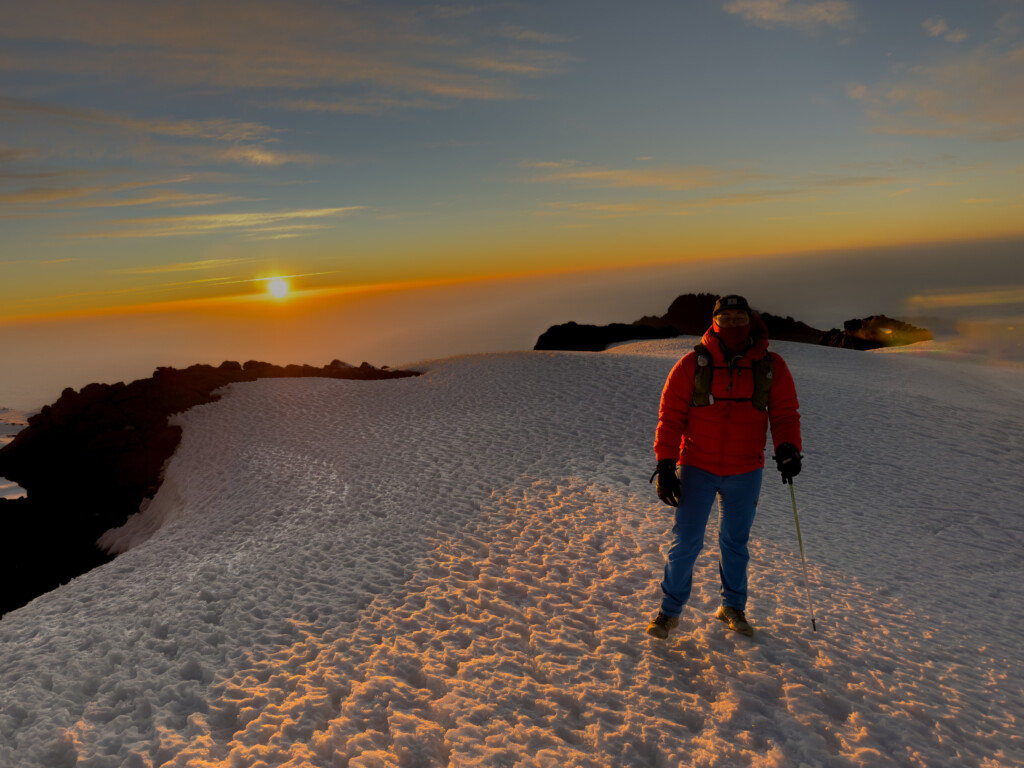
Climber in a red jacket standing on snow on the Kilimanjaro crater rim as the sun rises
Crater rim at sunrise · 5,800 m · Day 8
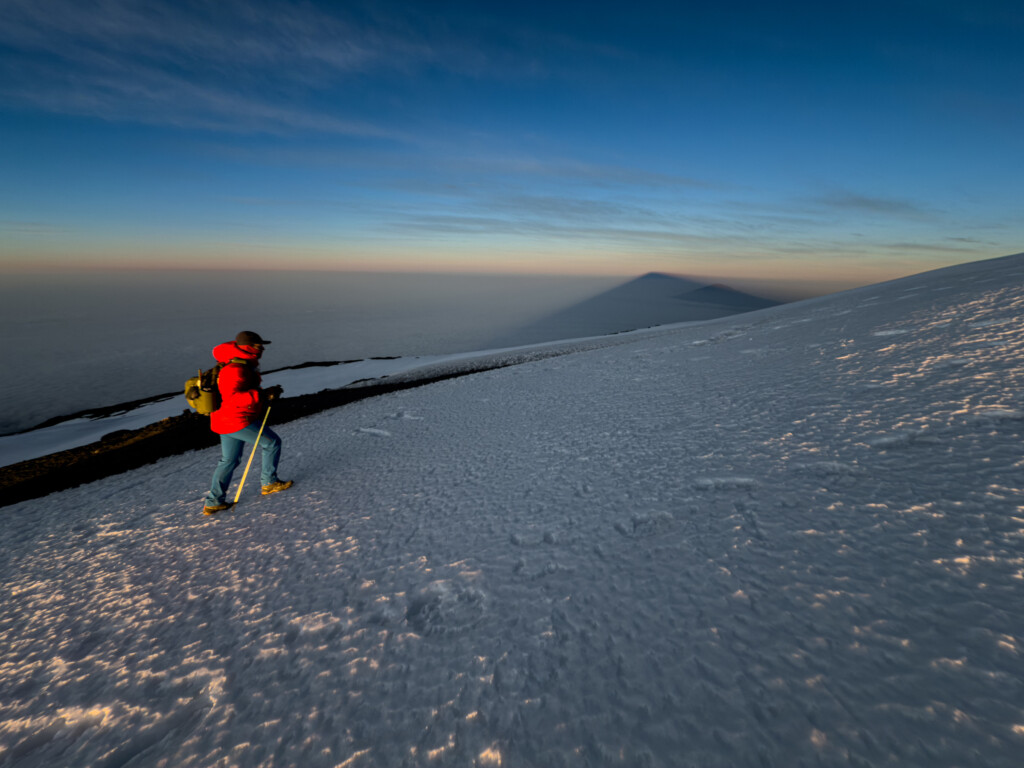
Climber on the crater-rim snowfield with the shadow of Kilimanjaro cast across the clouds
Crater rim snowfield · 5,845 m · Day 8
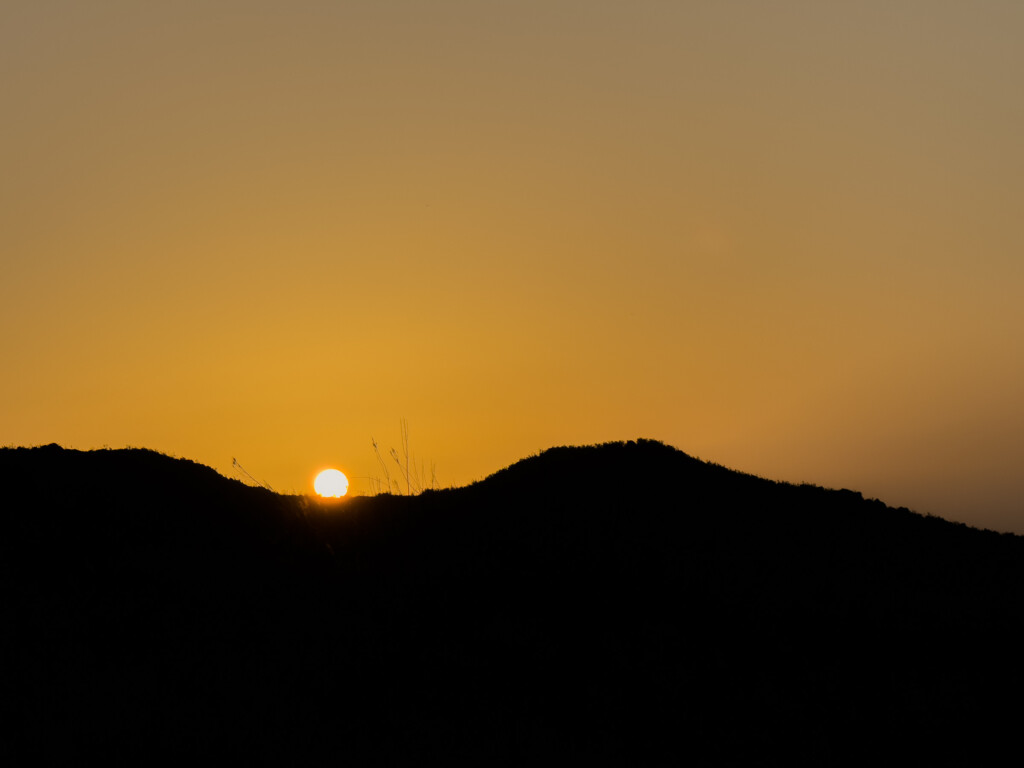
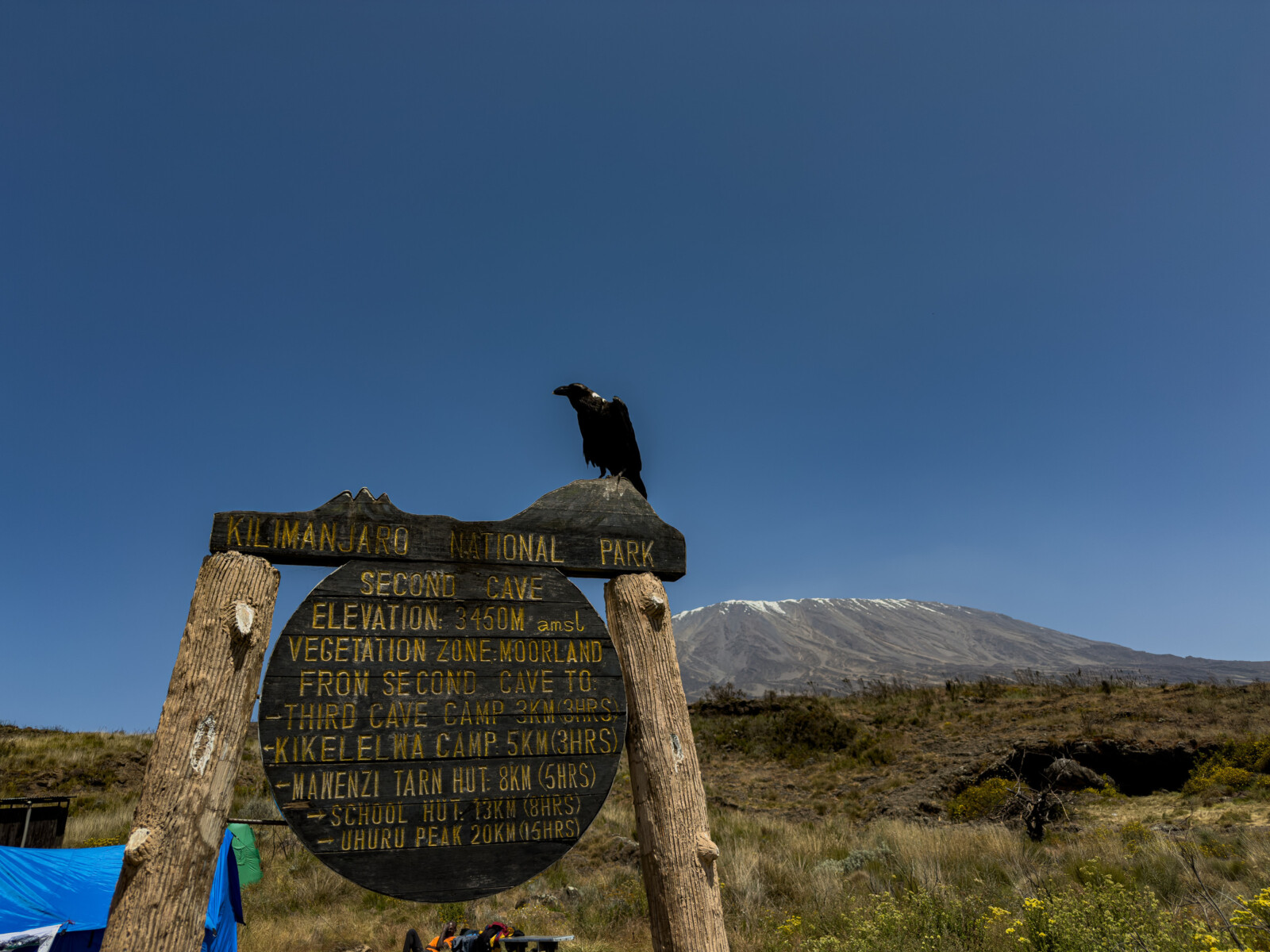
Orange sunset over the ridge at Second Cave camp on the Rongai route
Second Cave camp · 3,450 m · Day 4

We treat Kilimanjaro as a high-altitude expedition, not a trek. The route, the pace, the camps and the team size are all built around one goal: getting you to summit night ready for it.

The Mountain

Kilimanjaro rises to 19,341 ft / 5,895 m above the plains of northern Tanzania. It is the highest mountain in Africa, the highest free-standing mountain in the world, and one of the Seven Summits.

The route crosses five ecological zones: montane forest, heath and moorland, alpine desert, and finally the glaciers and ice cliffs of the summit crater. Many clients tell us the middle days, crossing the moorland into the alpine desert, are what they remember most. The summit is the objective. The climb is the experience.

At this altitude the mountain becomes less about effort and more about adaptation. Each day builds on the one before, so you reach the top adapted, not depleted.
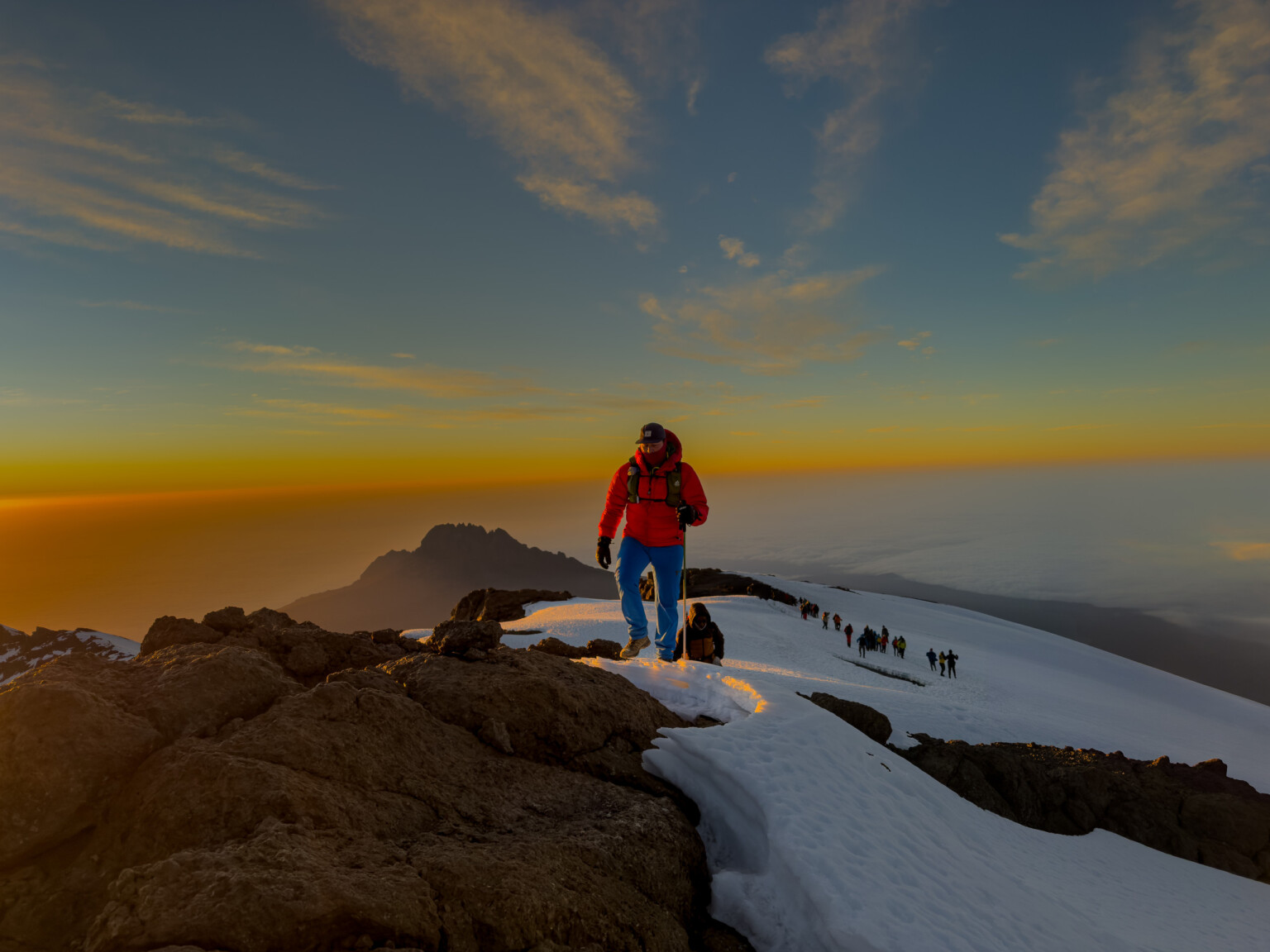
Climber on the Kilimanjaro crater rim at sunrise with the summit glaciers and a line of climbers behind
Crater rim glaciers · 5,850 m · Day 8 · Photo: BBP

Why We Climb the Rongai Route

Rongai approaches Kilimanjaro from the north, near the Kenyan border. It sees far fewer climbers than the southern routes, and it is drier and quieter. The trail climbs gradually through forest, moorland and alpine desert, which gives your body time to adjust.
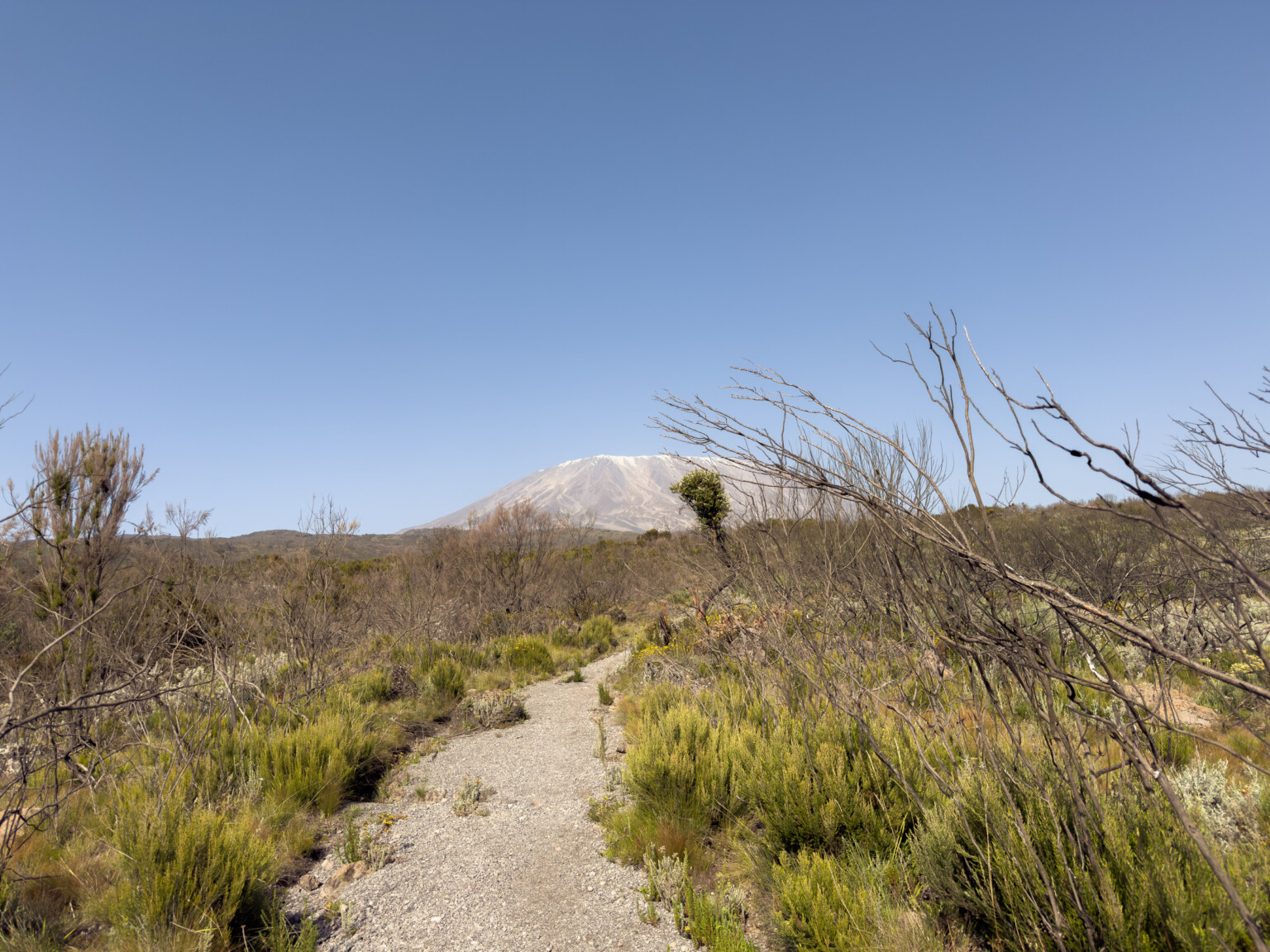
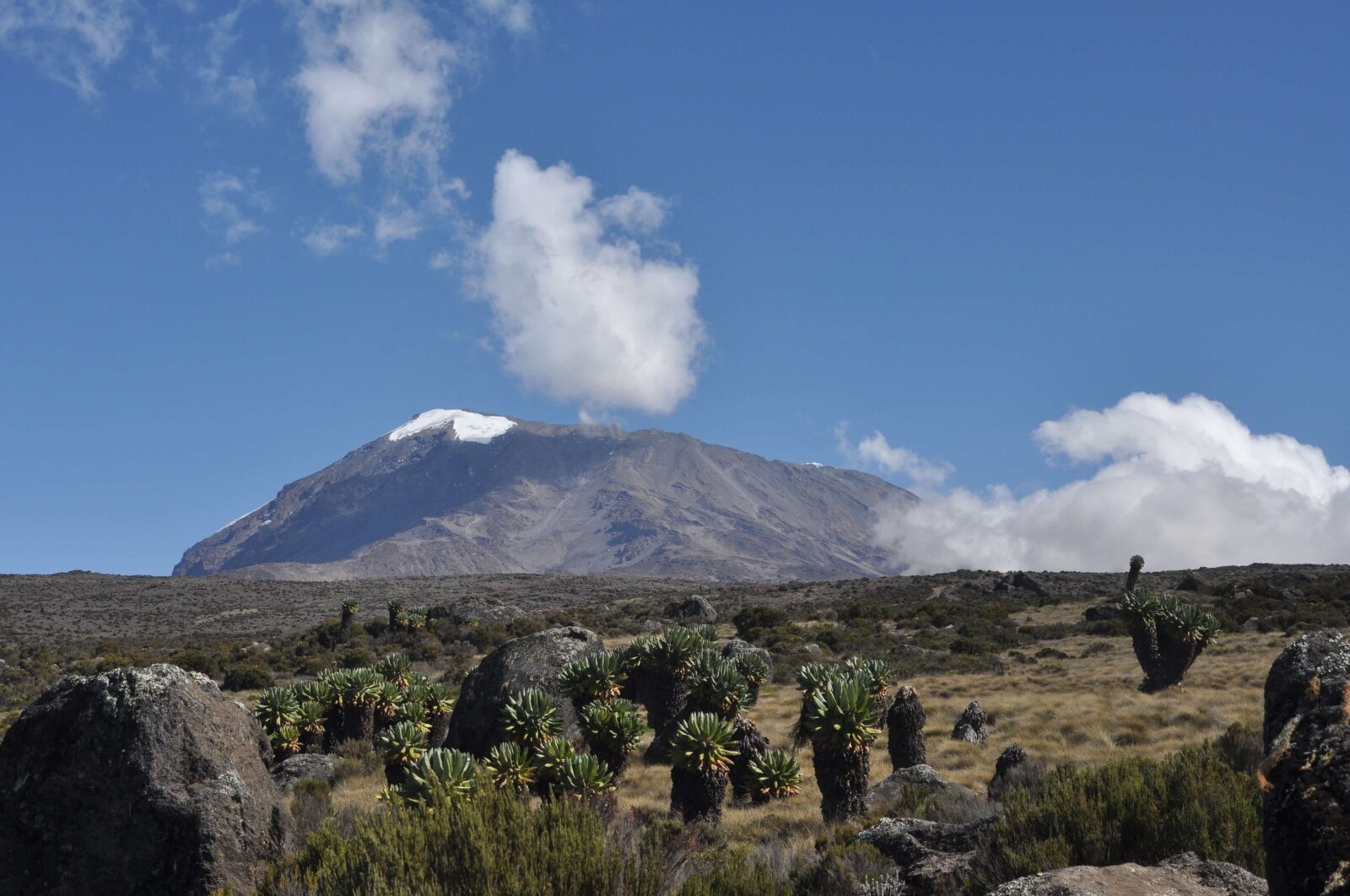
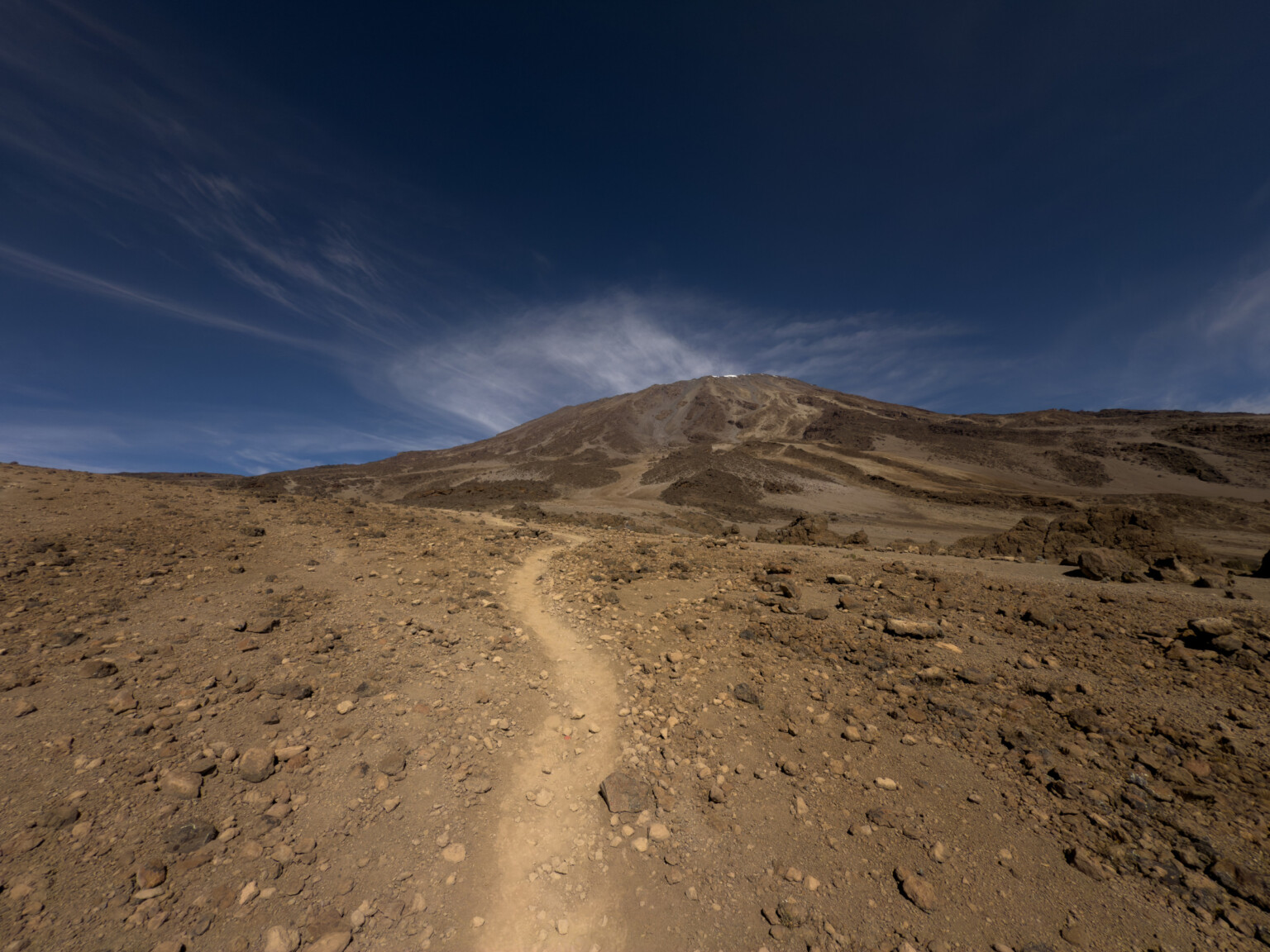
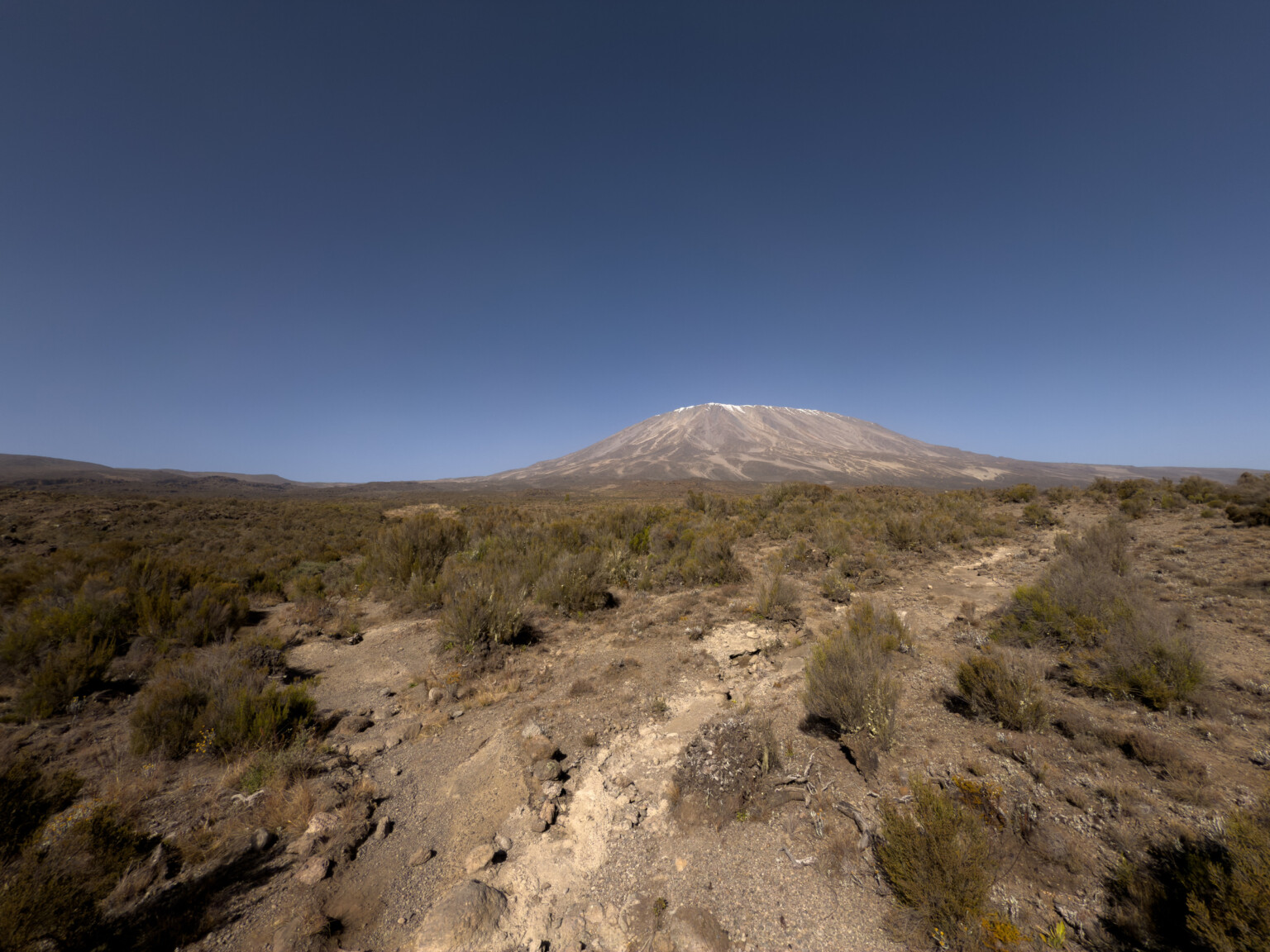
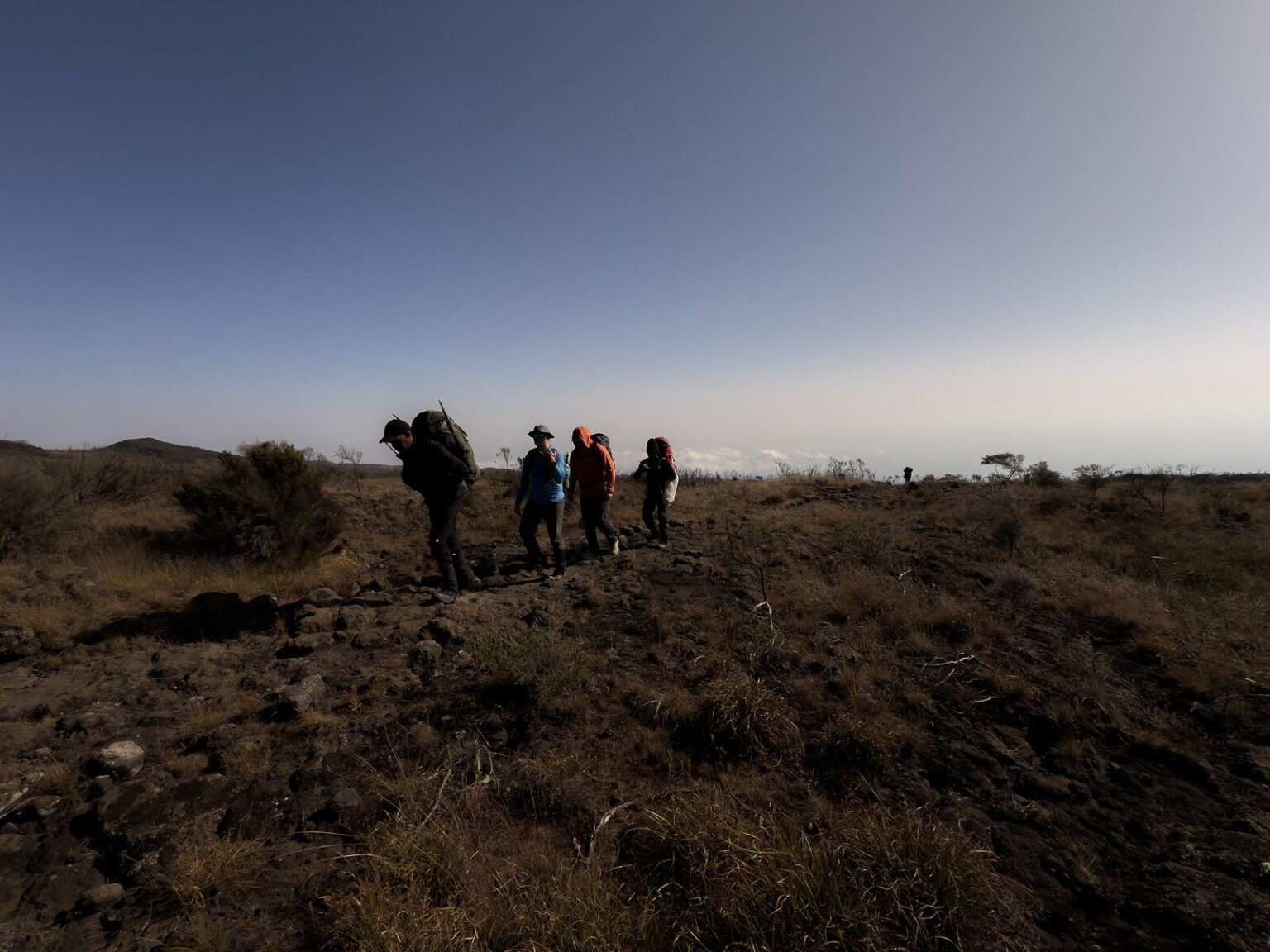
Trail through the moorland on the Rongai route with the snow-capped summit of Kilimanjaro in the distance
Moorland, Simba Camp to Second Cave · 2,900 m · Day 4 · Photo: BBP
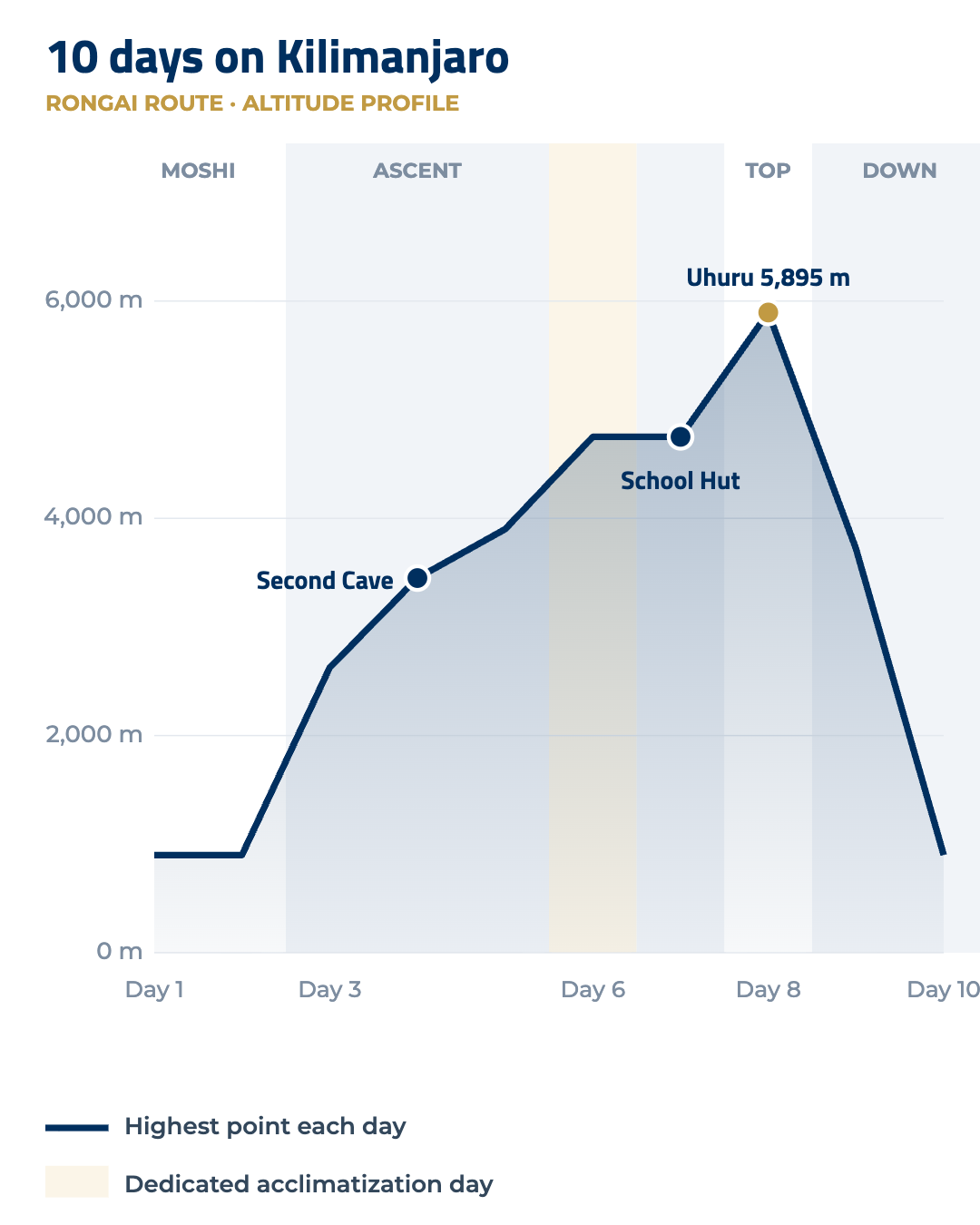
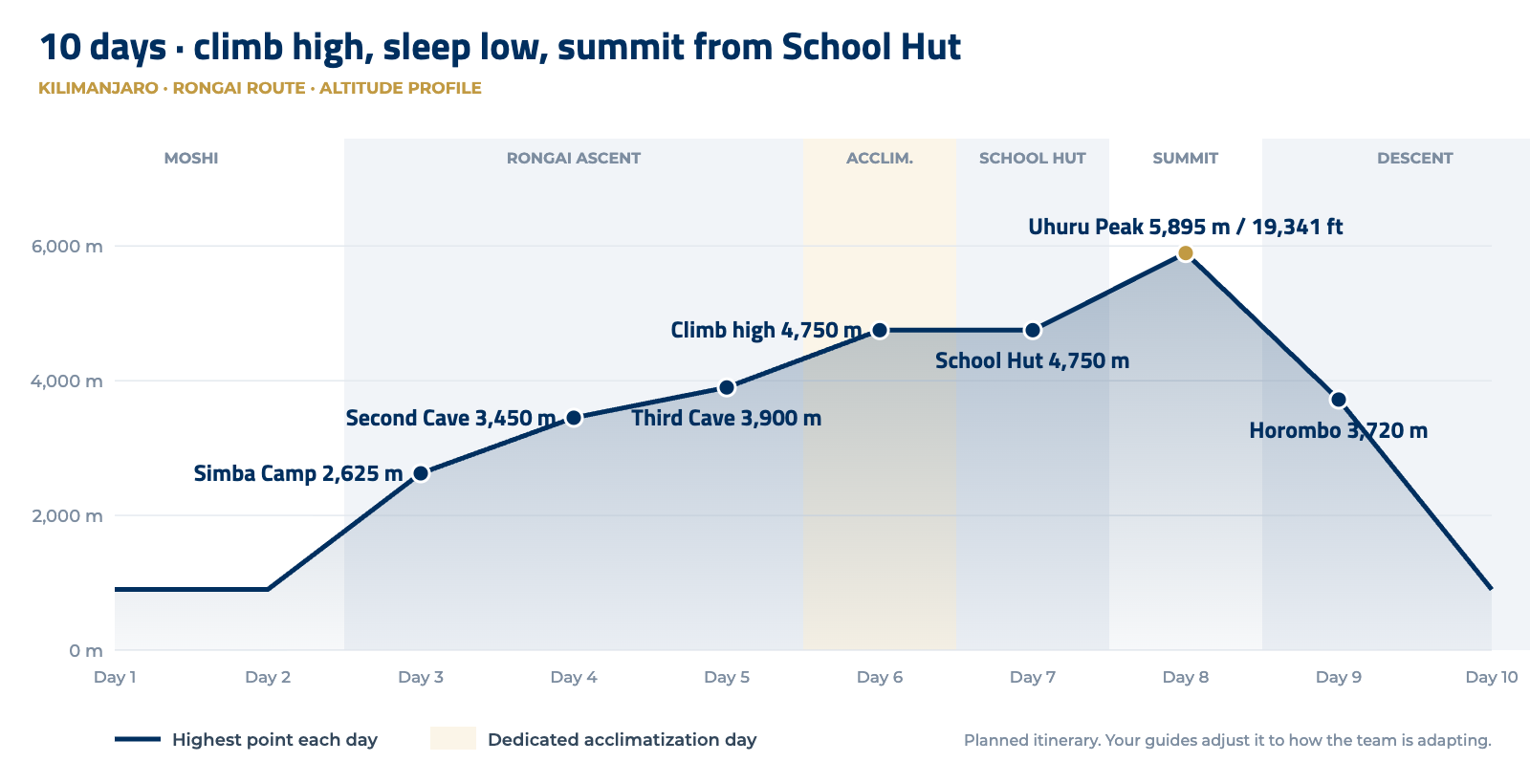
Altitude profile of the 10-day Kilimanjaro Rongai Route climb: Simba Camp, Second Cave, Third Cave, an acclimatization climb to 4,750 m, School Hut and Uhuru Peak at 5,895 mAltitude profile of the 10-day Kilimanjaro climb
Highest point reached each day. Climb high on Day 6, sleep low, then summit night from School Hut. See the full itinerary, day by day.

We ascend on Rongai and descend the south-east side to Marangu Gate, so over ten days you cross the mountain from one side to the other. The full route is on Day by Day.

The School Hut Strategy

On the eastern routes, the summit push normally starts from the busiest high camp on this side of the mountain. We stage from School Hut instead.
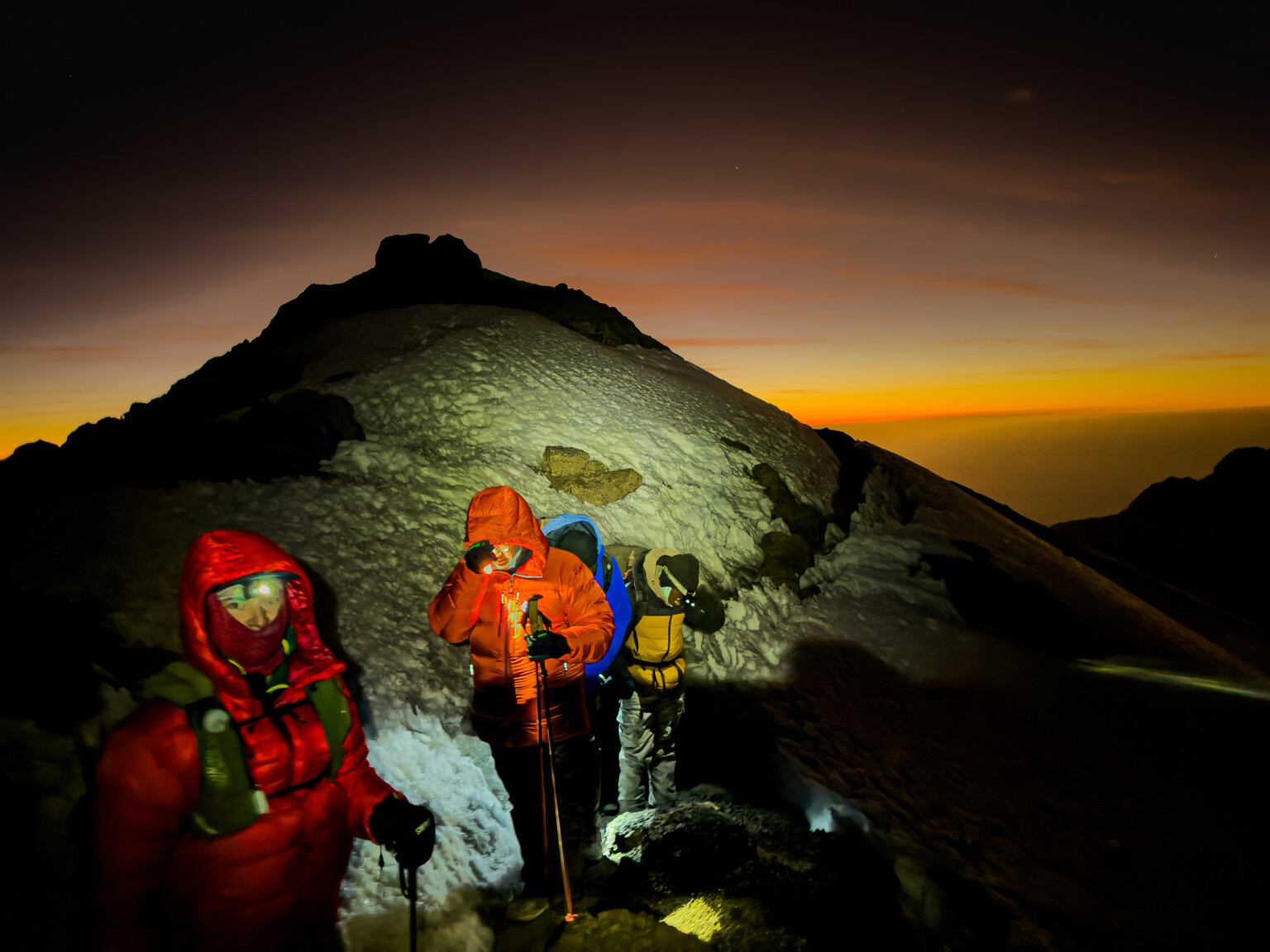
Climbers in down jackets with headlamps nearing the Kilimanjaro crater rim before dawn
Summit push, just below the crater rim · 5,730 m · Day 8 · Photo: BBP

The usual eastern summit push

  • Staged from the busiest high camp on this side
  • Start in the midnight crowd
  • The line of headlamps ahead sets the pace

Benegas Brothers Kilimanjaro

  • Staged from School Hut instead
  • You leave on your own schedule
  • Pace and turnaround decided for your team
  • Six climbers maximum

That puts the team away from the midnight crowd at the start of summit night. You leave on your own schedule and move at your own rhythm, and your guide makes pace and turnaround decisions based on your team, not on the line of headlamps ahead. We consider it one of the most important decisions we make for summit day.

Acclimatization: Climb High, Sleep Low

The body adapts during rest, not effort. Our itinerary builds that in:

  • Two nights in Moshi before the climb, with a full briefing and gear check
  • A gradual ascent on the north side, including a deliberately short day to Third Cave
  • A dedicated acclimatization day: up to 4,750 m, the altitude of our summit staging camp, and back down to sleep at Third Cave
  • One night at School Hut before summit night
Trail across the alpine desert zone toward the summit cone of Kilimanjaro
Alpine desert, acclimatization hike · 4,270 m · Day 6 · Photo: BBP

Why Six Climbers

Every scheduled departure is capped at six climbers. That one decision changes how the expedition runs:

  • Your guide knows how you are adapting, day by day: pace, appetite, sleep, hydration.
  • Pacing is adjusted for your team, not averaged across a crowd.
  • Summit decisions are made with full knowledge of each climber.
  • Camps are quieter, and meals and briefings are a conversation, not an announcement. You will never disappear into the group.
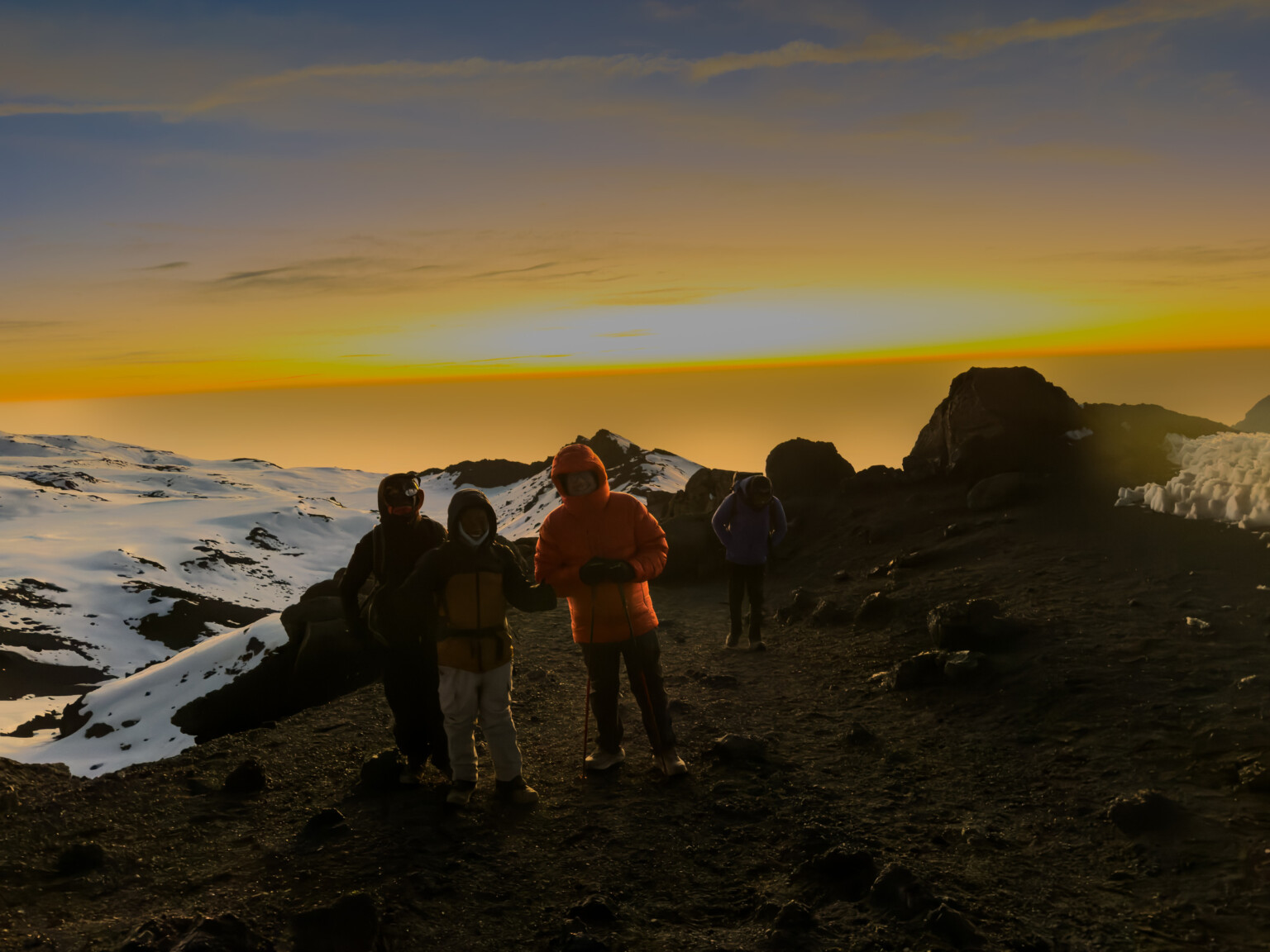
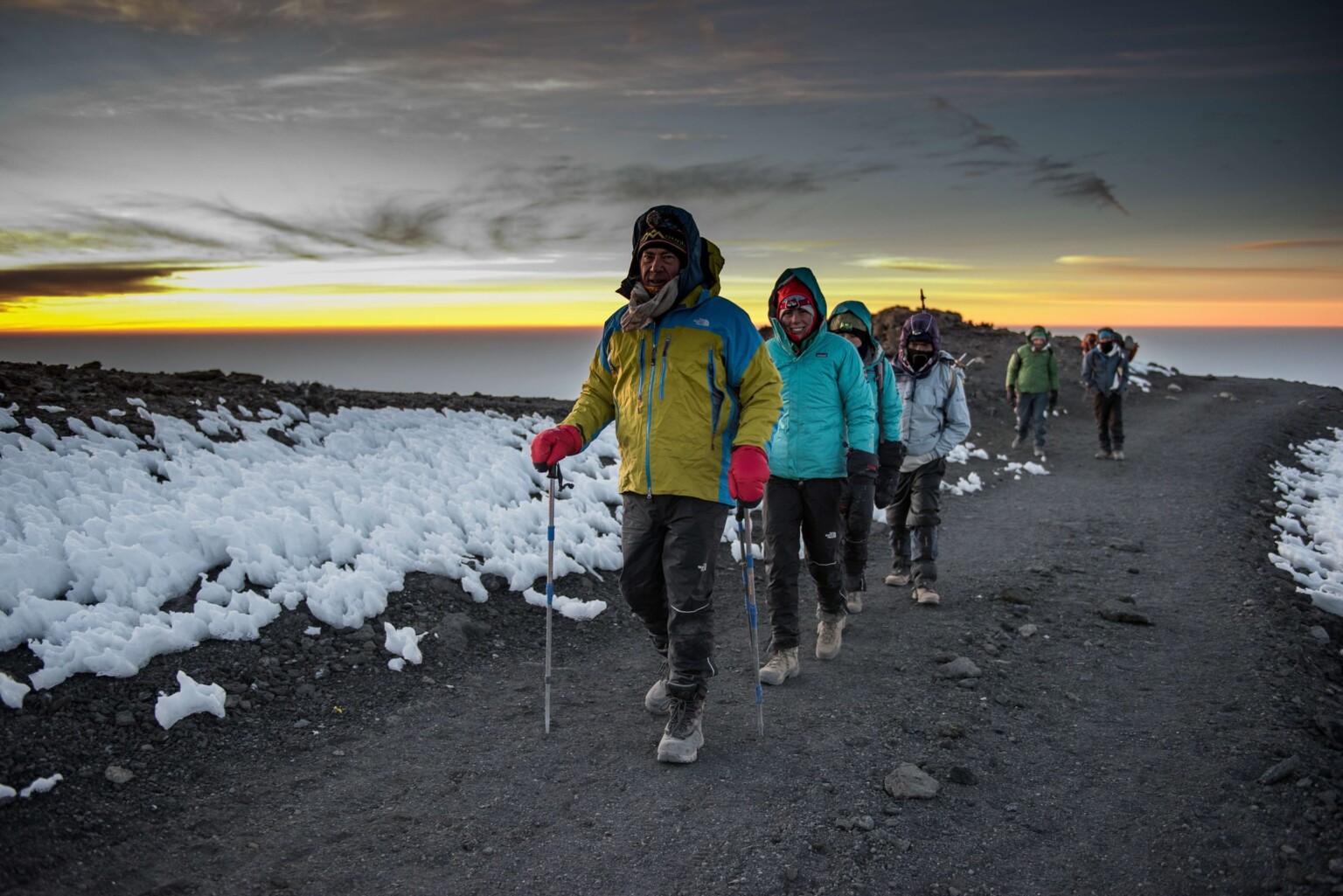
Climbers silhouetted against the sunrise on the crater rim of Kilimanjaro
Crater rim at first light · 5,795 m · Day 8 · Photo: BBP

The Guide Team

The program is built and managed to IFMGA standards. Each departure is led by a professional mountain guide certified by IFMGA, AMGA or an equivalent national body, working alongside licensed Tanzanian guides who know this mountain in every season. The mountain crew — cooks, porters and camp staff — is hired and paid to the standards of the Kilimanjaro Porters Assistance Project (KPAP).
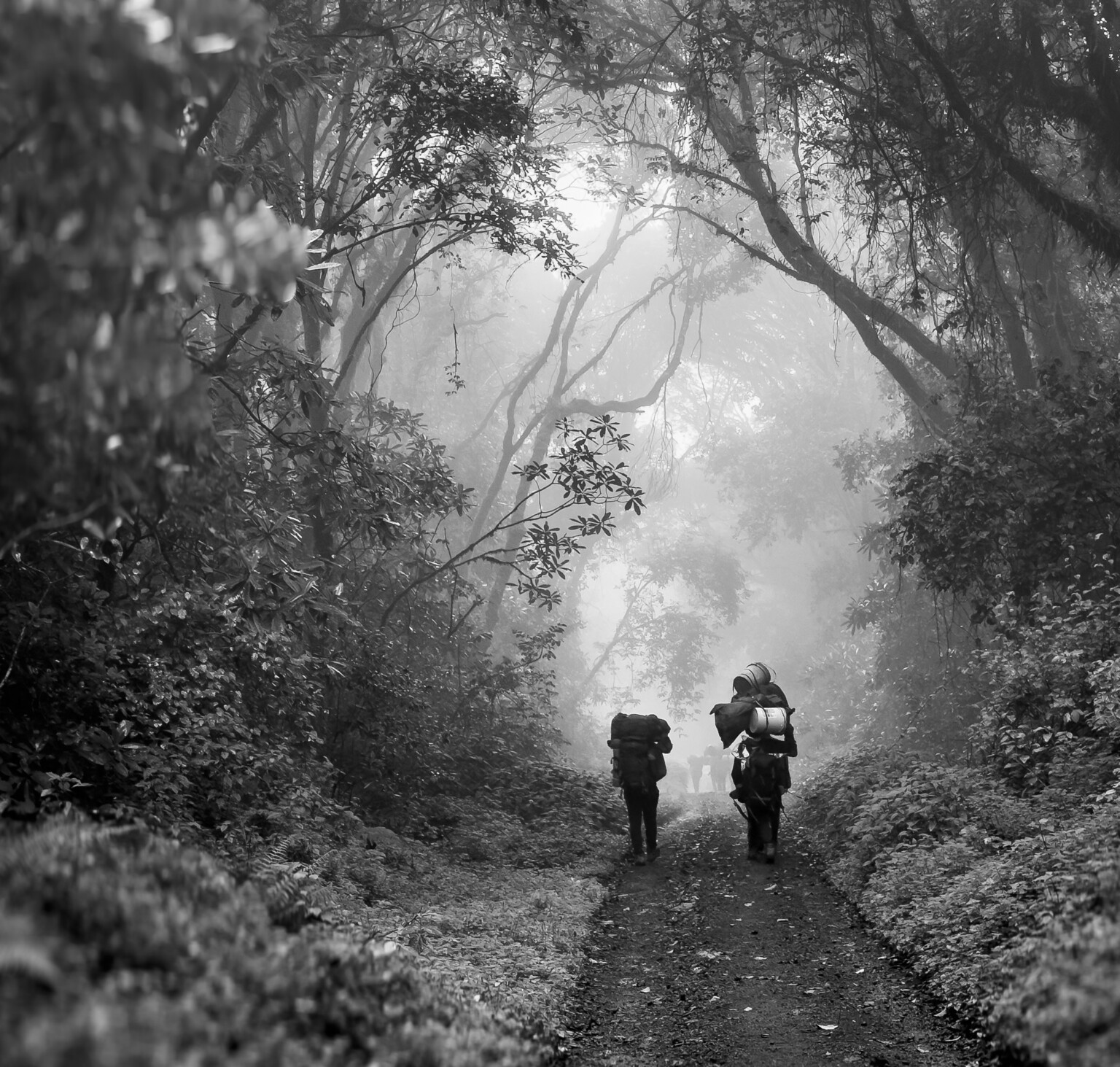
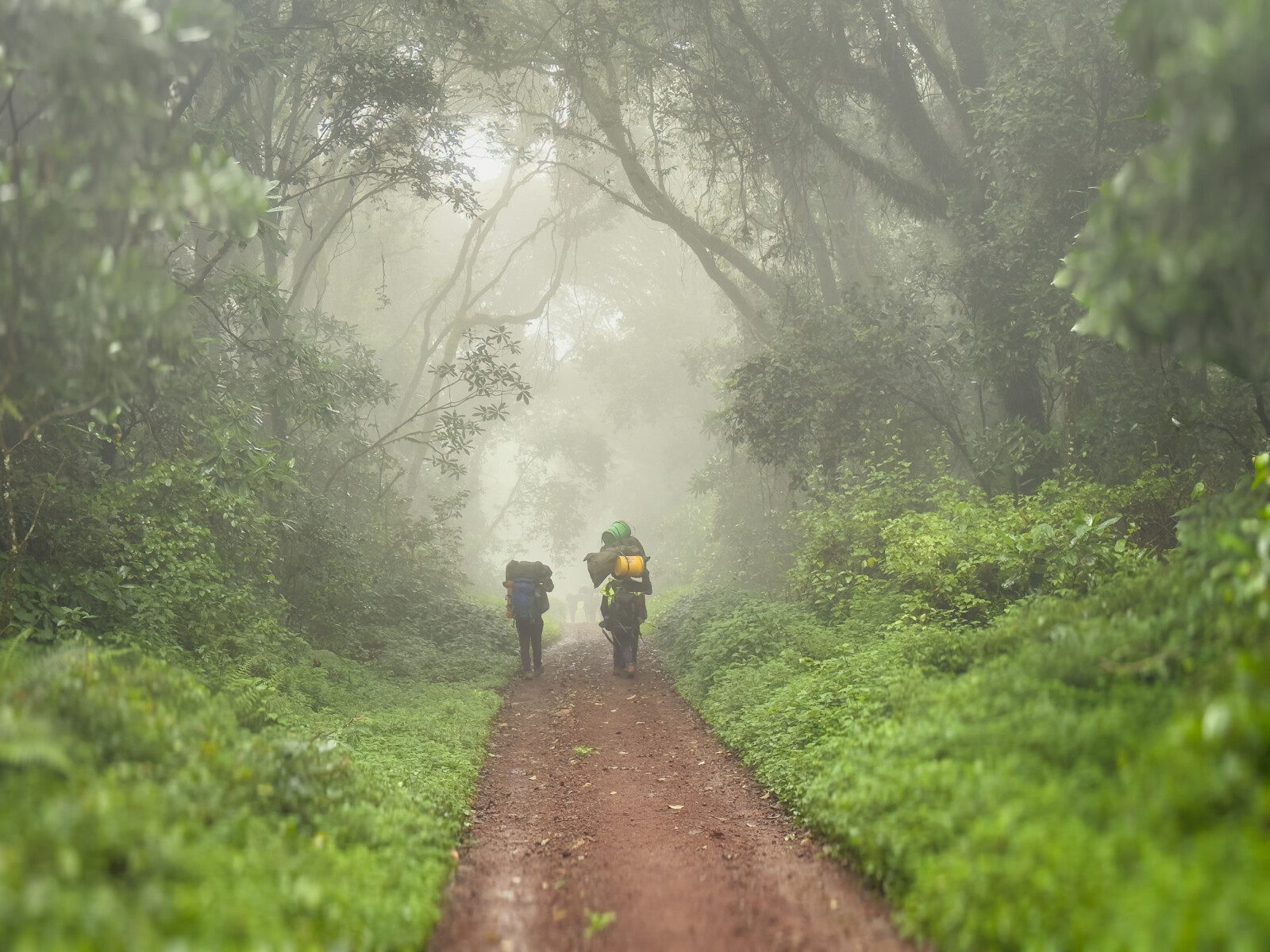
Black-and-white photo of two hikers on a misty forest trail on Kilimanjaro
Rainforest, Marangu descent · 2,060 m · Day 9 · Photo: BBP

Our guides don’t just lead. They teach breathing, pacing, layering, and eating and drinking at altitude, so you leave with skills you can take to every mountain after this one.

The system behind the program comes from decades of Benegas Brothers expeditions on Everest, Aconcagua, Denali and the world’s high peaks. The company’s guide team delivers it to that same standard on every departure.

Safety and Communications

Safety on a real mountain is a system, not a slogan. Every BBE Kilimanjaro departure runs with:

  • A certified professional lead guide
  • Satellite and radio communication with the team at all times
  • A comprehensive group medical kit on every climbing day
  • Emergency oxygen on the mountain, for medical use, not for climbing
  • Daily monitoring of every climber’s pace, hydration, appetite and recovery
  • Starlink in camp for a limited connection home and current weather — shared, and dependent on power and weather
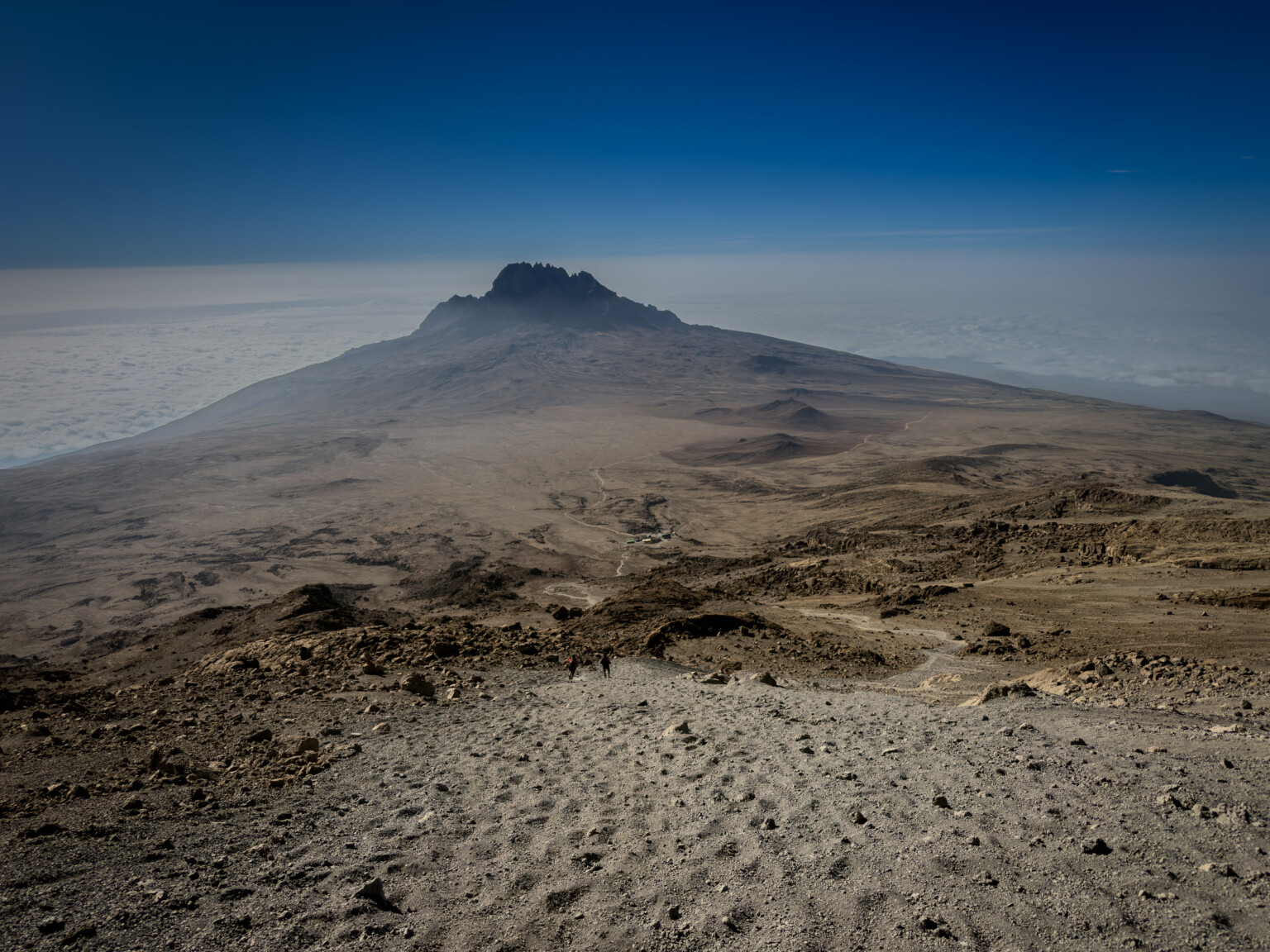
Scree slope on the descent from Kilimanjaro with the jagged peak of Mawenzi across the Saddle
Descent from the summit, Mawenzi ahead · 5,310 m · Day 8 · Photo: BBP

Turning around is sometimes the right call. When it is, your guide makes it early and clearly, and the descent plan is already in place.

Who This Climb Suits

First-time high-altitude climbers who want to do it properly, experienced hikers ready for a real altitude objective, climbers preparing for Aconcagua or the Himalaya, and couples, friends and small groups who want a shared challenge that means something. You don’t need a technical background. You need to prepare, commit and trust the process.
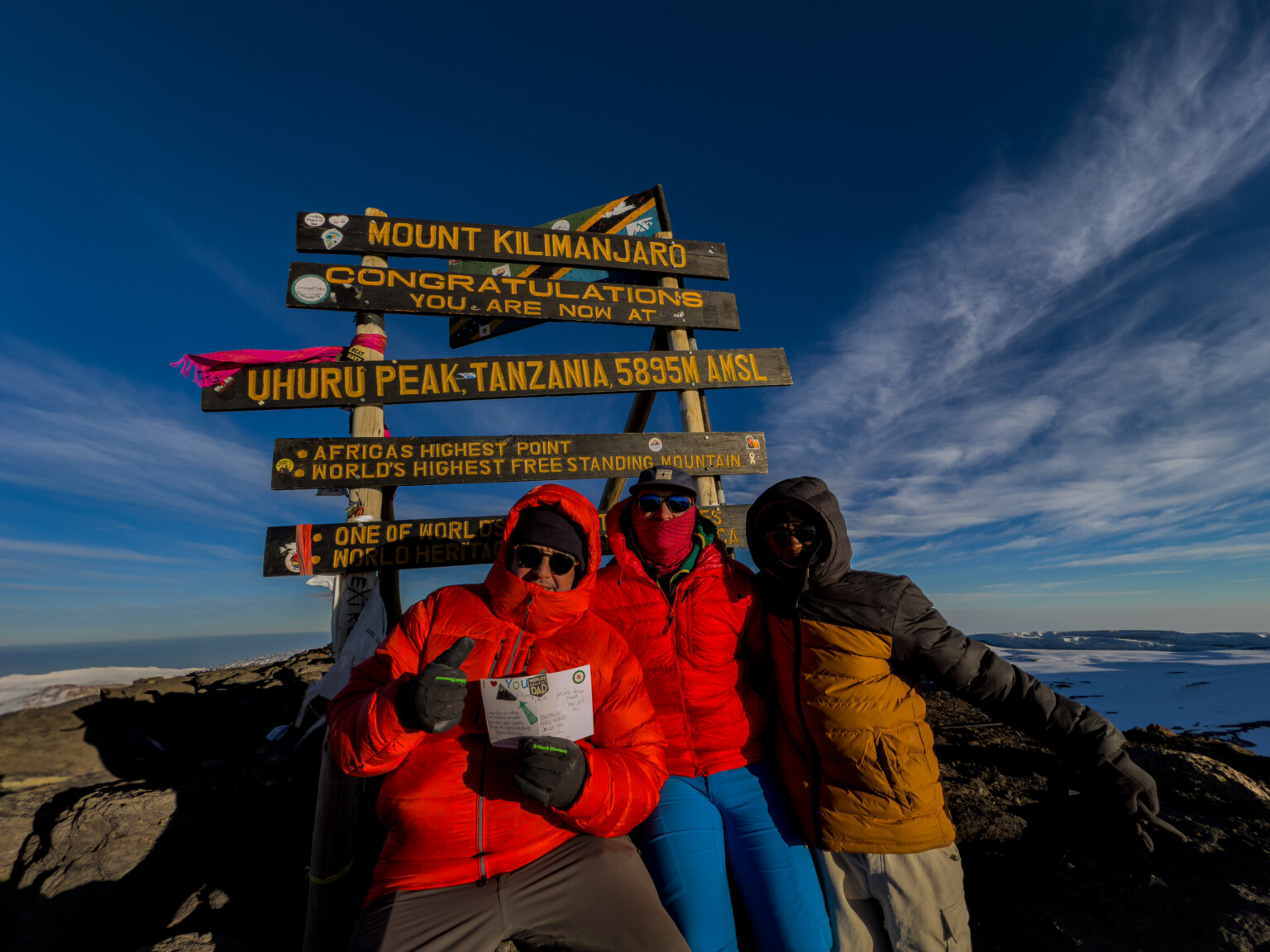
Climbers celebrating at the Uhuru Peak summit sign, the highest point in Africa at 5,895 m
Uhuru Peak, summit of Kilimanjaro · 5,895 m · Day 8 · Photo: BBP

For an honest look at how hard this is and how to prepare, read Is This for Me?

Where Kilimanjaro Can Lead

What you learn here — pacing, altitude, cold, summit-night discipline — carries directly into the next objective:

Ready for Kilimanjaro?

We don’t simply guide expeditions. We help people build a lifetime in the mountains. See dates and prices. · climbing@benegasbrothers.com
Ask a guide

Day by Day

Kilimanjaro · Rongai Route · 10 Days · Up the North Side, Down the South-East

Success on Kilimanjaro isn’t about speed. It’s about adaptation and sound judgment. This itinerary is a deliberate progression: two days in Moshi before the climb begins, a gradual ascent on the quiet northern side, a dedicated acclimatization day, and a summit push staged from School Hut, away from the traffic at the main eastern high camp.

Total distanceabout 78 km / 48.5 mi
Total gainabout 4,795 m / 15,730 ft
Total lossabout 4,885 m / 16,030 ft
SummitUhuru Peak, 5,895 m / 19,341 ft
Altitude profile of the 10-day Kilimanjaro Rongai Route climb: Simba Camp, Second Cave, Third Cave, an acclimatization climb to 4,750 m, School Hut and Uhuru Peak at 5,895 mAltitude profile of the 10-day Kilimanjaro climb
Highest point reached each day.

The Ten Days at a Glance

Each bar shows where you sleep that night. ▲ marks the day’s high point. Tap a day to open it.

In each day below, altitude reads start → high point → where you sleep. Distances and hiking times are estimates.

Climb high, sleep low

On Day 6 you climb to 4,750 m, then come back down to sleep at Third Cave. Watch the gap between the day’s high point and where you sleep.

Times are estimates

Hiking times change with the team and the conditions. A slow, steady pace is the plan, not a problem.

The plan can flex

Weather, how the team is acclimatizing and your guides’ judgment can change the daily plan. That flexibility is part of the plan.

Altitude: about 900 m / 2,950 ft · Hiking: none

A private transfer takes you from Kilimanjaro International Airport (JRO) to our hotel in Moshi, at the foot of the mountain. This is a day to recover from travel: hydrate, eat, sleep. On a clear evening, Kilimanjaro sits on the horizon. Any arrival time works; a late flight doesn’t affect the schedule.

Sleep: hotel, Moshi

Altitude: about 900 m / 2,950 ft · Hiking: light walk

Your lead guide runs the full expedition briefing and checks your gear item by item, for conditions that range from equatorial heat to well below freezing on summit night. Small missing items can usually be sourced in Moshi. If you plan to rent major items like a sleeping bag or down parka, tell us at least three weeks ahead.

A light walk through the coffee farms outside town gets the legs moving and introduces the pace you will hear about all week: slow, steady, deliberate. You also meet the mountain crew who will climb with you.

Sleep: hotel, Moshi

Distance: about 8 km · Altitude: 1,950 m → 2,625 m · Gain: +675 m · Hiking: about 4–5 hrs

A morning drive around the mountain’s northern flank brings us to Nale Moru Gate, near the Kenyan border. Most of Kilimanjaro’s traffic starts from the southern gates; the Rongai side is far quieter. The trail climbs gently through farmland and pine forest, where black-and-white colobus monkeys are common. From the first hour, your guides set a pace slower than feels necessary. That discipline is what summit night is built on.

At camp the routine begins: tents up before you arrive, hot drinks waiting, a cooked dinner, and an evening check-in with your guide on how you ate, how you’re hydrating and how you feel.

Sleep: Simba Camp, 2,625 m / 8,610 ft (BBE private camp)

Distance: about 9 km · Altitude: 2,625 m → 3,450 m · Gain: +825 m · Hiking: about 5–6 hrs

The forest thins and the moorland opens: long views, volcanic rock, giant heather. This is the first day you feel the altitude, and the first day daily monitoring really matters. Your guides watch pace, appetite and recovery for every climber. The summit cone comes into view for the first time.

Sleep: Second Cave, 3,450 m / 11,320 ft (BBE private camp)

Distance: about 5 km · Altitude: 3,450 m → 3,900 m · Gain: +450 m · Hiking: about 3–4 hrs

A deliberately short day. Reaching camp early with hours of daylight left is not wasted time; it is the acclimatization plan working. The afternoon is for eating well, napping and watching the light change over the Saddle.

Sleep: Third Cave, 3,900 m / 12,795 ft (BBE private camp)

Distance: about 8 km · Altitude: 3,900 m → 4,750 m → 3,900 m · Gain/Loss: +850 m / −850 m · Hiking: about 5–6 hrs

Climb high, sleep low. We hike up into the alpine desert to the altitude of our summit staging camp, then return to Third Cave to sleep. It is the most important acclimatization day of the expedition. It helps your body adjust, and it shows you what 4,750 m feels like, so when you sleep there tomorrow it is familiar ground.

Sleep: Third Cave, 3,900 m / 12,795 ft · High point: 4,750 m / 15,585 ft

Distance: about 6 km · Altitude: 3,900 m → 4,750 m · Gain: +850 m · Hiking: about 4–5 hrs

We cross the Saddle, the high, wind-scoured plateau between Mawenzi and the summit cone, to School Hut, our summit staging camp. It sits apart from the main eastern high camp and is quiet and calm. The afternoon is all preparation: an early dinner, a final equipment check, a detailed summit briefing, and as much sleep as the altitude allows.

Sleep: School Hut area, 4,750 m / 15,585 ft (BBE private camp — not the hut)

Distance: about 22 km · Altitude: 4,750 m → 5,895 m → 3,720 m · Gain/Loss: +1,145 m / −2,175 m · Hiking: about 12–16 hrs (about 7–9 up, 5–7 down)

We start around midnight by headlamp. The first hours are slow, rhythmic and cold, and this is where a week of pacing discipline pays off. The route climbs steep scree toward the crater rim, on our own line and at our own pace.

We reach Gilman’s Point (5,681 m) on the crater rim around sunrise. From there the rim trail passes Stella Point and continues roughly 90 minutes to Uhuru Peak, 5,895 m / 19,341 ft, the highest point in Africa.

Summit time is short and controlled; the summit is only the halfway point. The descent is long: back along the rim, down the scree and on to Horombo on the south-east side. It takes focus long after the high of the summit has faded, and your guides manage it as carefully as the ascent.

This is a hard day, and it is meant to be. Pace, weather and turnaround are professional judgment calls made by your guides with full knowledge of every climber. Reaching the summit is the goal. Coming down well is the job.

Sleep: Horombo, 3,720 m / 12,205 ft (BBE private camp) · High point: Uhuru Peak, 5,895 m / 19,341 ft

Distance: about 20 km · Altitude: 3,720 m → about 1,860 m · Loss: about −1,860 m · Hiking: about 6–7 hrs

A long walk down through the ecological zones in reverse: moorland, giant heather, then the rainforest closing overhead. At Marangu Gate, climbers who reached the crater rim or Uhuru Peak receive their official park summit certificates, and the crew tipping ceremony takes place. Then it’s back to Moshi for the first hot shower in a week and a celebration dinner with the team.

Sleep: hotel, Moshi

The morning is open for rest and packing before your private transfer to Kilimanjaro International Airport, or the start of a safari or Zanzibar extension. Expedition services end in Moshi.

The Team Behind the Team

No one climbs Kilimanjaro alone. Every BBE departure has a full Tanzanian mountain crew — porters, cooks and camp staff — who carry the camp, cook every meal and have tents up before you walk in. They are professionals, and we treat them that way: fair wages, proper equipment and honest loads, hired and paid to the standards of the Kilimanjaro Porters Assistance Project (KPAP).

How a crew is treated is a fair question to ask any Kilimanjaro operator, and we’re glad to answer it.

Weather and Flexibility

Kilimanjaro’s weather is generally stable in the climbing seasons, but it is still a big mountain. Your guides may adjust daily timings, rest stops or the summit start time based on conditions and how the team is adapting. Those calls are made for one reason: to give every climber the strongest and safest chance at the summit. No one can promise a summit.

Keep Planning

For how hard each part feels, read Is This for Me? For hotels and camps, see Where You’ll Stay.

Flights & Getting to Kilimanjaro · Private & Custom Expeditions · Dates & Prices

Questions about the itinerary? Ask a guide · See dates and prices · climbing@benegasbrothers.com

Is This for Me?

Kilimanjaro · Rongai Route · An Honest Answer, Not a Sales Pitch

Most people who climb Kilimanjaro with us have never done anything like it before. They are fit — they hike on weekends, maybe run a few times a week — but they are not athletes or mountaineers. They decided they wanted to do something that actually asked something of them.

That is who Kilimanjaro is for. The mountain is non-technical: no ropes, no glacier travel, no climbing experience required. That does not make it easy. It requires honest preparation, real fitness, and the willingness to face one very hard day after a week of good ones. This page tells you what that means.

Kilimanjaro at a Glance

Technical skillNone required
SummitUhuru Peak, 5,895 m / 19,341 ft
Longest daySummit day, about 12–16 hours
Coldest conditions−10°C to −20°C (14°F to −4°F) before dawn, colder in the wind
Training time8–12 weeks, structured
FamiliesWelcome
Team sizeMaximum six climbers
Guide ratioAt least 1 guide per 2 climbers

Technical Difficulty vs. What Actually Makes It Hard

There is no technical climbing on the Rongai Route. What makes Kilimanjaro hard is altitude, cold and duration: seven days on the mountain, sleeping in tents, and a summit night that climbs more than 1,100 meters through the dark to a point with roughly half the oxygen of sea level. Fitness helps you cope. It does not guarantee how your body will acclimatize — altitude affects fit and unfit people unpredictably.

Rocky trail through low heath toward the summit of Kilimanjaro on the Rongai route

Fitness: Can You Do These?

This is not about athletic talent. It’s about whether your body can keep working, day after day, when it’s tired. Use this as an honest self-check, not a pass/fail test.

  • Hike 6–8 hours on uneven ground with a daypack. Test it with a full day on a local trail carrying 20–25 lb.
  • Do it again the next day, on tired legs. Test it with two long hikes on back-to-back days.
  • Move steadily uphill for 7–9 hours. Test it with long, slow climbs: hills, stairs or a steep treadmill.
  • Keep going in the cold and dark when you’re tired. Test it with a pre-dawn start on a winter hike.

The third one matters most. Summit night is 7–9 hours of slow uphill work after a week on the mountain. Train for that, not just for general fitness.

What You Carry

You carry only a daypack: water, layers, snacks and a camera. Your main duffel travels with the porter team, and the crew carries and sets up the camp. On summit night your pack holds water, extra insulation and food — light, but you carry it for many hours in the cold.

Experience: What Helps, What’s Required

Helpful, but not required:

  • Multi-day trekking or backpacking
  • Time above 3,000 m / 10,000 ft
  • Hiking in cold or changing weather
  • Carrying a pack on consecutive days
  • Camping for several nights in a row

Not needed on this route: ropes, crampons or any climbing skills.

The less experience you have, the more deliberate your preparation needs to be. Ask a guide, and we’ll tell you honestly where you stand.

Camping, Cold and Recovery

Six nights on the mountain are spent in tents, two climbers per tent, in our private camp. The camps are well run — tents up before you arrive, hot meals, a dining tent — but the nights above 4,000 m are below freezing, sleep is lighter at altitude, and appetite drops. Recovering well between days is a skill: eating when you don’t feel like it, drinking at least four liters a day and resting in the afternoon. Life on the Mountain explains how.

What Will Feel Hard

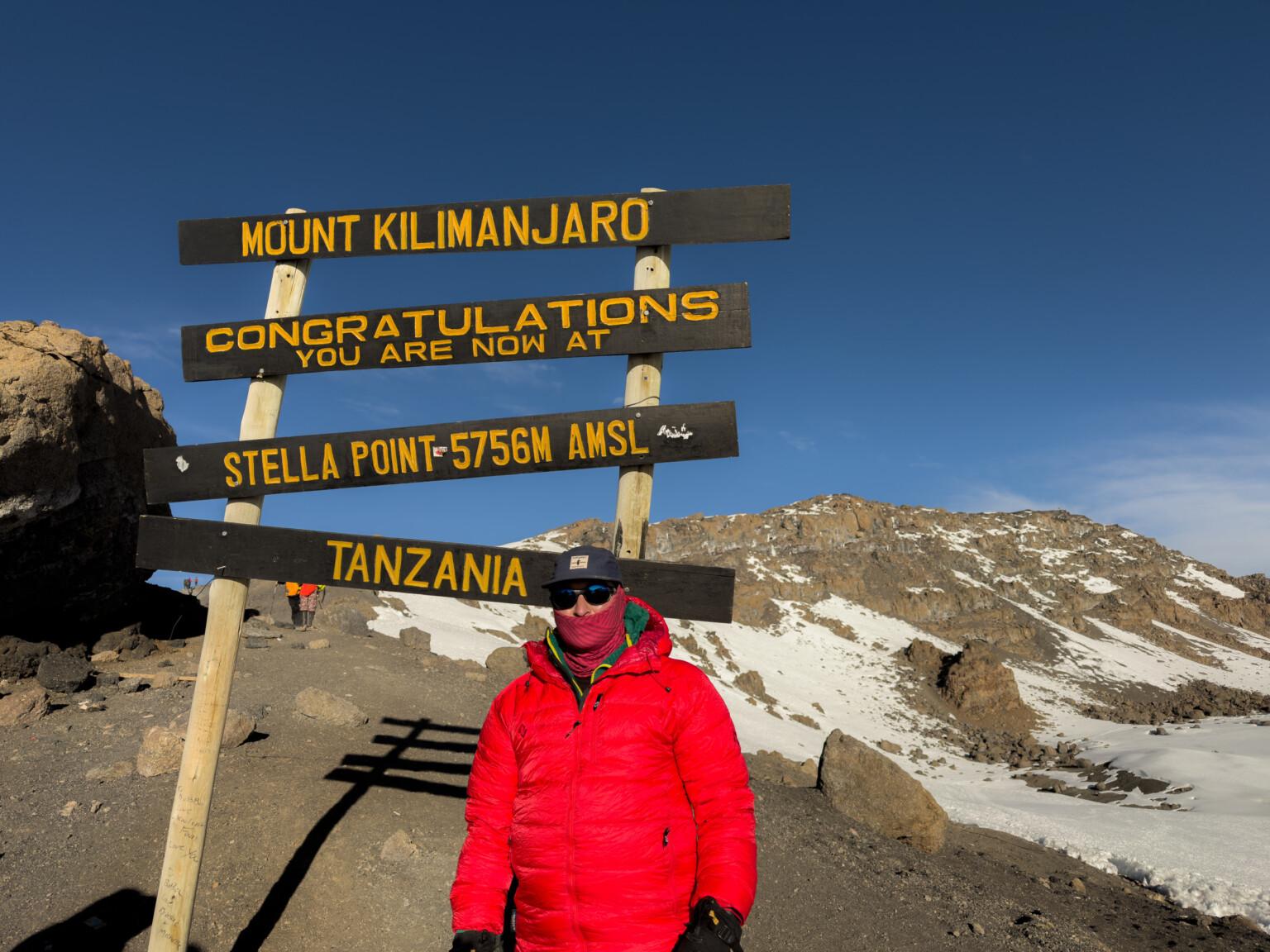
Climber in a red jacket at the Stella Point sign on the crater rim of Kilimanjaro
Stella Point · 5,756 m · Day 8 · Photo: BBP

Most people who climb Kilimanjaro are well prepared. Most still find summit night harder than they expected.

The first days are demanding but deeply enjoyable. The terrain changes every day, the camps are comfortable, and the rhythm of the mountain settles in quickly.

Summit night is different. For many of our clients — fit, prepared people — it is one of the hardest things they have ever done. Not because they did anything wrong, but because the top of this mountain is hard, and the best preparation is knowing exactly what is coming.

Summit Night in Brief

You leave School Hut (4,750 m) around midnight and climb 1,145 meters to Uhuru Peak (5,895 m) — about 7–9 hours up, mostly on loose volcanic scree to the crater rim. Temperatures sit between −10°C and −20°C before dawn, colder in the wind. Then you descend 5–7 hours to Horombo (3,720 m).

The midnight start

You’ve been trying to sleep since early evening — lightly, at altitude, in the cold. The alarm goes. You put on every layer you have, step out into the dark and start walking. Slowly, for hours, with nothing but headlamp light and the sound of your own breathing.

The cold

Between midnight and dawn it is well below freezing. However well you’re dressed, you will feel it — fingers, toes and face most of all.

The scree

The upper slopes are loose volcanic gravel: two steps up, one slides back. It is slow and tiring, and much easier to handle when you expect it. Your guides will tell you it’s coming. Believe them.

The altitude

Breathing takes focus, and the urge to stop is constant. This isn’t a fitness problem. It’s altitude, and it affects every person on the mountain.

Other teams

Even from School Hut, you will see headlamps from other teams near the crater rim. With six climbers and guides who know each of you, we keep the focus on your team.

The climbers who reach Uhuru Peak aren’t the ones who found it easy. They’re the ones who knew it would be hard and kept moving.

Patience and Following Guide Decisions

Your guides set a pace slower than feels necessary from Day 3, and they watch every climber every day. If your guide decides you should turn around, that call is made early and clearly, with your health first, and a guide goes down with you. It is a professional decision, not a failure. This climb only works if you are willing to accept it.

Is This the Right Climb for You?

This climb is a good fit if:

  • You’ll commit to 8–12 weeks of structured training.
  • You’re comfortable being uncomfortable: cold, broken sleep, low appetite.
  • You’ll slow down when your guide says slow down.
  • You want to do it properly: ten days, a small team and real acclimatization.
  • You understand no one can promise a summit.
  • You want a real altitude challenge without technical climbing.

It’s probably not the right fit if:

  • You’re hoping to get by on general fitness.
  • You need a comfortable bed and a hot shower every night.
  • You won’t accept a guide’s pace or turnaround call.
  • You want the shortest, lowest-cost way to the top.
  • You need a guaranteed summit to feel it was worth it.
  • You want ropes, glaciers and technical terrain. For that, look at Ecuador Mountaineering School.

Two more things to be clear about before you book:

Health

If you have a heart, lung or other medical condition, talk to your physician about high altitude before you commit. Every climber completes a medical history form, and we may ask for a physician’s clearance.

Age and Families

Families are welcome. Mentoring the next generation is a big part of who the Benegas Brothers are, and sharing a summit like this with your kids is exactly that. The minimum age is set by the park and your insurance, not by us: Kilimanjaro National Park allows climbers from age 10 on a summit climb, and children under 10 need special permission from the park before arrival. Without it, they can only go to about 3,100 m / 10,170 ft. Climbers under 18 climb with a parent or guardian, and each climber’s travel and rescue insurance must cover their age. If your family needs a special permit, we’ll help you apply, though approval is the park’s decision. There is no upper limit; fitness and health matter far more than age.

How to Prepare

Plan on a structured 8–12 week program before departure — longer if you’re starting from a lower base. Consistency matters far more than intensity.

Early weeks: build a base

Regular hikes, stairs or incline walking, three to four sessions a week.

Middle weeks: add load and length

Longer hikes with a pack, then back-to-back days.

Final weeks: peak, then ease off

Your longest back-to-back weekend, a night hike and a cold-weather outing, then taper in the last 7–10 days.

Five things that make the biggest difference:

  • Back-to-back long days. Two long days with a pack, the second on tired legs, is the closest thing to what the mountain asks.
  • Night hiking. Summit night starts at midnight. Hike in the dark at least a few times.
  • Cold exposure. Winter hikes and cold early starts. Staying warm while moving is a skill.
  • Uphill endurance, not speed. Train at the pace you could hold for eight hours, not one.
  • Mental preparation. Know what summit night feels like and why you’re there.

Every confirmed climber receives a full week-by-week training guide.

Where Kilimanjaro Can Lead

For many climbers Kilimanjaro is the first high mountain. Next steps often include Ecuador Mountaineering School (glaciers, crampons, rope work), the Mexico Volcanoes, and Aconcagua as the bigger altitude objective. If Everest is the long-term goal, The Road to Everest shows every step. Ask a guide what makes sense for you.

Still deciding?

With a maximum of six climbers per departure, we have time for a real conversation before you book. Tell us about your fitness, your experience and your concerns, and we’ll give you an honest assessment. If the timing isn’t right, we’ll tell you that too. Every climber speaks with a guide before booking. See dates and prices. · climbing@benegasbrothers.com
Ask a guide

Before You Go

Kilimanjaro Rongai Route · Before You Go

Preparing for Kilimanjaro: Start Here

On Kilimanjaro, the climbers who arrive relaxed aren’t the ones with the most experience. They’re the ones who sorted their visa, their boots and their cash weeks ago. This page puts your preparation in order: what to do, when, and where to find the details. Handle it early, and your energy in the final weeks goes into training, not logistics.

Trekkers on the Rongai Route, Kilimanjaro

Three Things to Know Now

You need a Tanzania visa$100 U.S. · $50 most others

Apply for the official e-visa four to six weeks before you fly. U.S. passport holders pay $100; most other nationalities that need a visa pay $50. We send you the host details after you register.

Rescue and evacuation insurance is requiredRequired

BBE requires it on every international expedition: coverage to at least 6,000 m, with helicopter evacuation and no altitude exclusion. Tanzania also requires its own $44 inbound travel insurance for entry. See Trip Insurance & Evacuation Coverage.

Tanzania runs on clean U.S. dollars$900–1,300

Plan on roughly $900–1,300 in bills printed in 2013 or later, for crew tips, meals in Moshi and a reserve.

Your Seven Preparation Guides

Your Preparation Timeline

When you book

  • Through the registration link we email you, complete the reservation form and pay your deposit by the invoice we send; then complete the Registration Form (profile, emergency contacts, medical history, climbing experience), passport copy, Terms & Conditions and Release
  • Check your passport: valid at least six months after you leave Tanzania, with blank visa pages
  • Buy rescue and evacuation cover soon after booking — pre-existing-condition waivers usually depend on it
  • Start your 8–12 week training program — see Is This for Me?
  • Read the gear list now; buy boots early and break them in

120 days before departure

  • Your balance is due. (If you book within 120 days, full payment is due at booking.)

Once you’ve paid in full

  • Send us your proposed flights, then book them, and email your final itinerary to climbing@benegasbrothers.com
  • Talk to your physician about altitude, altitude medication and any medical conditions

4–8 weeks before

  • Visit a travel clinic: vaccinations, malaria prevention for the lowlands, and yellow fever if your routing needs it
  • Apply for your Tanzania e-visa (four to six weeks before you fly)

At least 3 weeks before

  • Tell us about any major items you plan to rent in Moshi

The final 2 weeks

  • Do a full pack-out using the gear list
  • Get your cash: clean U.S. bills printed in 2013 or later, mostly $50s and $100s
  • Print your approved e-visa, and save copies of your passport, visa and insurance to your phone and the cloud
  • Ease off your training. Arrive rested, not worn out

Arrival day

A private transfer meets you at Kilimanjaro International Airport and takes you to our hotel in Moshi. Any arrival time works. Day 2 is the full briefing and gear check with your lead guide. From then on, logistics are our job. Yours is climbing.

Still Deciding?

This section assumes you’re going. If you’re still working out whether Kilimanjaro is right for you this season — whether you can commit to the training, how you’ll handle a 12–16 hour summit night — start with Is This for Me? and Your Questions. For different dates or your own team, see Private & Custom Expeditions.

Questions while you prepare?

Boots, the visa host details, how much cash to bring — ask early. Small questions are easiest to solve months out. See dates and prices. · climbing@benegasbrothers.com
Ask a guide

Your Expedition Checklist

The climbers who arrive in Moshi relaxed are the ones who sorted their paperwork, visa and boots weeks ago. None of it is complicated, but a few pieces take time, and one or two can’t be fixed once you’ve landed. This page lists everything BBE needs from you, what you need to arrange, and when.

Your Paperwork at a Glance

Everything BBE and Tanzania need from you, in the order you’ll do it. Tick items off as you go; your ticks are saved on this device.

Step 1At booking, in the registration formDone together with your deposit

Step 2Buy, then send to BBEEmail climbing@benegasbrothers.com

Step 3Arrange and carryNeeded at the border and on the trip

BBE arranges and pays Kilimanjaro National Park fees and climbing permits. You pay nothing at the park gate. The details for every item are below.

At Booking

How booking works. When you ask about a trip, we reply by email with the trip details and a link to our online registration form. Everything in this section is done there.

Reservation form. Your full name, email, date of birth and address, plus any notes for our program staff about your reservation.

Deposit. The reservation form includes a link to pay your deposit. Your place is confirmed once BBE receives it. Amounts and deadlines are on Dates & Prices.

Complete at Booking

Registration Form. Your personal profile, emergency contacts, medical history and climbing experience. Medical information stays within the guiding team and is used to plan for your safety. Be thorough and honest; it protects you.

Passport. A copy of your passport photo page. We use it to register you for your park permits.

Terms & Conditions. BBE’s booking, payment and cancellation terms. Read them before you sign.

Release. A liability release acknowledging the inherent risks of high-altitude climbing. Read it carefully. It means what it says.

When

Complete these in the registration form at booking, with your deposit.

Send us later. As soon as you have them, email climbing@benegasbrothers.com your flight itinerary (we use it to track your arrival and arrange your airport pickup, so it isn’t optional), your approved Tanzanian e-visa, and your rescue and evacuation insurance certificate with your insurer’s 24-hour emergency number, so your guide has the details in an emergency. Coverage is required.

Balance payment. Due 120 days before departure. If you book within 120 days of departure, full payment is due at booking.

Park Fees and Permits — Who Does What

BBE arranges and pays them. Kilimanjaro National Park fees and climbing permits are arranged by BBE through our Tanzanian team and are included in your expedition price. You don’t pay anything at the park gate.

What we need from you: your passport details and signed forms, on file in time to register you.

Your Visa

Every climber needs a visa to enter Tanzania. We recommend the official e-visa, applied for four to six weeks before you fly. After you register, we send you the host details to enter on the application. The full step-by-step guide is on Flights & Getting to Kilimanjaro.

Tanzania Inbound Travel Insurance

Since October 1, 2026, Tanzania requires every foreign visitor entering the mainland to hold its government inbound travel insurance, issued by the National Insurance Corporation (NIC). It costs $44, is valid for up to 92 days, and is required even if you already have your own insurance. Buy it online before you fly and carry the certificate with your passport. It is a basic entry requirement and does not replace the rescue and evacuation coverage BBE requires.

Health Preparation

See your physician. If you have any condition that altitude, cold or sustained exertion could affect, discuss the climb with your physician before you book, and be open about it on your medical form. Conditions that are well managed at sea level can behave differently above 4,000 m. We may ask for a physician’s clearance.

Altitude medication. If you are considering medication to help with altitude, talk to your physician well before departure. It is a decision for you and your doctor, not for us.

Prescription medications. Bring everything you take, for the full trip plus a few extra days, in your carry-on with copies of your prescriptions.

Travel clinic, 4–8 weeks before departure. Entry rules and recommendations change, and your clinic will advise based on your health history and exact routing. Topics to raise:

  • Routine vaccinations
  • Hepatitis A and typhoid, commonly recommended for East Africa
  • Malaria prevention: malaria is present at the lower elevations around Moshi and on safari, not on the upper mountain
  • Yellow fever: Tanzania requires proof of vaccination if you arrive from, or transit for more than 12 hours through, a country with yellow fever risk. Give your clinic your full itinerary.

First aid. Bring a small personal kit for blisters and minor problems. The guide team carries a comprehensive group medical kit and emergency oxygen.

Gear and Rentals

Read the gear list early. Boots need three months to break in, not three weeks.

Rentals. Tell us at least three weeks before departure if you plan to rent major items in Moshi.

Travel

Passport. Valid at least six months after you leave Tanzania, with blank visa pages — we recommend two. There’s no fix for an expired passport once flights are booked.

Flights. Book once your place is confirmed and you’ve paid in full, and send us your proposed itinerary before you buy. Favor changeable fares.

The Final Two Weeks

  • Do a full pack-out using the gear list — every item, packed the way it will travel
  • Get your cash: clean U.S. bills printed in 2013 or later (see What to Budget For)
  • Print your approved e-visa and your Tanzania inbound travel insurance certificate
  • Ease off your training. Arrive rested, not worn out
  • Save copies of your passport, visa, insurance certificate and itinerary to your phone and a cloud account, and carry paper copies separate from the originals

Bring With You to Tanzania

  • Passport and printed e-visa approval
  • Printed flight itinerary, and our contact and emergency numbers
  • Your rescue and evacuation insurance certificate and your insurer’s 24-hour emergency number
  • Your Tanzania inbound travel insurance (NIC) certificate
  • Written list of emergency contacts and relevant medical information
  • Prescription medications and copies of prescriptions
  • Clean U.S. dollar cash

Arrival Day

A private transfer meets you at Kilimanjaro International Airport and takes you to our hotel in Moshi. Any arrival time works. Day 2 is the full briefing and gear check with your lead guide. From then on, logistics are our job. Yours is climbing.

Questions? Paperwork is the least interesting and most fixable part of expedition preparation. Ask early.

Ask a guide · Back to Before You Go · climbing@benegasbrothers.com

Trip Insurance & Evacuation Coverage

Three kinds of cover apply to this climb. Two are required. One is strongly recommended.

Required by BBERescue and evacuation coverage

Required on every BBE international expedition. It pays to get you off the mountain and to proper medical care. It must cover helicopter evacuation to at least 6,000 m.

Required by TanzaniaTanzania inbound travel insurance

A $44 government policy from NIC, required for entry since October 1, 2026. Basic cover; it does not replace your rescue and evacuation policy.

Strongly recommendedTrip insurance

Protects the money you’ve spent if illness, a family emergency or a travel disruption stops or cuts short your trip.

Rescue and Evacuation Coverage — Required

Many countries and national parks now require visitors to carry insurance, and BBE requires rescue and evacuation coverage on all international trips. Emergencies on Kilimanjaro are rare with good guiding, but when they happen they are serious, and evacuation from the mountain is expensive. Without coverage, you would be responsible for all costs of your own evacuation and treatment. We need your certificate before departure.

A good policy for this climb covers:

  • Altitude: emergency evacuation from remote mountain terrain up to at least 6,000 m / 19,685 ft. Kilimanjaro’s summit is 5,895 m, and many standard plans stop at 3,000 m or 4,500 m.
  • Helicopter evacuation, stated explicitly.
  • Activity: high-altitude trekking or mountaineering, with no activity exclusion.
  • Destination: Tanzania, for your full travel dates.
  • Medical transport: to an appropriate facility, including international medical transport if needed.

Providers we recommend:

  • Global Rescue, with the High-Altitude Evacuation Package added. Standard Global Rescue membership does not cover evacuation above 15,000 ft / 4,600 m, and School Hut, summit night and the summit are all above that.
  • Ripcord Rescue Travel.

Tanzania Inbound Travel Insurance — Required by Tanzania

Since October 1, 2026, every foreign visitor entering mainland Tanzania must hold the government’s inbound travel insurance, issued by the National Insurance Corporation (NIC). It costs $44 and is valid for up to 92 days. It is required even if you have your own insurance. Buy it online before you fly and carry the certificate with your passport. It is basic cover for entry, not mountain rescue cover.

Trip Insurance — Strongly Recommended

Comprehensive trip insurance covers cancellation, interruption, flight delays and missed connections, lost or delayed baggage, and medical costs while traveling. BBE’s cancellation terms are based on how much notice you give, and refunds are not given for illness, injury, missed flights or visa problems (see Dates & Prices). In many of those situations, trip insurance is the only way to recover your costs.

Buy Early

Buy your coverage soon after booking. Many providers only waive pre-existing-condition exclusions if you buy within a set window after your first trip payment, often 10–21 days. Check your provider’s rule.

What to Confirm With Your Insurer

Before you buy, ask your insurer to confirm in writing:

  • The maximum altitude covered, and that it is at least 6,000 m
  • That helicopter evacuation is included
  • That high-altitude trekking or mountaineering is not excluded
  • The coverage limits for evacuation and for medical treatment
  • How to reach their emergency assistance line from Tanzania, and whether you must call before an evacuation
  • Whether pre-existing conditions are covered, and what the purchase deadline is

What to Send BBE

Before departure, send us a copy of your rescue and evacuation certificate and your insurer’s 24-hour emergency number, so your guide has the details in an emergency. Keep a copy on your phone and a paper copy in your daypack.

What Evacuation Actually Involves

Descent is the treatment for altitude illness, and on Kilimanjaro most problems are handled by walking or being helped down with a guide. A climber who needs to go down always goes with a guide. Helicopter evacuation is possible from parts of the mountain, but it depends on weather, visibility, landing sites and the availability of aircraft. It is never guaranteed, and a policy does not guarantee that a rescue can happen or that every cost will be paid. What good coverage does is remove cost from the decision and get you to proper care quickly once you’re off the mountain.

Questions about coverage? Read the fine print early, and ask us if anything is unclear. Insurance is far easier to sort out months before departure than days before.

Ask a guide · Back to Before You Go · climbing@benegasbrothers.com

Flights & Getting to Kilimanjaro

Getting to Kilimanjaro is simple: fly to Kilimanjaro International Airport (JRO), and we take it from there. The journey is long, though, and small problems on the way — a missed connection, a delayed bag, a visa left too late — can follow you into the start of the climb. The guidance below heads most of them off.

Before You Book

A departure is confirmed when we tell you so in writing. Please buy nonrefundable flights only after your departure is confirmed. Book your flights once your place is confirmed and you’ve paid in full. Send us your proposed itinerary before you buy, so we can check that your arrival and departure line up with the expedition and your transfers. Favor refundable or changeable fares, and book with your full legal name exactly as it appears in your passport.

Flying to Kilimanjaro

Every client flies into Kilimanjaro International Airport, airport code JRO, about an hour’s drive from Moshi. There are no direct flights from the United States, so every itinerary has at least one connection, and often two.

Common routings:

  • Amsterdam on KLM
  • Doha on Qatar Airways
  • Istanbul on Turkish Airlines
  • Addis Ababa on Ethiopian Airlines
  • Nairobi on Kenya Airways

Schedules change by season, so check current flights for your dates. Total travel time from North America is typically 20 to 30 hours. Avoid tight connections; a missed connection on the way to a timed expedition is the kind of problem that cascades.

If your routing goes through Nairobi or Addis Ababa, check the yellow fever rule on Your Expedition Checklist before you book.

When to Arrive

Arrive at JRO on Day 1, at any time. Day 1 is for travel and rest; the briefing and gear check are on Day 2. If you’d like extra time to recover, you can arrive a day early. Contact us and we’ll help arrange the extra hotel night in Moshi, at your cost.

Booking Your Flight Home

Book your flight home for Day 10, at any time that day. The team returns to Moshi on Day 9, so Day 10 is free for rest and packing before your transfer to the airport. If you’re adding a safari or Zanzibar extension, your flight home follows the extension. Tell us before you book.

Airport Transfers — Included

A private transfer meets you at JRO on Day 1 and takes you to our hotel in Moshi. Your driver waits outside the terminal, in the arrivals area, with a sign with your name. On Day 10, a private transfer takes you back to the airport.

Transfers on other days — an early arrival, a late departure after the trip, or the start of an extension — are additional arrangements. Ask us and we’ll set them up.

Your pre-trip packet includes the pickup contact details. If you don’t see your driver: stay at the airport, call the number in your packet, and don’t accept a ride from anyone not clearly connected to our team.

Your Passport

Valid at least six months after you leave Tanzania, with blank visa pages. We recommend two.

Your Tanzania Visa

Every climber needs a visa to enter Tanzania. Requirements and fees depend on your nationality, so check your own passport on the official site before you apply.

Three ways to get one:

  • E-visa, applied for online before you travel — our recommendation. You arrive with your visa approved and go straight to the visa stamp line.
  • Visa on arrival at JRO. Available for many nationalities, but the lines can be long after a long flight, and some travelers have had problems at check-in without a visa arranged in advance. We don’t recommend relying on it.
  • Through a Tanzanian embassy or consulate. Best if your passport can’t use the e-visa system.

Fees (Tanzania Embassy, checked October 2026):

  • U.S. passport holders: $100. Apply for the Multiple Entry Visa.
  • Most other nationalities that need a visa: $50 for the Ordinary (single-entry) Visa. Some nationalities are visa-exempt, and a few need prior approval.

Fees are set by Tanzania’s immigration service and can change.

How to Apply for the E-Visa

Apply four to six weeks before departure. To fill out the e-visa application, open a new browser and visit https://visa.immigration.go.tz/ — the official government site. Ignore third-party visa services. The stated processing time is up to ten days, but give yourself margin.

Have these ready. The registration form asks you to upload them and has file-size limits:

  • A passport-style photo
  • A scan or photo of your passport’s photo page
  • Your return flight ticket

Your host details. The application asks for a host in Tanzania. After you register, we send you the name and contact details of our local Tanzanian company to enter as your host. Copy them exactly as we send them; different information can delay processing.

Step by step:

  1. Create an account with your email address.
  2. Enter your contact and employment details.
  3. Enter your passport details.
  4. Enter your travel details, including the host details we sent you.
  5. List any travel companions.
  6. Upload your photo, passport scan and return ticket.
  7. Complete the declarations.
  8. Pay the visa fee online.

You can check your status with the application ID number, plus your email and password. The immigration service occasionally asks for a letter of invitation. If that happens, tell us and we’ll provide one.

Once your visa is approved, print the full PDF and keep it in your carry-on with your passport.

Arriving at JRO

Arrival has three steps: immigration, baggage claim and customs. At immigration, show your passport and your printed e-visa approval, and go to a visa booth line to have it stamped.

Baggage

Plan on one expedition duffel plus a daypack as your carry-on. Anything you don’t need on the mountain stays at the hotel in Moshi during the climb. Park rules limit porter loads, so your mountain duffel has a weight limit; your pre-trip packet gives the exact figure. Check your airline’s allowance when you book. Details on bags are on the Kilimanjaro Gear List.

What goes in your carry-on:

  • Passport and printed e-visa approval
  • Flight itinerary, and our contact and emergency numbers
  • Your rescue and evacuation insurance certificate, and your Tanzania inbound travel insurance certificate
  • Prescription medications
  • Hiking boots, worn on the plane if possible
  • One full set of trail layers
BBE tip

If your checked bag is delayed, boots and trail layers in your carry-on mean you can still start the climb. Most other items can be rented in Moshi. Boots that fit you can’t be. Put a tracking tag in your checked duffel.

If Something Goes Wrong

Flight delayed, cancelled or connection missed. Contact us right away at climbing@benegasbrothers.com, before you rebook if you can. We can usually adjust your pickup and work around the delay. Extra hotel nights, transfers and flight changes caused by travel disruption are your cost — this is where trip insurance earns its price.

Bag delayed. Report it to the airline before you leave the airport, then contact us. Most delayed bags arrive within a day or two, and we can help you rent what you need in Moshi.

Travel problems are solvable. Late information is what makes them expensive.

Questions before you book? A quick email now saves rebooking fees later.

Ask a guide · Back to Before You Go · climbing@benegasbrothers.com

Where You'll Stay

Recovery happens at camp: warmth, food and rest between long days are what add up to a strong summit night. On this climb you spend three nights in a hotel in Moshi and six nights in our private tented camp on the mountain. We never use the shared park huts.

Night by Night

Night 1 (Day 1)Hotel, Moshi
Night 2 (Day 2)Hotel, Moshi
Night 3 (Day 3)Simba Camp, 2,625 m / 8,610 ft
Night 4 (Day 4)Second Cave, 3,450 m / 11,320 ft
Night 5 (Day 5)Third Cave, 3,900 m / 12,795 ft
Night 6 (Day 6)Third Cave, 3,900 m / 12,795 ft
Night 7 (Day 7)School Hut area, 4,750 m / 15,585 ft
Night 8 (Day 8)Horombo, 3,720 m / 12,205 ft
Night 9 (Day 9)Hotel, Moshi
Day 10Departure

Moshi: Before and After the Climb

Moshi is the gateway town to Kilimanjaro: warm, relaxed, surrounded by coffee farms, with the mountain on the horizon on a clear day.

Our hotel in Moshi has:

  • Double rooms with private bathrooms and hot showers
  • Wi-Fi for your last messages home before the mountain
  • Breakfast included, and a restaurant
  • A pool or garden for resting and light movement
  • Secure storage for luggage you don’t need on the mountain

Room sharing. Rooms are shared by two climbers as standard. For climbers who prefer a single room in Moshi, this can usually be arranged for an additional fee; ask when you book. Single tents are not available on the mountain.

Meals in Moshi. Breakfast at the hotel, the welcome dinner and the final dinner after the climb are included. Other meals and drinks in Moshi are your own; see What to Budget For.

The time in Moshi is part of the expedition. It’s where your guide runs the briefing and gear check, the crew packs porter duffels, and the team takes a light walk to start moving. If you want an extra night before or after the climb, tell us and we’ll arrange it at your cost.

On the Mountain: Our Camp System

Once we enter the park, we move into a private, fully supported camp. Our crew goes ahead each day and sets up before you arrive, so your tent is up and hot drinks are ready when you walk in.

Every BBE camp on Kilimanjaro includes:

  • Roomy sleeping tents with foam mattresses, two climbers per tent
  • A dining tent with tables and chairs, for every meal
  • A private toilet tent for our team only
  • Our own cooks preparing hot, fresh meals
  • Purified drinking water
  • Full camp setup by our crew before you arrive
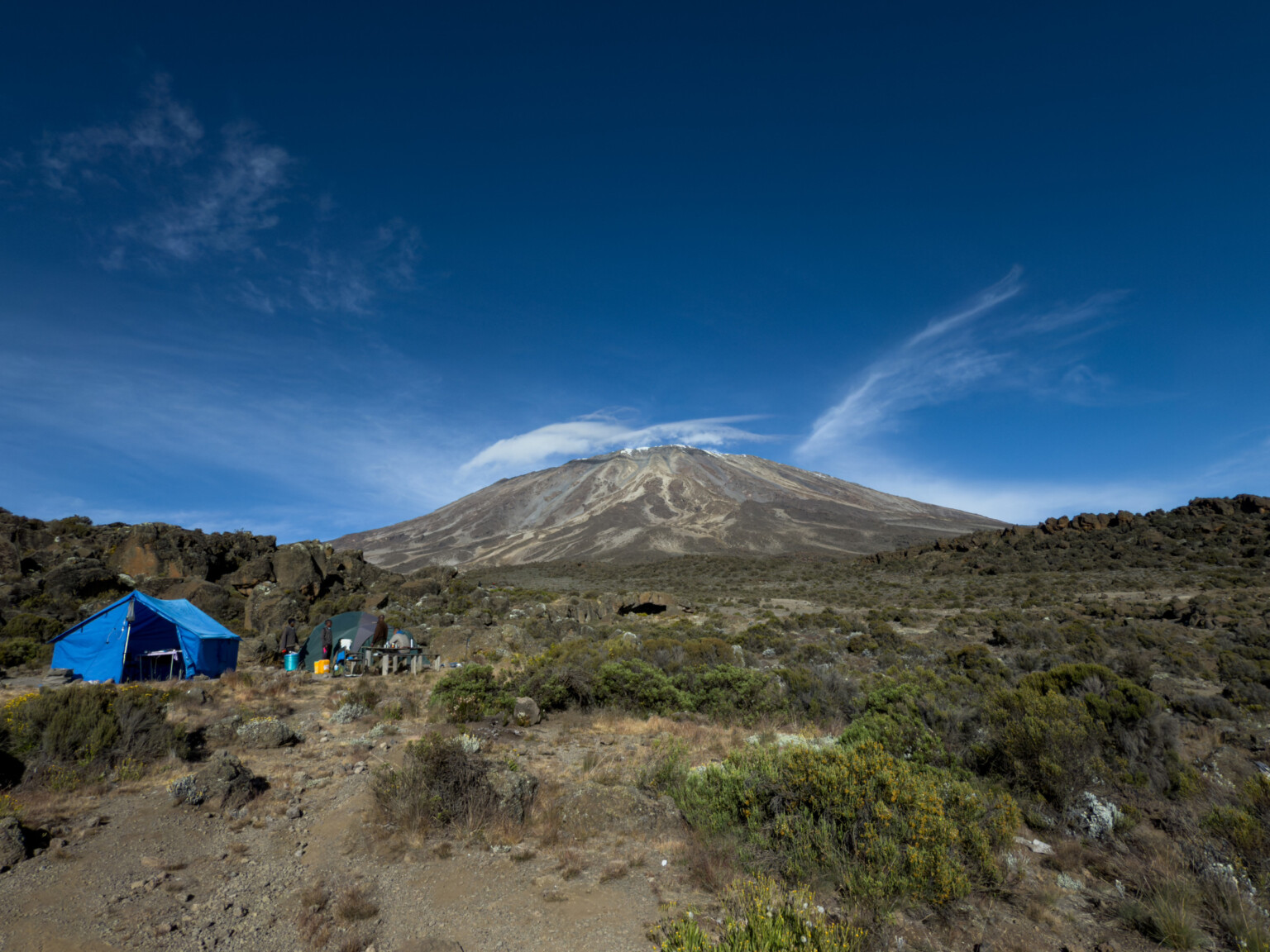
Expedition tents at Third Cave camp on the Rongai route with the summit of Kilimanjaro rising behind
Third Cave camp · 3,900 m · Day 5–6 · Photo: BBP

You bring your own sleeping bag and an inflatable sleeping pad to use on top of the foam mattress (see the Kilimanjaro Gear List). There are no showers on the mountain; the crew brings warm water for washing.

The Camps

Simba Camp — 2,625 m / 8,610 ft · first night on the mountain. At the edge of the northern forest and moorland. Quiet, with colobus monkeys often in the trees. A calm start to the camp routine.

Second Cave — 3,450 m / 11,320 ft. The moorland opens up, with wide views toward Mawenzi. You’ll notice the altitude here for the first time, and the evening check-ins with your guide start to matter.

Third Cave — 3,900 m / 12,795 ft · two nights. You arrive early after a short day, then sleep here again after the acclimatization hike. It’s a recovery camp: eating, drinking and resting well here pays off on summit night.

School Hut — 4,750 m / 15,585 ft. Our summit staging camp, set apart from the busier main high camp. We camp in our own tents here, not in the hut. The afternoon is for eating, drinking, packing your summit bag and going to sleep early. Summit night starts around midnight.

Horombo — 3,720 m / 12,205 ft. You reach Horombo on the way down, after the summit. We set up our own private camp here too. The air is warmer, and it’s the first night of real recovery before the walk out to Marangu Gate.

Questions about where you’ll stay?

Ask a guide · Back to Before You Go · climbing@benegasbrothers.com

Life on the Mountain

The summit is one day. The expedition is ten.

What separates climbers who thrive from those who merely get through is not fitness alone. It is how they handle the daily realities: eating when appetite fades, sleeping poorly at altitude, keeping themselves organized, and waiting patiently for the wind to ease.

Here is what life on Kilimanjaro actually looks like—and how to prepare for it.

The Daily Rhythm

Most days on the mountain follow the same pattern, and your body settles into it quickly:

  • A hot drink brought to your tent, then breakfast in the dining tent
  • A short morning briefing from your guide on the day’s route and how everyone is feeling
  • Walking at a pace built for acclimatization, with regular stops for water and food
  • Arrival at a camp already set up, with hot drinks waiting
  • Rest, tea and conversation through the afternoon
  • Dinner in the dining tent, an evening check-in with your guide, and an early night

With a maximum of six climbers, camp feels calm and focused. The evenings are one of the best parts of the trip.

The Three Kinds of Days

Moving days (Days 3, 4, 5, 7 and 9). Three to seven hours of walking with a daypack. Your duffel travels with the porter team; you never carry the camp. Day 5 is deliberately short — the afternoon is part of the plan.

The acclimatization day (Day 6). You hike up to 4,750 m and come back down to sleep at Third Cave. It feels like a rest day after lunch, and that’s the point: the body adapts during rest, not effort.

Summit day (Day 8). A midnight start, 7–9 hours up to Uhuru Peak and 5–7 hours down to Horombo. The afternoon before at School Hut is for an early dinner, packing your summit bag, a final equipment check and sleep. Is This for Me? describes summit night honestly.

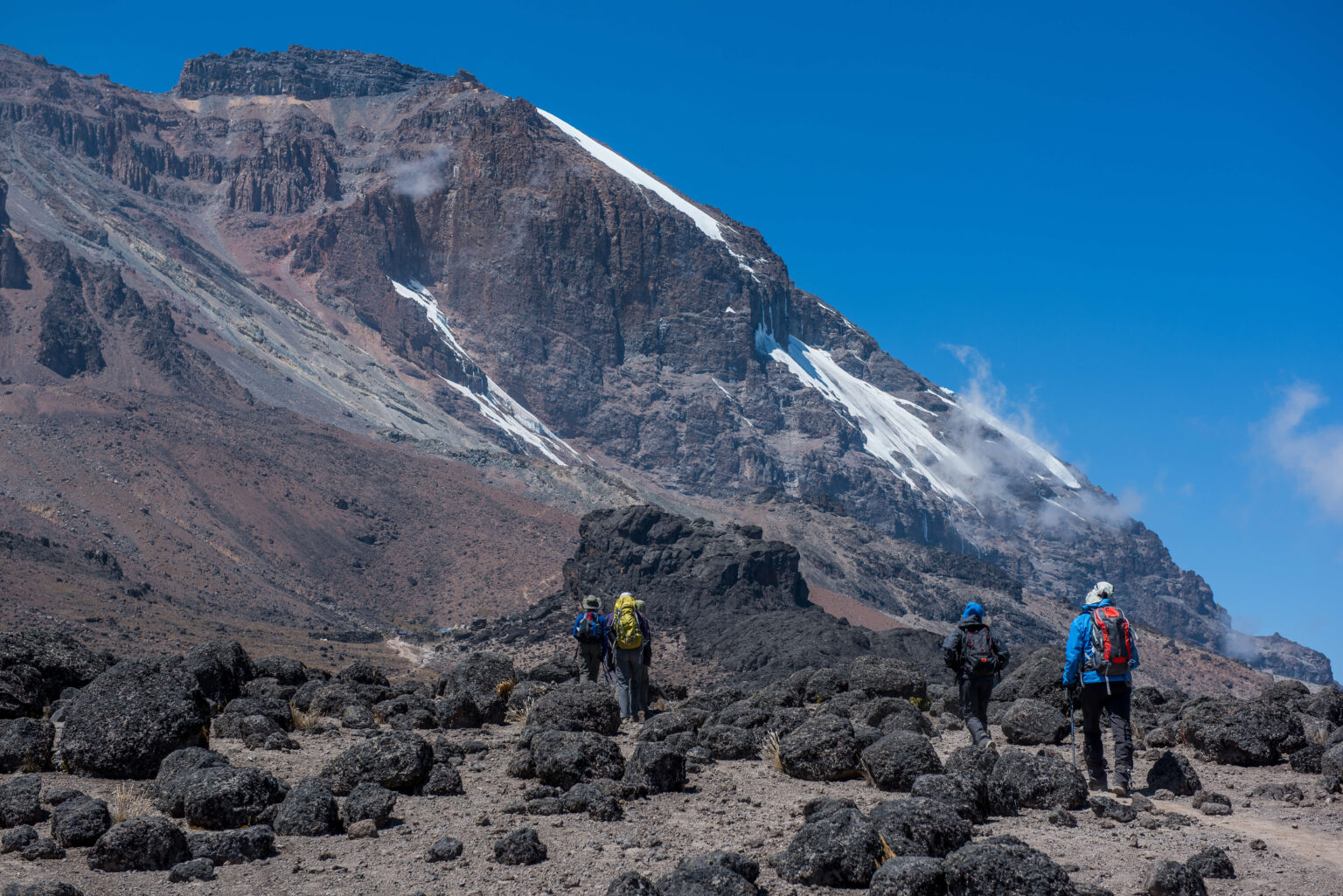
Climbers crossing rocky alpine desert below the snow-capped summit of Kilimanjaro
Moving day: alpine desert below the summit cone

Pacing: The Most Important Skill

On every mountain we guide, slow is fast. Climbers who push hard in the first days struggle later; climbers who move steadily and save energy do better on summit night and enjoy the climb more.

From the first hour on the trail, your guide is teaching you how to move at altitude: how to breathe, how to find a rhythm you can hold for hours, and how not to spend energy you’ll need later.

BBE tip

When your guide tells you to slow down, slow down. It’s a decision based on watching how you and your teammates are adapting.

What Your Guide Is Watching

Your guide watches every climber every day: pace, breathing, appetite, energy, sleep and mood. Those observations drive every decision on the mountain, including whether you go for the summit.

Tell your guide right away — don’t wait to see if it gets better — if you have:

  • A headache that doesn’t ease with water and rest
  • Nausea or vomiting beyond mild altitude adjustment
  • Dizziness or confusion
  • Shortness of breath well beyond normal effort
  • Unusual tiredness or loss of coordination
  • Chest tightness or a persistent cough

Catching altitude illness early is what keeps it manageable. Descent is the treatment, and a climber who needs to go down always goes with a guide.

Water: At Least Four Liters a Day

Dehydration is one of the most common, most preventable reasons climbers struggle.

  • All water at meals is boiled and purified by our crew.
  • Purified water is available to refill bottles at camp and at lunch stops.
  • As a second precaution, treat the water in your own bottles with tablets or a UV purifier.
  • Carry about three liters on the trail: two 1-liter wide-mouth bottles plus a soft bottle.
BBE tip

Start drinking before you feel thirsty. At altitude, by the time you feel thirsty, you’re already behind.

Eating When You Don’t Feel Like It

Your body burns roughly 3,000 to 5,000 calories a day on Kilimanjaro, while altitude dulls your appetite and changes how food tastes. Eat anyway — small amounts, often.

The kitchen. Our cooks shop for fresh produce and meat before each departure, and a re-supply system keeps fresh food coming through the climb. This isn’t freeze-dried trail food.

The dining tent. Tables and chairs for every meal. On longer days we serve a hot lunch on the trail; on shorter days, lunch is ready when you reach camp.

A typical day’s meals:

  • Breakfast: porridge, fresh fruit, eggs, toast and hot drinks
  • Lunch: soup, salads and grain dishes
  • Dinner: soup, then a main course with meat, local grains and vegetables

We can cater for vegetarian, vegan and gluten-free diets. Tell us before departure.

Your own snacks. Bring 2–4 lb of snacks you already know you like: bars, gels for summit night, hard candies (ginger chews work well), chocolate and electrolyte packets. Familiar flavors cut through a poor appetite.

Sleeping at Altitude

Sleep above about 4,000 m is lighter and more broken than at home, and that’s normal. Many climbers notice periodic breathing at night — deep breaths, then pauses — that can wake you. It’s a normal response to altitude, not a warning sign. Few people sleep well at School Hut.

What helps:

  • Put tomorrow’s layers inside your sleeping bag so they’re warm in the morning.
  • Sleep with your water bottles in your bag so they don’t freeze.
  • Keep your headlamp and gloves within reach.
  • Bring earplugs.
  • Use a pee bottle rather than going out into the cold at night.

Hygiene and Toilets

There are no showers on the mountain. Our crew brings you a bowl of warm water for washing in camp; wet wipes cover the rest. You’ll get a hot shower back in Moshi on Day 9. Every camp has a private toilet tent for our team only.

Two things matter more than anything else:

  • Wash or sanitize your hands before every meal. A stomach bug spreads quickly through a team and can end a climb.
  • Protect yourself from the sun from Day 1. Use high-SPF sunscreen and reapply through the day; put on SPF lip balm before your lips crack.

Keeping Yourself Organized

The crew carries and pitches the camp, cooks and fetches water. Your job is your own system: knowing where your headlamp, gloves and summit layers are, packing your daypack each morning, keeping electronics and water bottles warm at night, and having your duffel ready for the porters when the camp moves. Climbers who stay organized save energy every day.

Staying in Touch and Charging

Our camps have Starlink: a limited, shared connection that depends on power and weather. It’s enough to message home in the evening and for the guide team to check summit weather, not enough to work remotely. The guide team also carries satellite and radio communication at all times.

Bring a power bank (10,000 mAh or more) and keep it warm at night; cold drains batteries quickly. Tell your family before you leave that a quiet day or two, especially around summit night, is normal and not a sign of a problem.

Downtime

Afternoons are long, especially on Days 5 and 6. A book, cards, a journal or downloaded podcasts make them pass easily — and rest is doing real work.

Weather and Changes to the Plan

Kilimanjaro’s weather is generally stable in the climbing seasons, but rain on the lower slopes and wind and cold up high are normal. Your guides watch the summit forecast throughout the climb and may adjust daily timings or the summit start time. If conditions on summit night are unsafe, they adjust or turn the team around. Safety comes before the schedule.

Leave No Trace

We carry every piece of waste off the mountain. Single-use plastic bottles aren’t allowed in Kilimanjaro National Park, and Tanzania bans plastic carrier bags, so bring reusable bottles and bags. Stay on the trail, give wildlife space and keep camp quiet.

Questions about what the days actually feel like?

Ask a guide · Back to Before You Go · climbing@benegasbrothers.com

Kilimanjaro Gear List

The right gear makes almost as much difference to your comfort and safety as your training. Over ten days you pass through five climate zones, from Moshi’s tropical heat to a summit night that can drop to −20°C / −4°F with wind chill. This page explains how to build your systems. The full list, every item with recommended models, is a download you can print and take shopping.

Download the Kilimanjaro Gear List (PDF)

What the Weather Does

Your clothing has to work across all of these, sometimes in a single day:

Rainforest, 1,800–3,000 m15–20°C / 59–68°F by day and humid; 8–12°C / 46–54°F at night
Moorland, 3,000–4,000 m10–15°C / 50–59°F by day and breezy; 0–5°C / 32–41°F at night
Alpine desert, 4,000–5,000 m5–10°C / 41–50°F by day with strong sun; −10 to −5°C / 14–23°F at night
Summit zone, 5,000–5,895 m−12 to −6°C / 10–21°F at midday; down to −20°C / −4°F with wind chill on summit night
A line of climbers in full cold-weather gear walking past snow at dawn near the summit of Kilimanjaro
Summit morning: every layer matters until the sun reaches the crater rim

How to Think About Your Gear

The rule behind everything is layering. Several thin layers control moisture and warmth better than one bulky piece, and let you adjust as you move from rainforest humidity to alpine sun to summit-night cold. No cotton, anywhere.

Every item on the list is required unless it’s marked optional. For most items many brands work, so use our recommendations as a starting point, shop around and borrow where you can.

The Three Items Worth Investing In

Boots. Mid-weight, waterproof, Gore-Tex lined and properly broken in. This is the one item you can’t improvise or rent at the last minute. Buy them three months before departure, not three weeks. You don’t need mountaineering boots or crampons on the Rongai Route.

Sleeping bag. Rated to at least 0°F / −18°C, preferably −10°F / −23°C, ideally 800-fill down. Good sleep at altitude is part of summit performance.

Down parka. A hooded, 800-fill parka for summit night and the evenings at School Hut (4,750 m). When you stop moving in the dark near 5,500 m, this is what keeps you warm.

Your Systems

Feet. Boots, gaiters to keep scree out on summit night, liner socks (optional), three pairs of hiking socks, two pairs of warm socks, and camp shoes.

Sleep. Your sleeping bag, a full-length insulated inflatable sleeping pad (required — you use it on top of the foam mattress we provide), and a compression sack.

Layers — upper body. A lightweight wicking top, a long-sleeve base layer, a warm fleece mid-layer, a synthetic insulated jacket, a softshell jacket (recommended), a waterproof hard shell with a hood, and the down parka.

Layers — lower body. Non-cotton underwear, quick-dry shorts, base-layer bottoms, trekking pants, softshell pants, waterproof hard-shell pants, and insulated pants (optional, recommended if you run cold).

Hands and head. Lightweight gloves, insulated waterproof gloves, insulated mittens for summit night, a sun hat, a warm beanie, a buff and a balaclava. Sunglasses with side coverage; goggles are optional for a windy summit night.

On the trail. A 25–35 L daypack, trekking poles, a 300+ lumen headlamp with spare lithium batteries, two 1 L wide-mouth bottles, a soft bottle, insulated bottle covers and a thermos. Summit night is cold enough that hydration hoses freeze — rely on your bottles.

Health and hygiene. Sunscreen SPF 50+, SPF lip balm, hand sanitizer, wet wipes, water purification tablets or a UV purifier, a blister kit, a small personal first aid kit, and your personal medications. The PDF lists the full kit.

How Your Gear Travels

Pack everything for the mountain in one rugged, waterproof duffel of 90–120 liters. Don’t use a backpack for checked luggage; baggage handling damages the straps. On the mountain, the duffel travels with the porter team. Park rules limit porter loads, so the duffel has a weight limit; your pre-trip packet gives the exact figure.

You carry only a daypack with water, layers, snacks and a camera. A small bag with your travel clothes stays at the hotel in Moshi until you come down.

Test Everything Before You Go

Nothing should come out of the box in Moshi. Wear your boots on every long training hike. Use your full layering system on a cold early start. Sleep a night in your bag and on your pad. Try your gloves and mittens with your poles and headlamp. Problems found at home are easy to fix; problems found at School Hut are not.

What BBE Provides

You don’t bring any group equipment. On every departure, BBE provides:

  • Sleeping tents, two climbers per tent, with foam mattresses
  • A dining tent with tables and chairs
  • A private toilet tent
  • All cooking equipment, fuel and meals on the mountain
  • Purified drinking water at every camp
  • A comprehensive group medical kit and emergency oxygen
  • Satellite and radio communication, and Starlink in camp where power and weather allow

Renting Gear in Moshi

Good rental gear is available in Moshi: sleeping bags, down parkas, trekking poles, duffels and most layers. If you plan to rent major items, tell us at least three weeks before departure so we can arrange them. Final fitting happens at the gear check on Day 2. Rentals are paid directly to the rental shop.

Rentals are also your safety net if a checked bag is delayed. Boots are the exception: bring your own, broken in, in your carry-on.

The Gear Check

You don’t have to get this perfect on your own. On Day 2 in Moshi, your lead guide goes through your gear item by item. Anything missing, doubtful or worn out is found while there’s still time to rent or buy locally. Send us questions about specific items at any point before the trip.

Download the Kilimanjaro Gear List (PDF)

Questions about gear? Gear questions are exactly what Ask a Guide is for.

Ask a guide · Back to Before You Go · climbing@benegasbrothers.com

What to Budget For

The expedition price covers the climb itself; what it includes is on Dates & Prices. This page shows every other cost, so you arrive in Moshi with nothing left to figure out.

Beyond the price, most climbers spend$1,500–2,700

Visa, insurance, crew tips, meals and incidentals. Not flights, gear, rentals or extensions.

Cash to carry$900–1,300

In clean U.S. bills, for crew tips, meals in Moshi and your reserve.

Emergency reserve$300–500

Extra cash beyond your plan. It almost never gets used.

Your Budget at a Glance

RequiredCosts every climber pays
  • Tanzania visa$100 U.S. passports · $50 most others · paid online$50–100
  • Rescue & evacuation insuranceRequired by BBE · helicopter evacuation to 6,000 m$500–900
  • Tanzania inbound travel insuranceRequired by Tanzania · from NIC$44
  • Crew tipsGroup of six $510–630 · group of three to five $585–705$510–705
  • International flightsYou book these; send us your itinerary firstVaries
  • Personal gearDepends on what you already ownVaries
Strongly recommended
  • Trip insuranceCancellation, interruption, delays, baggage, travel medical$200–500
Personal spending
  • Meals in MoshiAbout $30–60 a day$50–150
  • Snacks2–4 lb you like, bought at home$50–100
  • IncidentalsLaundry, drinks, souvenirs$100–200
OptionalOnly if you add them
  • Gear rentals in MoshiPaid to the shop · tell us three weeks aheadVaries
  • Extra hotel nights in MoshiIf you arrive early or stay on$80–180 a night
  • Safari extension, 3–5 daysPlus about $80 for your safari guide$1,800–3,500
  • Zanzibar extension, 3–4 daysDepending on accommodation$800–2,000

Insurance details are on Trip Insurance & Evacuation Coverage, the visa on Flights & Getting to Kilimanjaro, and gear on the Kilimanjaro Gear List.

Tips: How They Work

It takes a large team to run a climb like this. On a full six-climber departure the crew is about 24 to 28 people: our lead guide, a Tanzanian lead guide, two or three assistant guides, a head cook and assistant cook, and 20 or more porters. Smaller teams have smaller crews.

Per climberGroup of sixGroup of 3–5
Crew tip poolAssistant guides, cooks and porters$250–300$325–375
Lead guide$200–250$200–250
Tanzanian lead guide$40–50$40–50
Hotel porters and driversIn small bills across the trip$20–30$20–30
Total per climber$510–630$585–705

Private climbs for one or two climbers start at about $710 per climber; we send exact guidance for your team before the trip. You’re always free to give more for great service.

1At the briefing in MoshiCollectedYour lead guide explains the tipping program and collects the money, so you don’t carry it on the mountain.
2Before the climbChanged to shillingsSo the crew is paid in local currency.
3Marangu Gate, last dayPaid in personEach crew member receives their share individually, in front of the whole team.

Gear donations. Many climbers leave good mountain gear for the crew — waterproof jackets and pants, fleece, boots in good repair, sleeping bags, headlamps, gloves, sunglasses. Give donations to the Tanzanian lead guide at the end of the climb. They’re a welcome extra on top of cash tips, not a replacement for them.

Cash and Cards

A good mix for $900–1,300$1About 20 bills, for hotel and driver tips$10About 10 bills, $100 in total$50$100The rest, for better exchange rates
Banks will refuse bills that fail thesePrinted in 2013 or laterCrisp and cleanNo tears, heavy creases, stamps or inkWorn or older-series bills: refused, and can’t pay the crew

Order fresh bills from your bank a couple of weeks before you leave. Carry your cash in a money belt while you travel. Local ATMs give Tanzanian shillings, handy for small purchases, but bring your tip cash from home. A credit card is useful for hotels and larger purchases; tell your bank you’re traveling.

Contingency

$Emergency reserve · $300–500

Cash beyond your planned spending, for an extra hotel night after a flight delay, a medical cost your insurance doesn’t cover, or anything unexpected.

!Disruption costs

If a flight is delayed or cancelled, or you need to leave the climb early, extra hotel nights, transfers, meals and flight changes are your cost, and unused expedition services are not refunded. Trip insurance is what usually covers these. Leaving-early and cancellation terms are on Dates & Prices.

Questions about costs? If you’d like a breakdown for your own situation, ask. We’d rather you plan it right than guess.

Ask a guide · See dates and prices · Back to Before You Go · climbing@benegasbrothers.com

Private & Custom Expeditions

Kilimanjaro · Your Dates, Your Team, Your Pace

Private & Custom Expeditions

Many of the Kilimanjaro climbs we run are private or customized in some way. If the scheduled dates don’t work for you, or you’d rather climb only with the people you bring, we build the expedition around you — with the same guides, camp system and standards as every BBE departure.

Who Private Climbs Suit

  • Couples, friends and families who want their own team, including parents climbing with their kids
  • Climbers who need specific dates
  • Solo climbers who want a guide’s full attention, one-to-one
  • Charity, corporate and leadership groups
  • Climbers returning after a previous attempt who want a different approach

What You Can Customize

Dates. Private climbs run year-round, subject to guide availability. The driest months are generally January to early March and June to October, and we’ll tell you honestly how conditions look for the dates you have in mind.

Team size and staffing. From one climber to a larger group. Guide and crew numbers are planned for your team size, and that shapes the proposal.

Route. The Rongai Route is our standard for good reasons: the quiet northern approach, the dedicated acclimatization day and the summit push from School Hut. A private climb can use Lemosho, the Northern Circuit or Marangu if it better fits your goals, your time or a previous attempt. We’ll tell you plainly what each route gains and gives up.

Pace and acclimatization. A private climb lets the daily pace fit your team. It doesn’t shorten what your body needs: we won’t build a private itinerary with less acclimatization than the mountain requires, and a private climb doesn’t change the fact that no one can promise a summit.

Extensions. A private three- to five-day safari through Tarangire, Ngorongoro Crater and the Serengeti fits straight onto the end of your climb, with a private vehicle and a professional safari guide. Or finish with three or four days on Zanzibar’s beaches — a short flight from Kilimanjaro Airport. We arrange the logistics; each extension is quoted individually. Estimated costs are on What to Budget For.

Led by Willie or Damian

Willie Benegas at altitude on Aconcagua, black and white portrait
Willie Benegas on Aconcagua, summit morning · Photo: BBP
Founder-led on request

Willie or Damian Benegas can personally lead a private or custom expedition on request. A founder’s participation applies only when it is confirmed in your written trip terms — never assumed.

Corporate, Team and Media Projects

Kilimanjaro is a strong shared objective for a team: a real summit, a real system, and ten days working toward something together. We run corporate and leadership groups with the same expedition management as every BBE departure, and we handle the planning so your organizer doesn’t have to. For filming, brand or media projects, contact us to discuss scope and logistics.

How a Proposal Comes Together

Pricing depends on route, length, group size, staffing and level of support. Starting prices are on Dates & Prices; every private expedition is quoted individually.

How to Start

Tell us your dates, your group and your goals. Private expeditions need lead time for park permits, guide scheduling and logistics, and the earlier you reach out, the more options we can offer. We answer every inquiry personally.

Tell us your dates, your group and your goals

We answer every inquiry personally. See dates and prices. · climbing@benegasbrothers.com
Ask a guide

Dates & Prices

Kilimanjaro Rongai Route · 10 Days · Tanzania · Maximum Six Climbers

Everything you need to book: departures, the price, what it covers, the payment schedule and the terms. If you’re still deciding, start with Is This for Me? or talk to a guide first. Every climber speaks with us before booking.

Expedition price$6,615

USD per person, shared room in Moshi. Park fees and climbing permits included.

Deposit to book$1,323

20% of the price. Includes a $350 non-refundable booking fee.

Balance$5,292

Due 120 days before departure. Inside 120 days, you pay in full at booking.

2027–28 Departures

January 9–18, 2027Scheduled departure

January is one of Kilimanjaro’s driest, most settled months.

June 26–July 5, 2027Scheduled departure

June starts the long dry season.

July 10–19, 2027Scheduled departure

Founder-led Damian Benegas leads this departure.

December 25, 2027–January 3, 2028Scheduled departure

A holiday departure: summit day falls on New Year’s Day.

Each departure takes a maximum of six climbers. A departure is confirmed when we tell you so in writing. Please buy nonrefundable flights only after your departure is confirmed. When it’s full, it closes. Day 1 is arrival in Moshi at any time, and Day 10 is departure. The full itinerary is on Day by Day.

When to Climb

Kilimanjaro can be climbed year-round. The driest, most settled months are generally January to early March and June to October. The long rains, roughly April and May, are the season most teams avoid. No month guarantees good weather.

What’s Included — and What Isn’t

Included in $6,615

Before you go
  • Preparation guidance and a week-by-week training guide
  • An equipment consultation and the Kilimanjaro gear list
In Tanzania
  • Private airport transfers on Day 1 and Day 10
  • Three hotel nights in Moshi, on a shared room basis
  • Breakfast daily at the hotel in Moshi, plus the welcome dinner and the final dinner
  • All ground transportation on the itinerary
  • Kilimanjaro National Park fees and climbing permits
On the mountain
  • A professional lead guide certified by IFMGA, AMGA or an equivalent national body, working with a Tanzanian lead guide and assistant guides
  • The full mountain crew: porters, cooks and camp staff, hired and paid to KPAP standards
  • All meals on the mountain, cooked fresh by our own kitchen
  • Our private camp: sleeping tents with foam mattresses, the dining tent, a private toilet tent and purified water at every camp
  • A group medical kit, emergency oxygen, and satellite and radio communication
  • Summit forecast monitoring and summit-night planning
  • Park summit certificates

Not included

  • International flights
  • Tanzania visa ($100 U.S. · $50 most others)
  • Rescue and evacuation insurance Required
  • Tanzania inbound travel insurance, $44 Required
  • Trip insurance (strongly recommended)
  • Personal gear and clothing, and any rentals in Moshi
  • Tips for the guides and crew
  • Lunches and other dinners in Moshi
  • Extra hotel nights and transfers outside the itinerary
  • Safari or Zanzibar extensions
  • Personal expenses
Dining dome glowing at camp after dark on Kilimanjaro, with KILI light-painted in the night sky
Camp after dark. Every BBE camp has a dining tent for meals and the evening check-in · Photo: BBP

Your Total Trip Cost

The expedition price is the biggest number, not the only one. Typical ranges per climber, in U.S. dollars:

Expedition price$6,615
Tanzania visa$50–100
Rescue and evacuation insurance (required)$500–900
Tanzania inbound travel insurance (required)$44
Trip insurance (strongly recommended)$200–500
Crew tips$510–705
Meals, snacks and incidentals$200–450
Typical total, before flights and gearabout $8,100–9,300

Not included in that total: international flights, personal gear and rentals, extensions, and an emergency cash reserve of $300–500. The full breakdown, including how crew tips work and which bills to bring, is on What to Budget For.

Payment & Cancellation

Deposit: $1,323 (20% of the trip price), due at booking. $350 of it is a nonrefundable booking fee.

Balance: $5,292, due 120 days before the start date. Booking within 120 days? Full payment is due at booking.

How to pay: bank transfer/ACH (no fee), wire transfer (you pay the bank fees) or credit card (3% surcharge). All prices are in U.S. dollars.

If you cancel:

  • 121 days or more before the start date: full refund, less the $350 booking fee
  • 90 to 120 days: 50% refund, after the $350 booking fee
  • 89 days or fewer: no refund

Can’t make it? Send a qualified climber in your place at no BBE fee.

Insurance: medical and rescue/evacuation coverage required. Trip cancellation insurance strongly recommended.

Once the trip begins, payments are nonrefundable.

Read the full Payment & Cancellation Policy →

Insurance

Rescue and evacuation insurance is required on every BBE international expedition. Your policy must cover helicopter evacuation to at least 6,000 m and international medical transport. Tanzania’s inbound travel insurance ($44, from NIC) is also required by Tanzania for entry, in addition to your own policy. Trip insurance is strongly recommended; in many situations it’s the only way to recover costs from disruptions outside anyone’s control. See Trip Insurance & Evacuation Coverage.

Private Departures

A private climb runs on your dates, with your group, on the Rongai, Lemosho, Northern Circuit or Marangu route.

Private expedition with a BBE guide: from $12,000.

Led by Willie or Damian Benegas: on request, priced individually. A founder’s participation applies only when confirmed in your written trip terms.

Every private expedition is priced individually, based on route, length, group size and level of support. See Private & Custom Expeditions.

Optional Extensions

  • Tanzania safari, 3–5 days: Tarangire, Ngorongoro and the Serengeti
  • Zanzibar, 3–4 days on the coast after the climb

Both are quoted individually. See Private & Custom Expeditions.

Why Book Early

The main reason is preparation time. The climbers who arrive most ready had months to build fitness, sort out their gear and understand what summit night asks of them. Booking early also gives you time to arrange flights and insurance sensibly.

Ready to book?

Reserve your place, or talk to a guide first. Ask a guide · climbing@benegasbrothers.com
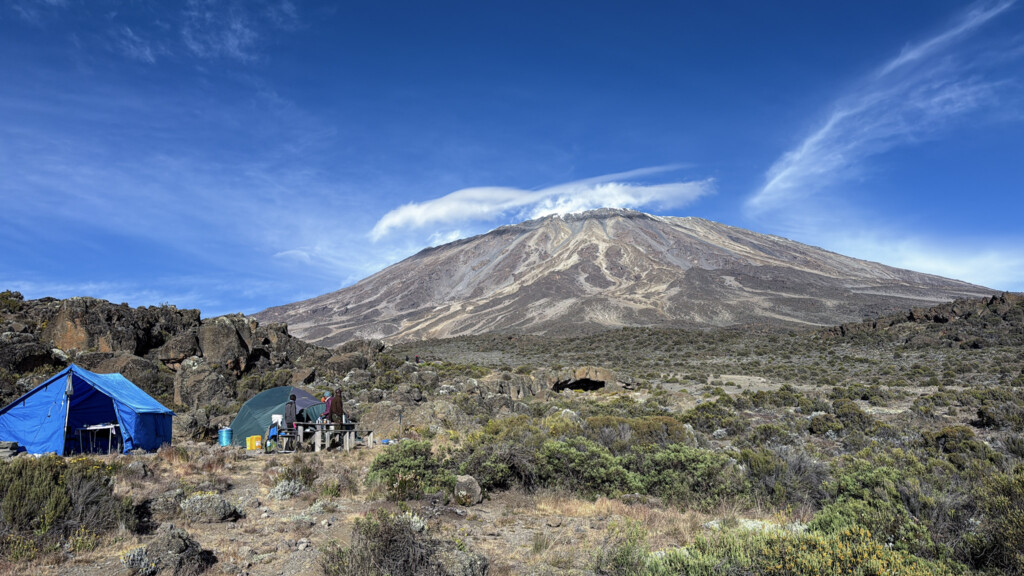
Register now

Your Questions

Kilimanjaro Rongai Route · Answered by the Guides

Straight answers to the questions climbers ask most before committing to Kilimanjaro. Each answer is short and points you to the page with the full detail. If your question isn’t here, ask us — we answer every inquiry personally.

Still have a question? Ask a guide See dates and prices climbing@benegasbrothers.com
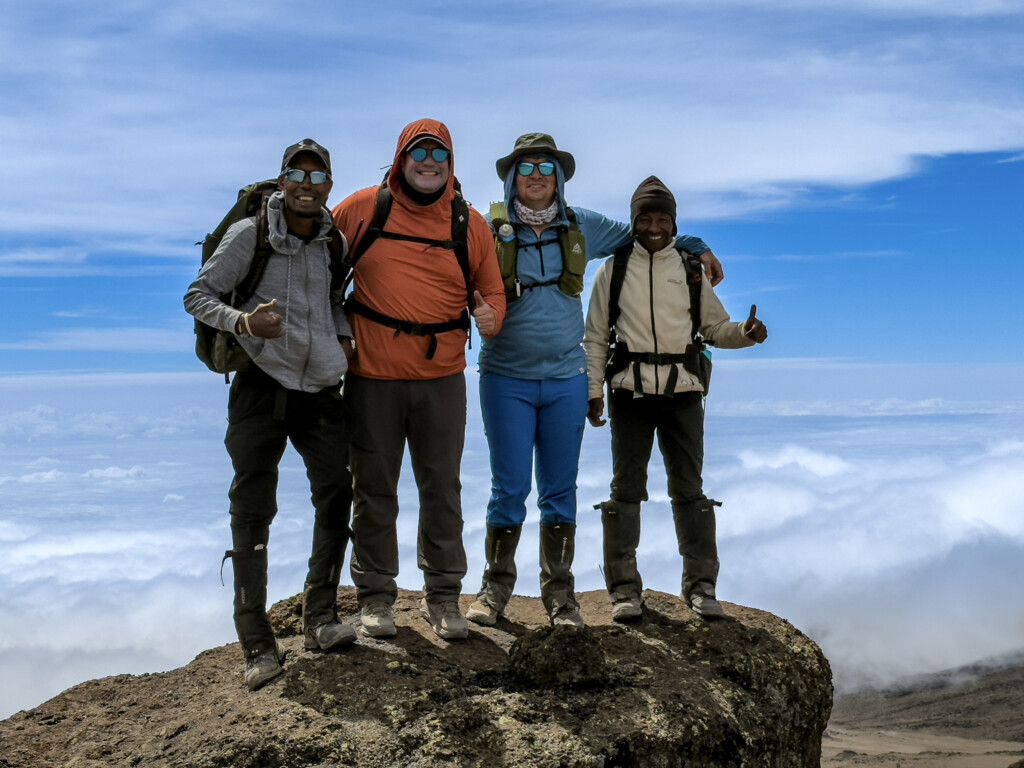
Yes. Most of our Kilimanjaro clients haven’t. The Rongai Route is non-technical: no ropes, no crampons, no climbing skills. What it does need is real fitness, 8–12 weeks of structured training and a willingness to follow your guide’s pace. Every climber speaks with a guide before booking, and we’ll tell you honestly where you stand.

Fit enough to walk 6–8 hours on uneven ground, then do it again the next day on tired legs, and to keep moving uphill for 7–9 hours on summit night. General gym fitness isn’t enough on its own. Is This for Me? has a self-check and the training approach.

Harder than most people expect, including fit, well-prepared people. You leave School Hut (4,750 m) around midnight and climb about 7–9 hours to Uhuru Peak (5,895 m), mostly on loose scree, at −10°C to −20°C before dawn. Then you descend 5–7 hours. Summit day runs about 12–16 hours in total.

That’s a normal place to start, and often a good sign. The climbers who struggle most tend to be the ones who underestimated it, not the ones who were nervous. Tell us about your fitness and your concerns. We’d rather spend twenty minutes on the phone helping you decide than have you book a climb you’re not ready for, or talk yourself out of one you could do.

Kilimanjaro National Park sets the minimum age at 10 for a summit climb, and we welcome families. Children under 10 need special permission from the park before arrival; we’ll help with the application, though approval is not guaranteed. Climbers under 18 climb with a parent or guardian, and each climber’s insurance must cover their age. There’s no upper limit. Fitness and health matter far more than age, and every climber completes a medical history form. We may ask for a physician’s clearance.

Ten days, airport to airport: two days in Moshi, seven days on the mountain including an acclimatization day, and departure on Day 10. See Day by Day.

Kilimanjaro can be climbed year-round. The driest months are generally January to early March and June to October; most teams avoid the long rains of April and May. Current departures are on Dates & Prices.

No. Every night on the mountain, including at School Hut and Horombo, you sleep in our own private tented camp, two climbers per tent. See Where You’ll Stay.

No, but our crew brings warm water for washing in camp. You get a hot shower back in Moshi after the climb.

Fresh, cooked meals from our own cooks, not freeze-dried food. Vegetarian, vegan and gluten-free diets can be catered for with notice. See Life on the Mountain.

In most cases, yes. Our camps have Starlink — a limited, shared connection that depends on power and weather. It’s enough for messages, not for work. Tell your family a quiet day or two is normal.

We don’t publish a success rate we can’t back with our own records. What we can tell you is what drives it: ten days on a route that gives your body time to adjust, a small team, and guides who watch every climber every day. Ask a guide and we’ll talk you through our recent departures.

It happens, and no honest operator can promise a summit. If your guide decides you should turn around, that call is made early and clearly, with your health first, and a guide goes down with you. Turning around at the right moment is a professional decision, not a failure.

Your guides check every climber every day for the early signs of altitude illness, and the team carries a medical kit, emergency oxygen and satellite and radio communication. Descent is the treatment, and a climber who needs to go down always goes with a guide. Evacuation depends on conditions and is never guaranteed. See Trip Insurance & Evacuation Coverage.

All mountain travel carries real risk, and anyone who tells you otherwise isn’t being straight with you. What reduces it is experienced leadership, an itinerary long enough to acclimatize properly, daily health checks, a small team and the willingness to turn around. That is how we run every departure.

Your guides watch the summit forecast throughout the climb. If conditions on summit night are unsafe, they adjust the start time or turn the team around. Safety comes before the schedule.

Yes, and many clients do. You’ll climb as part of a small team and share a tent with one other climber.

A maximum of six climbers on a scheduled departure. Every team is led by a certified lead guide working with a Tanzanian lead guide and assistant guides. On a full six-climber team that is four or five guides, so there is at least one guide for every two climbers. The porters, cooks and camp staff run the camp. You won’t disappear into the group.

Not on a scheduled departure unless we’ve confirmed it for your dates. Every team is led by BBE’s certified guides and our Tanzanian guide team, run to the same standards. Willie or Damian can lead a private expedition on request, confirmed in your written trip terms. See Private & Custom Expeditions.

Yes. Private departures run on your dates, with your group, on the Rongai, Lemosho, Northern Circuit or Marangu route. See Private & Custom Expeditions.

The expedition price is on Dates & Prices. On top of it, plan for flights, the Tanzania visa, insurance, crew tips, gear and personal spending. What to Budget For lays it all out.

Yes. Kilimanjaro National Park fees and climbing permits are arranged by BBE and included in the expedition price.

Tipping is expected on Kilimanjaro and is a real part of how guides, cooks and porters earn their living. Guidelines by group size, and how the tipping ceremony works, are on What to Budget For.

For most climbers, roughly $900–1,300 in clean U.S. dollars printed in 2013 or later. Older or worn bills are often refused in Tanzania.

Yes, every climber needs a visa for Tanzania. We recommend the official e-visa, applied for four to six weeks before you travel. After you register, we send you the host details for the application. See Flights & Getting to Kilimanjaro.

Yes. Rescue and evacuation coverage to at least 6,000 m, with helicopter evacuation and no altitude exclusion, is required on every BBE international expedition. Tanzania also requires its own $44 inbound travel insurance for entry. Trip insurance is strongly recommended. We recommend Global Rescue, with its High-Altitude Evacuation Package, or Ripcord. See Trip Insurance & Evacuation Coverage.

A 20% deposit reserves your place; the balance is due 120 days before departure. Cancellations must be in writing. Refunds depend on how much notice you give, and the fixed booking fee is non-refundable. Full terms are on Dates & Prices. Trip-cancellation insurance is strongly recommended.

Kilimanjaro International Airport (JRO). Arrive on Day 1 at any time and fly home any time on Day 10. Both airport transfers are included. Book once your place is confirmed and you’ve paid in full.

In Moshi, usually, for an additional fee. On the mountain, all climbers share tents two per tent.

Yes. The hotel stores anything you don’t need on the mountain until you come back down.

Yes, in Moshi: sleeping bags, down parkas, trekking poles, duffels and most layers. Tell us at least three weeks ahead. Boots are the exception — bring your own, broken in. See the Kilimanjaro Gear List.

It’s a strong foundation. You’ll learn how your body handles altitude, how to pace a long day and how to manage yourself on an expedition. For many climbers the next step is glacier skills at Ecuador Mountaineering School, then Aconcagua as the bigger altitude objective. If Everest is the long-term goal, The Road to Everest shows every step. Ask a guide what makes sense for you.

Summit night from School Hut.

Ten days on the quiet Rongai Route, a dedicated acclimatization day and six climbers maximum — so you arrive at summit night ready for it.

Price$6,615 per person
Private & Custom Your dates. Your team.

This trip can run privately, on the dates that work for you.

Scheduled departures
  • Saturday, Jan 9 - Monday, Jan 18, 2027Scheduled departure
  • Saturday, Jun 26 - Monday, Jul 5, 2027Scheduled departure
  • Saturday, Jul 10 - Monday, Jul 19, 2027Scheduled departure · Led by Damian Benegas
  • Saturday, Dec 25, 2027 - Monday, Jan 3, 2028Scheduled departure

Questions first? Ask a guide

Location:
Tanzania
Group:
Maximum 6 climbers
Duration:
10 Days
Skill:
Beginner to Advanced, good fitness encouraged
Activities:
Expeditions, 7 Summits
Pricing

All prices are in US dollars.

Summit night from School Hut.

Ten days on the quiet Rongai Route, a dedicated acclimatization day and six climbers maximum — so you arrive at summit night ready for it.

Book now

Private & Custom

Make Kilimanjaro Rongai your own expedition

Every trip we run can also run privately: on your dates, with your people, built around your goal. Same guides, same safety standard as our scheduled departures.

Your dates

We set the departure around your calendar, not the other way round.

Your people

Family, friends, a company team, or just you and a guide.

Your goal

Training for a bigger peak, a winter or speed attempt, a film, or a route that runs from summit to ocean.

Your price

Private trips are quoted for your group size, dates and plan.

Kilimanjaro · Rongai Route

Scheduled Departure

Maximum 6 climbers · 10 days · Rongai Route
Price per Person $6,615

The complete 10-day expedition: three hotel nights in Moshi, park fees and permits, a certified lead guide with a Tanzanian guide team, our private camp system, all mountain meals, and a summit push from School Hut.

Private & Custom

Your dates · Your team · Your route
Private, with a BBE guide From $12,000

A private expedition with a BBE guide, built around your dates and your group — with safari and Zanzibar extensions available. Quoted individually.

The BBE Advantage

Kilimanjaro Rongai — Tanzania

The Quiet Rongai Route

Rongai approaches from the north, near the Kenyan border. It sees far fewer climbers than the southern routes, and it is drier and quieter — and the gradual ascent gives your body time to adjust.

Kilimanjaro Rongai — Tanzania

The School Hut Strategy

We stage summit night from School Hut instead of the busiest high camp on this side. You leave on your own schedule, away from the midnight crowd.

Kilimanjaro Rongai — Tanzania

Six Climbers. Never More.

Your guide knows how you are adapting day by day. Pacing is adjusted for you, summit decisions are made with full knowledge of each climber, and you never disappear into the group.

Professional Mountain Standards

Our guide team includes internationally and nationally certified mountain professionals.

AMGA — American Mountain Guides Association logo
IFMGA / UIAGM — International Federation of Mountain Guides Associations logo
AAGM — Asociación Argentina de Guías de Montaña logo

Related Trips