Global Expeditions Chile South America

Ojos del Salado Expedition

Ojos del Salado · Atacama Desert, Chile · 22,615 ft / 6,893 m · 14 Days · Maximum Six Climbers

14 Days Group: Maximum 6 climbers $7,500 per person (2027)

The Climb

Ojos del Salado · Atacama Desert, Chile · 22,615 ft / 6,893 m · 14 Days · Maximum Six Climbers

Ojos del Salado is the highest volcano on Earth and the highest mountain in Chile. It sits in the Atacama, one of the driest places on Earth, ringed by salt flats, turquoise lagoons and a skyline of volcanoes above 19,700 ft / 6,000 m.

22,615ftOjos del Salado · 6,893 m
14Days, Copiapó to Copiapó
2Summits above 19,700 ft
6Climbers, maximum
3:1Maximum climber-to-guide ratio, with a full team
Day 12A summit and weather reserve day

The standard route holds no sustained technical climbing. There is a short rock and scrambling step near the top, where we use helmets, harnesses and rope. What Ojos demands instead is the ability to arrive at 22,615 feet properly acclimatized, and to perform there in wind, cold and extreme dryness.

That is what this expedition is built to do.
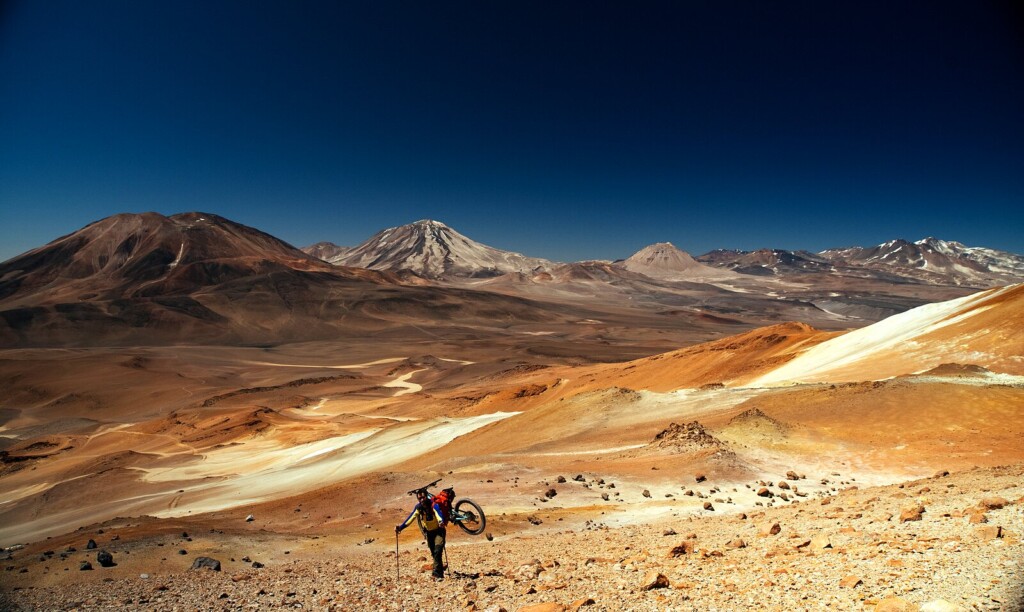
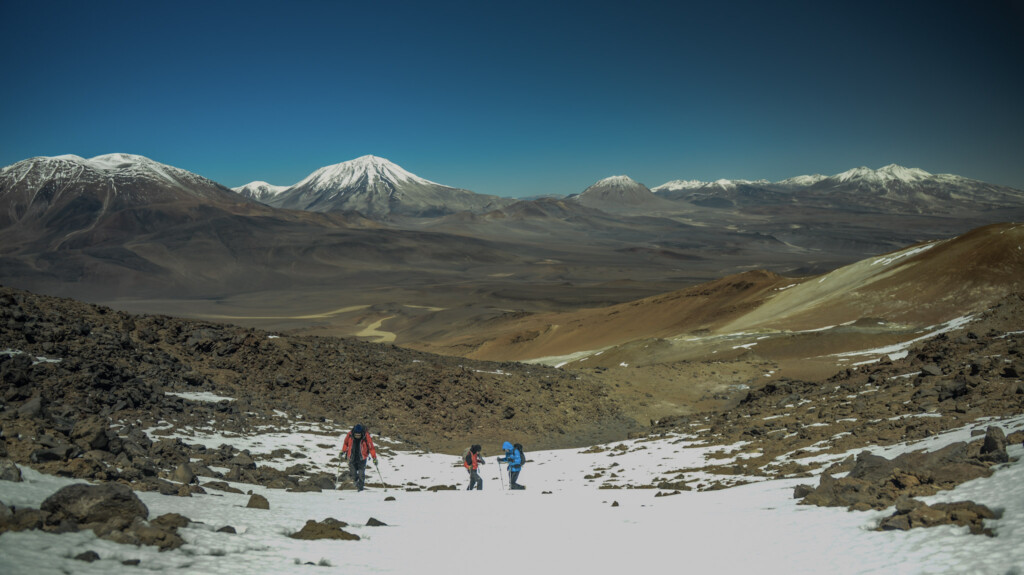
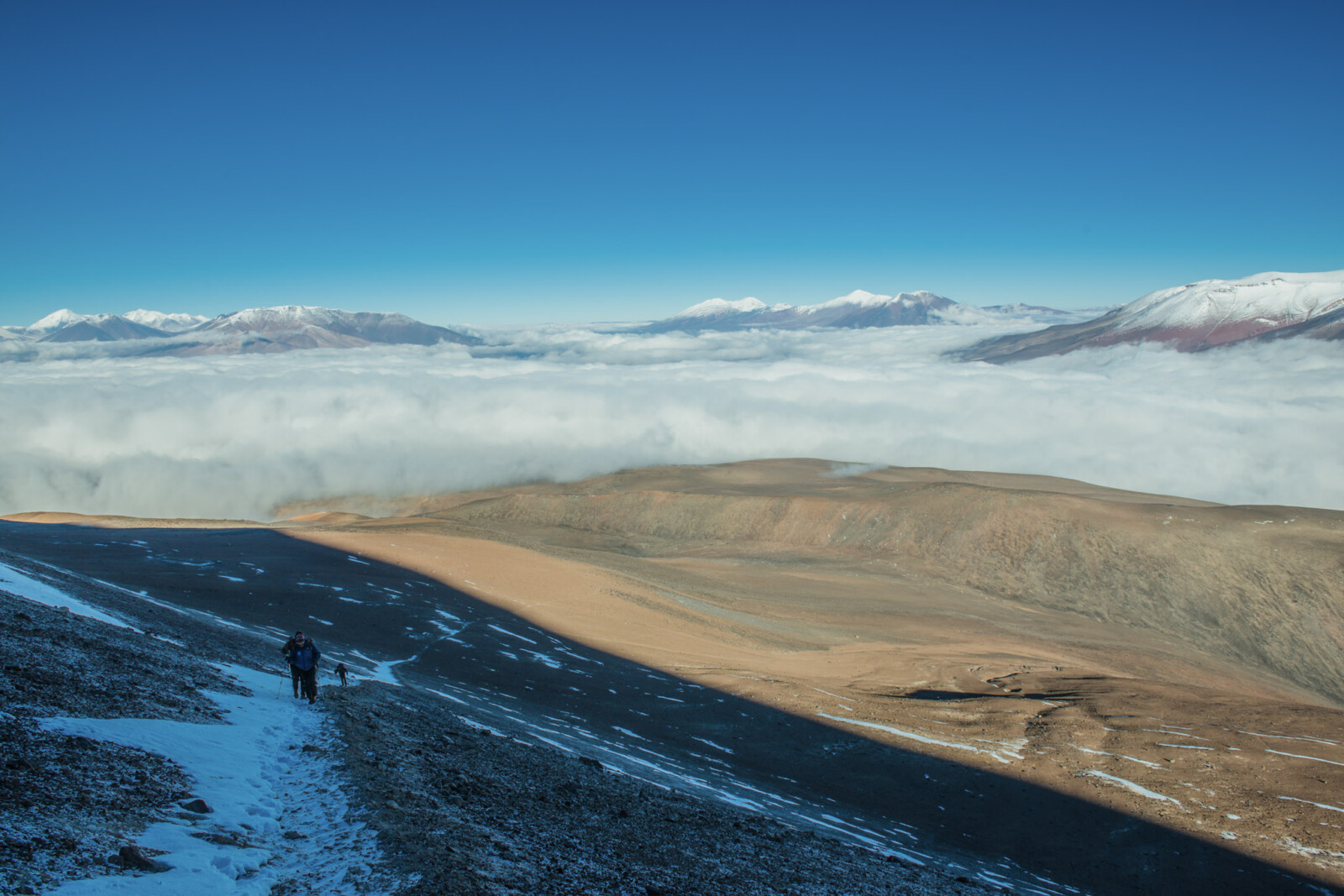
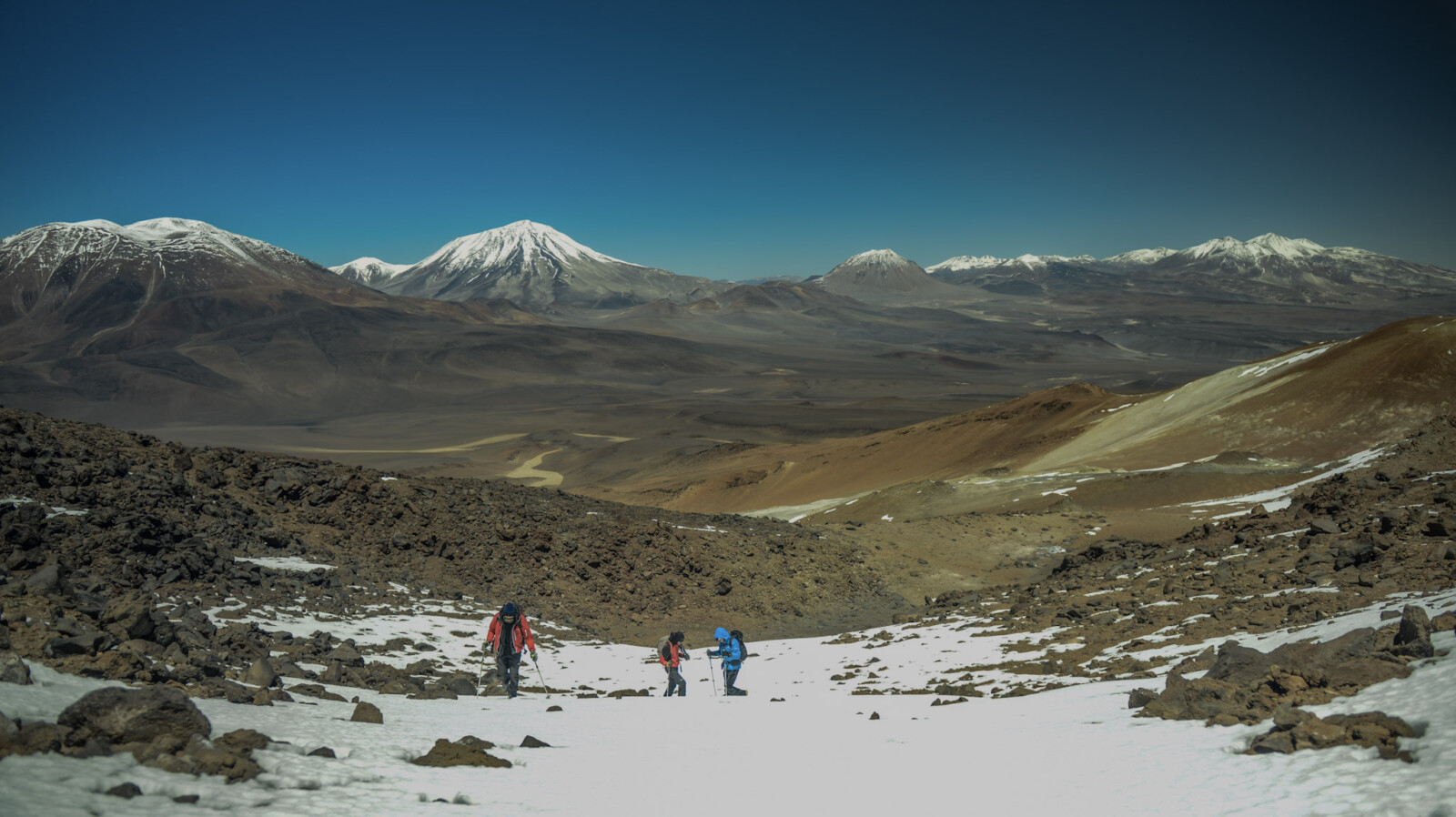
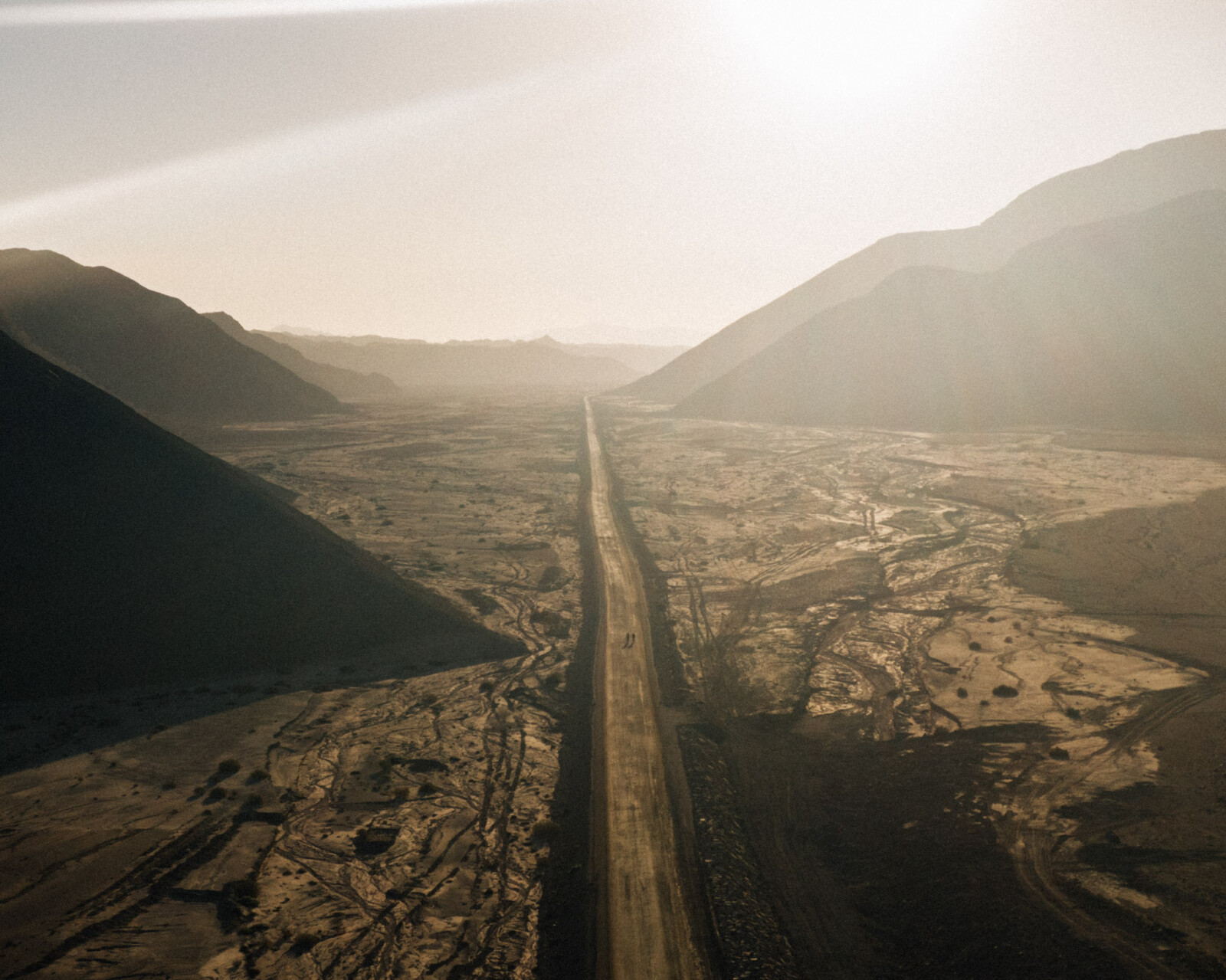
Volcanoes of the high Atacama near Ojos del Salado, Chile

The Mountain

Ojos del Salado22,615 ft / 6,893 m. The highest volcano on Earth, the highest mountain in Chile, and the second-highest in the Andes after Aconcagua.
Cerro San Francisco19,744 ft / 6,018 m. Our acclimatization summit on Day 6, on the Chile–Argentina border.
Refugio Tejos19,110 ft / 5,825 m. High Camp and the summit staging point.
SeasonThe austral summer. Departures run in January and February, when the Southern Hemisphere’s best high-altitude window is open and most Northern Hemisphere mountains are not.

A geological footnote worth knowing while you stand on it: Ojos has no confirmed eruption in recorded history. The last confirmed activity was roughly 1,300 years ago, but the volcano is still considered active, and fumarolic steam and gas were observed near the summit as recently as 1993.

The Road to 22,615 Feet

We do not drive straight to the mountain. Over the first week, the expedition climbs the desert itself in deliberate steps:

Valle Chico

10,000 ft / 3,000 m

Laguna Santa Rosa

12,500 ft / 3,800 m

Siete Hermanas

16,010 ft / 4,880 m

Laguna Verde

14,240 ft / 4,340 m

Cerro San Francisco

19,744 ft / 6,018 m

Ojos del Salado Base Camp

17,240 ft / 5,255 m

Refugio Tejos

19,110 ft / 5,825 m

Ojos del Salado

22,615 ft / 6,893 m

Every stage has a job. Climb high, sleep lower, recover properly, and arrive on Ojos with the altitude work already done. The full sequence is on Day by Day.

Two Summits Above 19,700 Feet

Before Ojos, the team climbs Cerro San Francisco at 19,744 ft / 6,018 m. For many climbers this is their first summit above 6,000 meters. It is a real objective in its own right, and the clearest possible test of how the body is handling altitude before we commit higher.

After San Francisco we descend to Laguna Verde and rest. The natural hot springs there make it a good place to recover between high climbs.

The summit push on Ojos begins between roughly 3:00 and 5:00 AM from Refugio Tejos, a mountain hut at 19,110 feet.

A Summit Day in Reserve

Day 12 is a summit and weather reserve day, built in on purpose.

On a mountain where wind decides more attempts than terrain does, a single fixed summit day means one bad forecast can end the expedition. We don’t build trips that way. If Day 11 is blown out, we go on Day 12. If we have already summited, that day becomes an unhurried descent instead of a forced march. It costs a day. It is worth it.

4×4 Support Changes What’s Possible

Ojos is a 4×4-supported expedition. There are no porters and no pack animals. That single fact shapes the whole trip: we can bring proper food, real camp infrastructure, and full medical and communications equipment to places that would otherwise take weeks of load-carrying.

It also means a descent is measured in hours, not days. That matters in terrain this remote, where the nearest hospital is in Copiapó.

Why Six Climbers and Two Guides

Every scheduled departure is capped at six climbers. With a full team we run two guides, a maximum 3:1 climber-to-guide ratio.

Small groups are not an upgrade at Benegas Brothers. They are the standard. At altitude, noticing that one person’s pace has quietly dropped is the difference between a managed problem and an emergency. You will never disappear into the group.

  • Your guides know how you are adapting, day by day: pace, appetite, sleep and hydration.
  • Camp moves faster, decisions happen faster when the weather changes, and there is less waiting.
  • On the final scrambling section, guides can manage each climber individually.

The Guide Team

Every detail of this itinerary reflects decades of BBE guiding across the Andes, the Himalaya and Alaska: the pacing, the acclimatization flow, the order of the summits and the equipment standards. The company’s professional guide team delivers the program to that standard on every departure, with guides certified to IFMGA, AMGA or equivalent national standards.

Ojos del Salado expeditions can also be personally led by Willie or Damian Benegas on request, confirmed in writing in the trip terms. See Private & Custom Expeditions.

Safety and Communications

Safety on a remote mountain is a system, not a slogan. Every BBE Ojos del Salado expedition runs with:

  • Satellite and radio communications within the team at all times
  • A comprehensive group medical kit on every climbing day
  • Daily checks on every climber’s pace, hydration and recovery
  • Starlink in camp: a connection home and to current forecasts when conditions and power allow, not hotel Wi-Fi

In terrain this remote, communication is not a convenience. It is how a small problem stays small.

Turning around is sometimes the right call. When it is, your guide makes it early and clearly. It is a professional decision, not a failure.

More Than the Summit

Many climbers arrive for the altitude and leave talking about the desert.

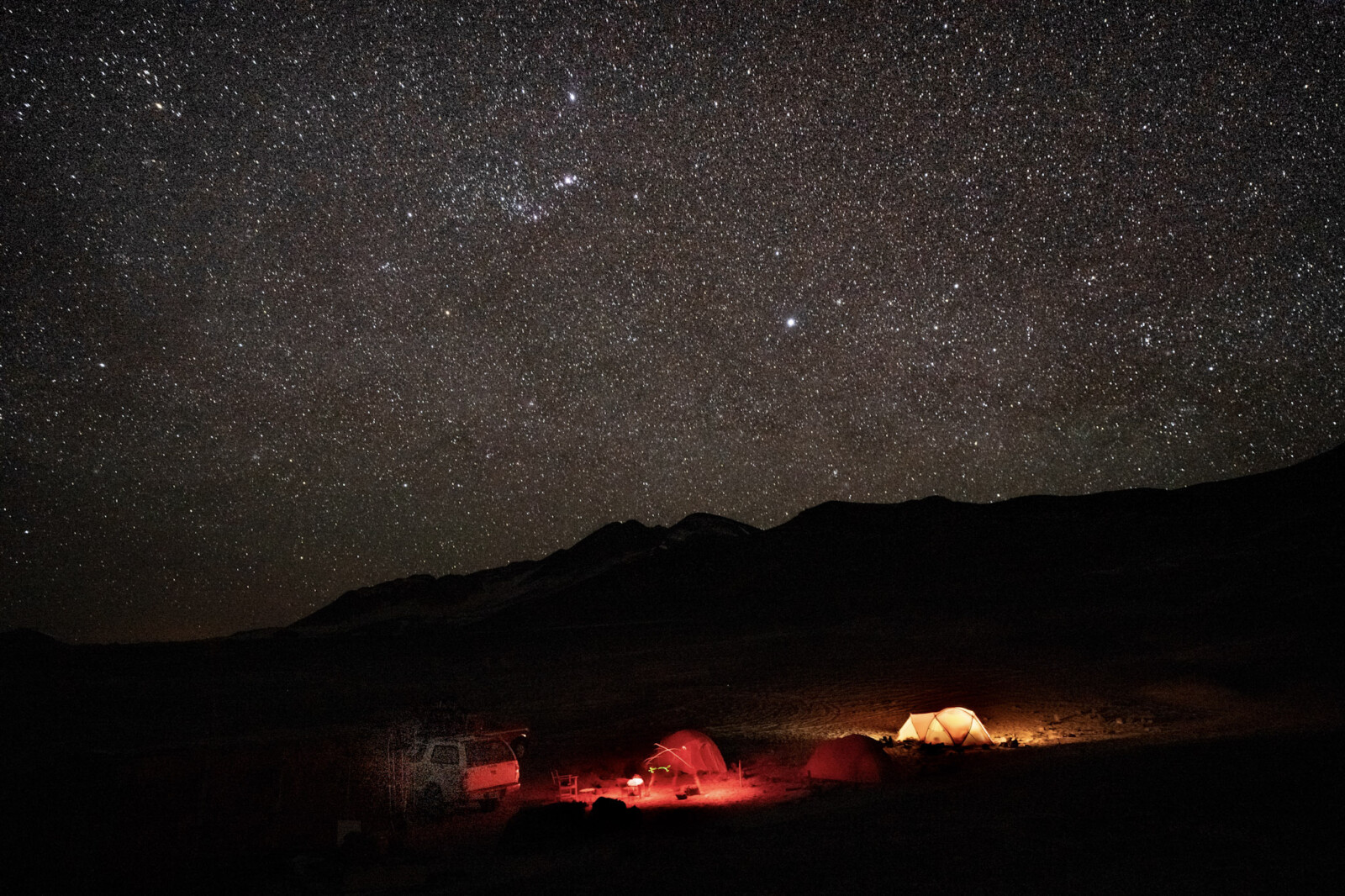
Flamingos on the salares. Ancient marine fossils at 10,000 feet. Natural hot springs at Laguna Verde with snow-capped volcanoes on the skyline. Archaeological sites beside the lagoons. Nights under the Atacama sky, in one of the emptiest landscapes on Earth.
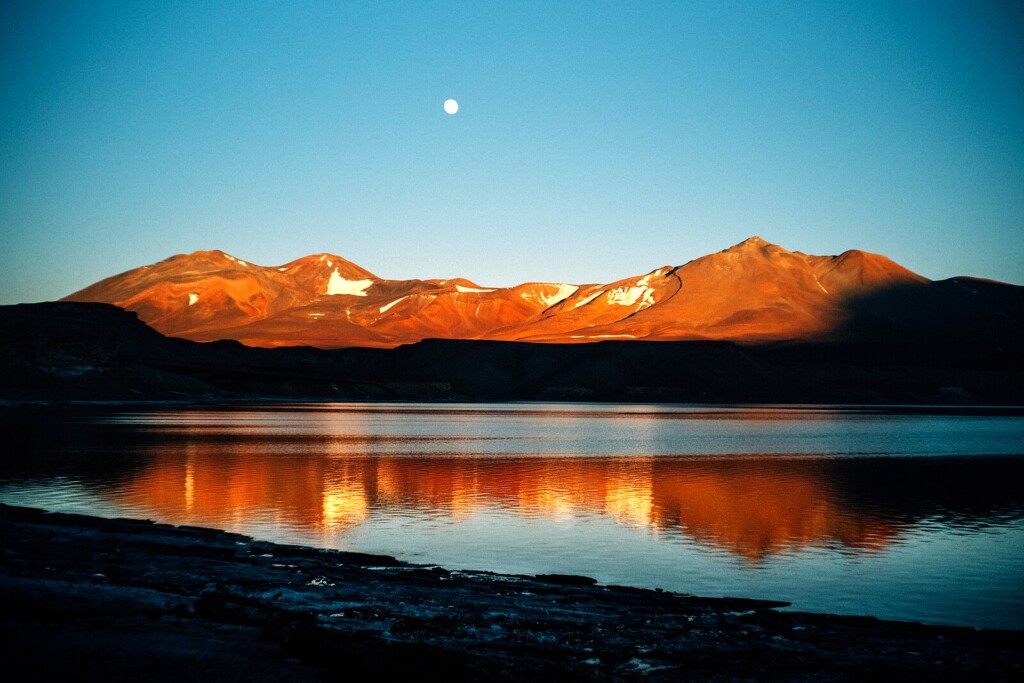
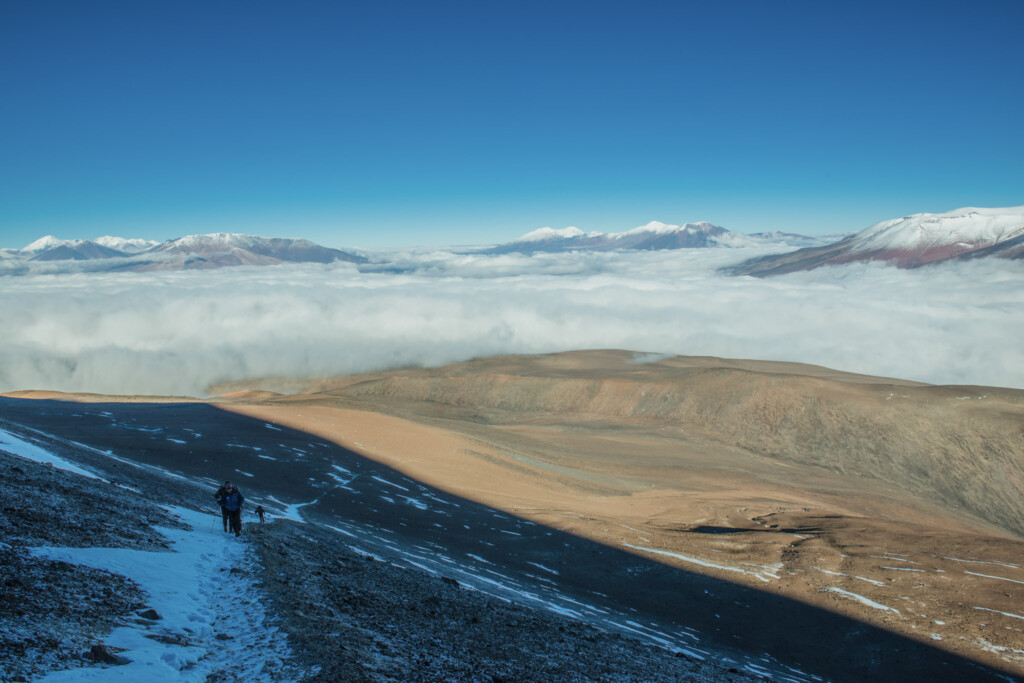
Alpenglow over a high-altitude lagoon in the Atacama, Chile

Who This Climb Suits

This expedition suits climbers with strong fitness who want a serious high-altitude summit without sustained technical climbing.

We strongly recommend prior experience above about 18,000 ft / 5,500 m before Ojos. It is not an absolute requirement, and climbers occasionally arrive without it and do well. But altitude is the hardest thing to predict about yourself, and climbers who already know how their body responds start this trip with a real advantage.

If Ojos would be your first time near 19,700 feet, talk to us early. We would rather help you build toward it than have you find out the hard way. For the full picture, read Is This for Me?

Where Ojos Can Lead

Maybe Ojos is the climb you have been working toward. That is a complete objective on its own.

For climbers with that altitude experience, Ojos is also strong preparation for Aconcagua, Denali or Himalayan objectives. There is no fixed ladder. The useful question afterward is not what the next highest mountain is.

It is: what did Ojos teach you about how you climb at altitude?

Ready for Ojos del Salado?

Tell us what you have climbed, how high you have been, how you train and what you want this expedition to be for you. If Ojos is the right objective, we will say so. If something else should come first, we will say that too.
We don’t simply guide expeditions. We help people build a lifetime in the mountains.

See dates and prices. · climbing@benegasbrothers.com

Ask a guide

Day by Day

Ojos del Salado · The Road to 22,615 Feet · 14 Days · Copiapó to Copiapó

This expedition is built around progressive acclimatization. Rather than driving quickly to the base of Ojos del Salado, we move gradually through the Atacama, sleeping progressively higher and using two acclimatization summits to prepare the body before committing to 22,615 feet.

Duration14 days, Copiapó to Copiapó
SummitsSiete Hermanas 16,010 ft / 4,880 m, Cerro San Francisco 19,744 ft / 6,018 m, Ojos del Salado 22,615 ft / 6,893 m
Highest campRefugio Tejos, 19,110 ft / 5,825 m
Nights2 in the hotel in Copiapó, 11 in mountain camps
Mealsall included

The journey is a major part of the expedition. The schedule is a plan; the mountain is the reality.

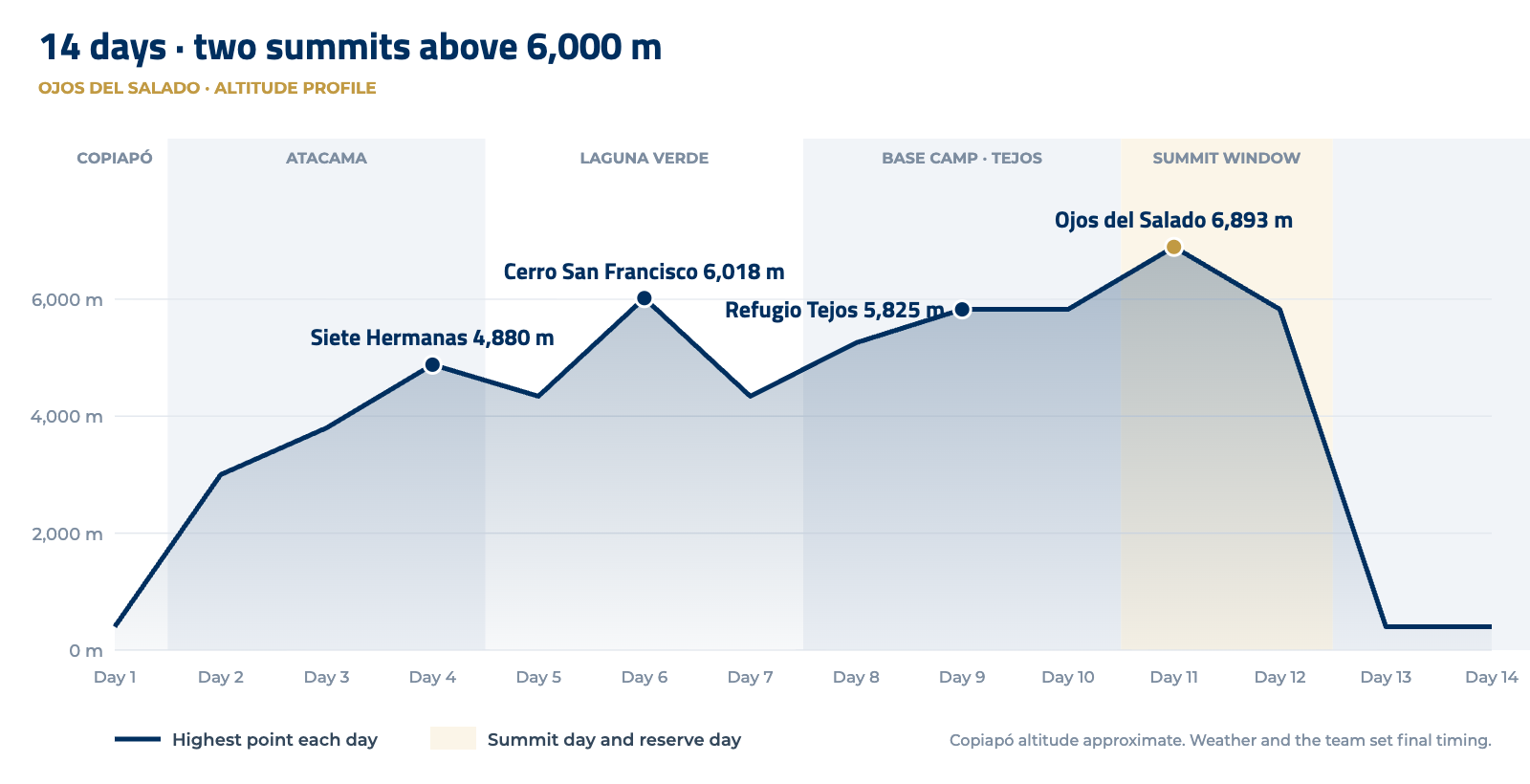
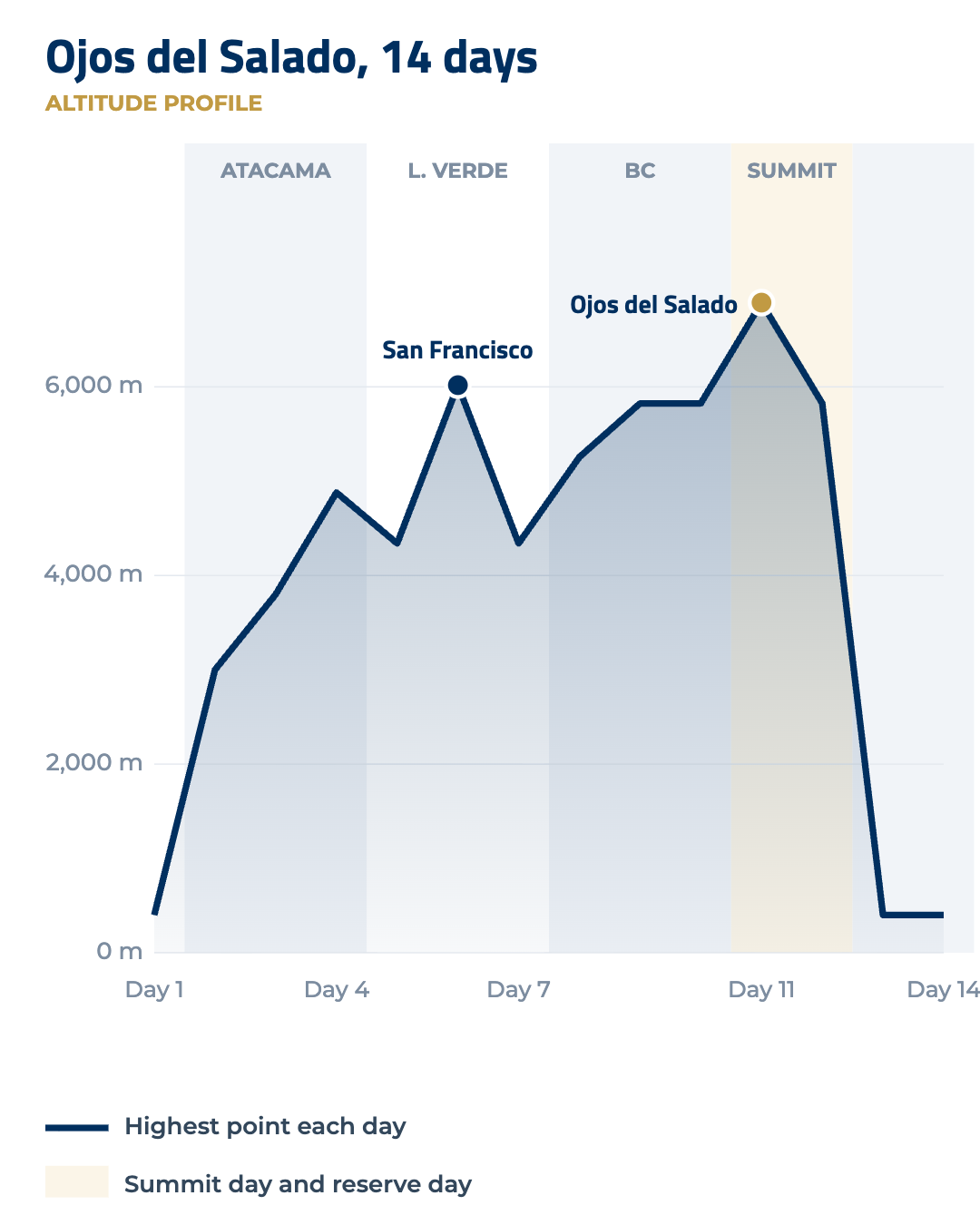
Altitude profile of the 14-day Ojos del Salado expedition: Valle Chico, Laguna Santa Rosa, Siete Hermanas 16,010 ft / 4,880 m, Laguna Verde, Cerro San Francisco 19,744 ft / 6,018 m, Base Camp 17,240 ft / 5,255 m, Refugio Tejos 19,110 ft / 5,825 m and Ojos del Salado 22,615 ft / 6,893 mAltitude profile of the 14-day Ojos del Salado expedition
Highest point reached each day. Day 12 is the summit and weather reserve day.

The 14 Days at a Glance

Each bar shows where you sleep that night. ▲ marks the day’s high point. Tap a day to open it.

In each day below, altitude reads start → high point → where you sleep. Distances and hiking times are estimates.

Climb high, sleep low

Some days climb well above where you sleep. The gap between the day’s high point and the night’s camp is how your body adapts.

Times are estimates

Hiking times change with the team and the conditions. A slow, steady pace is the plan, not a problem.

The plan can flex

Weather, how the team is acclimatizing and your guides’ judgment can change the daily plan. That flexibility is part of the plan.

Good to know

Each day lists its altitudes and where you sleep, plus timing details where we have reliable figures. Times are estimates and change with the team and the conditions. The shape of the progression matters more than the numbers.

Weather, wind, how the team is acclimatizing and your guides’ judgment can all change the daily plan. That flexibility is part of the plan, not a departure from it.

Meals

All meals are included, from your arrival in Copiapó through departure, in town and on the mountain. You pay only for alcohol and personal drinks.

Altitude: Copiapó · Hiking: none

Arrive at Copiapó Airport, where our team meets you and transfers you to the hotel.

In the afternoon we hold the expedition briefing, check equipment, review the climbing plan and make final preparations.

Sleep: Hotel Atacama Suites, Copiapó

Altitude: Copiapó → 10,000 ft / 3,000 m · Travel: 4×4 into the high desert

We leave Copiapó and drive into the Atacama. The first camp goes up in the Valle Chico area.

This is the first night at altitude and the start of acclimatization. Rather than climbing hard straight away, we let the body begin adapting while everyone settles into expedition life.

Sleep: Expedition camp, Valle Chico, 10,000 ft / 3,000 m

Altitude: 10,000 ft → 12,500 ft / 3,800 m

After a morning acclimatization hike, we continue higher by 4×4 toward the Salar de Maricunga.

Laguna Santa Rosa is where the landscape changes: salt flats, high-altitude wetlands, flamingos, volcanic peaks and an enormous open horizon.

Sleep: Expedition camp, Laguna Santa Rosa, 12,500 ft / 3,800 m

Altitude: 12,500 ft → 16,010 ft / 4,880 m → 12,500 ft · High point: Siete Hermanas

The first acclimatization summit and the first real altitude test.

The climb lets your guides see how each climber is responding to elevation: pace, hydration, breathing, layering and recovery. Then we descend to Laguna Santa Rosa for a second night.

Sleep: Laguna Santa Rosa, 12,500 ft / 3,800 m

Altitude: 12,500 ft → 14,240 ft / 4,340 m

We travel deeper into the Andes to Laguna Verde, surrounded by some of the highest volcanoes in the region. It becomes our base for the next phase of acclimatization.

Natural hot springs near camp make Laguna Verde a remarkable place to recover between high-altitude climbs.

Sleep: Laguna Verde camp, 14,240 ft / 4,340 m

Altitude: 14,240 ft → 19,744 ft / 6,018 m → 14,240 ft · High point: Cerro San Francisco

The first major high-altitude objective. After an early start and a 4×4 approach, we climb Cerro San Francisco on the Chile–Argentina border.

For many climbers this is their first summit above 6,000 meters. Reaching 19,744 feet before Ojos is central to the acclimatization strategy, and it tells climbers and guides how each body is performing at extreme altitude.

After the climb we descend all the way back to Laguna Verde.

Sleep: Laguna Verde, 14,240 ft / 4,340 m

Altitude: 14,240 ft / 4,340 m · Hiking: none

Today we rest. And we mean rest.

Eat. Hydrate. Sleep. Use the hot springs. After a climb above 19,700 feet, the smartest thing we can do is let the body recover and adapt. Recovery is part of acclimatization.

Sleep: Laguna Verde, 14,240 ft / 4,340 m

Altitude: 14,240 ft → 17,240 ft / 5,255 m · Travel: 4×4

We leave Laguna Verde and turn off the main route toward Ojos del Salado. The vehicles cross increasingly remote terrain: volcanic sand, rock and sometimes snow-covered tracks. Base Camp goes up near the Atacama Refuge.

This is the start of the real high-altitude phase.

Sleep: Ojos del Salado Base Camp (Atacama Refuge area), 17,240 ft / 5,255 m

Altitude: 17,240 ft → 19,110 ft / 5,825 m → 17,240 ft · High point: Refugio Tejos

From Base Camp up, the team carries all the gear to Tejos: your personal kit plus a share of the group gear. Today we climb toward Refugio Tejos with the first loads for the summit phase, spend time at 19,110 feet, cache the equipment and descend to Base Camp.

Climb high, sleep lower: one more acclimatization stimulus before we move up for good.

Sleep: Base Camp, 17,240 ft / 5,255 m

Altitude: 17,240 ft → 19,110 ft / 5,825 m

We return to Tejos carrying the rest of the gear, personal and group.

The day is deliberately shorter so the team arrives early to hydrate, eat, organize summit gear and rest. Guides review the weather and mountain conditions and finalize the summit plan.

Sleep: Refugio Tejos, 19,110 ft / 5,825 m

Altitude: 19,110 ft → 22,615 ft / 6,893 m → descent · Start: about 3:00 to 5:00 AM · Summit day: about 10–14 hrs

If weather, wind, mountain conditions and team readiness line up, today is the first summit opportunity.

The route climbs steadily through high volcanic terrain. Conditions vary from season to season, from largely dry scree to snow and ice. Near the summit is the final rock and scrambling section, where guides use helmets, harnesses and rope as conditions require.

From the top, the view runs across the Central Andes, the neighboring volcanoes and the summit crater. Then we descend carefully to Tejos, or lower, depending on conditions, timing and how the team is moving.

Sleep: Refugio Tejos or Base Camp, depending on conditions · High point: Ojos del Salado, 22,615 ft / 6,893 m

Altitude: Tejos or Base Camp

This day is built in on purpose.

If weather or wind stopped a safe attempt on Day 11, today is the second opportunity. If the team has already summited, it allows a safer, less rushed descent and recovery before leaving the high mountain.

We do not build an itinerary where one bad weather day automatically ends the summit opportunity.

Sleep: Refugio Tejos or Base Camp, depending on how the day is used

Altitude: descend to Copiapó · Travel: 4×4

We break camp, organize equipment, load the vehicles and begin the long drive down through the Atacama.

After days above 13,000 and 16,000 feet, Copiapó feels like another world. Hot shower. Good food. Real bed.

Sleep: Hotel Atacama Suites, Copiapó

Transfer to Copiapó Airport for flights to Santiago and onward travel. The expedition ends in Copiapó.

Weather and Flexibility

This itinerary is the plan, not a promise. The buffer sits where it matters most: Day 12 is a second summit opportunity, or an unhurried descent if it isn’t needed.

Wind is the deciding factor on Ojos more often than terrain. A calm morning can turn very windy by afternoon, so guides may change departure times, camp moves, acclimatization climbs, summit timing or rest days based on wind, snow, road conditions, team health and the forecast.

Those decisions are made in the field, by the people standing on the mountain, with your safety first and your best summit opportunity second. No one can promise a summit.

For how hard each part feels, read Is This for Me? For the hotel and camps, see Where You’ll Stay. For the daily rhythm, see Life on the Mountain.

Questions About the Itinerary?

Is This for Me?

Ojos del Salado · How Hard Is 22,615 Feet, Really? · An Honest Answer, Not a Sales Pitch

Ojos del Salado is often described as a non-technical high-altitude peak. That description can be misleading.

Most of the standard route does not need advanced technical climbing. But at 22,615 ft / 6,893 m, Ojos is an extremely high mountain.

Altitude changes everything. Walking gets slower. Recovery takes longer. Sleep gets harder. Appetite drops. Staying hydrated becomes constant work. Cold and wind become more serious. Simple decisions take more concentration.

The technical climbing may be moderate. The altitude is not.

Ojos del Salado at a Glance

Technical skillModerate. Hiking and mountaineering on scree, snow and possibly ice, plus a short rock and scrambling section near the summit. Previous crampon experience strongly recommended.
Altitude experienceStrongly recommended above about 18,000 ft / 5,500 m. Not a hard requirement.
SummitsSiete Hermanas 16,010 ft / 4,880 m; Cerro San Francisco 19,744 ft / 6,018 m; Ojos del Salado 22,615 ft / 6,893 m
Longest dayOjos summit day, about 10–14 hours
Coldest conditionsWell below freezing at the higher camps at night, colder in the wind
FamiliesWelcome
Team sizeMaximum six climbers; two guides with a full team, a maximum 3:1 climber-to-guide ratio

What Really Makes Ojos Difficult

The challenge comes from several things working together:

  • Extreme altitude. You spend multiple days above 13,100 ft / 4,000 m and eventually climb to 22,615 feet.
  • Wind and cold. The high Atacama is exposed, and strong wind can change summit day completely.
  • Very dry air. Dehydration happens quickly, often before climbers notice how much fluid they are losing.
  • Poor sleep. Sleeping above 16,400 ft / 5,000 m is rarely comfortable or fully restorative.
  • Long climbing days. Cerro San Francisco and Ojos summit day both ask for sustained effort at serious altitude.
  • Cumulative fatigue. The expedition gets harder gradually. Recovery and discipline matter as much as raw fitness.

This is why we do not rush the itinerary. It is built to give your body time to adapt.

Do I Need Technical Climbing Experience?

You do not need to be an advanced technical climber.

Most of the route is hiking and mountaineering over volcanic terrain, scree, snow and possibly ice, depending on conditions. Near the summit of Ojos there is a short rock and scrambling section. Guides may use helmets, harnesses, ropes and fixed or protected systems, depending on conditions.

You should be comfortable moving on uneven mountain terrain and following guide instructions efficiently. Previous crampon experience is strongly recommended.

How Fit Do I Need to Be?

You need strong cardiovascular endurance. A good Ojos candidate can hike 6 to 10 hours in mountain terrain and repeat significant efforts over consecutive days.

Your training should focus on:

  • Long uphill hiking
  • Cardiovascular endurance
  • Leg and core strength
  • Carrying a moderate pack
  • Back-to-back training days
  • Recovery between hard efforts

A useful benchmark: climb roughly 3,000 vertical feet / 900 m with a 30–40 lb pack at a controlled pace, and feel able to do another significant mountain day afterward.

You do not need to be fast. You need to be consistent.

Altitude Experience: Strongly Recommended

We strongly recommend previous experience above about 18,000 ft / 5,500 m before Ojos. It is not a hard requirement, and climbers occasionally arrive without it and do well. But altitude is the hardest thing to predict about yourself, and climbers who already know how their body responds start with a real advantage.

Good preparation includes Kilimanjaro, the Ecuador volcanoes, Mexico’s volcanoes, a climbing trip in Bolivia, Mount Elbrus, high-altitude trekking above 14,800–16,400 ft / 4,500–5,000 m, or previous expedition climbing. Aconcagua experience is excellent preparation but is not necessary.

For many climbers, Ojos is the logical step after Kilimanjaro or Ecuador, and before objectives such as Aconcagua, Denali or the Himalaya.

If you have never been to real altitude, talk to us early. We would rather have that conversation now than at 19,000 feet.

Your First Test Above 19,700 Feet

On this itinerary, Ojos is not your first time above 6,000 meters.

Before Ojos, we climb Cerro San Francisco at 19,744 ft / 6,018 m. For many climbers it is their first summit at that height. It shows you how your body performs at extreme altitude, and it gives your guides the information that matters: your pace, appetite, hydration, cold management, recovery and clarity of thinking.

After San Francisco we descend to Laguna Verde and recover before moving toward Ojos. That progression is intentional.

Expedition Life

Fitness alone is not enough. You should also be comfortable with:

  • Multiple nights in tents (11 of the 13 nights are in mountain camps)
  • Cold mornings and nights
  • Long stretches without normal comforts
  • Limited communication
  • Changing weather and changing plans
  • Early starts
  • Living and traveling closely with a small team
  • Taking responsibility for your own equipment and personal organization

4×4 vehicles carry the expedition’s loads as far as Base Camp. There are no porters or pack animals: from Base Camp up, the team carries all the gear to Tejos, your personal kit plus a share of the group gear. The vehicles make camp more comfortable than on many high-altitude climbs, but it does not remove the demands of altitude.

Once we move to Base Camp and Tejos, you are living at elevations where the body slowly deteriorates over time. Efficiency matters.

Small Teams Make a Difference

Every scheduled departure is capped at six climbers. With a full team we run two guides, a maximum 3:1 climber-to-guide ratio.

That matters most at altitude. Guides can watch each climber closely: pace, recovery, appetite, hydration, altitude symptoms and decision-making. Problems are easier to catch early, and pacing and strategy can be adjusted around actual people.

Small teams are not an upgrade at Benegas Brothers. They are how we operate.

Patience and Following Guide Decisions

Your guides make the calls that shape the climb: when to move, when to wait out the wind, whether to use the reserve day, and when to turn around.

When a turnaround is the right call, it is made early and clearly, with your safety first. It is a professional decision, not a failure. This expedition only works if you are willing to accept it.

Is This the Right Climb for You?

Ojos del Salado is a strong fit for:

  • Kilimanjaro graduates ready for a much higher and more serious mountain
  • Experienced trekkers moving into expedition mountaineering
  • Seven Summits climbers pursuing the Volcanic Seven Summits or building toward Aconcagua
  • Aspiring Himalayan climbers who want to learn how their body performs above 19,700 feet
  • Climbers who value the journey and want a real expedition through the Atacama, not simply fast transport to a summit attempt

You may need more preparation first if you:

  • Have little or no mountain hiking experience
  • Have never spent multiple days camping
  • Struggle with long uphill endurance days
  • Are uncomfortable with cold or difficult weather
  • Have never been to altitude and are unsure how your body responds

None of these automatically rules you out. But they may mean another trip should come first.

Two more things to be clear about before you book:

  • Health. If you have a heart, lung or other medical condition, talk to your physician about high altitude before you commit. No medical certificate is required. Every climber completes a Registration Form as part of booking.
  • Age. Chile’s high-mountain tourism standard sets age limits by altitude, and under the current standard the summit of Ojos (22,615 ft / 6,893 m) is for climbers 18 and over; climbers under 18 come with a parent or guardian, and we’ll confirm the current rule for your dates. Families are welcome, and if someone in your family is under 18, we’ll plan an objective that fits the rules.

Not Ready Yet, or Not the Right Fit?

If Ojos is a stretch right now, that is honest information, not a rejection.

Come back to Ojos ready, and the experience will be completely different.

Still Deciding?

We review every climber individually. Our goal is not to fill an expedition. It is to put the right people on the right mountain at the right time.

Tell us what you have climbed, how high you have been and how you train. If you are ready, we will tell you. If you need another step first, we will tell you that too.

Before You Go

Ojos del Salado · Before You Go

Preparing for Ojos del Salado: Start Here

The climbers who arrive in Copiapó relaxed aren’t always the ones with the most altitude experience. They’re the ones who sent their passport details for the border-zone permit early, sorted their rescue coverage, and tested their boots and sleeping system months ago. This page puts your preparation in order: what to do, when, and where to find the details. Handle it early, and your energy in the final weeks goes into training, not logistics.

Three Things to Know Now

Your border-zone permit has a deadline.20 days

Ojos del Salado sits on the Chile–Argentina border, so every climber needs DIFROL authorization from the Chilean government. BBE handles your DIFROL border-zone authorization. It’s free. We need your passport details early, at booking, because DIFROL requires the application at least 20 days before you enter Chile. Your Expedition Checklist has the detail.

Rescue and evacuation coverage is required.Required

It must cover high-altitude mountaineering to at least 7,000 m / 23,000 ft (above the 22,615 ft summit) and remote ground evacuation. You can buy it any time, but it must be in place before departure. We recommend Global Rescue (add its High-Altitude Evacuation Package) or Ripcord. On Ojos, an evacuation usually begins with hours of 4×4 driving across the desert, not a helicopter.

There is no banking past Copiapó.$800–1,200

Once we drive into the Atacama there are no ATMs and almost no commercial services. Plan on about $800–1,200 in cash, mostly Chilean pesos drawn in Copiapó, plus small US bills, for tips and small expenses.

Your Seven Preparation Guides

Your Preparation Timeline

When you book

  • Through the registration link we email you, complete the reservation form and pay your deposit by the invoice we send; then complete the Registration Form (profile, emergency contacts, medical history, climbing and altitude experience), passport copy, Terms & Conditions and Release
  • Check your passport: valid for your whole stay with at least one blank page. We recommend six months’ validity beyond your return date
  • Start or continue structured training. See Is This for Me?
  • Read the gear list now, and give your boots and crampons time to be fitted and tested together

Any time before departure

  • Buy your rescue and evacuation coverage, and trip insurance. You can buy it any time, but it must be in place before departure
  • Email your rescue and evacuation certificate to climbing@benegasbrothers.com

120 days before departure

  • Your balance is due. (Reservations made within 120 days of departure require full payment at booking.)

Once you’ve paid in full

  • Book your flights to Santiago and on to Copiapó, landing on Day 1 by early afternoon, or a day early if you can. Email your itinerary to climbing@benegasbrothers.com so we can arrange your airport pickup
  • Talk to your physician about altitude, altitude medication and any medical conditions

Your DIFROL deadline

  • Send us your passport details so we can file your DIFROL authorization. We ask for them at booking, with your registration forms: DIFROL requires the application at least 20 days before you enter Chile, and there is no fast track if it’s late

At least 3 weeks before

  • Tell us about any gear you plan to rent, and finish breaking in your boots
  • Check the baggage allowance on your Santiago–Copiapó ticket

The final 2 weeks

  • Save the copy of your DIFROL authorization we send you
  • Do a full pack-out using the gear list, and weigh your bags
  • Plan your cash: about $800–1,200, mostly Chilean pesos drawn in Copiapó, plus small US bills
  • Save copies of your passport, DIFROL authorization, insurance and itinerary to your phone and the cloud
  • Ease off your training. Arrive rested, not worn out

Arrival day

Carry your passport, DIFROL authorization, insurance documents, medications and boots in your carry-on. A BBE representative meets you at Copiapó’s Desierto de Atacama Airport and takes you to Hotel Atacama Suites. That afternoon we hold the expedition briefing and check your gear. From then on, logistics are our job. Yours is climbing.

Still Deciding?

This section assumes you’re going. If you’re still working out whether Ojos del Salado is right for you this season, whether your altitude experience is where it needs to be, or how you’ll handle eleven nights in camp and nights at 19,110 ft, start with Is This for Me? and Your Questions. Day by Day shows how the fourteen days build, including the summit and weather reserve day.

If Ojos isn’t the right fit yet, Aconcagua, the Ecuador Mountaineering School and Mexico Volcanoes are worth a look. If you already have high-altitude experience and less time, ask about Ojos del Salado Express. For different dates or your own team, see Private & Custom Expeditions.

Questions While You Prepare?

Gear choices, training doubts, insurance fine print, your permit details, flight timing: ask early. A question answered at home is easy. The same question at 19,000 ft is not. See dates and prices. · climbing@benegasbrothers.com

Ask a guide

Your Expedition Checklist

The climbers who arrive in Copiapó relaxed are the ones who handled the paperwork months ago, not weeks. None of it is complicated, but a few pieces take time, and one of them, your DIFROL border-zone permit, has a hard deadline set by the Chilean government. This page lists everything BBE needs from you, what you arrange yourself, and when.

Your Paperwork at a Glance

Everything BBE needs from you, in the order you’ll do it. Tick items off as you go; your ticks are saved on this device. The details for each item are below.

Step 1At booking, in the registration formDone together with your deposit

Step 2Buy, then send to BBEEmail climbing@benegasbrothers.com

Step 3Arrange and carryNeeded on the trip

At Booking

How booking works. When you ask about the expedition, we reply by email with the trip details and a link to our online registration form. Everything in this section is done there.

Reservation form. Your full name, email, date of birth and address, plus any notes for our program staff about your reservation.

Deposit. The reservation form includes a link to pay your deposit. Your place is confirmed once BBE receives it. Amounts and deadlines are on Dates & Prices.

Complete at Booking

Registration Form. Your personal profile, emergency contacts, medical history, and climbing and altitude experience. Medical information stays within the guiding team and is used to plan for your safety. Be thorough and honest. A condition we know about can usually be planned for; one we discover during an emergency at 19,000 ft is much harder to manage.

Passport. A copy of your passport photo page. We also use your passport details to file your DIFROL authorization, so we need them at booking.

Terms & Conditions. BBE’s booking, payment and cancellation terms. Read them before you sign.

Release. A liability release acknowledging the inherent risks of high-altitude mountaineering in a remote area. Read it carefully. It means what it says.

When: complete these in the registration form at booking, with your deposit.

Send us later. As soon as you have them, email climbing@benegasbrothers.com your flight itinerary (we use it to arrange your airport pickup in Copiapó) and your rescue and evacuation insurance certificate. You can buy it any time, but it must be in place before departure.

Balance payment. Due 120 days before departure. Reservations made within 120 days of departure require full payment at booking.

Your DIFROL Border-Zone Permit

Ojos del Salado sits directly on the Chile–Argentina border. Chile requires anyone who is not a resident to hold authorization from DIFROL, the Dirección Nacional de Fronteras y Límites del Estado, before mountaineering in a border zone. BBE handles your DIFROL border-zone authorization. It’s free. We need your passport details early, at booking, because DIFROL requires the application at least 20 days before you enter Chile.

BBE files it for you. It is a personal authorization tied to your passport, submitted through DIFROL’s online Expedition Authorization System. We prepare and submit the application using the details you give us at booking.

It is free. DIFROL charges nothing for the authorization. If you see a fee quoted elsewhere online, it is not DIFROL’s.

Send your passport details at booking. DIFROL’s stated minimum is 20 days before you enter Chile, and there is no fast track if the application is late. Having your details early lets us file well ahead of that.

What we need from you:

  • Your full name, nationality and passport number, exactly as in your passport
  • Your travel dates into and out of Chile (we add the itinerary, peaks and locations)
  • Your contact details and email
  • An emergency contact in your home country

DIFROL may require at least two people on an expedition, which this team satisfies. It may also require emergency rescue insurance, which we require anyway.

On arrival in the region, the team checks in with Carabineros de Chile, who verify permits and give local safety guidance. Your guides handle that step. When we send you your authorization, check that your name and passport number match your passport exactly.

Requirements and processing times are set by the Chilean government and can change. We confirm the current process for every departure, so work from what we send you rather than older information online.

Entry to Chile

US citizens don’t need a visa for a tourist stay. If you hold another passport, check your own requirements before you book flights. Chile enforces agricultural controls strictly: declare all food on arrival, including expedition snacks. Flights & Getting to Copiapó has the full detail.

Health Preparation

See your physician. Ojos del Salado reaches 22,615 ft / 6,893 m, a serious physiological environment. If you have a cardiovascular, respiratory, circulatory, neurological or other significant condition, discuss this expedition with your physician well before departure, and be open about it on your Registration Form. No medical certificate is required.

Altitude medication. If you are considering medication to help with altitude, talk to your physician well before departure. It is a decision for you and your doctor, not for us. Don’t take a new medication for the first time on the expedition unless a qualified medical professional directs it.

Prescription medications. Bring everything you take, for the full trip plus several extra days, in your carry-on, in original labeled containers where practical.

Vaccinations. Your routine immunizations should be current. Travel-health advice depends on your health, your vaccination history and any other countries you visit, so ask your physician or a travel clinic.

First aid. Bring a small personal kit: blister care, pain medication you normally use, stomach medication, sunscreen and SPF lip balm. The guide team carries an expedition medical kit and emergency systems.

Gear and Rentals

Read the gear list early. Boots and crampons need to be fitted and tested together at home, and that takes time. Nothing should be used for the first time at Refugio Tejos.

Rentals. Copiapó is a mining city, not a mountaineering center. Some equipment can be rented, but don’t plan to rent your high-altitude system on arrival. Tell us at least three weeks before departure about anything you want to rent.

Boots. Bring your own, properly fitted and broken in. They are the one item you can’t improvise.

Travel

Passport. Valid for your whole stay in Chile with at least one blank page. We recommend six months’ validity beyond your return date, which many airlines and connecting countries expect.

Flights. Book your flights to Santiago and on to Copiapó once your place is confirmed and you’ve paid in full. Land in Copiapó on Day 1 by early afternoon, or a day early if you can, and book your flight home for Day 14 or later. Favor changeable fares.

The Final Two Weeks

  • Save the copy of your DIFROL authorization we send you
  • Do a full pack-out using the gear list, and weigh your bags against your Santiago–Copiapó allowance
  • Plan your cash: about $800–1,200, mostly Chilean pesos drawn in Copiapó, plus small US bills. There are no ATMs once we leave Copiapó (see What to Budget For)
  • Check that your crampons still fit your boots, and that crampons, ice axe and poles are in checked luggage
  • Ease off your training. Arrive rested, not worn out
  • Save copies of your passport, DIFROL authorization, insurance certificate and itinerary to your phone and a cloud account, and carry paper copies separate from the originals

Bring With You to Chile

  • Passport, and any entry record you’re given on arrival, kept together until you leave Chile
  • Your DIFROL authorization
  • Printed flight itinerary, and our contact and emergency numbers
  • Rescue and evacuation insurance certificate and your insurer’s 24-hour emergency number
  • Written list of emergency contacts and relevant medical information
  • Prescription medications and copies of prescriptions
  • Two payment cards that work abroad, stored separately

Arrival Day

A BBE representative meets you at Copiapó’s Desierto de Atacama Airport and takes you to Hotel Atacama Suites. That afternoon the team holds the expedition briefing and checks your gear. Copiapó is the last practical place to solve an equipment problem, so bring anything doubtful to that check. From then on, logistics are our job. Yours is climbing.

Questions? Paperwork is the least interesting and most fixable part of expedition preparation. Ask early, especially about the passport details we need for your permit.

Ask a guide · Back to Before You Go · climbing@benegasbrothers.com

Trip Insurance & Evacuation Coverage

Ojos del Salado reaches 22,615 ft / 6,893 m in one of the most remote regions of Chile. Many travel-insurance policies exclude mountaineering or cap coverage well below that, and the exclusion is usually buried in the fine print. This page explains the two kinds of cover, which one is required, and how to confirm yours before you pay.

Required by BBERescue and evacuation coverage

Required on every BBE international expedition. It pays to get you off the mountain and to proper medical care. The coverage it must include for this trip is listed below.

Strongly recommendedTrip insurance

Protects the money you’ve spent if illness, a family emergency or a travel disruption stops or cuts short your trip.

Rescue and Evacuation Coverage: Required

Every climber on this expedition must carry rescue and medical evacuation coverage, with proof on file with BBE before departure. It pays for rescue, emergency treatment and transport to medical care if you’re injured or ill in the mountains. Without it, you are responsible for every cost of your own evacuation and treatment, and your standard health insurance almost certainly won’t cover international mountain rescue. DIFROL’s own terms also make clear that climbers in the border zone assume the risks and costs of rescue.

Your policy must cover all of the following:

  • Altitude: high-altitude mountaineering to at least 7,000 m / 23,000 ft (above the 22,615 ft summit).
  • Activity: mountaineering with crampons, ice axe, helmet and harness, including a short roped scramble near the summit, with no activity exclusion.
  • Remote ground evacuation: rescue and evacuation from remote desert and mountain terrain, including transport by 4×4 vehicle over long distances to medical care.
  • Field rescue: from Base Camp at 17,240 ft / 5,255 m, Refugio Tejos at 19,110 ft / 5,825 m and the summit route.
  • Air evacuation where it is operationally possible.
  • Destination: Chile, for your full travel dates.
  • Medical care and transport: hospital treatment in Chile and medical transport to an appropriate facility, including international medical transport and repatriation if needed.
  • 24-hour emergency assistance.

Don’t assume a policy sold as adventure travel insurance covers Ojos del Salado. Read the altitude limit and the activity exclusions, not the brochure.

We recommend Global Rescue or Ripcord. With Global Rescue, add the High-Altitude Evacuation Package; standard membership covers field rescue only to 15,000 ft / 4,600 m, and Base Camp, Refugio Tejos and the summit are all above that. Whichever you choose, confirm the plan covers evacuation to at least 7,000 m / 23,000 ft (above the 22,615 ft summit), by helicopter where one can fly and by ground across remote terrain.

Trip Insurance: Strongly Recommended

Trip insurance is not required, but we strongly recommend it. It covers trip cancellation, interruption, flight delays and missed connections, lost or delayed baggage, travel medical costs and extra accommodation caused by disruption. Baggage cover matters more than usual here: you’re flying with expedition gear through a domestic connection in Santiago.

BBE’s cancellation terms are based on how much notice you give, and refunds are not given for illness, injury, altitude illness, missed flights, weather delays or a summit not reached (see Dates & Prices). In many of those situations, trip insurance is the only way to recover your costs.

Rescue cover and trip insurance are often sold separately, and buying one doesn’t give you the other.

When to Buy

You can buy it any time, but it must be in place before departure.

One thing to check: some trip-insurance benefits, such as pre-existing-condition waivers and Cancel for Any Reason options, are only offered if you buy within a set time after your first trip payment. If those matter to you, check your provider’s rule.

What to Confirm With Your Insurer

Before you buy, give the provider this description:

“I will take part in a professionally guided mountaineering expedition to Ojos del Salado in the Atacama region of Chile, on the Chile–Argentina border. The itinerary includes 4×4 travel through remote high desert, an acclimatization climb of Cerro San Francisco to 19,744 ft / 6,018 m, nights in tented camps up to 19,110 ft / 5,825 m, and a summit attempt on Ojos del Salado at 22,615 ft / 6,893 m, including a short roped rock scramble with helmet and harness near the summit.”

Then ask them to confirm in writing:

  • The maximum altitude covered, and that it is at least 7,000 m / 23,000 ft (above the 22,615 ft summit)
  • That mountaineering is not excluded
  • That ground evacuation from a remote area, including long-distance 4×4 transport, is covered
  • If you use Global Rescue, that the High-Altitude Evacuation Package is on your membership for your travel dates
  • The coverage limits for evacuation and for medical treatment
  • How to reach their emergency assistance line from Chile, and whether you must call before an evacuation
  • Whether pre-existing conditions are covered

If they won’t clearly confirm those points, choose another policy.

What to Send BBE

Email your rescue and evacuation certificate to climbing@benegasbrothers.com as soon as you buy it. It should show the provider, policy or membership number, coverage dates and the 24-hour emergency number. Your guide carries these details on the mountain. Keep a copy on your phone, a paper copy in your pack, and the details accessible offline.

BBE doesn’t sell insurance and can’t interpret or guarantee an individual policy.

What Evacuation Actually Involves

Much of this expedition takes place in remote high desert reached only by 4×4. Help is a long way off, and that is why rescue coverage is required.

If a climber becomes sick or injured, the guide team assesses the situation and decides on the safest practical response. That can include first aid and stabilization, stopping the climb, an assisted descent with a guide, contacting your insurer’s assistance line, and arranging transport to medical care. Descent is the treatment for altitude illness, and a climber who needs to go down always goes with a guide.

In practice, an evacuation from Ojos usually means:

  • Descending from altitude on foot to vehicle-accessible terrain
  • Several hours of 4×4 travel over rough desert roads
  • Transfer to medical care in Copiapó
  • Further air or international medical transport, if needed

Don’t plan around a helicopter. Air evacuation may be possible in some situations, but altitude, wind, weather and aircraft availability all limit it, and the first part of any evacuation here happens on the ground. Your coverage has to support the whole chain, not just advertise helicopter cover.

BBE doesn’t control rescue services, aircraft, hospitals or insurance decisions, and a policy doesn’t guarantee that a rescue can happen or that every cost will be paid. What good coverage does is take cost out of the decision and get you to proper care once you’re off the mountain.

Your financial responsibility. Transport providers and hospitals may ask for payment before they act, even when you’re insured. Travel with a credit card with real available credit, and keep your policy number, emergency number and claim instructions saved offline. Any cost your insurance doesn’t pay remains yours.

Questions About Your Policy? Send us what your insurer told you, and we’ll tell you if anything looks missing. We can’t approve a policy for you, but we can point out the gaps we see most often.

Ask a guide · Back to Before You Go · climbing@benegasbrothers.com

Flights & Getting to Copiapó

The expedition begins and ends in Copiapó, the gateway to the high Atacama. Most climbers fly first to Santiago, then connect north on a domestic flight. The travel itself is straightforward, but you’re carrying expedition gear through a domestic connection, and a missed flight or a delayed bag matters more here than on a normal trip. The guidance below heads most of that off.

Before You Book

A departure is confirmed when we tell you so in writing. Please buy nonrefundable flights only after your departure is confirmed. Book your flights once your place is confirmed and you’ve paid in full. If you’re unsure about timing, send us your proposed itinerary before you buy. Favor refundable or changeable fares, and book with your full legal name exactly as it appears in your passport.

Once your flights are booked, email the full itinerary to climbing@benegasbrothers.com. We use it to arrange your airport pickup.

Flying to Santiago

Most climbers from North America, Europe and elsewhere arrive at Santiago’s Arturo Merino Benítez International Airport, airport code SCL, Chile’s main international gateway. From there you connect on a domestic flight north to Copiapó.

Santiago to Copiapó

Your expedition arrival airport is Copiapó’s Desierto de Atacama Airport, airport code CPO. The domestic flight takes about 1 hour 20 minutes, and several flights normally operate each day. Schedules and airlines change, so check current flights for your dates.

Allow at least 3–4 hours in Santiago between an international arrival and the flight to Copiapó, and more if the two are on separate tickets. You may need to clear immigration, collect your bags, pass customs and agricultural inspection, recheck your luggage and get to the domestic departure area, all with expedition baggage.

One ticket or two? Booking the international and domestic legs on one itinerary means the airline rebooks you if the first leg runs late. On separate tickets, expect to collect and recheck your bags, allow a longer connection, and know that one airline may not protect you if another causes a missed connection. Cheap airfare is not a bargain if it costs you the start of the expedition.

When to Arrive

Land in Copiapó on Day 1, preferably by early afternoon. Day 1 includes hotel check-in, the expedition briefing, the gear check and the team meeting.

We strongly recommend arriving a day early. An extra night buffers international delays, missed connections, delayed baggage, equipment problems and travel fatigue. For a remote expedition, it is inexpensive insurance. Contact us and we’ll help arrange the extra night, at your cost.

Some climbers also spend a night in Santiago before flying north, which helps if your international flight lands late or you want time to recover from the journey. Santiago lodging isn’t included unless specifically arranged.

Booking Your Flight Home

Book your departure from Copiapó for Day 14 or later. Don’t book a tight same-day international connection out of Santiago: the expedition has a summit and weather reserve day, and mountain timing can still vary.

Transfers in Chile: Included

A BBE representative meets you at Copiapó airport on Day 1 and takes you to Hotel Atacama Suites. From there, BBE handles all scheduled transport: hotel and airport transfers per the itinerary, every 4×4 day through the Atacama, moves between camps and climbing objectives, and the return to Copiapó and the airport on Day 14. You don’t need to arrange any transport during the expedition.

Transfers outside the itinerary, such as an early arrival or a later flight home, are additional arrangements. Ask us and we’ll set them up.

Your Passport

Chile requires your passport to be valid on entry and for your whole stay, with at least one blank page. We recommend six months’ validity beyond your return date anyway: it costs nothing and avoids problems with airlines and connecting countries.

Entering Chile

No visa for US citizens on a tourist stay. You’re admitted for up to 90 days, far longer than this expedition. If you hold another passport, or travel on a diplomatic or official passport, check your requirements before you book flights. Requirements vary by nationality and can change.

Your entry record. Chile’s immigration police record your entry on arrival. Keep any entry slip or record you’re given with your passport until you leave the country.

Declare your food. Chile’s agricultural service (SAG) enforces strict controls at the border. Declare all animal and plant products on arrival. Expedition food is exactly what gets flagged: jerky, cheese, fresh fruit, nuts and seeds, homemade trail food. Bring sealed, packaged snacks. When in doubt, declare it. Declaring costs you a minute; failing to declare can cost a fine.

Carry your DIFROL authorization with your passport. BBE handles your DIFROL border-zone authorization. It’s free. We need your passport details early, at booking, because DIFROL requires the application at least 20 days before you enter Chile. Your Expedition Checklist has the detail.

Baggage

Most climbers travel with a large expedition duffel, a smaller second bag, a carry-on and a personal pack.

  • Your expedition duffel holds everything for the mountain. It rides in the 4×4 vehicles from Copiapó to the camps.
  • Your second bag holds travel clothes and stays at the hotel in Copiapó while you’re in the Atacama.

Check your domestic allowance. Allowances on the Santiago–Copiapó leg may be lower than on your international ticket, and budget fares often include no checked bag. Check the policy on every leg before you buy, and pre-pay extra bags where you can.

Checked bags only: crampons, ice axe, trekking poles, knives and multi-tools. Cover crampon points and secure the pick and adze of your axe.

Don’t pack fuel. It can’t fly, and it is supplied locally as part of expedition logistics.

What goes in your carry-on:

  • Passport, DIFROL authorization and flight itinerary
  • Your rescue and evacuation insurance certificate
  • Wallet, phone and essential electronics
  • Prescription medications
  • One warm layer, and glacier glasses if you can
  • Your mountaineering boots, if you can manage them
BBE tip

Put a tracking tag in each checked bag. Expedition duffels all look alike, and a tracker tells you straight away whether your bag made the connection in Santiago. If a checked bag is delayed, you should still be able to function for the first day.

Money and Phones

Chile’s currency is the Chilean peso (CLP). Cards are widely accepted in Santiago and Copiapó, and Visa and Mastercard are the most useful. ATMs and currency services are available in both cities. There is no banking of any kind once we leave Copiapó, so sort out your cash there: about $800–1,200, mostly Chilean pesos, plus small US bills. What to Budget For explains the breakdown.

Santiago and Copiapó have normal cell and internet service. Check your carrier’s Chile roaming plan before you leave; a local SIM or eSIM helps in town but won’t help in the Atacama, where coverage ends. Life on the Mountain explains Starlink in camp.

If Something Goes Wrong

Flight delayed, cancelled or connection missed. Contact us right away at climbing@benegasbrothers.com, before you rebook if you can. We’ll work out the fastest way to get you to the team. Extra hotel nights, transfers and flight changes caused by travel disruption are your cost. This is where trip insurance earns its price.

Bag delayed. Report it to the airline before you leave the airport, then tell us. Copiapó is the last practical place to solve an equipment problem before we drive into the Atacama.

Travel problems are solvable. Late information is what makes them expensive.

Questions Before You Book? A quick email now saves rebooking fees later. Keep it simple, build in margin, and arrive rested.

Ask a guide · Back to Before You Go · climbing@benegasbrothers.com

Where You'll Stay

Recovery happens where you sleep. Warmth, food and rest between big days are what add up to a strong summit day. On this expedition you spend two nights at Hotel Atacama Suites in Copiapó, one at each end, and eleven nights in our 4×4-supported camps, rising from Valle Chico at 10,000 ft / 3,000 m to Refugio Tejos at 19,110 ft / 5,825 m. The higher we go, the simpler life becomes, and that progression is part of the expedition.

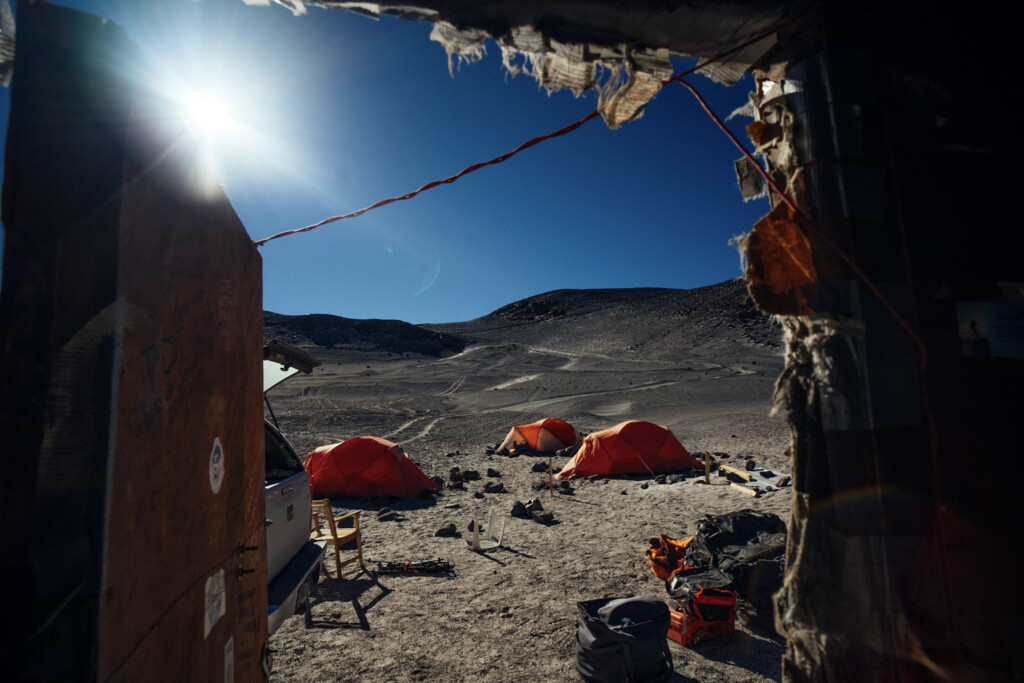
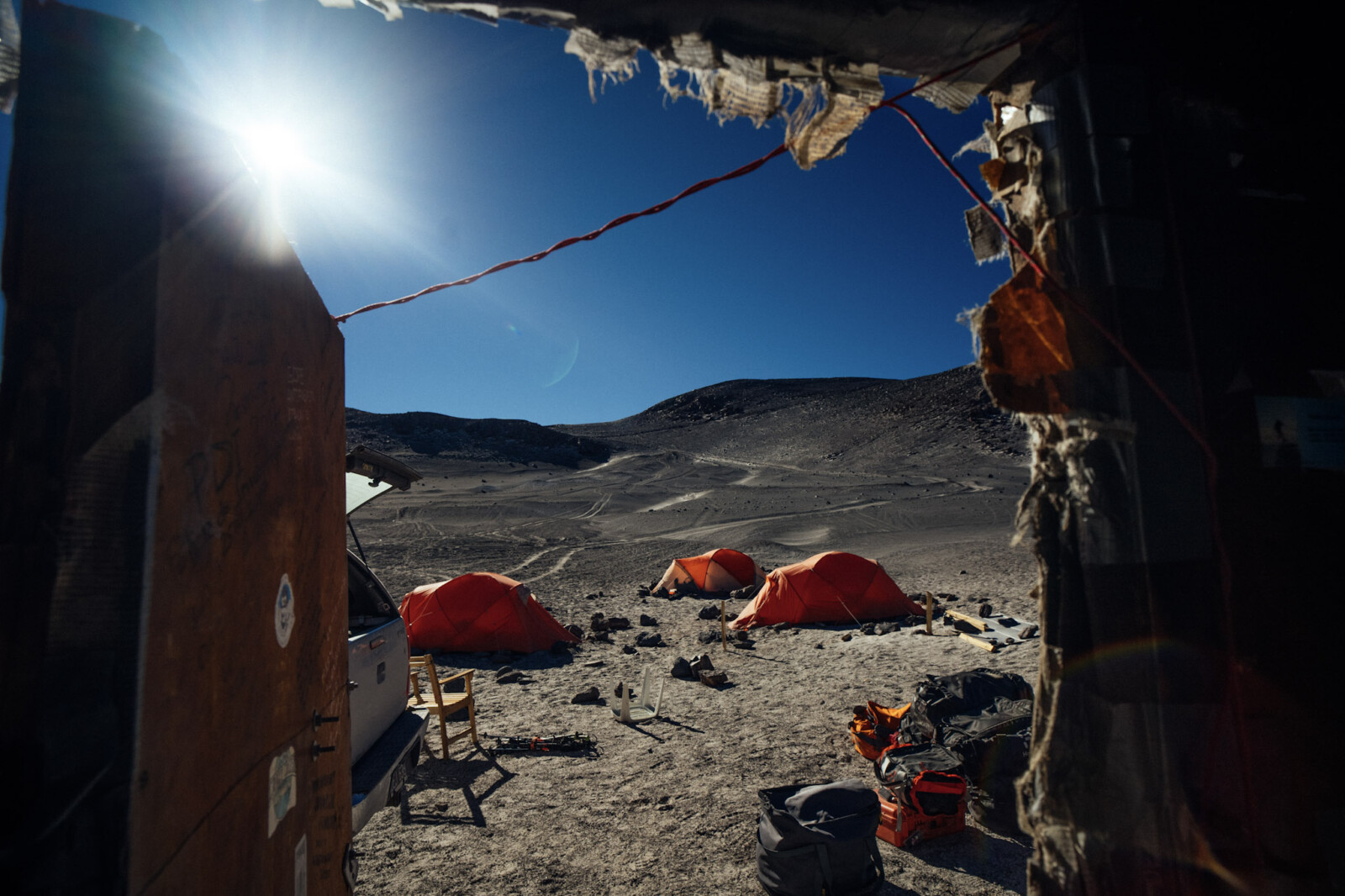
Expedition tents at camp in the Atacama, Ojos del Salado

Night by Night

  • Night 1 (Day 1): Hotel Atacama Suites, Copiapó
  • Night 2 (Day 2): Valle Chico camp, 10,000 ft / 3,000 m
  • Night 3 (Day 3): Laguna Santa Rosa camp, 12,500 ft / 3,800 m
  • Night 4 (Day 4): Laguna Santa Rosa camp, 12,500 ft / 3,800 m, after Siete Hermanas
  • Night 5 (Day 5): Laguna Verde camp, 14,240 ft / 4,340 m
  • Night 6 (Day 6): Laguna Verde camp, 14,240 ft / 4,340 m, after Cerro San Francisco
  • Night 7 (Day 7): Laguna Verde camp, 14,240 ft / 4,340 m, rest day
  • Night 8 (Day 8): Ojos del Salado Base Camp, 17,240 ft / 5,255 m
  • Night 9 (Day 9): Base Camp, 17,240 ft / 5,255 m, after the carry to Tejos
  • Night 10 (Day 10): Refugio Tejos, 19,110 ft / 5,825 m
  • Night 11 (Day 11): Refugio Tejos or Base Camp, after the first summit opportunity, depending on conditions
  • Night 12 (Day 12): Refugio Tejos or Base Camp, depending on how the reserve day is used
  • Night 13 (Day 13): Hotel Atacama Suites, Copiapó
  • Day 14: transfer to Copiapó airport and your flight home

Copiapó: Hotel Atacama Suites

Two nights, Days 1 and 13. Hotel Atacama Suites is our operational base in Copiapó: arrival, the team briefing, the gear check and final organization on Day 1, and recovery on Day 13. After nearly two weeks in the mountains, a hot shower, a real bed and full hotel service feel very good.

  • Full bathrooms with hot showers
  • Wi-Fi and power for charging
  • All meals included, as on the rest of the expedition; alcohol and personal drinks are your own
  • Your second bag with travel clothes stays here while you’re in the Atacama

Room sharing. Hotel rooms are shared by two climbers as standard.

Single rooms. Single rooms are available on request; we’ll quote the cost when you ask.

If availability ever requires it, we use a comparable property of the same standard and tell you in advance. If you want an extra night before or after the expedition, tell us and we’ll arrange it at your cost.

On the Mountain: Our Camp System

From Day 2, you move into our expedition camps. This expedition is 4×4-supported: our vehicles carry the camp, the kitchen and the group equipment between camps as far as Base Camp. There are no porters or pack animals. From Base Camp up, the team carries all the gear to Tejos: your personal kit plus a share of the group gear.

Because the vehicles do the carrying, we can bring a stronger camp system than a fully carried expedition could: larger tents, a proper dining and kitchen setup, fresh food, more water and fuel, and full medical and communications equipment. That means better camps and more energy saved for the climb. At nearly 23,000 ft, saved energy is the whole game.

On the mountain you’ll have:

  • Expedition sleeping tents at every camp, provided by BBE
  • Hot meals at every camp
  • A dining and kitchen setup at the vehicle-supported camps
  • Starlink in camp, and satellite and radio communications
  • Expedition medical and emergency equipment

You bring your own sleeping system: an expedition sleeping bag, an insulated inflatable pad and a closed-cell foam pad (see the Ojos del Salado Gear List). Because the team is capped at six climbers, camps stay uncrowded and organized.

The Camps

Valle Chico10,000 ft / 3,000 m · Night 2

The first mountain camp and the transition from city travel to expedition life. Your first night at altitude, with the full vehicle-supported camp: tents, dining and kitchen setup, and fresh food.

Laguna Santa Rosa12,500 ft / 3,800 m · Nights 3 and 4

Near the Salar de Maricunga: salt flats, high-altitude wetlands, flamingos and volcanic peaks. Open and exposed, with big temperature swings between day and night. You climb Siete Hermanas on Day 4 and return here to sleep.

Laguna Verde14,240 ft / 4,340 m · Nights 5–7

The most important camp of the first week, beside a turquoise lake ringed by volcanoes, with natural hot springs nearby. It is the base for Cerro San Francisco and the place we recover before moving onto Ojos. The ability to recover well here is a major part of how this expedition is designed.

Ojos del Salado Base Camp17,240 ft / 5,255 m · Nights 8 and 9

Near the Atacama Refuge. Cold, dry, exposed and remote, and higher than many major mountain summits. The camp is fully self-sufficient: tents, cooking systems, food and fuel, water, communications, and medical and emergency equipment.

Refugio Tejos19,110 ft / 5,825 m · Night 10, and Nights 11–12 depending on conditions

The high camp and summit staging point. A mountain hut stands here, but we never assume it will be available: its condition and capacity vary, so the expedition stays self-sufficient regardless. Depending on conditions, climbers may use expedition tents, refuge space, or both. At this altitude the priorities are shelter, warmth, hydration, food, rest and summit preparation, not comfort.

Sleeping at Altitude

Don’t expect to sleep at 17,000 or 19,000 ft the way you sleep at home. Sleep is often lighter and more broken, and that is normal. A proper sleeping system makes the difference: an expedition-quality bag, two pads, warm base layers, and your water bottles and tomorrow’s layers inside the bag with you. Nights at the upper camps are well below freezing, and colder with wind. Life on the Mountain has more on sleep and recovery.

Charging and Connectivity

In Copiapó. Wi-Fi and power at the hotel. Charge everything fully before Day 2.

On the mountain. There’s no cell service once we leave Copiapó. We carry Starlink in camp, which allows internet access in many camps when conditions and power allow, and we run solar panels and charging systems for essential equipment. Bring your own power bank, cables and spare batteries, and treat Starlink as a connection, not hotel Wi-Fi.

Questions About Where You’ll Stay? If you have a question about rooms, camps or what to sleep in, ask before you pack.

Ask a guide · Back to Before You Go · climbing@benegasbrothers.com

Life on the Mountain

“Take care of the mountain, and the mountain will take care of you.” It is the Benegas Brothers’ motto, and the rule we climb by.

The summit is one day. The expedition is fourteen.

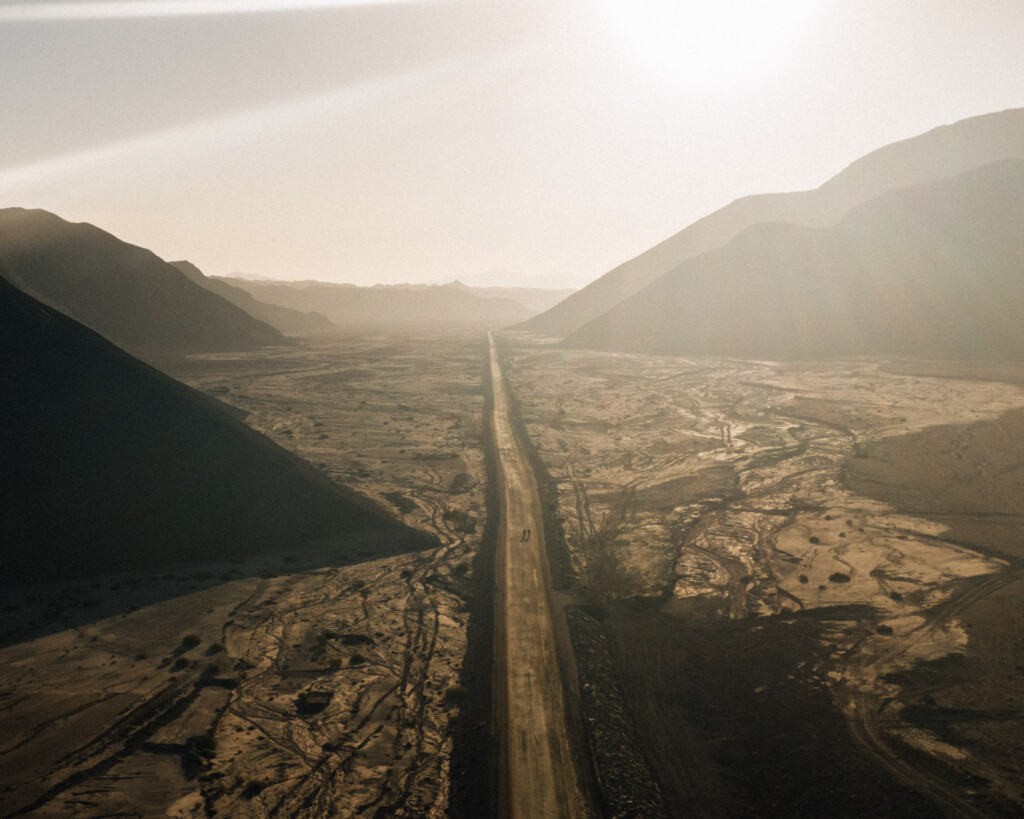
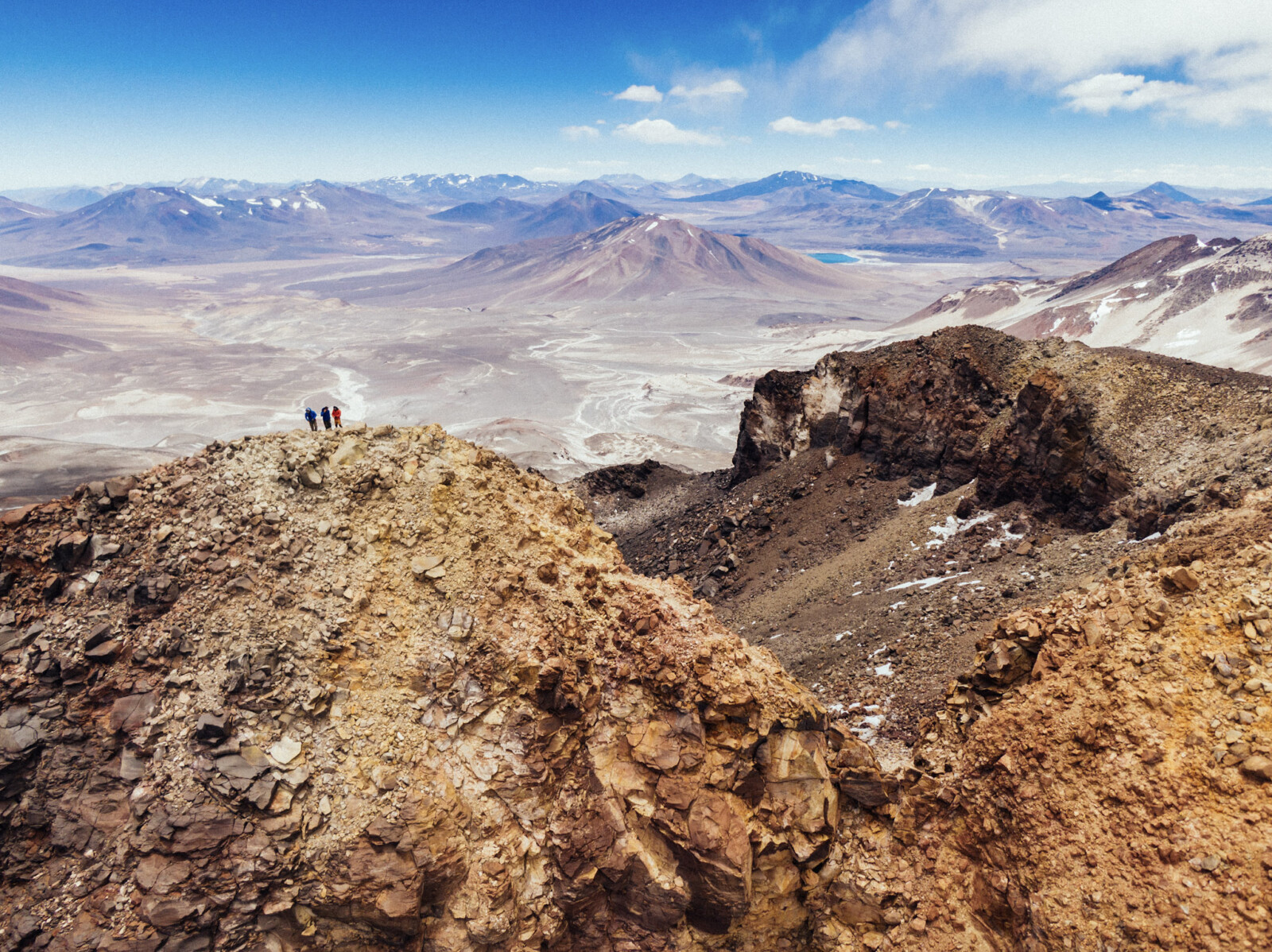
Two climbers crossing the high desert near Ojos del Salado

What separates climbers who thrive from those who merely get through is not fitness alone. It is how they handle the daily realities: eating when appetite fades, sleeping poorly at altitude, keeping their gear organized at Tejos, and waiting patiently for the wind to ease.

Here is what life in the high Atacama actually looks like—and how to prepare for it.

The Daily Rhythm

Most days begin early. At the lower camps, mornings are relatively relaxed; higher up, the schedule becomes more deliberate. A typical day:

  • Wake-up, a hot drink and breakfast, then water bottles filled
  • Pack, check your clothing, and a short briefing from your guide on the plan and how everyone is feeling
  • Drive, climb or both, at a controlled pace with regular stops for water and food
  • Arrive in camp, settle in, organize your gear, drink, eat and rest
  • A hot dinner, an evening check-in with your guide, and an early night

The goal is always to start prepared, not rushed. With a maximum of six climbers and two guides on a full team, a maximum of three climbers per guide, camp is quiet and focused, decisions happen quickly, and your guide knows exactly how you’re doing.

The Kinds of Days

4×4 travel days (Days 2, 3, 5 and 8). We move higher by vehicle, often with a short walk or acclimatization hike along the way. These are not just transport days: stopping, climbing a little and sleeping progressively higher is how the body adapts.

Acclimatization climbs (Day 4, Siete Hermanas; Day 6, Cerro San Francisco). Siete Hermanas, 16,010 ft / 4,880 m, is the first real altitude test. Cerro San Francisco, 19,744 ft / 6,018 m, is a summit in its own right and, for many climbers, their first above 19,700 ft / 6,000 m. After each, we descend to sleep lower.

Rest day (Day 7, Laguna Verde). Eat, drink, sleep and use the hot springs. The body adapts during rest, not effort.

Carry and move days (Days 9 and 10). From Base Camp up, the team carries all the gear to Tejos: your personal kit plus a share of the group gear. On Day 9 we carry the first loads to Refugio Tejos, 19,110 ft / 5,825 m, and return to Base Camp to sleep. On Day 10 we carry the rest and move up for good, on a deliberately shorter day so there’s time to hydrate, eat, prepare and rest.

Summit day (Day 11). The start is generally between about 3:00 and 5:00 AM, depending on wind and conditions, and you should be ready for roughly 10–14 hours of movement. Near the top is a short rock scramble where the guides use helmets, harnesses and rope as conditions require. Speed is not the goal; consistency is.

Summit and weather reserve day (Day 12). Built in on purpose. If wind or weather stops a safe attempt on Day 11, Day 12 is the second chance. If we’ve already summited, it becomes an unhurried descent and recovery instead of a forced march.

4×4 Support: What It Changes

This expedition is 4×4-supported. The vehicles carry the camp, the kitchen and the group equipment as far as Base Camp, and your duffel rides from camp to camp. There are no porters or pack animals. Up to Base Camp, on climbing days you carry only your own pack: water, layers, food and personal climbing gear. From Base Camp up, the team carries all the gear to Tejos: your personal kit plus a share of the group gear.

The vehicles are a critical part of the expedition system, not just transport. They let us bring better food, real camp infrastructure and full medical and communications equipment to places that would otherwise take weeks of load-carrying.

The roads get progressively rougher: washboard, sand, volcanic ground, sometimes snow, and long stretches with no services. Some days involve several hours of rough-road travel. If you’re prone to motion sickness, talk to your physician before you travel. Keep water, snacks, sunglasses and a warm layer within reach in the vehicle.

Wind

Wind can dominate daily life on Ojos. It affects temperature, walking, camp setup, vehicle travel, rest and, above all, summit timing. A calm morning can become very windy by afternoon, and we often shift the day’s timing to use the best conditions.

Wind is the factor most likely to end a summit day. We make summit decisions on actual conditions, not because the itinerary names a day, and that is exactly why Day 12 exists.

What Your Guide Is Watching

Your guide watches every climber every day: pace, breathing, hydration, appetite, energy, sleep, mood and recovery. Those observations drive every decision on the mountain, including whether you go for the summit.

Headache, reduced appetite, broken sleep and mild fatigue are common above 11,500 ft / 3,500 m. Tell your guide right away, without waiting to see if it gets better, if you have:

  • A headache that doesn’t ease with water and rest
  • Nausea or vomiting
  • Dizziness, confusion or loss of coordination
  • Shortness of breath at rest
  • Unusual tiredness
  • Chest tightness or a persistent cough

Catching altitude illness early is what keeps it manageable. Descent is the treatment, and a climber who needs to go down always goes with a guide. Turning around is a professional decision, not a failure.

Water in Very Dry Air

The Atacama is one of the driest environments on Earth, and you lose water faster than you realize. Hydration is a daily priority, and we watch it constantly alongside headaches, appetite, energy and recovery.

  • Aim for about 4 liters of fluid a day, drinking steadily, not only when thirsty
  • Carry two 1-liter wide-mouth bottles in insulated covers, and a thermos on summit day
  • Don’t rely on a hydration bladder up high: the hose freezes
  • Electrolyte packets help you drink more

Your skin, lips and nose will dry out. Heavy moisturizer, SPF lip balm and saline nasal spray matter more here than most climbers expect.

Eating When You Don’t Feel Like It

All meals are included, from your arrival in Copiapó to your departure. Because the vehicles carry the food, the kitchen is better and more varied than on a fully carried climb: fresh food where possible, hot breakfasts, soups, pasta, rice, protein dishes, vegetables, snacks and hot drinks. Meals get simpler as we go higher.

At altitude, appetite drops and hunger signals become unreliable. Eat regularly whether or not you feel like it, little and often. Simple calories often work better than complicated food. Tell us about any dietary needs before departure.

Your own snacks. Bring 2–3 lb of bars, gels, chocolate and dried fruit you already know you like, sealed and packaged for Chilean customs. Familiar food makes a real difference when nothing else appeals.

Sleeping at Altitude

Light sleep, frequent waking, vivid dreams, periodic breathing, or feeling tired after many hours in your bag: all common at altitude. Perfect sleep isn’t required for acclimatization. Rest, warmth and hydration matter more than hours logged.

  • Sleep on both pads: the inflatable on top of the closed-cell foam pad
  • Keep tomorrow’s layers and your water bottles inside your sleeping bag
  • Keep your headlamp, gloves and medications within reach
  • Bring earplugs for wind and thin tent walls
  • Use a pee bottle rather than going out into the cold at night

Laguna Verde and Rest Days

After Cerro San Francisco, we return to Laguna Verde at 14,240 ft / 4,340 m to recover. The natural hot springs are a rare chance to warm up, clean up and reset mentally. Bring a swimsuit and a quick-dry towel.

Some climbers get impatient with shorter days. At nearly 23,000 ft, recovery is part of the climb. The goal is not to stay busy; it is to arrive at summit day strong.

Hygiene and Toilets

There are no showers once we leave Copiapó; the Laguna Verde hot springs are your bath. Bring wet wipes, hand sanitizer, a toothbrush and toothpaste, a small towel and your personal hygiene items.

The lower, vehicle-supported camps have more organized toilet systems. Higher up, everything simplifies. Be comfortable with expedition-style sanitation; your guides explain the system at each camp. We pack out all waste and follow local regulations and Leave No Trace principles throughout.

  • Sanitize your hands before every meal. A stomach bug spreads quickly through a small team, and one sick climber at 19,000 ft affects everyone.
  • Protect yourself from the sun from Day 2. Altitude and Atacama sun burn fast. Use high-SPF sunscreen and reapply on long days. Glacier glasses with side shields are essential.

What You’re Responsible For

This is a guided expedition, but it is still an expedition. Your job is your own system:

  • Your personal gear and tent organization
  • Drinking, eating and managing your layers
  • Packing your pack each morning, and your duffel ready for the vehicles on move days
  • Knowing where your headlamp, gloves, glasses and summit layers are
  • Keeping batteries, electronics and water bottles warm at night

Guides lead, support, monitor and make decisions. Good organization saves energy, and energy is what you’re spending up here.

Staying in Touch and Charging

Cell service ends soon after we leave Copiapó. BBE carries Starlink, which allows internet access in many camps when conditions and power allow: enough to send messages home and for the guides to check forecasts and coordinate logistics. Treat it as a connection, not hotel Wi-Fi, and expect quiet stretches. The guide team also carries satellite and radio communications for operations and emergencies.

We run solar panels and expedition charging systems to keep essential equipment powered. Bring your own power bank of 20,000 mAh or more, cables and spare batteries, and keep them warm; cold drains batteries fast. Tell your family before you leave that a quiet day or two, especially around summit day, is normal and not a sign of a problem.

Weather and the Reserve Day

We climb in January and February, the austral summer. Expect intense sun, strong wind, dust, cold nights and big swings in temperature.

  • Copiapó: 77–86°F / 25–30°C by day; 54–61°F / 12–16°C at night
  • Laguna Santa Rosa: 50–64°F / 10–18°C by day; 18–28°F / −8 to −2°C at night
  • Laguna Verde: 41–59°F / 5–15°C by day; 10–23°F / −12 to −5°C at night
  • Base Camp: 23–46°F / −5 to 8°C by day; −4 to 14°F / −20 to −10°C at night
  • Summit day: −4 to 14°F / −20 to −10°C, with wind chill as low as −31°F / −35°C

The itinerary is a framework, and the mountain makes the final decisions. We may adjust departure times, camp moves, acclimatization climbs, summit timing or rest days for wind, snow, road conditions, forecasts, team health and acclimatization. Flexibility is not a weakness in the plan. No one can promise a summit, and safety always comes before the schedule.

A good day isn’t always the day you climb highest. It may be the day you reach camp hydrated, eat well, sleep better, or simply arrive stronger than the day before. Move higher, climb, recover, adapt, move higher again.

Questions About What the Days Actually Feel Like? If you want to know how a particular day will go, or whether this style of trip suits you, ask a guide.

Ask a guide · Back to Before You Go · climbing@benegasbrothers.com

Ojos del Salado Gear List

Ojos del Salado is 22,615 ft / 6,893 m high. Much of the route isn’t technically difficult, but the environment is serious: extreme altitude, strong wind, very dry air, real cold, snow and ice, volcanic scree, and a long summit day that ends with a short rock scramble. The right equipment isn’t about owning the most expensive gear. It’s about having the right system, knowing how to use it, and arriving with gear that fits. This page explains how to build and test that system. The full list, every item with recommended models, is a download you can print and take shopping.

What the Weather Does

We climb in January and February, the austral summer. Your clothing has to work across all of this, sometimes on the same day:

  • Copiapó: 77–86°F / 25–30°C by day, hot and dry; 54–61°F / 12–16°C at night
  • Laguna Santa Rosa, 12,500 ft / 3,800 m: 50–64°F / 10–18°C by day, with wind building after midday; 18–28°F / −8 to −2°C at night
  • Laguna Verde, 14,240 ft / 4,340 m: 41–59°F / 5–15°C by day; 10–23°F / −12 to −5°C at night
  • Base Camp, 17,240 ft / 5,255 m: 23–46°F / −5 to 8°C by day, with strong afternoon wind; −4 to 14°F / −20 to −10°C at night
  • Summit, 22,615 ft / 6,893 m: −4 to 14°F / −20 to −10°C on a pre-dawn start, with wind chill as low as −31°F / −35°C

How to Think About Your Gear

Ojos is a high-altitude climb, not a technical one, and that misleads people. The vehicles carry the camp to Base Camp. From Base Camp up, the team carries all the gear to Tejos: your personal kit plus a share of the group gear. The vehicles save your legs, not your margin. Summit morning near 23,000 ft in wind is not the place to find out a layer isn’t enough.

Think in systems rather than a shopping list, and in layers rather than single heavy pieces. No cotton, anywhere. Lightweight equipment is excellent when it still protects you, but this is not the place to save a few ounces by leaving warmth behind. Warmth, reliability and redundancy matter more than minimal weight.

Every item on the list is required unless it’s marked optional or recommended. For most items many brands work, so use our recommendations as a starting point.

The Three Items Worth Investing In

Double mountaineering boots. Insulated high-altitude double boots, designed for 19,700–23,000 ft / 6,000–7,000 m peaks, fully crampon-compatible, properly fitted and broken in. A single leather boot is not enough at 22,615 ft in Atacama wind. Boots that are too tight get colder, so don’t size them from your street shoes. Warm feet at this altitude are a safety issue, not a luxury.

Sleeping bag. An expedition-quality down bag rated to about −20°F / −29°C. Nights at Base Camp reach −4°F / −20°C, and colder at Tejos. Ratings vary a lot between manufacturers, so treat the number as a starting point and talk to us if your bag is marginal.

Your hand system. Liner gloves, midweight gloves, heavy insulated gloves, expedition mittens for summit day, and a spare pair. Losing or soaking your only warm gloves high on the mountain becomes a serious problem very quickly.

Your Systems

Technical. A helmet that fits over a hat or balaclava (required: the summit scramble is loose volcanic rock); a harness with adjustable leg loops you can put on over all your layers; steel crampons fitted to your boots before you fly; a general mountaineering ice axe; two locking carabiners you can operate with gloves; and adjustable trekking poles with snow baskets, essential on the scree and the long descents.

Feet. Double boots, approach or hiking shoes for the lagoon camps and acclimatization hikes, optional low gaiters, liner socks (optional), three pairs of hiking socks, two pairs of warm socks (a fresh, dry pair saved for summit day) and camp shoes or sandals for camp and the hot springs.

Sleep. Your sleeping bag, a full-length insulated inflatable pad with its repair kit, a closed-cell foam pad to go underneath, and a compression sack.

Layers: upper body. A sun hoody, a base-layer top, a midweight base layer, a fleece, a softshell jacket, a waterproof hard shell with a helmet-compatible hood, an insulated jacket, and an expedition down parka for summit day and cold camps.

Layers: lower body. Non-cotton underwear, lightweight and midweight base-layer bottoms, trekking pants, softshell pants, hard-shell pants with full side zips, insulated pants with side zips (strongly recommended), and optional shorts for Copiapó.

Head and eyes. Sun hat, warm beanie (one must fit under your helmet), two buffs or neck gaiters for dust and dry air, and a balaclava. Glacier glasses with side shields and category 4 lenses are essential, and bring a backup pair. Goggles for wind-blown dust and summit wind.

Packs and bags. A 90–120 L durable, dust-resistant expedition duffel; a 40–70 L second bag that stays at the hotel; a 35–45 L summit pack big enough for your down parka and 3 L of fluids (about 13–18 lb / 6–8 kg on summit day); and an optional small day pack for town.

Water and camp. Two 1 L wide-mouth bottles with insulated covers, a soft flask or extra bottle for the drives, a thermos, a pee bottle (female climbers: a pee funnel is highly recommended), a bowl, mug and spoon, electrolyte packets, 2–3 lb of sealed snacks, four sets of hand and toe warmers, and a swimsuit and quick-dry towel for the Laguna Verde hot springs. No hydration bladders on summit day; the hoses freeze.

Power and electronics. A headlamp of 300+ lumens with spare lithium batteries, a power bank of 20,000 mAh or more, cables and an adapter (Chile uses Type C and L plugs at 220 V), and sealable dust-proof bags for electronics, down and documents.

Health and hygiene. SPF 50+ sunscreen, SPF lip balm, heavy moisturizer, saline nasal spray, eye drops, hand sanitizer, wet wipes, a small toilet-paper stash and waste bags, a blister kit, a small personal first aid kit, earplugs and your personal medications. Talk to your physician about altitude medication. The PDF lists the full kit.

How Your Gear Travels

Pack your mountain gear in one large duffel, not your backpack; baggage handling damages straps. The duffel rides in the 4×4 vehicles from Copiapó to Base Camp; what goes up to Tejos travels in packs. The Atacama is dusty, so seal electronics and down inside it. Hard-sided luggage doesn’t work once we leave Copiapó.

  • Expedition duffel: everything for the mountain, clearly labeled
  • Second bag: travel clothes, waiting at the hotel in Copiapó
  • Carry-on: medications, documents, one set of climbing layers, and your boots if you can manage them

Crampons, ice axe and poles go in checked bags. Book a checked bag on your Santiago–Copiapó flight; budget fares often don’t include one. Flights & Getting to Copiapó has the full baggage guidance.

Test Everything Before You Go

Nothing should be used for the first time at Tejos. Test your full system at home:

  • Boots with your crampons, on real terrain
  • Your glove system, including clipping carabiners and adjusting crampon straps
  • Your harness over your full layering
  • Your helmet over a beanie or balaclava, with goggles
  • A night in your sleeping bag on both pads
  • Your summit pack, loaded with the parka and 3 L of fluids

Problems found at home are easy to fix. Problems found at 19,000 ft are not.

What BBE Provides

You don’t bring any group equipment. BBE provides:

  • Expedition tents, and dining and kitchen systems
  • Cooking equipment, fuel and all meals
  • Group rope systems and climbing and safety equipment
  • Starlink, and satellite and radio communications
  • Expedition medical kit and emergency systems
  • 4×4 vehicles and drivers

You bring your personal clothing, boots, sleeping system, packs and personal climbing gear.

Renting Gear

Copiapó is a mining city, not a mountaineering center, and rental options there are limited. Don’t plan to arrive and rent your high-altitude system. Your boots, sleeping bag, gloves, technical clothing and glacier glasses should come from home.

If you need to rent anything, tell us at least three weeks before departure so we can confirm availability. Rentals are paid directly to the shop and aren’t included in the expedition price. Talk to us before you buy anything expensive; we’ll tell you honestly what’s worth owning and what’s worth renting.

The Gear Check in Copiapó

On Day 1 in Copiapó, your guides go through your kit: boots, crampons, sleeping system, insulation, gloves, eye protection, harness, helmet and packs. Copiapó is the last practical place to solve an equipment problem. After that, you climb with what you brought.

The problems we see most often are simple and preventable: boots that are too tight, not enough hand protection, a sleeping bag that isn’t warm enough, weak wind protection, no backup glasses, untested crampon fit, too many unnecessary items, and critical gear buried where it can’t be reached quickly.

Every confirmed climber receives the final equipment list before departure. Use it as the final authority for packing, and don’t buy expensive specialized equipment until you’ve reviewed it or spoken with us.

Questions About Gear? Gear questions are exactly what Ask a Guide is for. Send us the model of your boots or bag and we’ll tell you if it’s enough.

Ask a guide · Back to Before You Go · climbing@benegasbrothers.com

What to Budget For

The expedition price is one number, and it’s on Dates & Prices with departures and booking terms. The real cost of the trip is another. This page lays out every cost beyond the price: what you must pay, what we strongly recommend, what’s optional and what to hold in reserve. We don’t want the published price to hide the real cost of the trip. You should know what you’re committing to before you book.

Typical total beyond the price$1,750–3,000

Plus any extra hotel nights.

Cash to carry$800–1,200

Mostly Chilean pesos, plus small US bills.

Emergency reserve$1,500–2,000

In accessible funds, on top.

Your Budget at a Glance

RequiredCosts every climber pays
  • Rescue & evacuation coverageRequired by BBE · to at least 7,000 m and ground evacuation$850–900
  • Flights to Santiago and CopiapóYou book these · extra baggage is yoursVaries
  • Personal gearDepends on what you already ownVaries
  • Guide and staff tipsWith two guides · $300–550 with one · details below$400–725
Strongly recommended
  • Trip insuranceCancellation, interruption, delays, baggage, travel medical$250–700+
Personal spending
  • SnacksBars, gels, summit food · sealed for Chilean customs$50–150
  • Personal expensesDrinks, laundry, phone, pharmacy · meals included$200–500
OptionalOnly if you add them
  • Extra hotel nightsA day early in Copiapó is smart insurance$100–250+ a night
  • Single room in CopiapóOn request · we quote when you askOn request
  • Gear rentalsLimited in Copiapó · tell us 3 weeks aheadVaries
  • Private & custom extensionsA second summit or more time in the AtacamaQuoted

Tips: How They Work

Our guide team and local staff put real work into guiding, camp logistics, driving, cooking, equipment and safety, much of it out of sight. A tip is a direct way to recognize it.

Guidelines per climber:

Lead guide$200–350
Assistant guide$100–175
Local staff pool (drivers, cooks, support)$100–200

Total per climber: about $400–725 with two guides. With one guide on a smaller departure: lead guide $200–350 plus local staff $100–200 ($300–550).

These are guidelines, not fees. The amount should reflect the quality of guiding, the personal attention you received and your overall experience. Tipping should reflect the quality of the guiding, not whether the mountain let you up: weather, altitude and conditions decide summits, and sometimes turning around is the right professional decision.

How it works. Near the end of the expedition, the guide team explains the structure so it’s handled fairly and simply. Cash is simplest for local staff; for guides, other methods may be possible, and we’ll explain what works for your team.

Cash and Cards

  • Currency. Chile uses the Chilean peso (CLP). You don’t need to arrive with a lot of it.
  • Where to get it. ATMs and currency services are available in Santiago and Copiapó. There is no banking of any kind once we leave Copiapó, so withdraw what you need there.
  • How much. About $800–1,200 in cash, mostly Chilean pesos drawn in Copiapó, plus small US bills. Tips alone come to $400–725 (less with one guide); the rest covers small personal spending.
  • Cards. Visa and Mastercard are widely accepted in Santiago and Copiapó. Carry a primary card and a backup stored separately; don’t rely on one payment method.
  • Before you leave. Check that your cards work abroad, your daily ATM limit and your foreign transaction fees, and save your bank’s emergency numbers.

Once we leave Copiapó, you can stop thinking about money and focus on the expedition.

Contingency

Emergency reserve$1,500–2,000

Accessible funds beyond your planned spending, on a credit card, debit card or bank account rather than in cash. It covers flight changes, extra hotel nights, delayed baggage, medical costs, replacement gear or unplanned transport. It usually goes home with you.

Disruption costsReserve

If a flight is delayed or cancelled, or you need to leave the expedition early, extra hotel nights, transfers, meals and flight changes are your cost, and unused expedition services are not refunded. Trip insurance is what usually covers these.

More cost details for this trip

What the Expedition Price Covers

In short: the 14-day guided program from Copiapó to Copiapó, with a maximum of six climbers and two guides on a full team; hotel nights in Copiapó per the itinerary; every meal from your arrival in Copiapó through your departure; airport transfers in Copiapó and all scheduled 4×4 transport; group tents, camp systems and group climbing and safety equipment; the expedition medical kit and emergency systems; satellite and radio communications and Starlink in camp; weather monitoring and summit planning; and the dedicated summit and weather reserve day. The controlling list of inclusions and exclusions is on Dates & Prices.

Your Climbing Permit: No Cost

Budget nothing for this. Ojos del Salado sits in a Chilean border zone, so you need DIFROL authorization. BBE handles your DIFROL border-zone authorization. It’s free. We need your passport details early, at booking, because DIFROL requires the application at least 20 days before you enter Chile. Some third-party sites quote a fee; that figure is not DIFROL’s. Your Expedition Checklist has the detail.

Budget Summary

Beyond the expedition price, your flights and your gear, typical ranges in US dollars:

Climbing permitfree
Rescue and evacuation coverageabout $850–900 on average

Required

Trip insurance$250–700+

Strongly recommended

Tips$400–725 with two guides; $300–550 with one
Snacks and personal expenses$250–650

Typical total: about $1,750–3,000, plus any extra hotel nights. On a one-guide departure, the typical total is about $1,650–2,800.

That total does not include your flights, personal gear, rentals or emergency reserve.

Emergency reserve: $1,500–2,000 in accessible funds, on top.

Questions About Costs? If you’d like a breakdown for your own situation, ask. We’d rather you plan it right than guess.

Ask a guide · See dates & prices · Back to Before You Go · climbing@benegasbrothers.com

Private & Custom Expeditions

Ojos del Salado · Your Dates, Your Team, Your Objective

Our scheduled Ojos del Salado departures give climbers a proven acclimatization schedule, a small team and experienced leadership. Fixed dates don’t work for everyone. If you have a specific goal, your own group, a timeline that doesn’t match our calendar or an objective beyond the standard program, we build the expedition around you, with the same guide standards, camp system and 4×4 support as every BBE departure in the Atacama.

Ojos is well suited to this. Because the expedition is 4×4-supported rather than dependent on porters or pack animals, we can adjust pacing, add objectives and reshape the schedule more easily than on many high peaks. What would be a logistical rebuild elsewhere is often a conversation here.

Private does not mean easier, and it does not mean more advanced. It means the expedition is designed around your team.

Who Private Climbs Suit

  • Solo climbers who want one-to-one guiding, with a guide’s full attention on their pacing, acclimatization and decision-making
  • Partners and small groups of two or three who already train together and want to climb only with each other
  • Families, friends or clubs who want the expedition run exclusively for their own team
  • Climbers who need dates outside the scheduled departures
  • Climbers using Ojos as preparation for a bigger objective, who want a guide reading their altitude response closely and continuously
  • Climbers who want to add a second high summit, or whose main interest is the Atacama landscape rather than the peak

What You Can Customize

Dates. Our scheduled departures run in January and February, in the heart of the austral summer. Private expeditions run on dates you request; we confirm feasibility for the season and conditions. We’ll tell you honestly how the high Atacama looks for the dates you have in mind.

Team size. From one climber with one guide to a private team of your own. Guides, vehicles and camp support are planned for your team size and objective, and that shapes the proposal.

Extended acclimatization. More days at Laguna Verde and in the salares before moving to Base Camp give your body more time to adapt before the high camps. If your schedule allows it, we’ll build the longer version.

Pace for experienced climbers. If you arrive already acclimatized from recent time at altitude, a private program can be shaped around your actual experience rather than a default assumption. It doesn’t shorten what your body needs: we won’t build a private itinerary with less acclimatization than Ojos requires, and no private plan changes the fact that no one can promise a summit. Climbers with prior high-altitude experience and less time can also look at Ojos del Salado Express, our shorter program.

Combined Andean programs. Ojos is climbed in the austral summer, the same season as Aconcagua and other Andean objectives. Climbers with time to spend in South America often want two mountains in one trip. We build those.

Photography, filming and research support. The high desert, the salares and Laguna Verde draw people for reasons that have nothing to do with the summit. If your objective is the landscape rather than the peak, tell us and we’ll structure the trip around it.

Younger climbers. Chile’s high-mountain tourism standard sets age limits by altitude, and under the current standard the summit of Ojos (22,615 ft / 6,893 m) is for climbers 18 and over; climbers under 18 come with a parent or guardian, and we’ll confirm the current rule for your dates. Families are welcome, and if someone in your family is under 18, we’ll plan an objective that fits the rules. Fitness, experience and health matter far more than age.

Adding Another High Summit

The ground around Ojos holds many volcanoes above 19,700 ft / 6,000 m. On a private expedition, with the right experience and enough days, we can add one.

Nevado Tres Cruces Sur22,139 ft / 6,748 m

The high point of the Tres Cruces massif west of Ojos. A serious objective in its own right, not a warm-up. Its neighbor Tres Cruces Centro reaches 21,749 ft / 6,629 m.

Incahuasi21,722 ft / 6,621 m

On the Chile–Argentina border near Paso San Francisco, close to ground the standard itinerary already covers. That makes it one of the more straightforward additions to build into a private program.

Which one fits depends on your experience, your acclimatization and how many days you have. Adding a second major summit isn’t simply a matter of booking extra days. Tell us what you’re after and we’ll tell you honestly what’s realistic.

Led by Willie or Damian

Willie or Damian Benegas can personally lead a private Ojos del Salado expedition on request. The founders have guided major expeditions across the Andes, the Himalaya and Alaska for decades, and a founder-led climb puts that experience on the mountain with you, subject to their schedules.

A founder’s participation applies only when it is confirmed in writing in your trip terms, never assumed. Scheduled departures are led by BBE’s professional guide team, run to the same standards.

How a Proposal Comes Together

Every private expedition is quoted individually. A private trip usually costs more per person than a scheduled departure, because fewer climbers share the fixed costs. The price depends on your team size, the number of days, the objectives you add and the level of support. We quote each one specifically rather than publishing a multiplier.

Private expeditions need lead time for vehicles, guide scheduling and your permit. BBE handles your DIFROL border-zone authorization. It’s free. We need your passport details early, at booking, because DIFROL requires the application at least 20 days before you enter Chile. Chile’s DIFROL may require a minimum of two participants in a climbing party; if you’re climbing on your own, we’ll work through that with you. The earlier you reach out, the more options we can offer.

How to Start

Tell us your goals, your group, your timeline and your altitude history, and whether you’d like Willie or Damian to lead. We’ll tell you honestly what’s possible, and if something else should come first, we’ll say that too. We answer every inquiry personally.

Dates & Prices

Ojos del Salado · 14 Days · Atacama Desert, Chile · Maximum Six Climbers

Everything you need to book: departures, the price, what it covers and the terms. If you’re still deciding, start with Is This for Me? or talk to a guide first. We review every climber’s experience before booking.

Expedition price$7,500

USD per person.

Deposit to book20%

Of the expedition price. Includes a $350 non-refundable booking fee.

Balance120 days

Due 120 days before departure. Inside 120 days, you pay in full at booking.

2028 departures: $8,125 USD per person.

Each departure takes a maximum of six climbers. With a full team, two guides lead the expedition, a maximum of three climbers per guide. A departure is confirmed when we tell you so in writing. Please buy nonrefundable flights only after your departure is confirmed. When it’s full, it closes.

Day 1 is arrival in Copiapó, preferably by early afternoon, and Day 14 is the flight out of Copiapó. The full itinerary is on Day by Day.

When to Climb

Ojos del Salado is climbed in the austral summer. January and February sit in the heart of that window, when temperatures are at their most workable and the high Atacama is at its most stable. No month guarantees good weather, and wind decides more summit days here than terrain does, which is why the itinerary carries a dedicated summit and weather reserve day.

Both departures each season run the identical 14-day program. Neither is a shortened or reduced version.

What’s Included — and What Isn’t

Included in the price

Before you go
  • Expedition preparation guidance, training recommendations and altitude preparation advice from our guide team
  • An equipment consultation and the Ojos del Salado Gear List
  • Your DIFROL border-zone authorization, filed by BBE (free)
In Chile
  • Airport transfers in Copiapó on Day 1 and Day 14
  • Two hotel nights in Copiapó at Hotel Atacama Suites, on Day 1 and Day 13, on a shared room basis
  • All scheduled 4×4 transportation throughout the expedition
  • All meals, from your arrival in Copiapó through your departure, in town and on the mountain
  • Full mountain logistics coordination
On the mountain
  • Professional guide leadership: two guides with a full team of six, a maximum of three climbers per guide, certified to IFMGA, AMGA or equivalent national standards
  • Group tents and camp systems at every camp, carried by 4×4 to Base Camp and by the team to Tejos
  • Group climbing and safety equipment, including rope systems for the summit scramble as conditions require (helmet and harness are personal equipment — see the Gear List)
  • An expedition medical kit and emergency systems
  • Satellite and radio communications
  • Starlink in camp: a limited connection, enough to message home. There is no normal cell signal once we leave Copiapó.
  • Weather monitoring, summit planning and technical coaching as needed
The climbing program
  • Acclimatization hikes and the Siete Hermanas ascent, 16,010 ft / 4,880 m
  • The Cerro San Francisco summit attempt, 19,744 ft / 6,018 m
  • The Ojos del Salado summit attempt, 22,615 ft / 6,893 m
  • A dedicated summit and weather reserve day

Not included

  • International flights, and the domestic flights between Santiago and Copiapó
  • Excess or extra baggage on any flight, paid to the airline
  • Rescue and medical evacuation insurance (required) and travel insurance (strongly recommended)
  • Personal climbing gear and clothing, and any rentals
  • Tips for guides and local staff
  • Alcoholic beverages and personal drinks
  • Personal snacks and summit-day food
  • A single room in Copiapó (available on request; we’ll quote the cost when you ask)
  • Extra hotel nights and meals before or after the program, including any night in Santiago
  • Evacuation and medical costs
  • Personal expenses

What each of these typically costs is on What to Budget For.

Your Climbing Permit

Ojos del Salado sits in a Chilean border zone, so every climber needs DIFROL authorization. BBE handles your DIFROL border-zone authorization. It’s free. We need your passport details early, at booking, because DIFROL requires the application at least 20 days before you enter Chile. There is nothing to pay us or anyone else for it.

The one thing that matters is timing, so send your passport details when you book. See Your Expedition Checklist.

Your Total Trip Cost

The expedition price is the biggest number, not the only one. Typical ranges per climber, in U.S. dollars:

Expedition price (2027)$7,500
Typical costs beyond the price$1,750–3,000
Typical total, before flights and gearabout $9,250–10,500

Not included in that total: international flights, personal gear and extra hotel nights. 2028 departures are $8,125. The full breakdown is on What to Budget For.

Payment & Cancellation

Deposit: $1,500 (2027) or $1,625 (2028) (20% of the trip price), due at booking. $350 of it is a nonrefundable booking fee.

Balance: $6,000 (2027) or $6,500 (2028), due 120 days before the start date. Booking within 120 days? Full payment is due at booking.

How to pay: bank transfer/ACH (no fee), wire transfer (you pay the bank fees) or credit card (3% surcharge). All prices are in U.S. dollars.

If you cancel:

  • 121 days or more before the start date: full refund, less the $350 booking fee
  • 90 to 120 days: 50% refund, after the $350 booking fee
  • 89 days or fewer: no refund

Can’t make it? Send a qualified climber in your place at no BBE fee.

Insurance: medical and rescue/evacuation coverage required. Trip cancellation insurance strongly recommended.

Once the trip begins, payments are nonrefundable.

Read the full Payment & Cancellation Policy →

Insurance

Rescue and medical evacuation coverage is required on this expedition. Your policy must cover high-altitude mountaineering to at least 7,000 m / 23,000 ft (above the 22,615 ft summit) and remote ground evacuation. You can buy it any time, but it must be in place before departure.

Ojos is climbed in one of the most remote regions of Chile. Evacuation there is a ground operation measured in hours of 4×4 driving, not a quick helicopter lift. Read your policy carefully: many adventure travel policies have altitude limits well below 22,615 ft. Coverage pays for a rescue; it can’t guarantee one.

Travel insurance is strongly recommended, not required. Trip cancellation, interruption, baggage and medical cover is, in many situations, the only way to recover costs from disruptions outside anyone’s control. See Trip Insurance & Evacuation Coverage.

Private Departures

January 10–23, 2027Scheduled departure
February 7–20, 2027Scheduled departure
January 16–29, 2028Scheduled departure
February 6–19, 2028Scheduled departure

A private expedition runs on dates you request, with your own team or one-to-one with a guide; we confirm feasibility for the season and conditions. It can follow this program or add a second summit such as Tres Cruces Sur or Incahuasi.

Led by Willie or Damian Benegas: on request, priced individually. A founder’s participation applies only when it is confirmed in writing in your trip terms.

Every private expedition is priced individually, based on objectives, length, team size and level of support. See Private & Custom Expeditions.

Your Questions

Ojos del Salado · Answered by the Guides

Straight answers to the questions climbers ask most before committing to Ojos del Salado. Each answer is short and points you to the page with the full detail. If your question isn’t here, ask us. We answer every inquiry personally.

Still have a question? Ask a guide · See dates & prices · climbing@benegasbrothers.com

Ojos del Salado reaches 22,615 ft / 6,893 m on the border between Chile and Argentina. It is the highest mountain in Chile, the second-highest summit in the Andes after Aconcagua, and the highest volcano on Earth. Nearly 23,000 ft is an entirely different physiological environment from a normal trekking peak, and the altitude is what makes this a serious expedition.

Most of the standard route isn’t. It’s hiking and mountaineering over volcanic scree, rock, snow and sometimes ice, depending on the season. Near the summit there is a short rock and scrambling section where we may use helmets, harnesses and rope systems. Previous crampon experience is strongly recommended. The climbing is moderate; the altitude is the real difficulty. See Is This for Me?

Physically, it’s a serious high-altitude expedition. The biggest challenges are extreme altitude, strong wind, cold, very dry air, dehydration, poor sleep, long climbing days and cumulative fatigue. Ojos is often underestimated because the standard route isn’t highly technical. At 22,615 ft, even straightforward terrain becomes demanding. A useful benchmark: climb about 3,000 vertical feet / 900 m with a 30–40 lb pack at a controlled pace, and feel ready for another big day after it.

We strongly recommend experience above about 18,000 ft / 5,500 m, though it isn’t a hard requirement. Climbers coming from Kilimanjaro, Ecuador, Mexico, Bolivia or similar objectives often find Ojos a good next step. We review every climber’s experience before booking, and if we think you need another step first, we’ll tell you. See Is This for Me?

Yes. Kilimanjaro reaches 19,341 ft / 5,895 m. Ojos reaches 22,615 ft / 6,893 m, almost 3,300 vertical feet higher, and that difference at extreme altitude is substantial. Ojos also involves a longer acclimatization process, colder conditions, stronger winds, high camps and a short technical summit section. For a well-prepared Kilimanjaro climber, though, Ojos can be an excellent next step.

They’re different expeditions. Aconcagua involves more continuous trekking and load carrying, with a demanding multi-week progression on the upper mountain. Ojos has significant 4×4 support, which removes much of the heavy carrying. But Ojos still reaches nearly 23,000 ft, and the altitude, dryness, cold and wind are completely serious. We wouldn’t call either mountain easy.

Tell us what you’ve climbed, how high you’ve been and how you train. If Ojos is the right objective, we’ll say so. If something should come first, that’s not a rejection. It’s a sequence. The Ecuador Mountaineering School builds crampon and glacier skills with instruction built in, and the Mexico Volcanoes give you real altitude on a shorter trip. We’d rather have that conversation now than at 19,000 ft.

Chile’s high-mountain tourism standard sets age limits by altitude, and under the current standard the summit of Ojos (22,615 ft / 6,893 m) is for climbers 18 and over; climbers under 18 come with a parent or guardian, and we’ll confirm the current rule for your dates. Families are welcome, and if someone in your family is under 18, we’ll plan an objective that fits the rules. Fitness, experience and health matter far more than age.

No medical certificate is required. Every climber completes a medical history in the Registration Form, and we ask you to disclose any condition honestly so we can plan for it. Routine vaccinations should be current; see a travel clinic about anything else. Talk to your physician about any medication, including altitude medication, well before departure, and never try a new medication for the first time on the mountain. See Your Expedition Checklist.

Fourteen days, Copiapó to Copiapó. We don’t build a nearly 23,000 ft expedition around a single summit opportunity. The itinerary includes progressive acclimatization through the Atacama, a summit of Cerro San Francisco, recovery at Laguna Verde, and a dedicated summit and weather reserve day on Ojos. One bad weather day shouldn’t automatically end the expedition. See Day by Day.

In January and February, the heart of the austral summer. Current departures are on Dates & Prices. If you need different dates, a private expedition runs on dates you request; we confirm feasibility for the season and conditions.

Yes. We climb Cerro San Francisco, 19,744 ft / 6,018 m, on Day 6. For many climbers it’s their first summit above 19,700 ft / 6,000 m. It’s a real objective in its own right, and it shows both you and your guides how you perform at that altitude before going higher.

We build altitude gradually: Valle Chico at 10,000 ft, Laguna Santa Rosa at 12,500 ft, Siete Hermanas at 16,010 ft, Laguna Verde at 14,240 ft, Cerro San Francisco at 19,744 ft, recovery at Laguna Verde, Base Camp at 17,240 ft, a carry to Tejos at 19,110 ft, and finally Ojos del Salado at 22,615 ft. We don’t rush to Base Camp. Every stage gives the body time to adapt before we move higher. See Day by Day.

Laguna Verde, at about 14,240 ft / 4,340 m, sits beneath large volcanoes in the heart of the high Atacama. We use it as an acclimatization and recovery base. After Cerro San Francisco we come back down here to eat, hydrate, sleep and use the nearby natural hot springs. That recovery is an important part of the strategy, not a luxury.

Two nights at Hotel Atacama Suites in Copiapó, at the start and the end, in shared rooms. In between, you sleep in our 4×4-supported tent camps at Valle Chico, Laguna Santa Rosa, Laguna Verde, Base Camp at 17,240 ft and Tejos at 19,110 ft. We never plan around the Tejos refuge; we carry tents and use hut space only if it’s genuinely available. See Where You’ll Stay.

It’s classified as active, but there has been no confirmed eruption in recorded history. The last confirmed activity was roughly 1,300 years ago, and fumarolic steam and gas were observed near the summit as recently as 1993. In practical terms, volcanic activity isn’t a hazard climbers plan around on this expedition. Altitude and wind are.

Be prepared for roughly 10 to 14 hours of movement, depending on conditions and pace. We generally start between about 3:00 and 5:00 AM, depending on wind, temperature, snow and the forecast. At this altitude, speed isn’t the goal. Consistency is.

Near the top there’s a short rock and scrambling section. Conditions vary, and guides may use helmets, harnesses, ropes and fixed or protected climbing systems. The section is short, but it comes close to 22,600 ft, so we treat it seriously. It’s one more reason small teams matter.

Not normally. The expedition is designed around proper acclimatization instead. Emergency oxygen may be carried as part of the medical and safety system, but it isn’t routine summit support.

Yes. Wind is one of the biggest factors on Ojos, and it can make an otherwise straightforward day unsafe. That’s why the itinerary carries a dedicated summit and weather reserve day on Day 12. If Day 11 is blown out, we can go on Day 12. If a window never comes, we make the call that’s right for the team. Summit decisions follow actual conditions, not the itinerary.

We don’t publish one. Results depend on the season, the wind and how the team is climbing, and a single number would hide all of that. What moves the odds: arriving fit, a progressive acclimatization schedule, a summit above 19,700 ft before Ojos, a reserve day, and a 3:1 ratio with guides who watch every climber daily. Ask a guide and we’ll talk you through recent seasons.

The summit is the goal, not the contract. Altitude, wind, conditions and how the team is moving all play a part, and no one can promise a summit. What we can promise is that you’ll be coached and supported throughout, and every call is made with your safety first. Turning around at the right moment is a professional decision, not a failure.

Tell your guide early. Small problems managed quickly rarely become big ones. The team carries an expedition medical kit and satellite and radio communications, and descent is the first treatment for altitude illness. Evacuation from the high Atacama is a ground operation measured in hours of 4×4 driving to Copiapó, which is why rescue and evacuation coverage is required. See Trip Insurance & Evacuation Coverage.

Up to Base Camp, no. The 4x4s carry the group equipment, so on climbing days you carry water, layers, food and personal climbing gear in a 35–45 liter pack. From Base Camp up, the team carries all the gear to Tejos: your personal kit plus a share of the group gear, over Days 9 and 10. Train with a loaded pack. See Life on the Mountain.

Yes, every meal, in Copiapó and on the mountain, from arrival to departure. Only alcohol and personal drinks are extra. Because the vehicles carry it, the food is better and more varied than on a fully carried climb: fresh food where possible, hot breakfasts, soups, pasta, rice, protein and vegetables, simplifying as we go higher. Bring a few snacks you know you like. See Life on the Mountain.

Usually. There’s no normal cell signal once we leave Copiapó, but we run Starlink in camp when conditions and power allow, enough to message home. Treat it as a connection, not normal signal, and tell your family that quiet stretches are normal. The guide team also carries satellite communication for operations and emergencies.

A maximum of six climbers. With a full team, two guides lead the expedition, a maximum of three climbers per guide. Our guides are certified to IFMGA, AMGA or equivalent national standards. Drivers, cooks and other local staff support the expedition; we don’t count them as guides.

Because small teams work better in the mountains. Guides know every climber personally, pacing is easier to manage, and altitude symptoms are caught earlier. Vehicle logistics are more efficient, decisions happen faster when weather changes, and at the summit scramble guides can manage climbers individually. You won’t disappear into the group.

Yes. Many of our climbers join individually. Because departures are capped at six, even a full team stays small and personal. You don’t need to arrive with your own group.

Scheduled departures are led by BBE’s professional guide team, run to the same standards. Willie or Damian can personally lead a private Ojos del Salado expedition on request, confirmed in writing in your trip terms. See Private & Custom Expeditions.

Yes. A private expedition can be one climber with one guide, a pair, a family or your own group, on dates you request. On a private trip, with the right experience and enough days, we can add a second summit. Incahuasi, 21,722 ft / 6,621 m, is the easier addition, close to ground the standard itinerary already covers. Tres Cruces Sur, 22,139 ft / 6,748 m, is a major objective that needs the experience and the extra days to justify it. See Private & Custom Expeditions.

The simplest answer is small teams: a maximum of six climbers, with two guides on a full team. But that’s only part of it. We combine small teams with progressive acclimatization, strong 4×4 logistics, a separate high summit before Ojos, a true reserve day and personal guide attention throughout. We aren’t trying to fit the maximum number of people onto each departure. We’re trying to run the expedition well.

The expedition price is on Dates & Prices. On top of it, plan for international and domestic flights, required rescue coverage, travel insurance, tips, gear and personal spending. What to Budget For lays it all out. A private expedition is quoted individually and usually costs more per person, because fewer climbers share the fixed costs.

Guide leadership at a maximum 3:1 ratio, airport transfers in Copiapó, two nights at Hotel Atacama Suites, all scheduled 4×4 transportation, all meals from arrival to departure, group tents and camp systems, group climbing and safety equipment, the expedition medical kit, satellite and radio communications, and Starlink in camp. The full list is on Dates & Prices.

International flights and the Santiago–Copiapó flights, extra baggage, rescue and evacuation insurance (required) and travel insurance (strongly recommended), personal gear and rentals, tips, alcohol and personal drinks, personal snacks, a single room, and extra nights. What to Budget For has typical ranges for each.

Yes. Ojos sits on the Chile–Argentina frontier, so every climber needs DIFROL border-zone authorization. BBE handles your DIFROL border-zone authorization. It’s free. We need your passport details early, at booking, because DIFROL requires the application at least 20 days before you enter Chile. Some third-party sites quote a fee; that figure isn’t DIFROL’s. See Your Expedition Checklist.

Yes. Rescue and medical evacuation coverage is required, and it must cover high-altitude mountaineering to at least 7,000 m / 23,000 ft (above the 22,615 ft summit) and remote ground evacuation. You can buy it any time, but it must be in place before departure. Many travel policies exclude mountaineering or cap altitude well below Ojos, so read the limits. We recommend Global Rescue, with its High-Altitude Evacuation Package, or Ripcord. Travel insurance is strongly recommended, not required. See Trip Insurance & Evacuation Coverage.

A 20% deposit reserves your place, and the balance is due 120 days before departure. Reservations made within 120 days of departure require full payment at booking. Cancellations must be in writing, refunds depend on how much notice you give, and the fixed booking fee is non-refundable. Full terms are on Dates & Prices. Trip-cancellation insurance is strongly recommended.

Tipping is customary but optional, and it should reflect the service you received. With two guides, our planning guidance is $400–725 per climber in total, shared between the lead guide, the assistant guide and the local staff. On a smaller departure with one guide, it’s lead guide $200–350 plus local staff $100–200 ($300–550). Cash is simplest for local staff. Bring about $800–1,200 in cash, mostly Chilean pesos drawn in Copiapó, plus small US bills: there are no ATMs once we drive into the Atacama. See What to Budget For.

Talk to a guide first if you have any doubt about fit. Then complete the reservation form through our online registration link and pay by the invoice we send. Once you’re booked, you complete the Registration Form, upload a copy of your passport, and accept the Terms & Conditions and Release. See Dates & Prices.

Most climbers fly into Santiago (SCL), then connect on a domestic flight of about 1 hour 20 minutes to Copiapó (CPO). Arrive in Copiapó on Day 1, preferably by early afternoon; our team meets you at the airport. Allow at least 3–4 hours for the Santiago connection, and arriving a day early is smart insurance. Book your flight home from Copiapó for Day 14 or later. See Flights & Getting to Copiapó.

Once you’ve paid in full. Book the international and Santiago–Copiapó flights on one ticket if you can, so the airline rebooks you if something slips, and send us your full itinerary. See Flights & Getting to Copiapó.

U.S. citizens don’t need a visa for tourism and are admitted for up to 90 days. Your passport must be valid for your stay, with at least one blank page; six months’ validity beyond your return is the safer standard for airlines. Other nationalities should confirm their own requirements, which vary and can change. See Your Expedition Checklist.

A single room in Copiapó is available on request; we’ll quote the cost when you ask. On the mountain, climbers share tents.

Some items may be available, but don’t plan to arrive and rent your whole high-altitude system. Copiapó is a mining city, not a mountaineering center, so bring properly fitted double boots, broken in. Arrange any rentals at least three weeks before departure, and talk to us before you buy anything expensive. See the Ojos del Salado Gear List.

Ojos can be a complete objective on its own. For many climbers, it’s also the first real look at how their body handles extreme altitude, ahead of objectives such as Aconcagua, Denali or the Himalaya. There’s no required ladder. The useful question after Ojos is what it taught you about how you climb at altitude. Ask a guide what makes sense for you next.

Small groups are not an upgrade at Benegas Brothers. They are the standard.

We combine small teams with progressive acclimatization, strong 4x4 logistics, a separate high summit before Ojos, a true reserve day and personal guide attention throughout.

Price$7,500 per person (2027)
Private & Custom Your dates. Your team.

This trip can run privately, on the dates that work for you.

Scheduled departures
  • Sunday, Jan 10 - Saturday, Jan 23, 2027Scheduled departure · $7,500
  • Sunday, Feb 7 - Saturday, Feb 20, 2027Scheduled departure · $7,500
  • Sunday, Jan 16 - Saturday, Jan 29, 2028Scheduled departure · $8,125
  • Sunday, Feb 6 - Saturday, Feb 19, 2028Scheduled departure · $8,125

Questions first? Ask a guide

Location:
Chile
Group:
Maximum 6 climbers
Duration:
14 Days
Skill:
Intermediate
Activities:
Expeditions
Pricing

All prices are in US dollars.

Small groups are not an upgrade at Benegas Brothers. They are the standard.

We combine small teams with progressive acclimatization, strong 4x4 logistics, a separate high summit before Ojos, a true reserve day and personal guide attention throughout.

Book now

Private & Custom

Make Ojos del Salado Expedition your own expedition

Every trip we run can also run privately: on your dates, with your people, built around your goal. Same guides, same safety standard as our scheduled departures.

Your dates

We set the departure around your calendar, not the other way round.

Your people

Family, friends, a company team, or just you and a guide.

Your goal

Training for a bigger peak, a winter or speed attempt, a film, or a route that runs from summit to ocean.

Your price

Private trips are quoted for your group size, dates and plan.

Ojos del Salado Expedition

2027 Departures

Maximum 6 climbers · 14 days · 2 summits above 19,700 ft
Price per Person, 2027 $7,500

Fourteen days from Copiapó: all meals, hotels, 4x4 transport, group camps, Starlink in camp, the Siete Hermanas and Cerro San Francisco climbs, and a dedicated summit reserve day.

2028 Departures

Maximum 6 climbers · 14 days
Price per Person, 2028 $8,125

The identical 14-day program. From 2028 the price moves to $8,125.

The BBE Advantage

Ojos del Salado Expedition — Chile

The Road to 22,615 Feet

We do not drive straight to the mountain. Over the first week, the expedition climbs the desert itself in deliberate steps.

Ojos del Salado Expedition — Chile

Two Summits Above 19,700 Feet

Before Ojos, the team climbs Cerro San Francisco at 19,744 ft / 6,018 m, the clearest possible test of how the body is handling altitude before we commit higher.

Ojos del Salado Expedition — Chile

A Summit Day in Reserve

Day 12 is a summit and weather reserve day, built in on purpose. If Day 11 is blown out, we go on Day 12.

Professional Mountain Standards

Our guide team includes internationally and nationally certified mountain professionals.

AMGA — American Mountain Guides Association logo
IFMGA / UIAGM — International Federation of Mountain Guides Associations logo
AAGM — Asociación Argentina de Guías de Montaña logo

Related Trips